






















































Antigua and Barbuda is a two-island state that imports nearly every calibrated building surface it lays. The islands do have stone of their own, and plenty of it: limestone, volcanic rock, clay, barite and a small amount of salt are worked here, with Burma Quarry supplying subbase and base materials and Bendals Quarry producing crushed stone for road surfacing. What the domestic industry does not produce is dimension paving cut to a repeatable thickness with sawn arrises and a consistent surface finish. So the honest division of work on almost every villa terrace, resort pool deck and driveway apron is this: the base, the blinding and often the blockwork are Antiguan, and the wearing surface arrives on a ship. Citadel Stone supplies that wearing surface, and nothing about our position requires pretending the local industry is not there.
This page is the freight-and-clearance page. It covers how pallets actually reach St John’s, what the Customs and Excise Division will assess, when a licensed broker becomes compulsory, how Barbuda is priced as its own leg, which exposure zones change the specification, and how thickness and format decisions move the landed cost long before anyone talks about square footage. If you want the material science, meaning absorption, density, slip and the places where pale stone should not be used, that sits on our limestone paving page for these islands. If you want interior and threshold work, that sits on the tiles page. Read this one first, because on a Leeward island the logistics decide the specification far more often than the specification decides the logistics.
Direct Ocean Freight From Florida to Deep Water Harbour
Antigua and Barbuda has something most small Eastern Caribbean markets do not: a direct ocean service from the United States mainland. Tropical Shipping runs from the Port of Palm Beach at Riviera Beach, Florida, straight into St John’s. That matters more than it sounds on paper. Markets that depend on a feeder hop out of a regional hub carry two sets of handling charges, two schedules that have to line up, and a second opportunity for a pallet to be dropped, re-stowed or left behind. A direct call means one loading, one voyage and one discharge, and it means the transit clock starts at the Florida load port rather than at a hub two islands away.
Deep Water Harbour at St John’s, UN/LOCODE AGSJO, is the country’s principal cargo port and handles the container trade. It reopened after a redevelopment lasting roughly four years and costing around US$100 million, built by China Civil Engineering Construction Corporation, which added multipurpose berths, new warehousing and administrative buildings, marine operations and port services, a modern container terminal and a dedicated container freight station. Government positioning for the rebuilt port quotes capacity of about 550,000 tonnes a year and the ability to work two 10,000-tonne vessels at the same time, with the stated ambition of serving as the Eastern Caribbean and OECS hub.
What that infrastructure means in practice for a stone order:
- Full-container loads are the efficient unit. Stone is dense, so a box fills out on weight long before it fills out on volume, and pallet count is set by tonnage rather than by floor area.
- Smaller shipments are possible through consolidation in South Florida, but the consolidation window sits outside the carrier’s sailing schedule and outside anyone’s control, so allow for it honestly in the program.
- A dedicated container freight station at the port makes stripping the box at the terminal a genuine option when a site cannot receive a full container.
- Because the service is direct, a missed sailing costs you one cycle rather than two, which is why cut-off discipline on drawings and approvals pays for itself.
Duty, ABST and the Levies Your Broker Will File
Antigua and Barbuda is a full member of CARICOM, and that single fact sets the duty position. Import duty is assessed under the CARICOM Common External Tariff on the CIF value of the shipment. Goods certified as being of CARICOM origin enter free of import duty. Cut natural stone shipped from the United States and produced outside the region is not of CARICOM origin, so it pays the full CET rate for its tariff classification. Say that out loud early in a project, because buyers who assume that a US-based supplier means a US-style entry are always surprised at the wrong moment, usually the moment the entry is lodged.
On top of duty sits ABST, the Antigua and Barbuda Sales Tax, at a standard rate of 17% with effect from 1 January 2024, raised from 15% under the Revenue (Miscellaneous Provisions) Act No. 13 of 2023. ABST is not calculated on the commercial invoice alone. It is calculated on CIF plus duty plus other government charges, which is why the final lines of an entry compound rather than simply add, and why shaving weight or freight rate improves two numbers at once.
The Customs and Excise Division publishes the full list of what it collects by official name: Import Duty, Export Duty, the Throughput Levy, the Disposal or Environmental Levy, the National Solid Waste Levy, the Revenue Recovery Charge and ABST. The official page names those charges without publishing rates, and freight blogs that quote percentages for them are not a source you should build a client budget against. In addition to CET duty and ABST, confirm the current Revenue Recovery Charge and levy rates with your broker before you commit to a price.
- The duty base is CIF, so ocean freight and insurance sit inside the taxable value; cheaper freight lowers duty and ABST as well as the freight line itself.
- A licensed customs broker becomes necessary once an entry runs to more than six lines or reaches a value of EC$5,000 or more, and any pallet-quantity stone order clears that threshold comfortably, so budget brokerage from day one.
- Declarations run through ASYCUDA World on the Single Administrative Document, prepared and lodged by the broker on your behalf.
- Customs and Excise operates automated services around the clock, which helps when a vessel discharges outside normal office hours.
- Keep the line count on the packing list tight. A tidy entry with a few well-described product lines clears faster and cheaper than one that lists every size separately.
Barbuda Is a Separate Leg, Never a Line Item
Barbuda has no deep-water cargo port. Everything that lands there moves in two distinct stages: ocean freight to St John’s, then a small-vessel leg north. Cargo boats and inter-island ferries arrive at River Wharf on Barbuda’s south-west coast, also known locally as River Landing or River Dock. Codrington, the island’s only village, sits inland on the lagoon, so there is a road move at the far end as well. Barbuda Express and Codrington Express carry freight for an additional charge, and that charge is a real number that belongs in your budget rather than a rounding error at the end of it.
One detail catches importers out repeatedly. The Antigua-side ferry dock is at the bottom of High Street in St John’s Harbour. That is a different facility from Deep Water Harbour, where your container is discharged and cleared. Somebody has to move the goods across town between the two, and if nobody has priced that move it becomes an argument on the day the pallets are sitting on the ground.
Because there is no container crane waiting at River Wharf, the constraints on a Barbuda delivery are physical rather than commercial:
- Pallets must be sized and weighted so they can be handled with the equipment that genuinely exists at both ends, not the equipment a mainland distribution yard takes for granted.
- Small-unit products travel far better on this leg. Setts and standard-format pavers survive double handling in a way that oversized thin pieces simply do not.
- Weather cancels sailings, so build float into any Barbuda schedule, particularly between August and October.
- Quote the Antigua delivery and the Barbuda leg as two separate lines, so the client can see which cost belongs to which stage and nobody feels ambushed later.
Codrington is still working through its rebuild, and materials planning there rewards patience, generous lead times and honesty about schedule far more than it rewards optimism.
Site Access, Offloading and Delivery Windows in St John's
St John’s is a working capital with cruise berthing at Heritage Quay and Redcliffe Quay, and the streets around the port were not laid out with articulated trucks in mind. Delivery planning therefore has to start at the site rather than at the terminal. The question is never whether a container can reach Antigua, because it can and does every week. The question is whether a container can reach the specific villa gate, resort service yard or marina hardstand where the stone is actually needed, and what happens to the material if it cannot.
On the resort and villa work that makes up most of the high-end demand, three access patterns come up again and again. The first is a gated estate with a weight limit and a gatehouse that will not admit a full box, which means stripping the container at a yard and shuttling on flatbeds. The second is a hillside villa on a private driveway where the last few hundred feet decide everything about the delivery method. The third is a marina or waterfront site where the working area is shared with boat movements and the delivery slot is measured in hours rather than days.
Order sequencing solves most of this without heroics. Split the delivery into a perimeter drop and a field drop: land the edge units, curbstones, steps and any pattern pieces first so setting out can begin while the bulk of the field material is still staged. That way a small access window is spent on the pieces that unlock the work rather than on tonnage that will sit under a tarpaulin for a fortnight. Our the paver catalog by format is produced in formats that stack consistently on pallets, which makes staged delivery predictable rather than improvised, and makes a partial drop something a foreman can plan around instead of something that stops the crew.
Exposure Zones: Coast, Storm Season and the Cistern
Antigua and Barbuda sits squarely in the hurricane belt of the northern Leeward Islands, and the reference event is Hurricane Irma on 6 September 2017. Official statements at the time described Barbuda as barely habitable, with something close to 95% of its structures destroyed, and the entire population was evacuated to Antigua, reportedly the first time in roughly three centuries that nobody lived on the island full time. The mandatory evacuation order was lifted about three weeks later, in late September 2017. Any hardscape specification written for these islands that does not account for that kind of event is not a serious document.
Freeze-thaw resistance, the standard talking point in northern markets, is meaningless here and we will not try to sell it to you. The exposures that actually govern the specification are different ones:
- Salt aerosol on exposed north and west coasts. Use non-ferrous or stainless fixings throughout; ferrous cramps, dowels and edge restraints will bleed rust staining through pale stone within a single season.
- Wind-borne debris in a severe event. Loose-laid units on an exposed terrace or roof deck become projectiles, so bed and bond where the exposure is real and reserve loose-laid pedestal systems for sheltered internal courts.
- Short, high-intensity rainfall on a dry island. Falls, channels and outlets should be sized for a burst rather than for an annual average, because that is how the water arrives.
- Rainwater catchment. There are no permanent streams or rivers on either island, water stress is classed as extremely high, and new houses are fitted with rainwater collection and storage. Hard surfaces that feed a cistern must not be treated with jointing compounds, sealers or chemical products that would taint stored water.
- Biological growth on shaded, humid elevations. Specify a surface texture that can be brushed clean with water and a neutral cleaner rather than one that needs acid to recover.
That last pair of points is what separates an island specification from a mainland one. About 86% of households are on the public supply and the remainder rely on cisterns and wells, and even connected properties normally hold their own storage underground. On these islands a terrace is part of the water system, not just part of the garden.
Formats and Thicknesses, Read Against the Duty Base
Because duty and ABST are both assessed on CIF, every extra kilogram you ship is charged for twice: once in the ocean freight rate, and again in the duty and tax that the freight rate inflates. Thickness is therefore a commercial decision as much as a structural one, and the discipline is to specify the thinnest section that genuinely does the job in each zone rather than applying a single comfortable thickness across a whole site out of habit or out of caution.
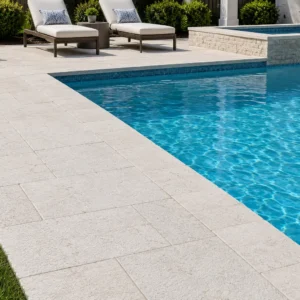
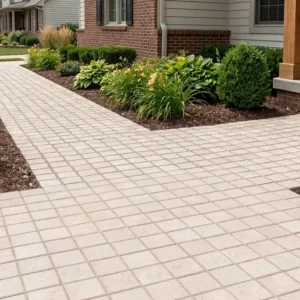
- Pedestrian terraces, pool surrounds and courtyards over a bound base: a moderate paver thickness is normally sufficient, and going heavier buys freight rather than performance.
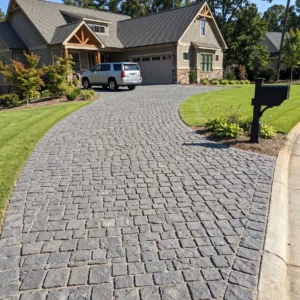
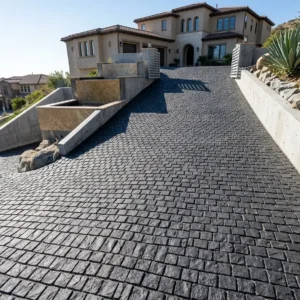
- Driveway aprons, turning areas and anything a delivery truck will cross: increase the thickness, or switch to a small-unit sett where the load spreads across many joints instead of concentrating on a few large pieces.
- Interior floors and covered verandas: tile thicknesses bedded on a screed, which is usually where the largest weight saving on a mixed villa order is found.
- Copings, treads and steps: heavier sections are correct here, but quantities are small, so specify them properly and accept the weight.
- Mixed orders: keep the number of distinct sizes down. Fewer product lines means a shorter entry, faster clearance and simpler stacking if there is a Barbuda leg at the end of it.
Format choice interacts with the sea as much as with the tariff. Very large thin units are awkward to handle over a wharf without a crane, they are unforgiving on any base that has moved, and they concentrate the consequences of one breakage into a large visible gap. Medium formats and modular ranges lose less material in transit, are far easier to replace a piece at a time after a storm season, and let a crew keep working when a pallet arrives short. When you are ready to price a specific mix, request a delivered St John’s quote with your zone-by-zone thicknesses listed, and we will build the weight against the container rather than the other way around.
Working With Antiguan Stone, Local Trades and the New Code
Imported paving is a complement to the domestic industry here, not a competitor to it, and the geology makes that obvious. Antigua has three units. The Basal Volcanic Suite occupies the mountainous south-west, with dacite, quartz basalt and andesite, agglomerate and tuff of Oligocene age. The Central Plain Group runs from St John’s toward the south-east, mixing siliciclastic rock with limestone. The fossil-rich Antigua Formation limestone sits in the north-east, and it is the rock you are looking at when you stand at Devil’s Bridge. Barbuda is a different animal entirely: a low, flat coral-limestone island whose oldest rock is the Middle Miocene Highlands Formation, rising only about 120 feet above sea level, with Pleistocene reef and lagoon deposits over the top.
That rock is worked locally for aggregate, base course and blockmaking feedstock, and it is genuinely good at those jobs. Nearly every imported paver we ship into St John’s ends up bedded on Antiguan material. The imported piece is the wearing surface; the local piece is the structure underneath it and often the wall behind it. Any supplier who frames this as imported stone replacing local stone is selling a story rather than describing a site.
The regulatory side is worth watching closely this year. Development runs through the Development Control Authority under the Physical Planning Act 2003, amended by the Physical Planning (Amendment) Act 2024, with planning permission preceding a building permit and reported turnaround in the region of six to eight weeks. The building code legislated in 1996 was based closely on the Caribbean Uniform Building Code, and a draft revised national code adapted from the revised OECS Building Code has been released for public comment by the Department of Environment together with the DCA. Cabinet has indicated that an updated national building code goes to Parliament in the first quarter of 2026, adding resilience, energy efficiency, ventilation and safe-room provisions.
- Confirm setbacks and coastal requirements directly with the DCA rather than with an online guide; figures circulating on expatriate sites are not reliable enough to design against.
- Coastal development attracts environmental assessment, so plan approval time into the program alongside build time.
- Heritage-controlled areas exist around English Harbour and Falmouth Harbour, and consent there governs materials and pattern rather than massing alone.
- Specify fixings, bedding and drainage toward the resilience standard the revised code is heading for, because a terrace laid in 2026 will be judged against it for the rest of its life.
Get the route, the entry and the exposure right, and the stone itself becomes the easy part of the job.