

































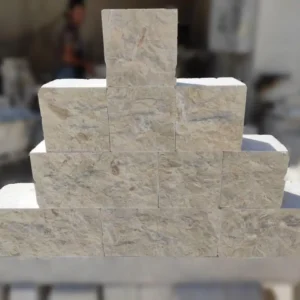
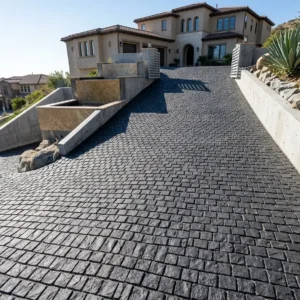
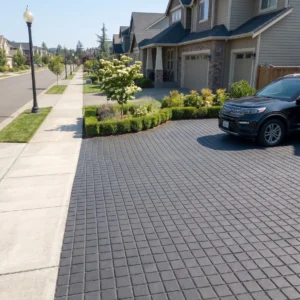
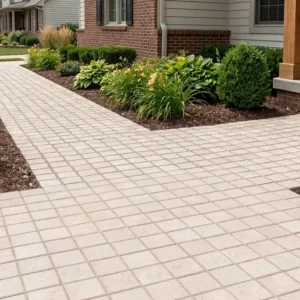



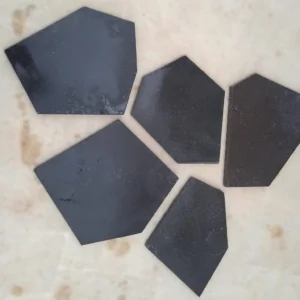

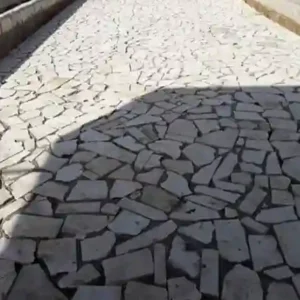

Cobblestone setts are usually sold on hills. Most of the material written about them is really about grade, traction on a slope and the way small units cope with a road climbing a mountainside. Grand Cayman has almost no grade at all. It is a low, flat island, and outside the Bluff on Cayman Brac there is very little in the territory that a paving designer would call a slope. So the argument for setts here has to be a different one, and it is: they turn, they bend, they take load in small increments, and they follow a shape that a rectangular slab has to be cut to death to imitate.
This page is about small-unit work specifically. Where setts beat slabs on a Cayman site, how to build a driveway apron that survives the turning loads it will get, which patterns suit the work here, how to handle heritage and public frontages, and the cost inversion that catches out anyone budgeting setts as if they were slabs with a smaller face. Freight routing, duty rates and material science each have their own page. This one is about the small unit and the hands that lay it.
A flat island changes what setts are for
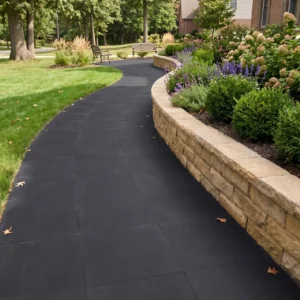
On a flat island the case for setts is geometric rather than topographic. A sett is a small enough module to follow a curve without cutting, which means a circular planter surround, a radiused driveway entrance or a serpentine path edge can be built by laying rather than by sawing. A slab field cannot do that without either visible cut lines or an expensive template exercise. The same property makes setts the right material for anything that has to be shaped in three dimensions: a drainage channel with a fall along its length, a shallow dish that collects surface water, the transition from a raised terrace down to a lawn in a couple of shallow steps.
Setts also solve the awkward junction problem, which is common on these islands because so much has been added to over time. Where new paving meets an existing concrete apron, an old wall foundation or a services cover that cannot move, a band of setts absorbs the discrepancy neatly and looks deliberate rather than apologetic. On Cayman Brac the Bluff introduces the territory’s only real grade, and there the traditional argument applies too, since small units give a foothold on a ramped surface that a smooth slab does not.
- Curves and radii can be laid rather than cut, which saves both waste and site time.
- Three-dimensional shapes such as drainage channels and dished collection areas are built up from small units.
- Junctions with existing concrete, walls and services covers are absorbed cleanly by a sett band.
- Shallow level changes of a few inches read better in setts than in a cut slab edge.
- The Bluff on Cayman Brac is where the classic traction-on-grade argument for setts genuinely applies.
Driveway aprons and turning loads
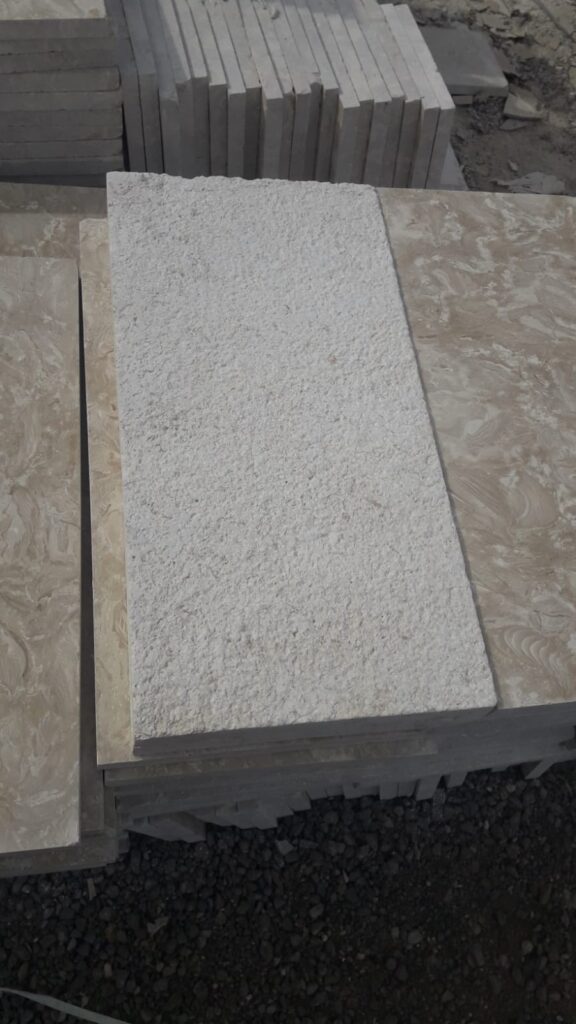
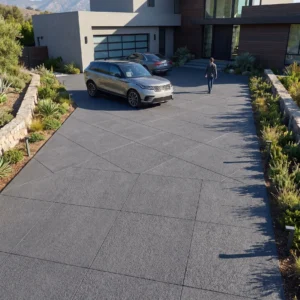
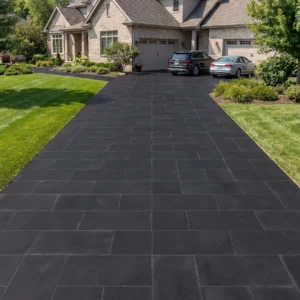
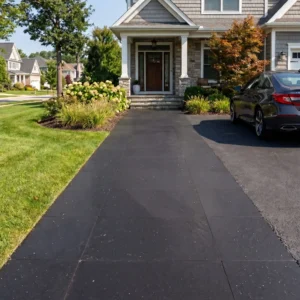
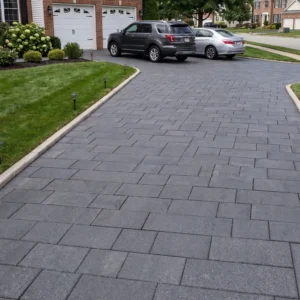
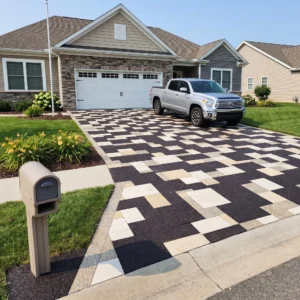
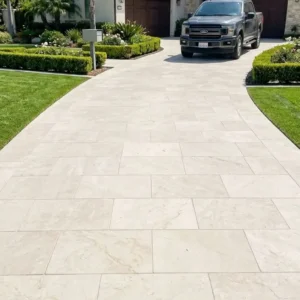
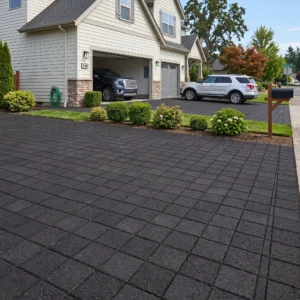
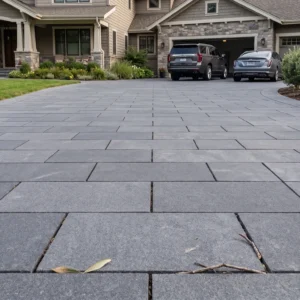
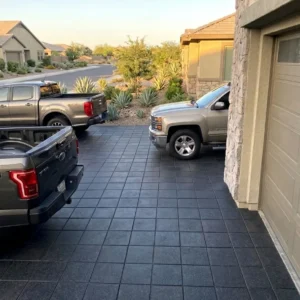
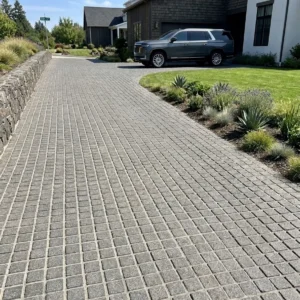
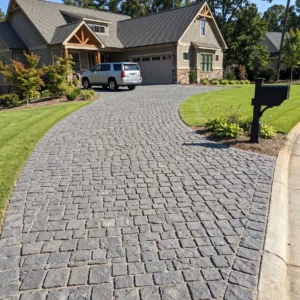
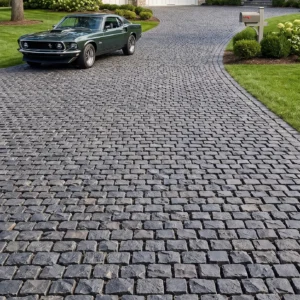
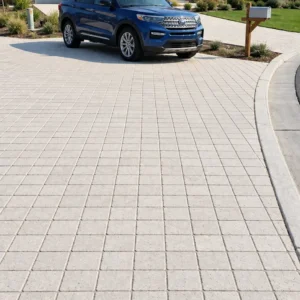
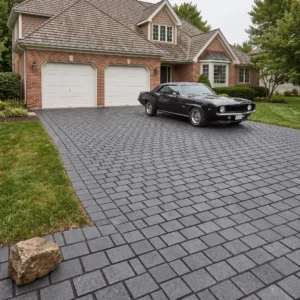
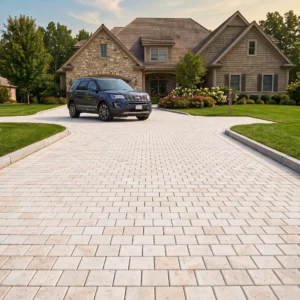
The apron, the strip between the public road and the property, is the hardest-worked paved area on most Cayman properties, and it is where setts prove themselves. Every vehicle entering the site turns on it, brakes on it and puts a steering load through it while stationary or nearly so, which is a far more punishing action than driving straight across a surface. Delivery trucks, service vehicles and construction traffic all use the same few square meters. A surface that survives that is a surface that has been designed for it.
Setts handle it because the load is shared across many small units, each restrained by its neighbors and by the bedding around it. When something does eventually fail, it fails as one or two units that can be lifted and reset rather than as a cracked slab that has to be cut out and matched. The requirements are straightforward and non-negotiable: real depth in the sett, a properly compacted base, a bonded bed or a well-designed jointed system, and edge restraint that will not creep. Skimp on any of those and the surface will rut under turning, no matter how good the stone is.
- Use a deeper sett for vehicular areas than for pedestrian paths; turning loads are not the same as walking loads.
- Compact the base properly and confirm it before laying, because the base fails before the stone does.
- Provide firm edge restraint at both road and property sides so units cannot migrate outward.
- Lay the pattern so joint lines run across the direction of travel rather than along it.
- Keep a small reserve of setts on site; individual units can be lifted and reset years later.
Curves, radii and the details slabs cannot do
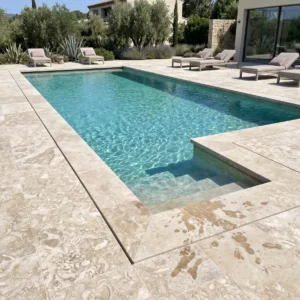
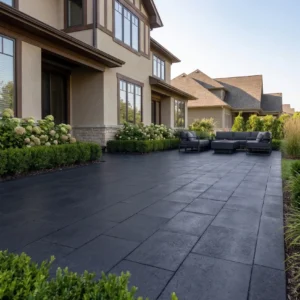
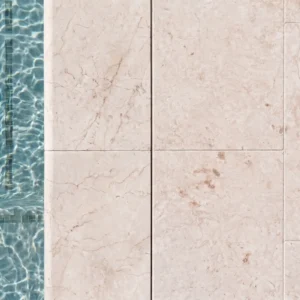
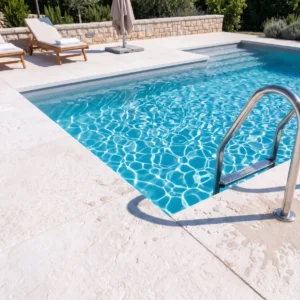
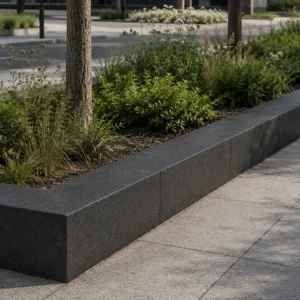
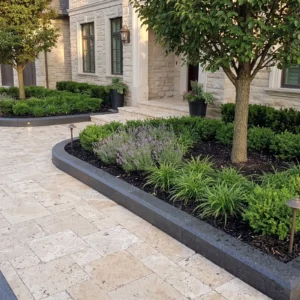
Beyond aprons, setts do the fine work in a landscape. A banding course of setts around a slab field gives the terrace a defined edge and lets the slab layout stay simple and square while the setts absorb the irregularity at the perimeter. Tree pits in a paved courtyard, which are unavoidable on these islands because mature shade is worth protecting, are far easier to build and to alter later in small units. Pool coping on a curved pool, a valley gutter running to a drain, a step nosing on a radiused stair: all of these are sett work.
They also serve as a visual device. A change of module tells a person walking that something is different, which is why setts are used across driveway crossings, at the mouth of a pedestrian route and around service covers. On a site where the whole surface is one large-format stone, a sett band adds scale and stops a big terrace reading as an empty expanse. Our cobblestone setts and small units come in a range of face sizes so the module can be matched to the job rather than the job to the module.
- Perimeter banding lets a slab field stay square while the setts take up the irregular edge.
- Tree pits and planter surrounds are simpler to build and to modify later in small units.
- Curved pool coping and radiused step nosings are natural sett work rather than cut slab work.
- A change of module signals a vehicle crossing or a route change without any signage.
- Face size can be matched to the scale of the space, from small setts to larger cubes.
The cost inversion: labor outweighs material
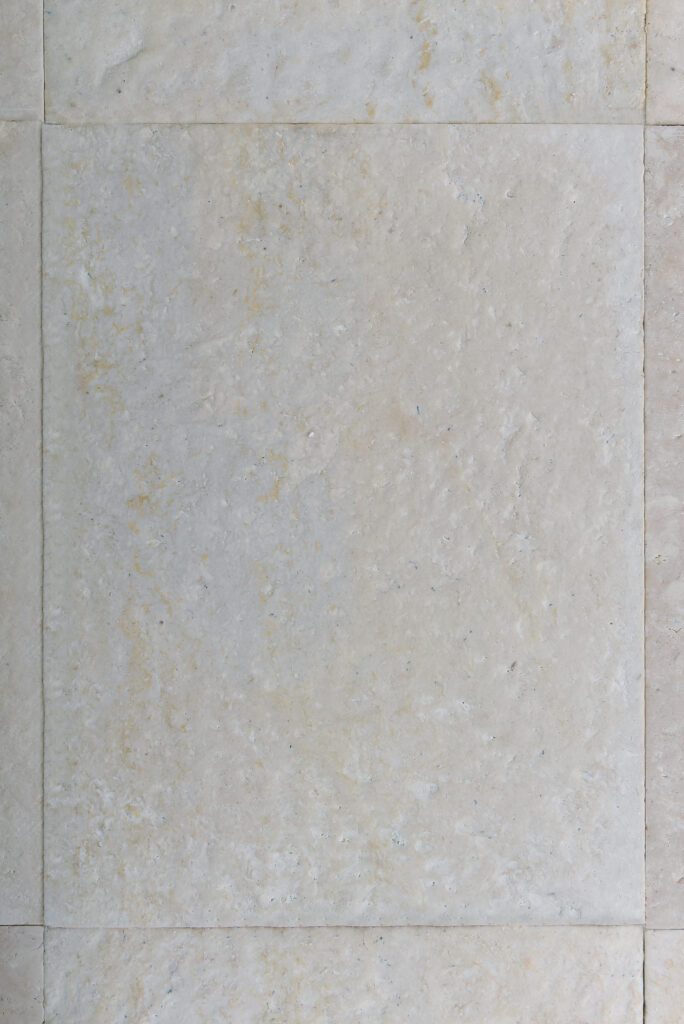
Here is the part that catches people out, and it is worth understanding before you compare quotations. On slab paving, material is typically the dominant cost and installation follows. On sett paving the relationship inverts. Laying setts is slow, skilled, hand-intensive work, and on a project of any size the labor line will usually exceed the stone line, sometimes by a substantial margin. That single fact reshapes every other calculation on a Cayman sett project.
It changes the duty math in particular. On Cayman Brac and Little Cayman the building-materials duty waiver running to 31 December 2030 applies to the imported material, and on Grand Cayman the concessionary building-materials rate applies to the same imported material. Neither touches local labor. So on a sett job, where material is the minority of the total, a duty concession moves a smaller share of the overall budget than it does on a slab job where material dominates. That is not an argument against setts, it is an argument for budgeting them honestly. It also means a decision to use setts should be made on what they do better, not on landed material price. Small units do have one clear logistical advantage: they are packed in crates or bags that pass through a lighterage port with far less risk than large slabs, and they are far easier to move on a site with no crane.
- Expect installation to be the largest line on a sett project rather than the stone itself.
- Duty concessions apply to material, so they move a smaller share of a labor-heavy sett budget.
- Complex radii, banding and tree pits raise the labor rate above a plain straight-run field.
- Small units handle better through a barge and across a tight site than large-format slabs do.
- Get the installation quote and the stone quote at the same time; judging one without the other misleads.
Heritage frontages and the public realm
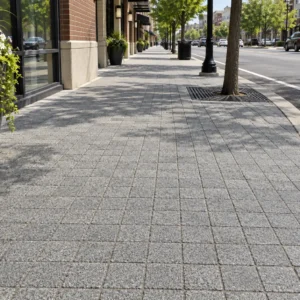
Setts carry a memory of older streetscapes, and that is a large part of why clients ask for them. On these islands the appropriate use is measured rather than theatrical. A sett apron and edging in front of an older George Town property, a church or civic frontage, or a restored building looks correct because the module and the hand-laid irregularity match the age of the architecture in a way a large sawn slab never will. The same material also works well in contemporary pedestrian environments, where the Camana Bay generation of mixed-use development has established a public realm built on a finer grain of paving, planting and shade.
Approvals are worth checking early on anything that touches a frontage. Development is regulated under the Development and Planning Act (2021 Revision) through the Central Planning Authority, and where a scheme sits close to the coast the setback rules referencing the ironshore come into play as well. None of that makes sett paving difficult, but it does mean the boundary treatment, the crossing detail and the seaward extent of any hard surface deserve a conversation before design is locked rather than after. Where a project has a genuine heritage character, the restrained approach nearly always ages better than a full field of setts everywhere.
Patterns that suit Cayman work
Pattern choice is functional as much as decorative. Herringbone is the strongest option for vehicular surfaces because the interlocking geometry resists the shear that turning wheels apply, which makes it the natural pick for a driveway apron. Running bond is the straightforward, quiet choice for paths and banding, and its joint lines can be run deliberately across the direction of travel. Stack bond suits narrow edging courses and framing bands where a strict, formal line is the intention.
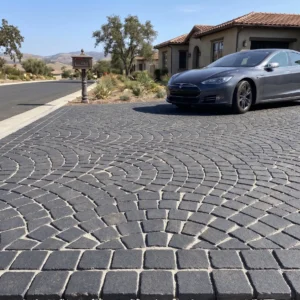
Fan and segmental arc patterns are the classic answer for wide radiused areas, forecourts and turning circles, and they solve a real geometric problem: a repeating arc absorbs a curve without any cutting at all, which is why the pattern survived centuries of use. It is labor-intensive and needs an experienced setter, so specify it where the shape genuinely calls for it rather than everywhere. If you want to see how the geometry works before deciding, our guide to fan pattern setts laid radially walks through the layout. Joint width should be chosen with the maintenance regime in mind, since narrow joints look refined and wide sand-filled joints hold weeds in a wet season.
- Herringbone: strongest interlock, the correct choice for aprons and any vehicle turning area.
- Running bond: simple and quiet for paths, bands and edges, with joints run across the traffic direction.
- Stack bond: formal, disciplined lines for narrow edging and framing courses.
- Fan or segmental arc: absorbs curves without cutting, ideal for forecourts and turning circles.
- Match joint width to the maintenance regime and the drainage strategy, not just to the look.
Ordering setts: calibration, quantities and waste
Setts are ordered by area, but they are shipped by weight, and the relationship between the two depends on the depth of the unit. A deeper vehicular sett covers far less area per tonne than a shallow pedestrian one, which is the most common source of error when a first-time buyer converts a drawing into an order. Send us the areas and the intended use rather than a tonnage, and let the quantities be worked back from there.
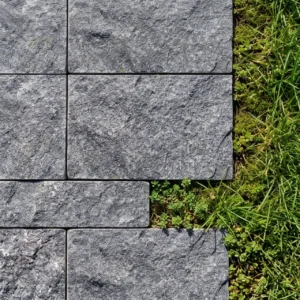
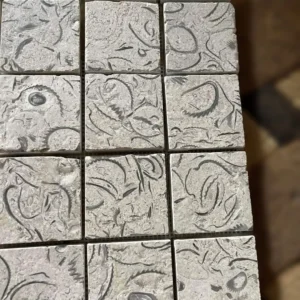
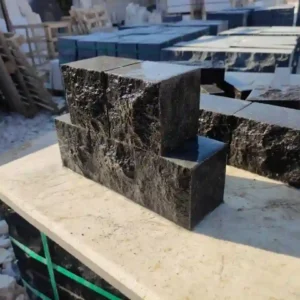
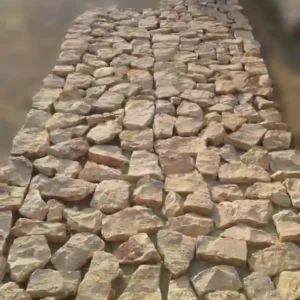
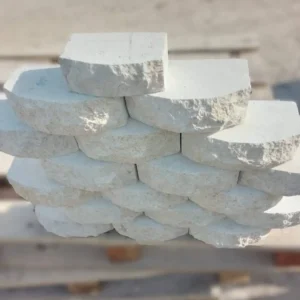
Calibration is the other decision worth making consciously. Setts with sawn sides and a split or flamed top lay quickly to a tight, even joint and give a crisp modern surface. Setts split on all faces have a rougher, more traditional appearance and need a wider joint and more setting time, which shows up in the labor line. Both are legitimate; they are simply different products with different installation costs, and mixing expectations between them causes friction on site. Allow extra material for curves and radii, where cutting waste is genuinely higher, and always lay a sample panel on site before the full area is set out so the client sees the joint width, the pattern and the color range in real light rather than in a photograph. Send us the areas, the traffic type and the radii, and we will quantify the setts, the pattern and a realistic waste allowance so the job is costed once and costed correctly.