










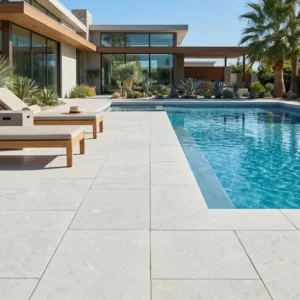
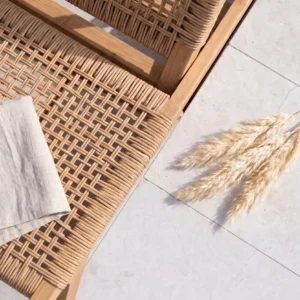
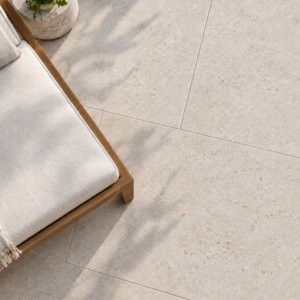


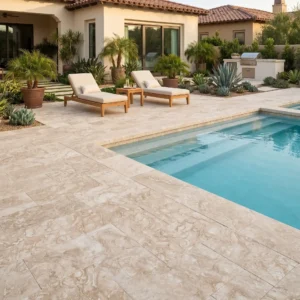








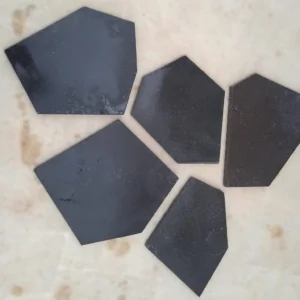



An interior floor in the Cayman Islands works in two climates at once. Inside, air conditioning holds a room dry and cool for most of the year. Outside, the air is warm and heavily humid, and those two conditions meet every time a slider opens onto a terrace. Add sand carried in on bare feet from the beach, sunscreen and pool water on the soles crossing a lobby, and salt haze that drifts in through open doors, and an interior floor here is doing something quite different from an interior floor in a temperate climate.
This page is about that indoor job specifically. Which limestone finishes stay safe when a wet foot lands on them, which formats suit the room proportions Cayman condos and villas actually have, how to detail the point where inside becomes outside, how to clean and seal stone in a marine environment, and where the island’s own stone belongs in an interior. Freight routes and duty rates are covered at length on our broader Cayman paving page. Here the subject is the floor itself, its edges and its upkeep.
Cool underfoot on an air-conditioned island
Dense pale limestone carries real thermal mass, and in a conditioned building that is an advantage rather than a nuisance. A stone floor takes on the temperature of the room around it, so a Cayman living space running air conditioning through the day settles at a floor temperature that reads as cool and steady underfoot without ever feeling cold. There is no heating season to design around, which removes the main reason temperate-climate specifications reach for warmer, softer floor coverings in the first place.
The counterpart to that mass is condensation. A floor held at conditioned temperature for hours will pull moisture out of humid outside air the moment a slider is opened wide on a hot afternoon. It arrives as a thin film that is invisible from standing height and slippery under a wet foot. This is not a defect in the stone and it is not unique to stone floors, but it is a solid reason to specify some texture in circulation zones near external doors rather than a glassy surface, and a reason to design entrance matting in from the start rather than adding it later once somebody has slipped.
- Stone holds room temperature, so conditioned interiors feel cool and even underfoot year round.
- No heating season means none of the usual temperate arguments against a stone floor apply here.
- Expect a brief condensation film near wide sliders on hot, humid afternoons and detail for it.
- Recessed matting wells at main entrances trap sand and water before they reach the finished floor.
- Sand is abrasive, so entrance zones wear faster than the middle of a room and deserve the harder finish.
Formats that suit Cayman rooms
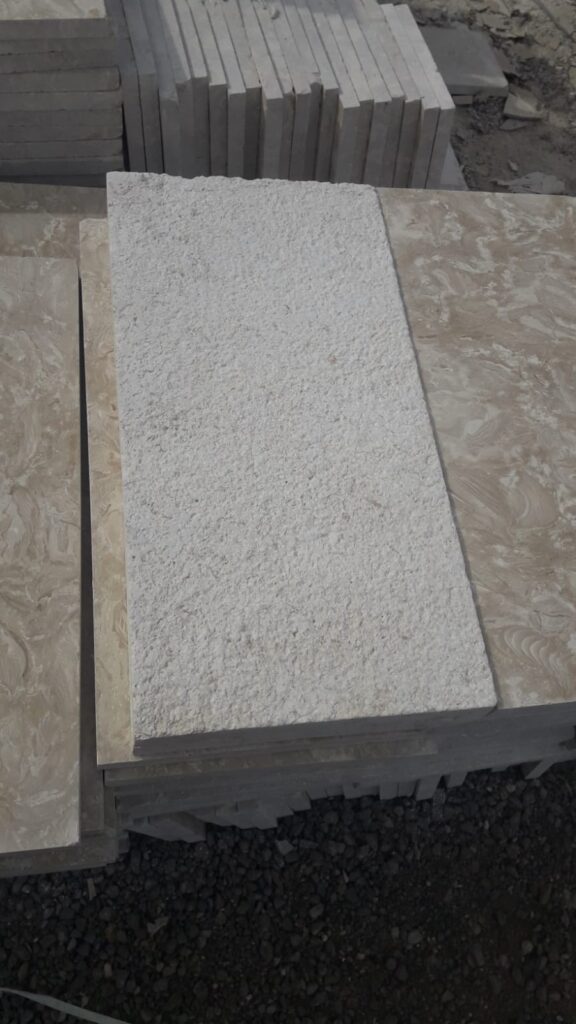
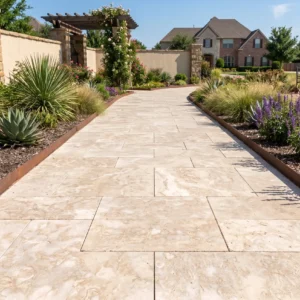
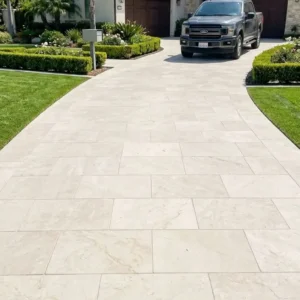
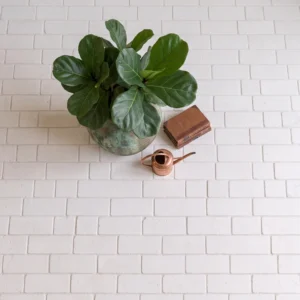
Cayman interiors have a recognizable geometry. Beachfront condos tend toward long, open living and dining spaces oriented at the water, with the whole seaward wall glazed. Villas run wider and more broken up, often with covered outdoor rooms of similar size to the indoor ones. Both reward large-format tile with fewer joint lines, because joints are where sand collects and where the eye reads a room as busy rather than calm.
Thickness is a structural question as much as an aesthetic one. Interior floors on a suspended slab are usually best served at 12 mm to 20 mm, which keeps the dead load and the floor build-up sensible and lets the tile sit flush with adjoining finishes. Where a large-format tile is going into an occupied building, the practical limit is often the service elevator rather than the design intent: a single crate of large tile is heavy and awkward, and it is worth confirming the lift dimensions before the order is placed. Modular and pattern layouts remain a strong choice for villa interiors where the architecture is not rigidly rectilinear.
- Large formats read calm in open-plan condo living space and reduce the joint lines sand collects in.
- 12 mm to 20 mm suits interior floors on suspended slabs and keeps the floor build-up manageable.
- Modular and multi-size pattern layouts fit villa interiors with irregular room shapes.
- Run the long dimension toward the view; the eye follows the joint lines to the water.
- Check crate weight against service-lift capacity in occupied buildings before confirming a format.
Finishes for wet feet and open doors
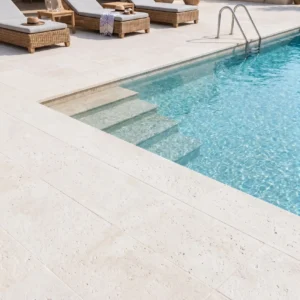
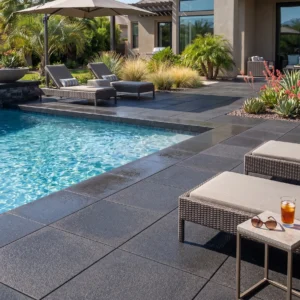
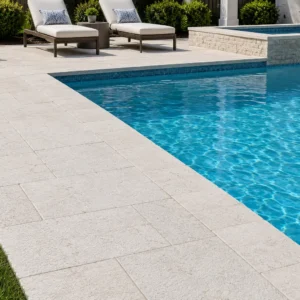
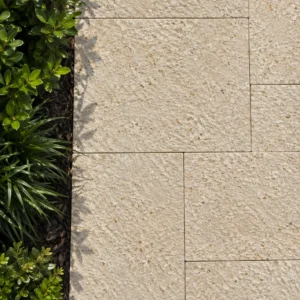
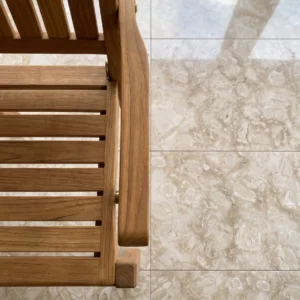
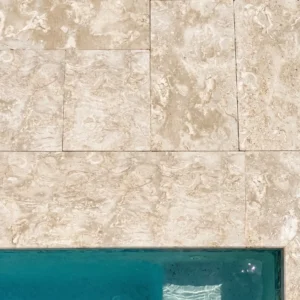
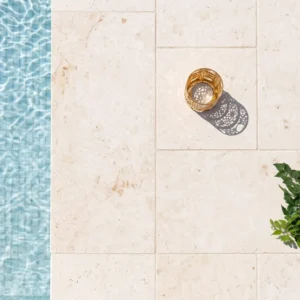
Finish choice is the safety decision on a Cayman interior floor, and it is worth more thought than color. A honed surface is the standard interior answer: matte, easy to clean, comfortable barefoot, and free of the glare that a high-gloss floor throws back off a fully glazed seaward wall. Where water is genuinely expected, a lightly brushed or textured honed surface gives a measurable improvement in grip while still reading as a smooth, refined interior floor.
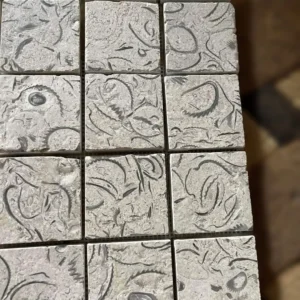
Polished limestone belongs in very few places on these islands and none of them are near a pool door. It looks superb in a photograph and behaves badly the first time somebody walks in from a swim. Tumbled and brushed surfaces suit bathrooms, outdoor showers and the transitional zones where a floor is wet several times a day. The sensible approach is zoning: the calm honed field through the living space, a texture step-up at entrances, wet rooms and the threshold band. You can compare surface finishes side by side before deciding which combination belongs in which room.
- Honed: the default interior field finish, matte, comfortable and low glare against bright glazing.
- Lightly brushed: better grip for kitchens, entries and rooms that open onto a pool deck.
- Tumbled: softened edges and a forgiving surface for bathrooms and outdoor shower floors.
- Polished: keep it to vertical surfaces, feature walls and dry areas well away from water.
- Zone the finishes deliberately rather than running one surface everywhere for simplicity.
The threshold: inside to verandah without a stumble
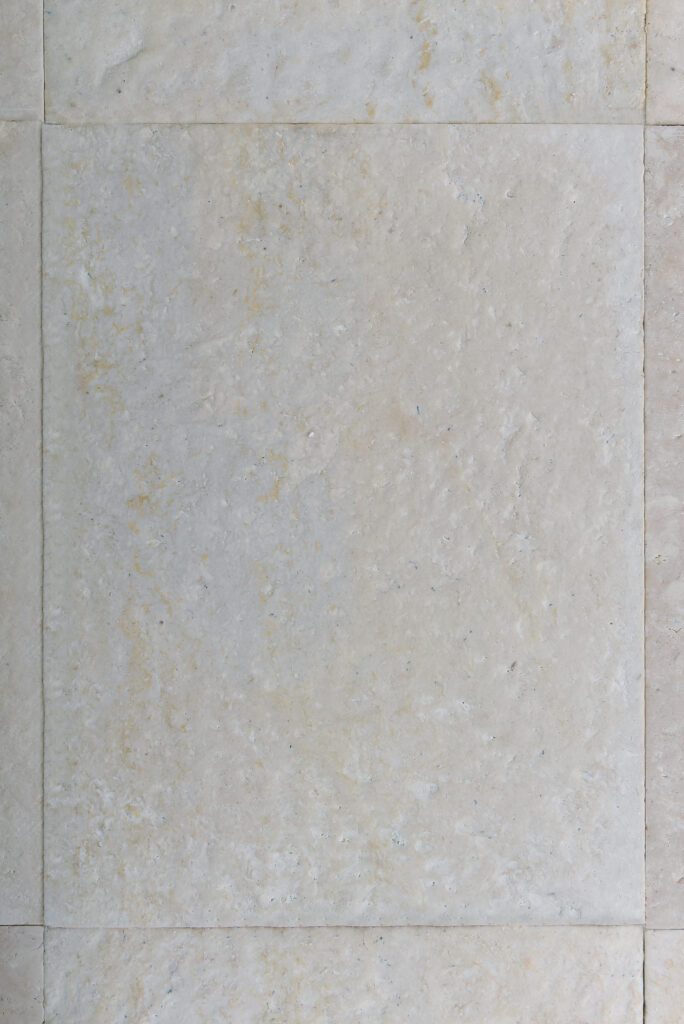
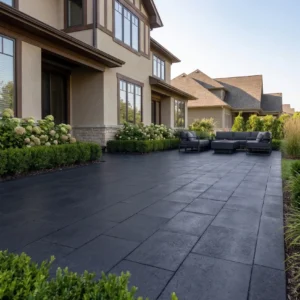
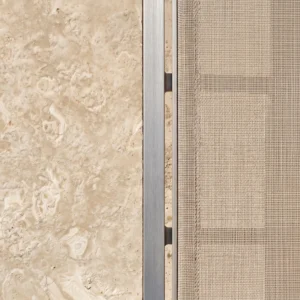
The threshold is where Cayman interiors are won or lost. A covered verandah or terrace is treated as living space here, not as an add-on, and the design intent is nearly always a continuous floor plane with no visual break at the door line. Achieving that takes coordination, because the outside face has to fall away for drainage, the inside face has to stay level, and a hurricane shutter track or a storm-rated door sill frequently sits precisely on the line where the two meet.
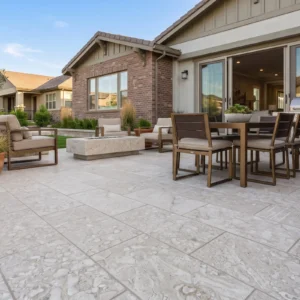
The technique that works is one stone in two finishes and two thicknesses. Run the honed interior tile up to the door line, then continue the identical stone outside in a textured finish at a greater thickness on a bonded bed, with the outside surface set slightly lower and falling away from the opening. Put a movement joint on that line rather than trying to bond straight through it, since the two sides move at different rates in this climate. Detail the shutter track so it drains rather than holding standing water, and keep the joint under the sill accessible for future maintenance instead of burying it.
- Same stone, two finishes: honed inside, textured outside, so the color reads continuous and the grip changes.
- Set the external surface slightly lower with a positive fall away from the opening.
- Place a movement joint on the threshold line rather than bonding straight across it.
- Coordinate with shutter tracks and storm-rated sills early; they usually land on the same line.
- Keep the sill joint serviceable so a future re-seal does not mean lifting tile.
Cleaning and sealing in salt haze
Salt haze reaches interior floors here, particularly in buildings that spend most of the day with doors open to a sea breeze. Freshwater rinsing is standard practice across the islands for exactly that reason, and the interior equivalent is a simple discipline: regular damp cleaning with a pH-neutral stone cleaner, and nothing acidic. Vinegar, limescale removers, bathroom descalers and acidic general-purpose cleaners all etch limestone, and once a floor is etched the repair is a mechanical one, not a chemical one.
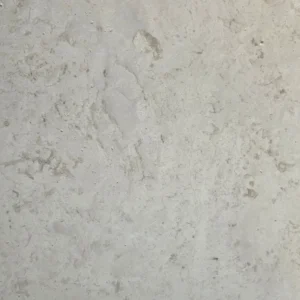
Sealing is about stain resistance rather than waterproofing. An impregnating sealer sits inside the pore structure, leaves the appearance unchanged and buys time to wipe up sunscreen, cooking oil, red wine or hand cream before it goes in. Topical coatings look impressive on day one and then scratch, cloud and peel in a sandy coastal environment, which makes them a poor choice on these islands. Re-seal intervals depend on traffic rather than on the calendar; a busy resort lobby will need attention long before a second-home villa does. Our white limestone tile collection lists the surfaces we most often specify for humid coastal interiors.
- Use pH-neutral stone cleaners only, and keep acidic household products off the floor entirely.
- Choose an impregnating sealer over a topical coating, which will scratch and cloud in a sandy environment.
- Deal with sunscreen and oil marks quickly, since they are the most common stains near a pool door.
- Rinse and dry rather than letting salt-laden water evaporate on the surface and leave a bloom.
- Set re-seal intervals by traffic level, not by a fixed number of months on a maintenance sheet.
Caymanite, and where the island's own stone belongs
No interior page written for these islands is complete without Caymanite. It is a rare banded semi-precious dolomite formed in paleokarst voids within the Bluff Formation, and it is found only on the Cayman Brac bluff and at the East End of Grand Cayman. Its layered earth-tone bands come from differing metallic content in each stratum, which is why no two pieces are alike, and it is worked into gold-set jewelry and fine souvenirs rather than sawn into flooring.
That is the point worth making honestly. Caymanite is a national ornament and an identity object, not a paving or tile material, and the same is true in a different way of the Ironshore and Bluff Formation rock quarried across the islands for fill, aggregate and base course. Those materials are hard, irregular and genuinely useful, and they sit under a great deal of what gets built here. What no local operation produces is factory-flat, thickness-consistent, finish-controlled dimension tile with documented absorption, which is the specific gap imported limestone fills.
In an interior, the honest and rather good-looking pairing is an imported limestone floor with a piece of Caymanite treated as exactly what it is: something set into a lobby display, framed as a reception detail, or worn as jewelry by the person who lives there. Designers working on villas and boutique hospitality projects here increasingly use that contrast deliberately, letting a calm, continuous pale floor act as the quiet background against which a genuinely local object is allowed to be the focus. It is a better result than any attempt to make a floor look indigenous, and it respects a material that took millions of years to form in the paleokarst voids of a single bluff.
- Caymanite is a banded semi-precious dolomite, worked into jewelry and fine objects rather than sawn into flooring.
- It occurs only on the Cayman Brac bluff and at the East End of Grand Cayman, which is part of why it matters.
- Its earth-tone banding comes from differing metallic content stratum by stratum, so no two pieces repeat.
- Local Ironshore and Bluff Formation rock supplies the fill, aggregate and base course beneath most construction here.
- Use a calm imported floor as the background and let a local piece carry the identity of the room.
Getting interior tile onto a Cayman site in the right order
Interior stone is one of the last wet trades and one of the first things a client inspects closely, which puts it in an awkward place in the schedule. Sequence matters. Sample approval should happen before the container is booked rather than while it is at sea, because a change of mind at the wharf costs weeks on a weekly service. Substrate condition should be checked before delivery, since a slab that needs leveling will add days that nobody allowed for. Tile is best delivered close to the point of laying, because a stack of crates in an unconditioned space in August will pick up moisture it then releases under an adhesive bed.
Build in a breakage allowance and keep attic stock. Cutting waste on a patterned or large-format interior floor is real, and replacing four damaged tiles from a selected quarry two months after handover is a far longer exercise than most clients expect. A crate of the same batch, stored dry on site, has rescued more Cayman handovers than any other single precaution. On Grand Cayman the building-materials rate applies to interior tile just as it does to exterior paving, and on Cayman Brac and Little Cayman the building-materials waiver runs to the end of 2030, so the island genuinely changes the arithmetic on an interior package as much as on a terrace. Send us your floor plans, the finishes schedule and the handover date, and we will build a tile package with the right formats, the right finishes and enough attic stock to protect the schedule.