









50 Years Of Manufacturing & Delivering The Highest-Quality Natural Stone. Sourced & Hand-Picked From The Middle East.

Escrow Payment & Independent Verifying Agent For New Clients

Contact Me Personally For The Absolute Best Wholesale & Trade Prices:

USA & Worldwide Hassle-Free Delivery Options – Guaranteed.

Natural Limestone Floor Tiles in Arizona

Natural limestone floor tiles in Arizona perform differently depending on what lies beneath them — and in Arizona, soil conditions are rarely uniform. Expansive clay soils common across the Phoenix metro and caliche-dense subgrades found throughout Tucson and Scottsdale can shift, heave, or compress unevenly under load, making proper subgrade preparation a non-negotiable step before any limestone installation. Limestone's natural density and moderate porosity make it a strong candidate for interior and covered exterior floors, but only when the base beneath it is engineered to stay stable. Citadel Stone Natural Limestone Floor Tiles in Arizona are available in multiple finishes and format sizes, with specification support to help contractors match material selection to actual site conditions. Understanding how subgrade movement interacts with grout joint width and tile thickness is one of the more important variables this guide addresses directly. Natural Limestone Floor Tiles from Citadel Stone is available to Arizona contractors and designers serving Phoenix, Tucson, and Scottsdale.

See & Feel the Quality – Free Arizona Stone Samples

Our stones are made for the Arizona sun. See how the colors hold up in your specific light.

Design Your Arizona Home with a Local Stone Expert

Get personalized advice on the best stone for Arizona's climate and your design style.

Premium Natural Stone — All Sizes & Thicknesses Available

From standard cuts to fully custom dimensions — our limestone, granite, basalt & shellstone
are cut to your exact specifications. Residential or commercial, we’ve got you covered.

Showing all 69 resultsSorted by popularity

Get Your Free Arizona Stone Quote

Transparent Pricing for Your Arizona Project

Elevate Your Arizona Property with Premium Stone, Priced for Value.

Unlock $10,000 Worth of Deals on Beautiful Paver, Tiles & Cobble Setts—For Free!

Invest in Arizona’s Landscape: Stone That Lasts a Lifetime.

100% Happiness Guarantee

Trust 50 Years of Expertise. Invest in Quality Limestone Tiles

Custom-Cut for Your Arizona Project: Any Size, Any Finish.

No-Obligation Consultation: Get Expert Advice for Your Arizona Home.

The Stone Supplier Trusted by Arizona's Leading Architects & Designers.

Arizona's Most Diverse Selection of Natural Stone.

Elevate Your AZ Property with Natural Stone Built for the Desert. Our expansive collection of Natural Stone brings timeless beauty and proven durability to both residential and commercial spaces across Arizona. As the state’s leading supplier, we offer a diverse palette of colors and finishes—from cool, light tones that reflect the sun to rich, earthy textures that complement the Southwest landscape. Transform your environment with limestone that stands up to the Arizona heat while providing the sophisticated aesthetic you desire.

Incredible Prices for Top-Quality Stone—Shop Citadel Stone Today!

Table of Contents

Subgrade variability is the single factor that separates successful natural limestone floor tiles installations in Arizona from the ones that start showing grout fractures within three seasons. Most specifiers focus their attention on the stone itself — finish, color, thickness — while the ground underneath receives a standard aggregate base callout and nothing more. That approach works in stable soil environments. It rarely works here, where the soil composition shifts dramatically between desert basins and plateau elevations, and where expansive clay layers and caliche hardpan can undermine even a well-chosen material.

How Arizona Soil Conditions Shape Limestone Floor Tile Performance

Arizona’s soil profile is not uniform, and your installation specifications shouldn’t be either. The low desert around Phoenix is dominated by alluvial soils with moderate plasticity, but the critical challenge is the layer of caliche — a naturally cemented calcium carbonate hardpan — that often sits between 18 and 36 inches below grade. When you’re installing interior limestone floor tiles in Arizona adjacent to slab-on-grade construction or over a crawl space with exterior soil exposure, the expansive behavior of moisture-reactive soils in the Phoenix basin can telegraph movement upward through your substrate faster than most installation guides account for.

Citadel Stone’s technical team regularly consults on soil-sensitive projects, drawing on years of direct experience evaluating site conditions before recommending limestone formats and thickness specifications. The limestone itself is not the variable — the ground it sits on is. Treating soil assessment as part of your material specification, rather than a separate civil engineering concern, is the standard that separates durable installations from costly callbacks.

  • Alluvial desert soils in low basins show low-to-moderate swell potential but compress unevenly under point loads without proper compaction to 95% Proctor density
  • Caliche layers, while hard, are often discontinuous — bridging voids between caliche and surrounding soil create differential settlement zones directly beneath tile fields
  • Expansive clay soils common in Tucson’s Sonoran Desert transition zones have plasticity indices above 20, meaning moisture variation of even a few percent produces measurable vertical movement
  • Sandy loam profiles in mesa areas drain well but require deeper aggregate bases — typically 6 to 8 inches of compacted crushed aggregate — to distribute loads without localized depression
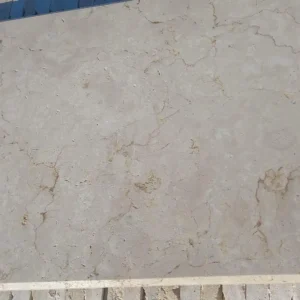
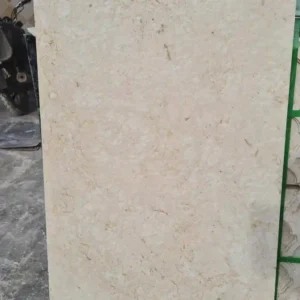
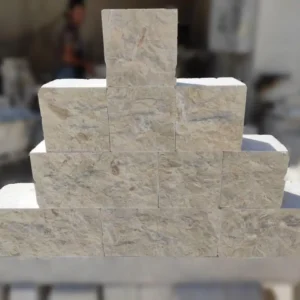
Large light beige limestone slab resting on stacked stone blocks.

Limestone Properties That Matter for Arizona Indoor Floors

Natural limestone floor tiles carry a compressive strength range of 4,000 to 12,000 PSI depending on formation density, and that range matters more than most buyers realize. Lower-density limestones — the highly porous varieties from certain Mediterranean and domestic quarries — perform adequately in dry climates but develop absorption issues in Arizona zones where seasonal monsoon humidity creates condensation cycles against cool slab surfaces. For limestone indoor floor tiles in Arizona, you want an absorption rate below 3%, tested per ASTM C97, for any installation near exterior-facing slabs or ground-contact assemblies.

The thermal expansion coefficient for limestone sits around 4.4 to 5.0 × 10⁻⁶ per °F. For interior applications, this is rarely a structural issue, but it determines your expansion joint spacing. The standard 20-foot joint interval in generic tile specifications is too generous for floor fields exposed to significant HVAC cycling — particularly in commercial spaces in Arizona where interior temperature swings between unoccupied night setpoints and daytime occupancy can reach 15 to 20°F. Specifying joints every 12 to 15 feet keeps the tile field within safe differential movement limits.

  • Honed finishes provide a surface friction coefficient between 0.42 and 0.60 (dry), meeting ASTM C1028 minimums for interior pedestrian traffic
  • Brushed or tumbled finishes increase surface texture and improve wet-condition traction — relevant in Arizona kitchens and bathrooms where tile extends near water sources
  • Polished limestone achieves COF values as low as 0.35 dry, which falls below ADA-recommended thresholds for accessible flooring areas without supplemental anti-slip treatment
  • Cream and ivory limestone tones are the most common specification for Arizona residential interiors, reflecting interior light effectively without the high-glare issues of white marble

Base Preparation Standards for Limestone Installation in Arizona

Your base preparation protocol for limestone indoor floor tiles in Arizona has to account for what’s happening below the slab, not just the slab surface itself. Concrete slabs-on-grade in Arizona are typically poured over 4 to 6 inches of compacted aggregate, but the long-term performance of that base depends on whether the subgrade soil was adequately moisture-conditioned before compaction. Dry desert soils compacted without moisture pre-treatment can experience post-compaction settlement when irrigation, roof drainage, or subsurface water introduces moisture years after installation. That settlement is what you see later as tent-cracking at grout joints.

For direct-bond limestone tile installations over existing concrete, your slab surface needs a flatness tolerance of FL25 or better — that’s a maximum of 3/16 inch deviation in any 10-foot run. Arizona slabs frequently exceed this tolerance near control joints and perimeter edges due to differential curing shrinkage in high-heat conditions. You’ll need to grind high spots and skim-coat low areas with a polymer-modified self-leveling underlayment before setting any tile. Skipping this step because the floor looks flat to the eye is one of the most consistent sources of hollow-spot failures in natural limestone floor tiles installations in Arizona. Getting the slab surface prep right at this stage prevents the most costly long-term callbacks. For projects requiring complementary stone elements in adjacent outdoor spaces, Natural Limestone Floor Tiles from Citadel Stone covers specification details that apply across both interior and exterior site conditions.

  • Use a large-format tile mortar (ANSI A118.15 compliant) for limestone tiles 15 inches or larger — standard thin-set lacks the non-sag performance needed for full-coverage back-buttering on heavy stone
  • Achieve minimum 95% mortar contact coverage on limestone tiles — the 80% standard for ceramic is insufficient for natural stone’s weight and brittleness at unsupported edges
  • Allow new concrete slabs to cure a minimum of 28 days and reach moisture vapor emission rates below 5 lbs per 1,000 sq ft per 24 hours before bonding limestone
  • Install uncoupling membrane systems (Schluter Ditra or equivalent) over slabs showing active vapor drive — this protects the tile bond layer from hydrostatic cycling without adding significant height

Selecting Limestone Formats and Sizes for Arizona Projects

Format selection for limestone indoor floor tiles is partly aesthetic and partly structural. Large-format tiles — 24×24 inch and 24×48 inch planks — are the dominant specification trend in Arizona residential and hospitality projects right now, and they work well on stable substrates with properly prepared slab surfaces. The challenge is that large-format limestone requires absolutely flat subgrades and back-buttered installation; any deviation results in lippage that’s visible and a trip hazard. Your specification should explicitly state a maximum lippage tolerance of 1/16 inch for large-format stone unless a specific design exception is documented.

Citadel Stone stocks limestone floor tiles for sale in Arizona in standard formats including 12×12, 16×16, 18×18, 24×24, and 12×24 inch cuts, with thickness options from 3/8 inch (for overlay applications) to 3/4 inch and 1-1/4 inch for structural settings. Requesting sample tiles before committing to a full specification is especially worthwhile when matching limestone to existing stone elements in a renovation project, since dye-lot variation between quarry runs affects tone consistency more in cream and ivory limestones than in darker, more uniformly pigmented materials.

  • 12×24 plank formats create a linear visual rhythm that works effectively in corridor and long-hall applications common in Scottsdale hospitality and resort projects
  • Random ashlar patterns using 4×4, 4×8, and 8×8 modules allow you to work around irregular plan shapes without generating excessive cut waste at perimeter conditions
  • Versailles pattern sets — combining four different square and rectangular formats — require precise base flatness but deliver a traditional aesthetic popular in high-end Arizona residential builds
  • Mosaic limestone floor tiles in 2×2 and 1×2 formats serve well in wet areas, providing more grout joints that add natural slip resistance in shower and bath applications

Limestone Color and Finish Options for Arizona Interiors

Arizona’s design vernacular pulls heavily toward warm earth tones — terracotta, sand, warm gray, and cream — and natural limestone floor tiles deliver these tones authentically rather than through applied pigment. Cream and ivory limestone floor tiles remain the highest-volume specification in the Phoenix and Scottsdale market because they complement the stucco and Adobe-influenced architecture that dominates residential construction here. That said, there’s been a notable shift in commercial projects toward cooler gray limestones, particularly in tech campus interiors and healthcare facilities where warm tones read as dated.

In Tucson, where the architectural tradition blends Spanish Colonial and contemporary desert modernism, you’ll encounter more demand for limestones with pronounced veining and geological character — the material is expected to read as genuinely natural rather than processed. Finish selection in this market tends toward honed and brushed rather than polished, because the matte surface texture harmonizes better with rough plaster, exposed wood, and clay tile elements typical in the region’s residential architecture.

  • Honed finish: uniform matte surface, slightly porous, requires sealing before use — the dominant choice for high-traffic Arizona residential floors
  • Brushed finish: directional texture from wire brushing, enhances fossil and crystalline detail, provides good traction in entry areas and mudrooms
  • Tumbled finish: rounded edges and pitted surface simulate aged stone — works well in traditional and Tuscan-style architecture but complicates cleaning in commercial applications
  • Polished finish: high-reflectivity surface, reveals full color saturation — specify only in low-traffic zones or where wet-traction conditions are actively managed
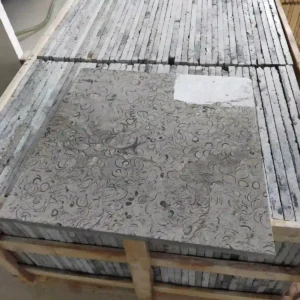
Rectangular light gray limestone slabs with subtle veining arranged in a row.

Sealing and Maintenance Protocols for Arizona Limestone Floors

Sealing natural limestone floor tiles is non-negotiable in Arizona, but the type of sealer and the application timing matter more than most installation guides specify. Penetrating impregnator sealers — silane-siloxane or fluoropolymer-based — are the correct choice for interior limestone in Arizona. They fill the interconnected pore structure of the stone without creating a surface film that can trap moisture vapor or peel under the HVAC cycling conditions typical in Arizona commercial buildings. Surface-coat sealers (acrylic or urethane) look impressive initially but tend to cloud, peel, and trap soil in high-traffic zones within 18 to 24 months.

Apply your first sealer coat only after the installation mortar has fully cured — at minimum 72 hours at 70°F, and up to five days if your installation environment was cooler or more humid due to monsoon season timing. Apply two coats of penetrating sealer with a 30-minute dwell time per coat, buffing off excess before it surface-cures. Plan for resealing on a biennial cycle in residential settings and annually in commercial or high-traffic environments. In Flagstaff, where elevation introduces genuine freeze-thaw cycling unlike the low desert, sealing also provides critical protection against moisture infiltration that would otherwise exploit micro-fissures in the stone during freeze expansion events.

  • Test sealer effectiveness annually using the water bead test — drop water on the tile surface and observe; if it absorbs rather than beads within 30 seconds, resealing is due
  • Use pH-neutral cleaners exclusively on sealed limestone — acidic cleaners (including many common household products) etch the calcium carbonate surface and strip sealer penetration
  • Address grout joint maintenance separately from tile sealing — grout absorbs staining compounds differently than dense limestone and may require re-grouting after 10 to 15 years in commercial use
  • Limestone floor tiles in Arizona kitchens need sealer touch-up near cooking zones every 12 to 18 months due to oil vapor deposition that breaks down fluoropolymer sealer chemistry faster than normal foot traffic

Get Natural Limestone Floor Tiles Delivered Across Arizona

Citadel Stone supplies limestone floor tiles for sale in Arizona from regional warehouse inventory, which typically reduces lead times to one to two weeks compared to the four to six week import cycle most tile distributors operate on. For contractor accounts and wholesale trade enquiries, project pricing and volume availability can be confirmed directly with Citadel Stone’s specification team before you commit your project to a particular format or finish. Verifying warehouse stock levels before finalizing your material schedule is especially important for large-format tiles in specific color lots, where batch consistency across multiple pallets is worth confirming in advance.

Available formats include 12×12 through 24×48 inch field tiles, Versailles pattern sets, mosaic sheets, and custom-cut pieces for curved or non-standard plan conditions. Thickness options span 3/8 inch overlay cuts to 1-1/4 inch structural formats. For projects involving multiple stone elements — limestone floors combined with exterior hardscape or coping details — your broader Arizona stone project may benefit from reviewing related material resources. Citadel Stone supports full-scope stone specifications across the state, and for that wider context, Hardscape Stone Suppliers in Arizona provides additional information on how the team supports hardscape and exterior stone alongside interior floor specifications. Truck delivery is available to project sites statewide, and the Citadel Stone team can advise on access logistics for deliveries to sites with constrained truck access or phased construction schedules. Citadel Stone supplies Natural Limestone Floor Tiles to Arizona contractors working across Flagstaff, Sedona, and Yuma on residential and commercial sites.

Why Arizona’s Builders Choose Citadel Stone?

Free AZ Comparison: Citadel Stone vs. Other Suppliers—Find the Best Value!

FeaturesCitadel StoneOther Stone Suppliers
Exclusive ProductsOffers exclusive natural stones sourced from selected quarriesTypically offers more generic or widely available stone options
Quality and AuthenticityProvides high-grade, authentic natural stones with unique featuresQuality varies; may include synthetic or mixed-origin stone materials
Product VarietyWide range of premium productsProduct selection is usually more limited or generic
Global DistributionDistributes stones internationally, with a focus on providing consistent qualityOften limited to local or regional distribution
Sustainability CommitmentCommitted to eco-friendly sourcing and sustainable production processesSustainability efforts vary and may not prioritize eco-friendly sourcing
Customization OptionsOffers tailored stone solutions based on client needs and project specificationsCustomization may be limited, with fewer personalized options
Experience and ExpertiseHighly experienced in natural stone sourcing and distribution globallyExpertise varies significantly; some suppliers may lack specialized knowledge
Direct Sourcing – No MiddlemenWorks directly with quarries, cutting unnecessary costs and ensuring transparencyOften involves multiple intermediaries, leading to higher costs
Handpicked SelectionHandpicks blocks from quarries and hand select paver and tile post manufacture for quality and consistency. Ensuring only the best materials are chosenSelection standards vary, often relying on non-customized stock
Durability of ProductsStones are carefully selected for maximum durability and longevityDurability can be inconsistent depending on supplier quality control
Vigorous Packing ProcessesUtilizes durable packing methods for secure, damage-free transportPacking may be less rigorous, increasing the risk of damage during shipping
Citadel Stone OriginsKnown as the original source for unique limestone tiles from the Middle East, recognized for authenticityOrigin not always guaranteed, and unique limestone options are less common
Customer SupportDedicated to providing expert advice, assistance, and after-sales supportSupport quality varies, often limited to basic customer service
Competitive PricingOffers high-quality stones at competitive prices with a focus on valuePrice may be higher for similar quality or lower for lower-grade stones
Escrow ServiceOffers escrow services for secure transactions and peace of mindTypically does not provide escrow services, increasing payment risk
Fast Manufacturing and DeliveryDelivers orders up to 3x faster than typical industry timelines, ensuring swift serviceDelivery times often slower and less predictable, delaying project timelines

Extra Benefits

Choosing Citadel Stone offers unique advantages beyond premium stone quality:

Exclusive Access to Durable Stones

Citadel Stone specializes in unique, regionally exclusive stones, sourced directly from the Middle East.

Transparent Pricing – No Hidden Costs

With no middlemen, Citadel Stone provides direct, transparent pricing that reduces unnecessary costs.

Flexible Customization for Bespoke Projects

Tailor your order to precise specifications, from sizes to finishes, ensuring your project aligns perfectly with your vision.

Streamlined Delivery & Reliable Stock Availability

Benefit from fast production and delivery timelines, designed to minimize delays and ensure reliable availability.

The Preferred Stone Supplier for Luxury AZ Developments.

Scale Your Vision: We Support Arizona's Largest Projects with Reliable, Fast Delivery.

With unlimited tiles, pavers, cobble setts, curbstones, and the fastest delivery options, What’s not to love? Say goodbye to unnecessary hassles!

Leading AZ Stone Suppliers are Loving Citadel Stone!

Don’t Settle for Less. Source the Best Stone for Your Local Stone Expert.

DanielOwner
Thank you, Kareem. We received the order. The stones look great!
FrankOwner
You are a good businessman and I believe a good person. I admire your honesty, this is why I call you a good businessman.
Gemma C
Gemma CPrivate Project
Undoubtedly the price was the reason that we chose Citadel stone, in addition to the fact that you offer a white limestone that is hard to source. Your products are very good value for money by comparison with other companies. You have helped at every stage of the process and have been quick and reliable in your responses. It was a big risk for us to pay everything up front including shipping and not know the quality. You did make me feel that I could trust you and your company however and we are very happy with the tiles. They appear to have been finished to a very high quality of smoothness and I can't wait to see them once they have been laid. We need to see now how easy they are to fit and maintain, yet you also sealed them before shipment so we think that they will be very durable. Our building project has been delayed for a few months now so it may be sometime before we see them laid, but I promise that I will send photos as soon as we have them down. Thank you so much Kareem and your team, you have done a great job. I am hoping that we can pay for, and receive our second shipment in the not too far future, so that we can finish everything off. Wishing you well. Gemma
Molly McK
Molly McKPrivate Project
I appreciate the quality of product and care for the custom order in packaging each crate to minimize breakage as well as the flexibility with the order to help us make the most of shipping. The timely communications are impressive from the beginning and throughout the process. It's reassuring to have gone through one order to know what the process will be like in the future. I am glad to have had some guidance through the importing process and recommendations for shipping partners to assist. It's incredible to think about the journey the stone traveled to get to our site and I'm grateful to have made it to the next stage of the project relatively smoothly and with from what I can tell

Frequently Asked Questions

If your question is not listed, please email us at [email protected]

How do Arizona's expansive clay soils affect natural limestone floor tile installation?

Expansive clay soils — prevalent across much of the Phoenix and Tucson basins — absorb moisture and swell, then contract as they dry out. This repeated movement creates differential stress beneath a rigid tile bed, which can crack grout joints, loosen adhesive bonds, and eventually fracture the limestone itself. Proper subgrade stabilization, adequate mortar bed thickness, and movement joints at defined intervals are essential mitigation steps before installing natural limestone floor tiles in these conditions.

Caliche layers — the calcite-cemented hardpan found throughout Arizona’s desert soils — present a different challenge than clay: they resist compaction modification and can create an inconsistently hard subgrade that transfers point loads unevenly. When caliche sits at varying depths across a slab footprint, the concrete above it can develop stress fractures that telegraph through a limestone tile installation over time. Identifying caliche depth during site evaluation and addressing any slab integrity issues before tiling is standard practice on Arizona projects.

For Arizona installations where minor subgrade movement is anticipated, a minimum 3/16-inch grout joint is generally advisable for natural limestone floor tiles — wider than what many installers default to on porcelain. The added joint width accommodates minor differential movement without transmitting stress directly into the stone. Using an unsanded polymer-modified grout in narrower joints or a sanded equivalent in wider spacings also improves long-term joint integrity in conditions where thermal and moisture cycling is present.

Limestone can perform well in covered or shaded outdoor areas in Arizona, but fully exposed installations require careful stone selection and sealing. Dense, low-absorption limestone varieties tolerate the desert environment more reliably than softer, more porous options. The greater concern for outdoor use is often the subgrade below a concrete slab — if the slab was poured over poorly compacted fill or active soil, long-term tile stability is compromised regardless of the stone’s surface quality. A penetrating sealer appropriate for the specific limestone density should always be applied and maintained.

Natural limestone requires periodic resealing — typically every one to three years depending on traffic and exposure — whereas porcelain is essentially maintenance-free at the surface level. However, limestone offers a visual warmth and material authenticity that porcelain approximations do not fully replicate, which remains a primary reason architects and designers specify it. In Arizona homes, the more practical maintenance consideration is often not the tile itself but the grout and substrate beneath it, particularly in areas with known soil movement history.

Contractors consistently value the breadth of Citadel Stone’s limestone inventory — multiple finishes including honed, brushed, and tumbled, across a range of format sizes, sourced with consistent quality control from slab to tile. Citadel Stone’s familiarity with Arizona’s varied building conditions — from high-desert hillside projects in Scottsdale to slab-on-grade residential work in the Phoenix valley — informs how inventory is maintained and what formats are kept in reliable supply. Arizona professionals benefit from Citadel Stone’s regional coverage, which supports material continuity from initial specification through project completion.