








50 Years Of Manufacturing & Delivering The Highest-Quality Natural Stone. Sourced & Hand-Picked From The Middle East.

Escrow Payment & Independent Verifying Agent For New Clients

Contact Me Personally For The Absolute Best Wholesale & Trade Prices:

USA & Worldwide Hassle-Free Delivery Options – Guaranteed.

Limestone Flooring in Arizona

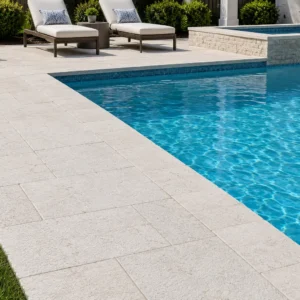
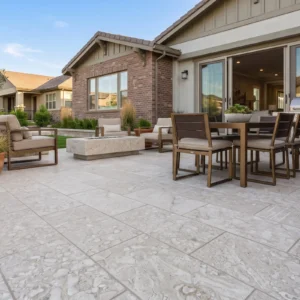
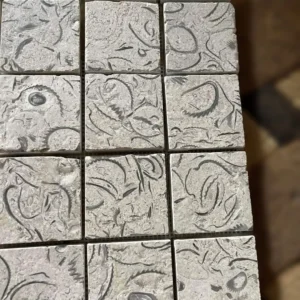
Limestone flooring in Arizona must meet specific structural requirements before aesthetics ever enter the conversation. Arizona's International Building Code adoptions mandate minimum floor assembly load ratings — typically 40 psf live load for residential applications — and limestone's natural density means substrate preparation, mortar bed depth, and deflection limits all require careful engineering review before installation begins. For architects and contractors specifying natural stone, these compliance checkpoints are non-negotiable starting points. Citadel Stone Limestone Flooring in Arizona is available in multiple formats — from large-format slabs to modular tile cuts — with material documentation to support specification packages and permit submissions. Choosing the right limestone thickness and finish for your structural assembly is a decision point the full article addresses with practical guidance on slab-on-grade versus suspended floor applications. Citadel Stone supplies Limestone Flooring sourced from quarries across the Mediterranean and Middle East to projects in Phoenix, Tucson, and Scottsdale, Arizona.

See & Feel the Quality – Free Arizona Stone Samples

Our stones are made for the Arizona sun. See how the colors hold up in your specific light.

Design Your Arizona Home with a Local Stone Expert

Get personalized advice on the best stone for Arizona's climate and your design style.

Premium Natural Stone — All Sizes & Thicknesses Available

From standard cuts to fully custom dimensions — our limestone, granite, basalt & shellstone
are cut to your exact specifications. Residential or commercial, we’ve got you covered.

Showing all 69 resultsSorted by popularity

Get Your Free Arizona Stone Quote

Transparent Pricing for Your Arizona Project

Elevate Your Arizona Property with Premium Stone, Priced for Value.

Unlock $10,000 Worth of Deals on Beautiful Paver, Tiles & Cobble Setts—For Free!

Invest in Arizona’s Landscape: Stone That Lasts a Lifetime.

100% Happiness Guarantee

Trust 50 Years of Expertise. Invest in Quality Limestone Tiles

Custom-Cut for Your Arizona Project: Any Size, Any Finish.

No-Obligation Consultation: Get Expert Advice for Your Arizona Home.

The Stone Supplier Trusted by Arizona's Leading Architects & Designers.

Arizona's Most Diverse Selection of Natural Stone.

Elevate Your AZ Property with Natural Stone Built for the Desert. Our expansive collection of Natural Stone brings timeless beauty and proven durability to both residential and commercial spaces across Arizona. As the state’s leading supplier, we offer a diverse palette of colors and finishes—from cool, light tones that reflect the sun to rich, earthy textures that complement the Southwest landscape. Transform your environment with limestone that stands up to the Arizona heat while providing the sophisticated aesthetic you desire.

Incredible Prices for Top-Quality Stone—Shop Citadel Stone Today!

Table of Contents

Limestone flooring in Arizona demands a specification approach grounded in local building codes before anything else — and that distinction matters more than most project teams realize until they’re mid-installation and facing a failed inspection. Arizona’s adopted version of the International Building Code, with state and municipal amendments, sets floor assembly requirements that directly affect your thickness selection, substrate design, and load distribution calculations. Getting those details right from the start is what separates a compliant, long-lasting installation from one that needs remediation within two years.

Arizona Building Code Requirements for Limestone Flooring in Arizona

The IBC load requirements governing interior flooring assemblies in Arizona specify minimum live load ratings that vary by occupancy classification. For residential applications, you’re working with a 40 psf live load floor standard in habitable spaces, but commercial occupancies — retail, hospitality, office — escalate those demands significantly, sometimes reaching 100 psf or higher depending on use. Natural limestone flooring in Arizona must be specified at thicknesses that satisfy both the structural load transfer requirements and the bonding system’s capacity to distribute those loads without delamination.

The Arizona Department of Fire, Building, and Life Safety enforces code compliance through municipal plan review processes in each jurisdiction. Your permit drawings need to reflect the stone thickness, mortar bed depth, and substrate system together — not just the finish material. Inspectors in commercial builds will look at the tile assembly as a composite system, not just an aesthetic choice. For projects where Citadel Stone’s team reviews specifications before purchase, this is exactly the kind of documentation review that prevents expensive rework downstream.

  • Minimum nominal thickness for limestone floor tile under commercial live loads typically starts at 3/4 inch, with 1-inch to 1.25-inch preferred for high-traffic corridors
  • Substrate deflection limits under ANSI A108 require that the supporting structure not exceed L/360 under full design load — this governs your concrete slab or joist system before you even select the stone
  • Arizona’s seismic design category varies from B in the low desert to D in specific fault-adjacent zones, affecting expansion joint placement requirements in your floor system
  • Slip resistance compliance under ADA standards (ASTM C1028 and DCOF AcuTest) is a code requirement for public accommodations — not optional guidance
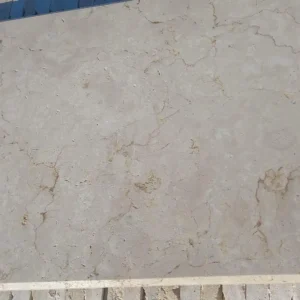
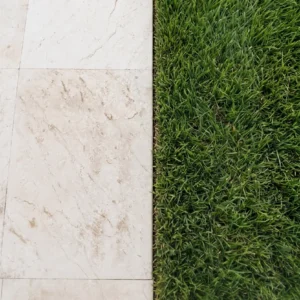
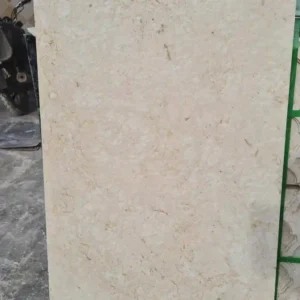
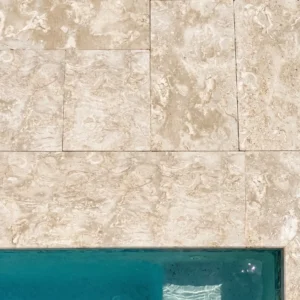
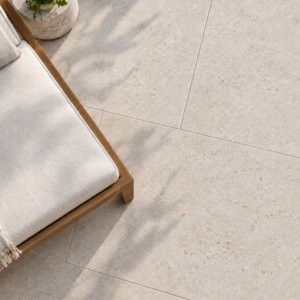
Close-up of a light cream limestone slab with subtle brown veining.

Structural Substrate Requirements for Interior Limestone Flooring

The substrate system beneath your interior limestone flooring in Arizona does more structural work than the stone itself. Arizona’s expansive clay soils — prevalent across the Phoenix basin and in the Tucson metro — create a heave risk that post-tension slab systems were specifically designed to address. Post-tensioned slabs perform differently under tile assemblies than conventionally reinforced slabs because the tensioned cables restrict crack propagation patterns. You need to understand where the tendon layout runs before cutting any saw joints for crack isolation membranes.

Crack isolation membranes are non-negotiable for limestone stone flooring in Arizona on any slab with a history of movement or on slabs over expansive soils. The membrane decouples the tile assembly from substrate movement, absorbing differential displacement up to 1/8 inch depending on product specification. In Phoenix, where post-tension slab construction dominates residential and light commercial builds, you’ll want to confirm tendon locations with the original structural drawings before specifying membrane penetration depths or saw-cut joint locations.

  • Concrete slab flatness tolerance for natural stone installation: SR (Surface Regularity) value of FF 35 minimum, measured per ASTM E1155 — tighter than standard concrete finishing specs
  • Moisture vapor emission rates above 3 lbs per 1,000 sq ft per 24 hours (ASTM F1869) require a vapor barrier system beneath the mortar bed, especially in slab-on-grade construction
  • Thin-set mortar systems require minimum 3/4-inch concrete substrate above structural members — thinner slabs should move to a full mortar bed system at 1.25 to 1.75 inches
  • Hydronic radiant heat embedded in slabs requires additional expansion joint frequency — reduce joint spacing from 20-25 feet to 12-15 feet to accommodate thermal cycling

Seismic Considerations for Limestone Floor Tile in Arizona

Arizona doesn’t carry California-level seismic exposure, but the state is not seismically inactive either. The seismic hazard map published by the Arizona Geological Survey identifies fault systems in the Basin and Range province that affect design requirements in portions of Maricopa, Pinal, and Pima counties. For limestone flooring tile in Arizona assigned to Seismic Design Category C or D, ASCE 7 requirements influence how your expansion joint system must be designed — particularly at perimeter walls and structural column lines.

In practice, this means your expansion joint layout can’t be driven purely by aesthetic preferences or simplified rules of thumb. Joints must occur at all changes of plane, at all structural columns, at all door thresholds, and at regular field intervals determined by the calculated joint width formula accounting for coefficient of thermal expansion and seismic displacement. Limestone exhibits a thermal expansion coefficient of approximately 4.4 to 5.3 × 10⁻⁶ per °F — lower than ceramic tile but meaningful at the span lengths common in large commercial floors. You should coordinate your joint layout drawing with the structural engineer of record, not develop it independently during the installation phase.

  • TCNA (Tile Council of North America) Detail EJ171 governs expansion joint placement for tile and stone — it is referenced by most AHJs as the standard of care
  • Sealant selection for expansion joints in seismic zones should meet ASTM C920 Type S, Grade NS, Class 35 minimum — accounting for both thermal movement and lateral seismic displacement
  • Flagstaff and communities at higher elevation have measurable freeze-thaw exposure that introduces additional joint movement cycling not present in the low desert

Limestone Flooring Performance in Arizona Climate Conditions

Thermal mass is a legitimate performance advantage for indoor limestone flooring in Arizona’s high-desert climate — but it creates a specific condition that specifiers routinely underestimate. Morning temperature recovery on a heavily shaded limestone floor slab can lag ambient air temperature by 90 to 120 minutes after sunrise, creating a condensation window in humid monsoon months when warm air contacts the still-cool stone surface. This isn’t a defect — it’s thermodynamic behavior — but your client needs to understand it before they attribute surface moisture to a sealing failure.

The porosity of natural limestone flooring in Arizona varies significantly by quarry source and formation type. Dense micritic limestone from certain formations carries absorption rates below 0.5% by weight, while more open-textured oolitic limestone can reach 3.5% or higher. Those absorption differences translate directly to sealing protocol differences, stain resistance variation, and cleaning product compatibility. At Citadel Stone, we inspect incoming material for batch consistency specifically because porosity variation within a single order — not just between orders — creates uneven sealing uptake that shows up as blotchy appearance after the first reseal.

  • Interior limestone flooring in Arizona should be sealed with a penetrating impregnating sealer (fluoropolymer or siloxane-based) rated for the stone’s specific absorption class
  • Topical sealers create a film that traps vapor in high-moisture environments and is not recommended for floors subject to radiant heat systems
  • Limestone’s Mohs hardness of 3 to 4 means it is susceptible to abrasion from silica-bearing soils — common throughout Arizona’s desert environment — making entrance mat systems a maintenance requirement, not merely a preference
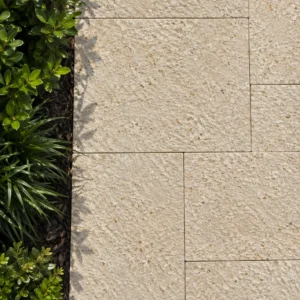
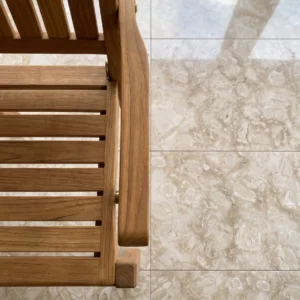
  • Color variation across limestone flooring tile in Arizona projects ranges from consistent cream and buff tones in some formations to dramatic veining in others; specifying from a single quarry batch reduces field variation

Thickness and Format Selection for Limestone Interior Flooring

Format selection for limestone interior flooring in Arizona isn’t just an aesthetic decision — it has structural and code implications that flow through to your whole assembly specification. Large-format tiles (24×24 and above) require a higher standard of substrate flatness, a back-buttering requirement under ANSI A108.02, and in some cases a medium-bed mortar to bridge minor substrate irregularities without hollow spots. Hollow spots exceeding 33% of the tile area are a code violation under ANSI standards for tiles larger than 15 inches in any dimension.

For projects in Scottsdale — where high-end residential and boutique hospitality projects often specify large-format natural stone — the combination of large-format limestone and radiant heat systems is particularly demanding. The differential thermal movement between a 24×48 limestone slab and a hydronic-heated mortar bed creates peel stress at the bond line that standard thin-set cannot resist without a flexible additive (ANSI A118.4 or A118.11 rated). Specifying standard Type S mortar without a latex additive in this application is the single most common field failure we encounter. For projects needing complementary stone elements and pricing context, Limestone Flooring from Citadel Stone covers detailed cost and specification information that supports early-stage project budgeting.

  • Standard residential thickness: 3/8 to 1/2 inch nominal for thin-set applications on concrete slab
  • Commercial and high-traffic thickness: 3/4 to 1 inch nominal, often with full mortar bed system
  • Stair treads and transition pieces: minimum 3/4 inch for code-compliant nosing profiles
  • Dimensional tolerance for limestone flooring tile should comply with ASTM C615 or equivalent — verify with your supplier before committing to large-format specifications

Citadel Stone stocks natural limestone flooring in Arizona in standard formats including 12×12, 16×16, 18×18, 24×24, and 12×24 planks, with 3/8-inch through 1-inch thicknesses available depending on formation type. You can request sample tiles and thickness specifications before committing to a project order — especially important when matching to an existing installation or working within tight tolerance requirements.

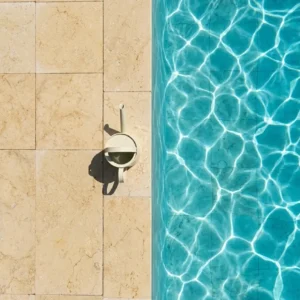
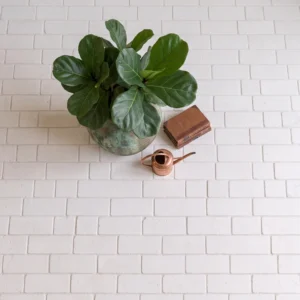
Small terracotta teapot rests on light-colored limestone tiles.

Installation Best Practices for Limestone Stone Flooring in Arizona

Layout planning for limestone flooring tile in Arizona projects should begin with a dry-lay across the full floor area before any mortar is mixed. This step catches color and veining variation between boxes — limestone is a natural material and even well-graded batches carry variation that only becomes visible at floor scale. Mixing material from three or four boxes simultaneously during installation produces the distributed variation that reads as intentional character rather than patchy inconsistency.

Mortar open time is shorter than printed data sheets suggest in Arizona’s low-humidity environment. At 15% relative humidity — common in Phoenix during spring and early summer — mortar skin-over time can drop to 8 to 12 minutes from the 20 to 30 minutes you’d see in temperate climates. You need to adjust your crew size, work area dimensions, and batch volume accordingly. Working in small sections and back-buttering every tile is standard practice on quality installations; in Arizona’s climate, it’s essential for bond integrity.

  • Grout joint width for natural limestone should be a minimum of 1/16 inch to accommodate dimensional variation inherent in natural stone — tighter joints create lippage risk
  • Grout selection should be unsanded for joints under 1/8 inch, sanded for 1/8 inch and above — and epoxy grout is the preferred specification for kitchen and wet-area applications
  • Allow a minimum 24-hour cure before foot traffic and 72 hours before full load — longer in humid monsoon conditions when mortar hydration slows
  • Protect the finished surface with kraft paper or foam board during construction activity — limestone’s relatively low hardness makes it vulnerable to dropped tools and abrasive debris

Maintenance and Resealing Protocols for Limestone Flooring in Arizona

Maintenance requirements for indoor limestone flooring in Arizona are more about consistency than intensity. The dry climate slows biological growth and reduces the freeze-thaw stress that drives delamination in cold regions, but the abrasive silica in Arizona’s airborne dust and tracked soils accelerates surface wear faster than most homeowners anticipate. A disciplined entrance protocol — quality mats at all exterior entries, no outdoor footwear on stone floors — extends the reseal cycle from the typical 18-to-24-month schedule to 36 months or beyond on lightly trafficked areas.

pH-neutral cleaners are mandatory for limestone stone flooring in Arizona. Acidic cleaners — including many common household products and anything citrus-based — etch limestone’s calcium carbonate surface chemistry on contact, leaving dull patches that require professional honing to restore. Hard water with elevated calcium and magnesium content, standard across much of Arizona, can create mineral deposits on limestone that pose a secondary etching risk if the wrong removal product is used. Diluted white vinegar — a popular DIY cleaning recommendation — will permanently damage your limestone floor surface and should never be used.

  • Reseal schedule: penetrating sealers on residential floors every 18 to 36 months depending on traffic; commercial floors every 12 to 18 months
  • Test sealer effectiveness annually with the water-bead test — droplets should bead for at least 5 minutes on a properly sealed surface
  • Professional deep cleaning and honing every 5 to 7 years restores surface luster and removes accumulated micro-scratching without reducing stone thickness
  • Avoid steam cleaning — the thermal shock to the stone surface and the moisture driven into joints can compromise bond integrity in thin-set systems

Get a Quote on Limestone Flooring in Arizona from Citadel Stone

Citadel Stone supplies limestone flooring across Arizona in formats suited to both residential and commercial project scales. Available options include honed, brushed, and polished finishes across cream, buff, and warm grey tones — in standard field tile dimensions as well as custom-cut formats for stair treads, thresholds, and transition pieces. Sourced from established quarry partners, each batch is inspected for dimensional consistency and surface quality before warehouse staging, which matters when you’re specifying a uniform field across a large floor area.

You can request sample tiles, material data sheets, or project-specific thickness specifications directly from Citadel Stone’s technical team before committing to your order. For trade accounts and wholesale enquiries, Citadel Stone works with contractors, architects, and interior designers on volume pricing and scheduled delivery coordination across Arizona. Warehouse stock levels for standard formats typically support 1-to-2-week lead times on confirmed orders; custom cuts and non-standard thicknesses require additional lead time that the team can confirm at the quote stage. Truck delivery is coordinated to your site or receiving yard, and the team can advise on palletized quantities to minimize handling on delivery day. For your next Arizona project, contact Citadel Stone to request a material quote or schedule a sample review — the specification conversation is worth having early, before substrate work is committed.

As you finalize your Arizona stone specification, related flooring formats and surface options are worth reviewing alongside your limestone selection. Natural Limestone Floor Tiles in Arizona provides further detail on tile formats, finish options, and application guidance specific to Arizona conditions. Stone selections for Arizona projects in Flagstaff, Sedona, and Yuma include Limestone Flooring supplied direct from Citadel Stone.

Why Arizona’s Builders Choose Citadel Stone?

Free AZ Comparison: Citadel Stone vs. Other Suppliers—Find the Best Value!

FeaturesCitadel StoneOther Stone Suppliers
Exclusive ProductsOffers exclusive natural stones sourced from selected quarriesTypically offers more generic or widely available stone options
Quality and AuthenticityProvides high-grade, authentic natural stones with unique featuresQuality varies; may include synthetic or mixed-origin stone materials
Product VarietyWide range of premium productsProduct selection is usually more limited or generic
Global DistributionDistributes stones internationally, with a focus on providing consistent qualityOften limited to local or regional distribution
Sustainability CommitmentCommitted to eco-friendly sourcing and sustainable production processesSustainability efforts vary and may not prioritize eco-friendly sourcing
Customization OptionsOffers tailored stone solutions based on client needs and project specificationsCustomization may be limited, with fewer personalized options
Experience and ExpertiseHighly experienced in natural stone sourcing and distribution globallyExpertise varies significantly; some suppliers may lack specialized knowledge
Direct Sourcing – No MiddlemenWorks directly with quarries, cutting unnecessary costs and ensuring transparencyOften involves multiple intermediaries, leading to higher costs
Handpicked SelectionHandpicks blocks from quarries and hand select paver and tile post manufacture for quality and consistency. Ensuring only the best materials are chosenSelection standards vary, often relying on non-customized stock
Durability of ProductsStones are carefully selected for maximum durability and longevityDurability can be inconsistent depending on supplier quality control
Vigorous Packing ProcessesUtilizes durable packing methods for secure, damage-free transportPacking may be less rigorous, increasing the risk of damage during shipping
Citadel Stone OriginsKnown as the original source for unique limestone tiles from the Middle East, recognized for authenticityOrigin not always guaranteed, and unique limestone options are less common
Customer SupportDedicated to providing expert advice, assistance, and after-sales supportSupport quality varies, often limited to basic customer service
Competitive PricingOffers high-quality stones at competitive prices with a focus on valuePrice may be higher for similar quality or lower for lower-grade stones
Escrow ServiceOffers escrow services for secure transactions and peace of mindTypically does not provide escrow services, increasing payment risk
Fast Manufacturing and DeliveryDelivers orders up to 3x faster than typical industry timelines, ensuring swift serviceDelivery times often slower and less predictable, delaying project timelines

Extra Benefits

Choosing Citadel Stone offers unique advantages beyond premium stone quality:

Exclusive Access to Durable Stones

Citadel Stone specializes in unique, regionally exclusive stones, sourced directly from the Middle East.

Transparent Pricing – No Hidden Costs

With no middlemen, Citadel Stone provides direct, transparent pricing that reduces unnecessary costs.

Flexible Customization for Bespoke Projects

Tailor your order to precise specifications, from sizes to finishes, ensuring your project aligns perfectly with your vision.

Streamlined Delivery & Reliable Stock Availability

Benefit from fast production and delivery timelines, designed to minimize delays and ensure reliable availability.

The Preferred Stone Supplier for Luxury AZ Developments.

Scale Your Vision: We Support Arizona's Largest Projects with Reliable, Fast Delivery.

With unlimited tiles, pavers, cobble setts, curbstones, and the fastest delivery options, What’s not to love? Say goodbye to unnecessary hassles!

Leading AZ Stone Suppliers are Loving Citadel Stone!

Don’t Settle for Less. Source the Best Stone for Your Local Stone Expert.

DanielOwner
Thank you, Kareem. We received the order. The stones look great!
FrankOwner
You are a good businessman and I believe a good person. I admire your honesty, this is why I call you a good businessman.
Gemma C
Gemma CPrivate Project
Undoubtedly the price was the reason that we chose Citadel stone, in addition to the fact that you offer a white limestone that is hard to source. Your products are very good value for money by comparison with other companies. You have helped at every stage of the process and have been quick and reliable in your responses. It was a big risk for us to pay everything up front including shipping and not know the quality. You did make me feel that I could trust you and your company however and we are very happy with the tiles. They appear to have been finished to a very high quality of smoothness and I can't wait to see them once they have been laid. We need to see now how easy they are to fit and maintain, yet you also sealed them before shipment so we think that they will be very durable. Our building project has been delayed for a few months now so it may be sometime before we see them laid, but I promise that I will send photos as soon as we have them down. Thank you so much Kareem and your team, you have done a great job. I am hoping that we can pay for, and receive our second shipment in the not too far future, so that we can finish everything off. Wishing you well. Gemma
Molly McK
Molly McKPrivate Project
I appreciate the quality of product and care for the custom order in packaging each crate to minimize breakage as well as the flexibility with the order to help us make the most of shipping. The timely communications are impressive from the beginning and throughout the process. It's reassuring to have gone through one order to know what the process will be like in the future. I am glad to have had some guidance through the importing process and recommendations for shipping partners to assist. It's incredible to think about the journey the stone traveled to get to our site and I'm grateful to have made it to the next stage of the project relatively smoothly and with from what I can tell

Frequently Asked Questions

If your question is not listed, please email us at [email protected]

What structural or building code requirements apply to limestone flooring installations in Arizona?

Arizona jurisdictions follow adopted versions of the International Building Code, which establish minimum floor live load capacities — generally 40 psf for residential and higher thresholds for commercial occupancies. Limestone flooring, depending on thickness and format, adds meaningful dead load to the assembly, so engineers and inspectors will review subfloor deflection ratings, mortar bed specifications, and fastener schedules as part of permit compliance. Projects on slab-on-grade foundations face different documentation requirements than those on wood-frame suspended floors. Confirming local amendments with the Authority Having Jurisdiction before finalizing your specification is strongly recommended.

Limestone performs reliably in high-traffic interior applications when the correct hardness grade and finish are selected — softer limestone varieties are better suited to low-traffic decorative applications, while harder, denser limestone sourced from Turkish or Israeli quarries holds up well under sustained foot traffic. A honed or brushed finish is generally preferred over polished in active living areas, as it reduces surface scratching visibility and improves slip resistance. Sealing the stone appropriately for the application environment is a practical step that directly extends the service life of the installation.

Arizona’s arid conditions accelerate fine particle abrasion on stone surfaces, making routine dry mopping or dust control matting more important than in humid climates where moisture is the primary concern. Limestone is alkaline-sensitive, so cleaning products should be pH-neutral — acidic cleaners, including vinegar-based solutions, will etch the surface permanently. Penetrating sealers applied at installation and reapplied on a schedule appropriate to traffic levels provide meaningful protection against dust infiltration into the stone’s natural porosity. Annual inspection of grout lines and sealer integrity is a practical maintenance standard for Arizona installations.

For slab-on-grade residential installations — the predominant foundation type across Phoenix, Tucson, and Scottsdale — a minimum 3/8-inch limestone tile thickness is common, though 1/2-inch and 3/4-inch formats provide greater edge integrity during cutting and installation. On suspended wood subfloor systems, deflection control becomes the critical variable: the subfloor assembly must meet or exceed L/360 deflection limits to prevent cracking at grout joints over time. Citadel Stone carries limestone in multiple thickness profiles, allowing contractors to match material specification to the structural assembly rather than defaulting to a single standard format.

Expansive clay soils — present in portions of the Phoenix metro and other Arizona valley areas — can exert upward pressure on slab-on-grade foundations during moisture events, creating differential movement that translates into cracked tile and failed grout joints. Geotechnical reports identifying soil classification are foundational to designing an appropriate subbase, and some projects require post-tension slab engineering specifically to counteract expansive soil movement. Limestone, while rigid and dimensionally stable as a material, has no tolerance for subgrade movement, making proper soil stabilization and moisture barrier installation upstream decisions that directly protect the stone investment.

Contractors working on Arizona limestone flooring projects consistently point to Citadel Stone’s ability to support the full workflow — from initial material selection and sample review through specification documentation and coordinated delivery — as a practical advantage over suppliers focused purely on order fulfillment. Citadel Stone supplies Arizona projects at any scale, from single-pallet residential bathroom renovations to multi-truckload commercial flooring programs, with consistent material batching to minimize color and texture variation across large orders. Arizona professionals benefit from Citadel Stone’s established regional supply presence, which keeps lead times manageable and supports project scheduling from the specification phase through final delivery.