

Key Takeaways
- Shellstone is a fossil-rich limestone: pale, porous and comparatively soft — and all three vary from bed to bed. Almost everything it does well, and everything it does badly, follows from those three properties.
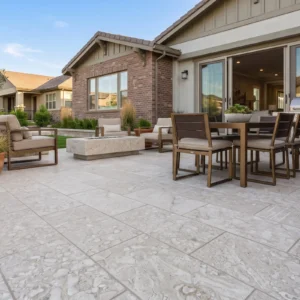
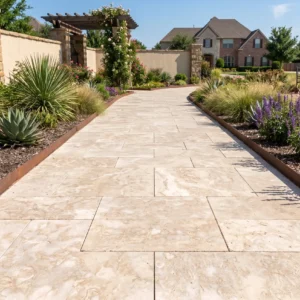
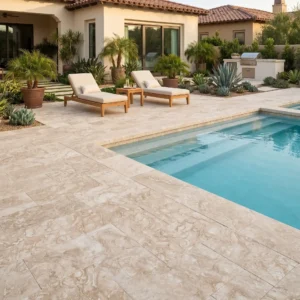
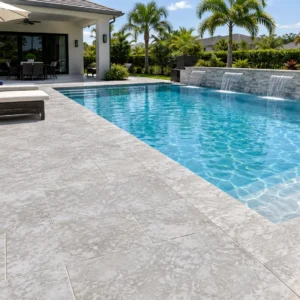
- It suits exterior applications including driveways — pool surrounds, barefoot terraces, patios, walkways and drives — with the thickness chosen for the traffic: the datasheet’s 7–10 cm units suit driveways and high-traffic areas, and its 16–20 cm units suit industrial and heavy-load pavements. It is the wrong specification for surfaces that will be de-iced with salt, and for anywhere acids are spilled.
- Specify by exposure and traffic: load decides thickness, bedding and base; exposure decides finish; and wet slip belongs to the finish you actually buy, not to the material in general.
- Every order is cut to order at our selected quarries, lead times are quoted with your order, and delivery is arranged and quoted alongside it.
What Shellstone Is, and Who It Suits
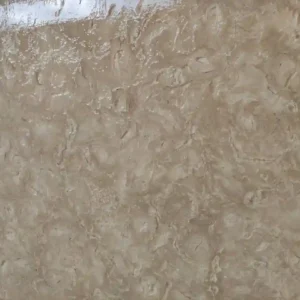
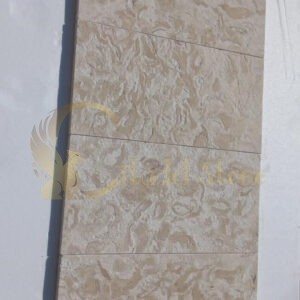
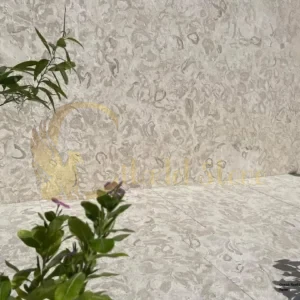
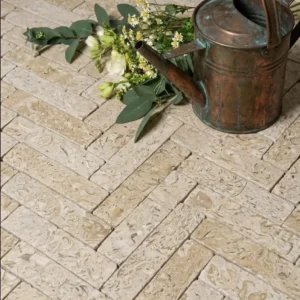
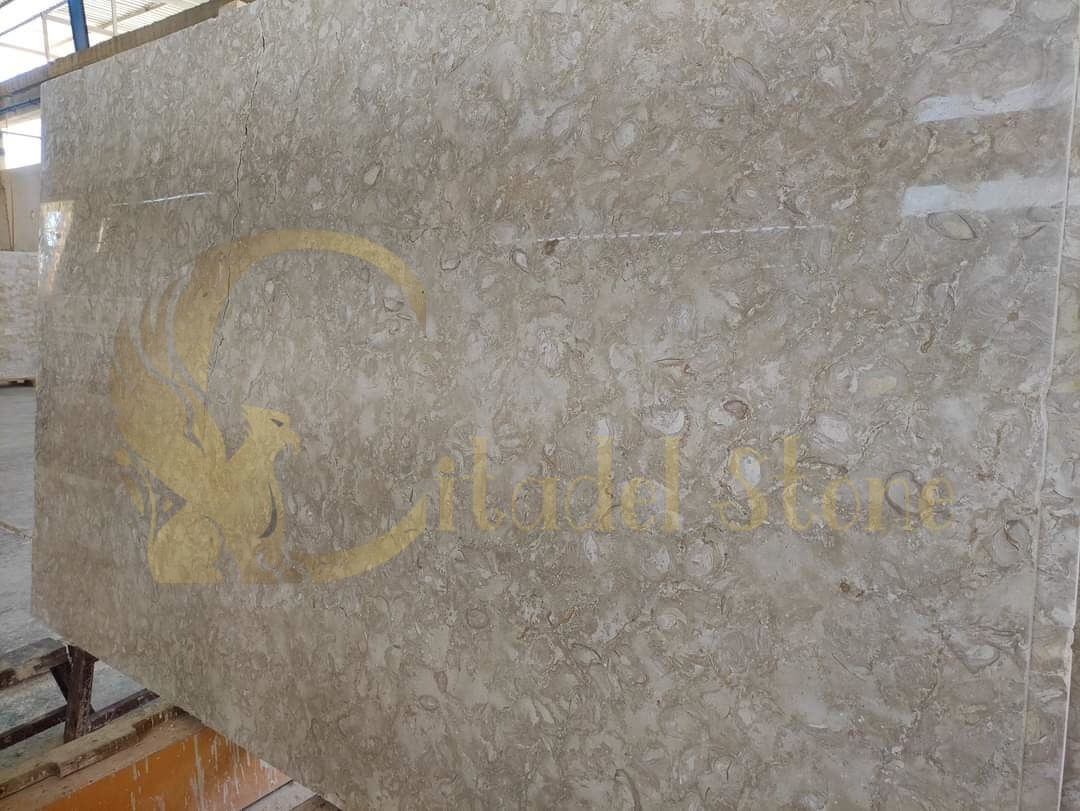
Shellstone is a fossil-rich limestone — shell, coral and marine debris laid down in shallow water and cemented into rock over geological time. Cut and dressed, it reads as a pale cream to soft beige surface with visible shell fragments and small open voids, and no two units are identical. That plain description is more useful than any adjective, because almost everything shellstone does well, and everything it does badly, follows from three properties: it is pale, its pore structure is open and varies from bed to bed, and it is softer than the dense stones and engineered units it is usually set against. Shellstone spans a band rather than sitting at a point, so confirm absorption and strength against the test certificate for the batch you are buying before you design around either.
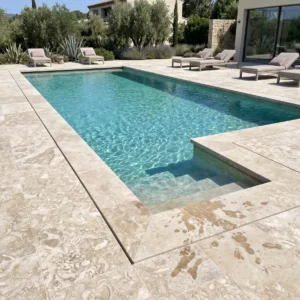
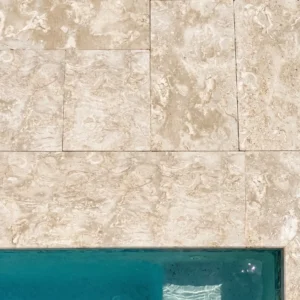
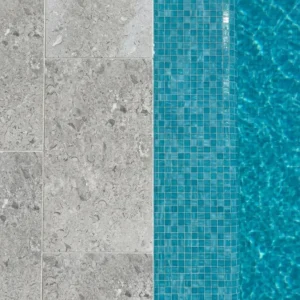
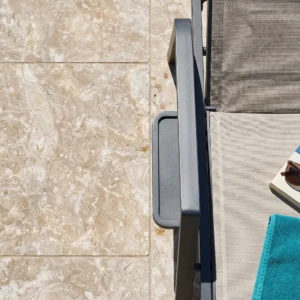
Pale and porous gives you a surface that runs cooler under sun than a dark, dense unit and keeps its grip when wet, which is why shellstone ends up around pools, on barefoot terraces and on garden walkways more often than anywhere else. Comparatively soft means it cuts, profiles and drills readily on site — a real advantage for radius coping and step nosings — and also that it marks, etches and wears where a harder stone would shrug. Shellstone is for a client who wants a surface that ages into a patina. It is not for a client who wants year ten to look like handover day.
This page is the front door to the material: whether it fits your project, how to specify it, what the family contains, and how ordering works. The subjects that deserve their own treatment have their own pages, and they are signposted as they come up. If you want the case for the material argued in full, start with the complete guide to what shellstone pavers are and where they earn their place.
Is Shellstone Right for Your Project?
Four questions settle most specifications. Take them in order, because each one narrows the next.
- What is the exposure? Around pools and near the coast, shellstone is in its element — texture where the surface is walked on wet, and a light face that does not punish bare feet. Both chlorinated and salt water leave deposits as they evaporate, so plan on rinse-down and on drainage that carries water off the stone rather than letting it pond and dry there. In freeze-thaw country the material can work, but the assembly has to earn it: a free-draining base, joints that drain, no standing water, and freeze-thaw data for the batch you are buying. In hot-arid conditions the pale surface is the whole argument — watch irrigation instead, because hard or iron-bearing water will mark a pale, open stone.
- What traffic does it carry? Foot traffic is unproblematic at conventional thickness. Vehicular traffic is a thickness decision, not a question mark: a private driveway or a parking apron takes the driveway thicknesses in the table below — the datasheet’s 7–10 cm row covers driveways and high-traffic areas — and industrial or heavy-load pavements, service routes included, take the datasheet’s 16–20 cm units. Specify the thickness by the traffic, lay it on a base built for wheel loads rather than a pedestrian build-up, and have both written into the quote: the base decides how a drive survives its first winter, and the unit at the right thickness suits the load.
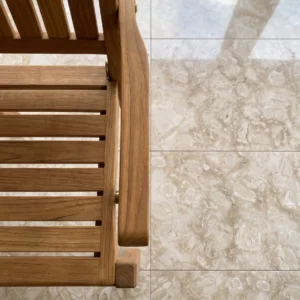
- Interior or exterior? Indoors, shellstone goes down as a thinner unit bonded to a flat, stiff, movement-jointed substrate, and the finish can be smoother because the floor stays dry. Outdoors, thickness, bedding and falls do the work, and every detail should assume water gets in and needs a way out.
- Wet or dry underfoot? Finish follows water. A textured face — a natural or tumbled finish — belongs anywhere that gets wet or walked barefoot; honed and other smooth faces belong in dry interiors. Which finishes the range is cut in, and what each one does, is set out on the guide to shellstone paver colors, finishes and sizes. Confirm wet slip on the finish you intend to buy — ANSI A326.3 wet DCOF, measured on that finish, sealed the way you intend to seal it.
If those four answers point the same way, the rest of this page is about specifying it properly. If any of them lands in the list below, say so early: the cheapest change to a specification is the one made before anything is cut.
Where Shellstone Is the Wrong Choice
A hub that never says no is a brochure. These are the projects where a different material is the better answer, and none of them is fixed by a sealer.
- Pavements that will be de-iced with salt. Chloride de-icers drive surface scaling and spalling in porous limestone, and no coating reliably prevents it. If a walk or drive has to stay open through ice, plan on sand or grit — or specify something else for that area.
- Acid-splashed surfaces. Limestone etches. Citrus, vinegar, wine, many proprietary patio cleaners and every mineral-acid masonry wash will dull and pit the face. Shellstone in an outdoor kitchen or bar top is a decision to accept etching, not a problem to engineer away.
- Polished faces in wet or exterior locations. A polished shellstone floor is a fine dry interior. Outside, or in a shower or pool surround, the same face is a slip claim waiting to happen.
- Projects that must match exactly across phases. Fossil density, color and vein run vary between blocks and between seasons of extraction. If phase two must be indistinguishable from phase one, order both together or choose a manufactured unit.
- Clients who want zero maintenance. Shellstone patinas, takes the odd mark and wants periodic cleaning and, in most exterior settings, resealing. That is the deal. If the brief says “nothing to do, ever”, the brief and the material disagree.
- Thin units under wheels, and any field laid over a base that has not been designed. Most shellstone failures that get blamed on the stone are base failures, joint failures or drainage failures wearing the stone’s name.
Where Shellstone Comes From, in Short
Shellstone is a coastal limestone. The shells, coral fragments and marine debris in the face are not decoration applied to a stone — they are the stone, compacted and cemented in shallow water and then lifted and quarried. Fossil density, color and the size of the open voids vary from bed to bed and block to block, which is why a sample tells you a range rather than a color. Citadel Stone’s shellstone is cut to order at our selected quarries in the Middle East.
The geology in full — how the beds form, why one course is shell-packed and the next nearly plain, and what that means when you are laying a floor from more than one crate — belongs to the guide to shellstone’s geological background and formation. For how it sits against the other limestones in the range, see shellstone compared with other limestone.
Specifying Shellstone: Thickness and Finish by Application
The table below maps the datasheet’s thickness bands to the applications a specifier meets. The structural design sets the base and bedding beneath them, and local code and the batch’s test data confirm the detail. Thicknesses are nominal: natural stone is cut to a nominal dimension with a tolerance, and a calibrated unit and a split unit do not behave the same way in a bedding course. The range table higher up this page lists the thicknesses the range is cut in; the table below is about which of them to choose for a given application.
| Application | Thickness starting point | Finish for the exposure | What to watch |
|---|---|---|---|
| Interior floor, dry | 12-20 mm (1/2-3/4 in), bonded | Honed or another smooth face | Substrate deflection and movement joints; acid spills |
| Covered terrace, pedestrian | 20-30 mm (3/4-1 1/4 in), bonded to slab or screed | Textured, or honed under full cover | Falls and drainage, even under cover |
| Open patio and walkway, sand-set | 50-60 mm (2-2 3/8 in) | Textured | Edge restraint on every free edge |
| Pool surround, barefoot | 30 mm (1 1/4 in) bonded, or 50-60 mm sand-set | Textured — never polished | Wet DCOF, rinse-down, coping overhang and fixing |
| Steps and treads | 50-80 mm (2-3 in), thicker where the tread oversails | Textured, with the grip carried across the nosing | The nosing is the wear point and the trip point |
| Driveway and parking apron | 70-100 mm (the datasheet’s 7-10 cm driveway and high-traffic row) | Textured | Engineered base depth; the apron, where braking and turning loads land |
| Commercial and heavy-load pavement | 16-20 cm (the datasheet’s industrial and heavy-load row), over an engineered pavement design | Textured | The pavement design governs base, bedding and jointing; axle and point loads |
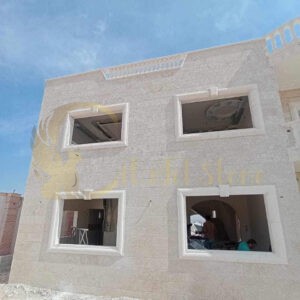
| Wall cladding | 20-30 mm adhered at low level; thicker and mechanically anchored above | Any; texture is a design choice off the floor | Mechanical support and an engineer’s fixing design above low level |
Format is a design decision more than a performance one within these thickness conventions. The range is cut in a spread of sizes, and the guide to shellstone paver colors, finishes and sizes sets out which size suits which kind of space, and the trade-offs between them.
What the Assembly Has to Do
Base, bedding, jointing and falls belong to the installation guide, and the step-by-step installation guide sets out base preparation, bedding, jointing and drainage in full, with the figures. What belongs here is why they matter more on this stone than on a dense one. A porous unit that sits in water takes it up, so positive falls to a drainage route, a free-draining base and joints that let water out are not refinements — they are the conditions the material was specified under. Ponded water is the input to nearly every failure mode shellstone gets blamed for.
Two jointing choices sit with the specifier rather than the installer. Joint width follows the edge you bought: a calibrated, machine-cut edge closes up, while a tumbled edge wants to be seen. And the filler manufacturer’s minimum joint width and minimum joint DEPTH both govern, whatever the edge looks like — a joint filled too shallow fails at any width. Filler chemistry matters more here than on dense stone, because a hard, impermeable filler against a softer, permeable unit concentrates stress and traps water, with results familiar enough to have their own guide to joint filler problems and how to fix them. Where the pattern is modular rather than running bond, set it out before ordering: the French pattern layout guide covers the module maths and the laying sequence, and the cutting allowance that comes with it.
Edges, Coping and Movement
Field units are the easy part. Most of what goes wrong on a shellstone terrace goes wrong at an edge, so the details below are worth settling before anything is cut.
- Coping profile. Square eased, bullnose and drop-face (full-bullnose) copings each read differently and cost differently to cut. A drop-face hides the beam and returns water away from the edge; a bullnose is simpler and more forgiving of small setting-out errors. Whatever the profile, keep an overhang past the face — roughly 20-40 mm is the usual range — and take a drip on the underside so water leaves the edge instead of tracking back.
- Fixing and separation. Coping bedded on a pool beam wants a bond breaker and a compressible joint between coping and deck, so that deck movement is not transmitted into the coping course. Cantilevered or heavily overhung pieces want mechanical fixing, designed rather than assumed.
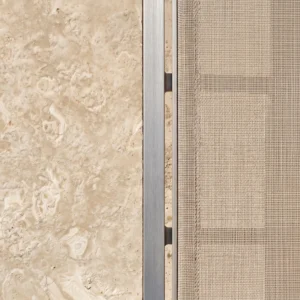
- Movement joints. Bonded fields need joints at perimeters, at changes of plane and around anything that penetrates the floor. A rigid field pinned at every edge will relieve its stress somewhere, and on a soft stone it relieves it through the stone.
- Edge restraint on sand-set work. Every free edge needs restraint or the field creeps, joints open and the pattern walks. This is the single cheapest detail on the job and the one most often skipped.
- Adhesives and mortars. A pale, porous stone shows what is behind it: dark or oily adhesives can telegraph through thin units, and a mortar mix that stains one batch will stain the next. Sample the build-up, not just the stone — the guide to choosing adhesive for caps and steps covers where each type belongs.
- Salt and chlorine. In splash zones, deposits concentrate exactly where evaporation is fastest. Rinsing with fresh water is more effective than any later remedy, and the guide to salt-air exposure on coastal projects sets out what to expect where the air itself carries salt.
Pool-specific setting out — coping course, deck falls, drainage and the barefoot zone — is treated in detail on the shellstone pool deck page.
Interior and Exterior Use
Shellstone pavers perform equally well indoors and out. Their adaptability suits a broad range of design aesthetics, from coastal and contemporary to transitional and traditional. Compared to heavier natural stones like granite, shellstone’s lighter weight simplifies installation without compromising structural integrity.
Indoors it goes down as a thinner bonded unit on a flat, stiff substrate; outdoors, thickness, bedding and falls do the work. In both cases the assembly, not the stone, decides how long the surface lasts — which is why the conventions above are given by application rather than as one number for the material.
Technical Characteristics of Shellstone Pavers
Understanding the technical profile of shellstone pavers is essential for specifying the right material for your project. Classified as a medium-density stone comparable to marble, shellstone offers a compelling balance of robustness and workability — suitable for a wide range of residential and commercial applications.
Density, Strength and What to Ask For
Limestone for dimension-stone use is classified by density, and ASTM C568 — the material specification for limestone dimension stone — sorts it into low, medium and high density classes. Which class a batch falls into tells you more about how it will behave in service than any single headline figure lifted from a brochure. The tests worth requesting by name are bulk specific gravity and absorption (ASTM C97), compressive strength (ASTM C170), flexural strength (ASTM C880) and, for anything taking foot traffic, abrasion resistance (ASTM C241). Ask for them on the material you are actually buying: a figure published for someone else’s block describes someone else’s floor. Verify the current edition of each standard before you write it into a specification, and note that a table quoting a different standards family is not interchangeable with an ASTM result — ask which test method produced any figure you are given.
The published profiles for the range are collected on the shellstone pavers datasheet and the shellstone tiles datasheet.
Absorption and Freeze-Thaw
Absorption is the property that governs cold-climate behavior, because water held in the pore structure expands when it freezes and the expansion has to go somewhere. But absorption on its own does not predict frost damage — pore size and connectivity do, which is why freeze-thaw cycling data is worth more than an absorption percentage anywhere winters bite. Request the freeze-thaw test report for the batch you are buying, and design the assembly so the stone can drain: a free-draining base, joints that let water out, positive falls, no ponding, and no trapped water behind a bonded unit. Cold-climate practice is set out on the climate considerations guide for hot, cold and coastal projects, and the seasonal routine on preparing a shellstone surface for winter.
Surface Temperature and Wet Slip
Two properties decide whether a paved surface is usable barefoot, and neither is a marketing adjective. Surface temperature is driven by color and texture: a pale, textured, porous face runs cooler in sun than a dark, dense, smooth one, though shade, breeze and wetting all move the number more than material choice does. Slip is a property of the finish, not of the stone — the same block yields a face that grips wet and a face that does not, depending only on how it was dressed. For wet and barefoot areas such as pool decks and surrounds, choose a textured face: brushed in a coarse grit is a popular choice, and natural and tumbled faces work too. Any paving can be slippery when wet, and a sealer can change how a surface behaves, so ask your designer to confirm local pool-deck and code requirements. The cool-surface guide for hot climates compares the options where sun exposure is the governing condition.
The Ocean Reef Shellstone Collection
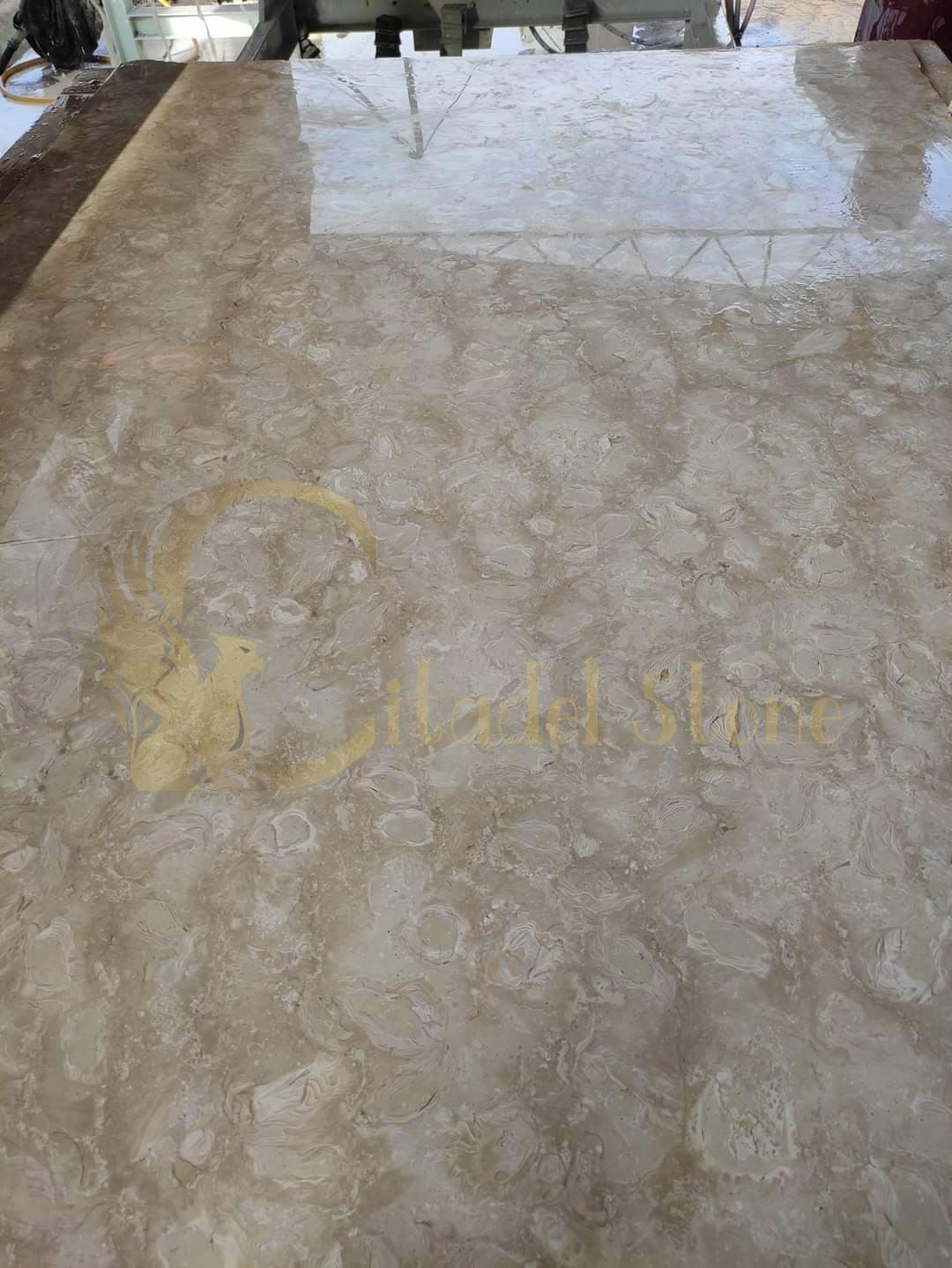
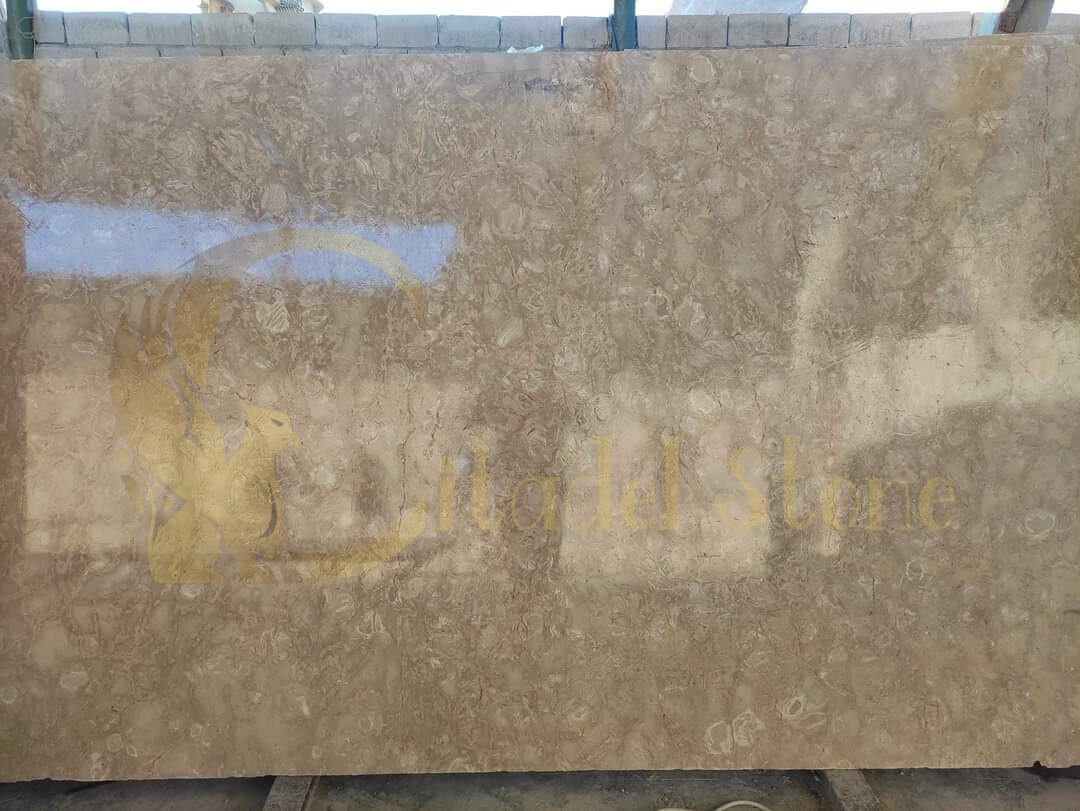
Citadel Stone’s shellstone is led by the Ocean Reef range: a cream-to-beige shell limestone cut to order as pavers, tiles, slabs, pool coping and wall units. Within the range, color runs from near-white through warm beige, and finish changes the character of the material far more than color does — the same stone honed and the same stone tumbled look different, feel different underfoot and behave differently when wet.
Color, finish and size are the subject of the buyer’s guide rather than this page: the complete guide to shellstone paver colors, finishes and sizes sets them out variety by variety, with the trade-offs between them. The wider limestone family it belongs to is on the Ocean Reef limestone and paver collection, the palest end of it on white shellstone pavers, tiles and pool coping, and the paver range itself on the Ocean Reef shellstone pavers page. Sizes and thicknesses normally cut are tabled on this page; anything outside them is a cut-to-order question rather than a catalogue one.
How Ordering Actually Works
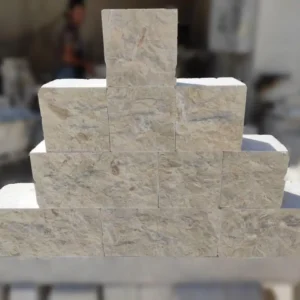
Citadel Stone cuts to order at our selected quarries. Nothing is pulled off a rack on this side of the water: the sizes, thicknesses, finish and edge details you specify are cut for your project and shipped in. That is slower than collecting manufactured units from a builders’ merchant, and it is the reason you can have a nonstandard thickness, a bespoke coping profile, a radius piece or a format that appears on nobody’s price list.
What to Send With an Enquiry
- Areas by application — field, coping, steps, cladding — each with its own quantity and thickness, rather than one combined figure.
- Finish per area, and whether that area is wet, barefoot or both.
- Edge and coping details: profile, overhang and any radius work, with the pool or step dimensions they have to follow.
- Laying pattern and joint width, since a diagonal or modular pattern changes the cutting allowance before it changes anything else.
- Site access and offloading — what can reach the site, and what is available to take crates off a vehicle.
- The programme dates you are working to, so lead times can be quoted against a real date.
Samples, Allowances and Lead Times
Ask for a sample of the finish before committing, and judge variation from more than one piece: natural stone is a range, not a color, and a single tile flatters or maligns the whole batch. Add a cutting allowance on top of the measured area — around 10 per cent for straight-laid work is the common convention, and 10 to 15 per cent or more where the field is diagonal, broken up by planting and steps, or set out in a modular pattern. Order the allowance with the original order rather than after it, because a later top-up is a different cut from a different block.
Lead times are quoted with your order and cover cutting, finishing, packing and sailing. Delivery is arranged and quoted alongside the order: Citadel Stone books and quotes the freight and tells you what will arrive and in what form, rather than operating vehicles of its own. We Quarry It. We Cut It. We Deliver It.
For budget planning, the cost guide sets out what shellstone pavers cost and what moves the number. For programme-scale quantities, see bulk purchase options, and when the specification is settled, start an order and request a sample.
The Environmental Case, in Short
Shellstone is quarried and cut rather than manufactured, so no kiln or curing energy sits in its production. Its porosity also lets a paved field give rainwater back to the ground instead of shedding all of it to a drain, which is worth designing for rather than treating as a bonus. Those are the two claims worth making here. The case in full — what quarried stone costs environmentally, what it does not, and where the honest limits are — belongs to the environmental case for quarried shellstone paving.
Technical Datasheet
Shellstone is a moderately porous, medium-density limestone. The published test profile for the range — density, absorption, compressive and flexural strength — is set out on the shellstone pavers datasheet and the shellstone tiles datasheet, and the tests behind each figure are named further up this page. Values move between beds and between blocks, so request the test certificate for the batch you are buying rather than specifying from a published figure.
Where We Ship
As a natural stone supplier, Citadel Stone ships shellstone pavers to all 50 U.S. states and internationally, so project location is a freight question rather than an availability one. How an order is assembled, what an enquiry needs, and how lead times and delivery are quoted are set out under How Ordering Actually Works above, and they are the same wherever the material is going.
Where to Go Next
A hub can orient you; it cannot out-teach a page written about one subject. These are the pages that own each part of the material, and each goes further than this page should.
- Colors, finishes and sizes, variety by variety — the buyer’s guide to choosing between them.
- What shellstone pavers cost, and what drives the number.
- Step-by-step installation, from base preparation to jointing.
- Cleaning, sealing and long-term care, with a second guide to maintenance where salt air is the daily condition.
- How shellstone compares with other paving materials.
- Where shellstone comes from and how the beds form.
- The shellstone pavers datasheet and the shellstone tiles datasheet.
- Hot, cold and coastal climate practice, and preparing a shellstone surface for winter.
- Pool deck layout, coping and detailing.
- Landscape designs built around shellstone paving.
- The environmental case for quarried stone paving.
- Shellstone limestone pavers: selection and uses.
Shellstone Pavers & Tiles: Crafting Beautiful Spaces — Project by Project
Real Orders, Real Deliveries
We only publish projects we have actually supplied. See our Las Vegas white limestone delivery — two containers, 6,884 sq ft, 32 crates, shipped door to door — and how we supplied Creative Environments in Arizona with 21 containers across a 70,000+ sq ft installation: white limestone pavers and tiles, shellstone and Ocean Reef pavers.
Had Citadel Stone material installed on your project? Send us your photos and we will feature the work here, with your permission.
Market Momentum and Innovation Driving Shellstone Demand
From South Florida’s luxury waterfront promenades to Colorado’s alpine retreat patios, shellstone pavers are surging in popularity as designers and homeowners pivot toward sustainable natural stone alternatives. Unlike standard limestone, these quarried tiles feature embedded shell fossils that create a subtly variegated surface — appealing to those seeking authentic, biophilic aesthetics that manufactured materials simply cannot provide.
Behind the scenes, producers are integrating laser-guided extraction and diamond-wire cutting to minimise microfractures and improve yield by up to 12% — a technological advancement that reduces quarry waste and aligns with green-build mandates. Finishing lines now employ low-pressure, recirculating water systems to achieve the matte surface finish increasingly preferred by U.S. specifiers who prioritise slip resistance over gloss.
On the logistics front, regional distributors have partnered with temperature-controlled carriers to safeguard moisture content in transit — critical for freeze-thaw climate installations. Progressive manufacturers are also embedding NFC tags into pavers, granting installers instant access to extraction dates, batch specifications, and certified CO₂-offset metrics. This transparency elevates consumer confidence and cements shellstone’s position as a frontrunner in the sustainable natural stone market. Buy shellstone pavers — Request a sample today.
Why Choose Citadel Stone for Your Next Shellstone Project?
When it comes to sourcing shellstone pavers, Citadel Stone stands apart as a premier supplier trusted by homeowners, contractors, and designers across the United States. We offer a curated selection of shellstone tiles and pavers that bring timeless elegance and proven durability to driveways, patios, pool surrounds, and beyond. Every paver in our collection reflects the authentic beauty of this remarkable stone — because we source directly at our selected quarries, which are ethically operated.
Our team guides you through the entire selection process, helping you identify the right product for your specific application, climate, and design vision. Whether you are a contractor delivering a high-end development or a homeowner transforming your outdoor space, we bring the expertise to make your project a success.
Choosing Citadel Stone means choosing superior materials, expert support, and delivery anywhere in the U.S. Invest in shellstone pavers that perform as beautifully as they look — and create outdoor spaces that impress for decades to come. Explore our Ocean Reef range at the most competitive prices.