50 Years Of Manufacturing & Delivering The Highest-Quality Natural Stone. Sourced & Hand-Picked From The Middle East.

Escrow Payment & Independent Verifying Agent For New Clients

Contact Me Personally For The Absolute Best Wholesale & Trade Prices:

USA & Worldwide Hassle-Free Delivery Options – Guaranteed.

Travertine Limestone Tiles in Arizona

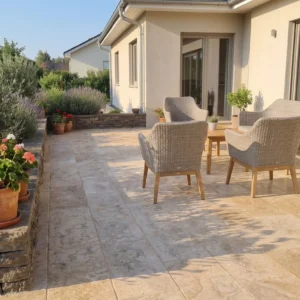
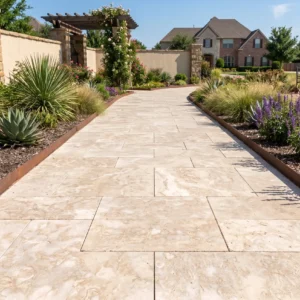
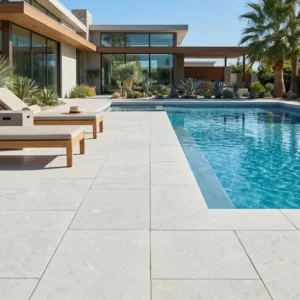
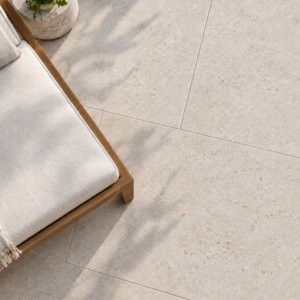
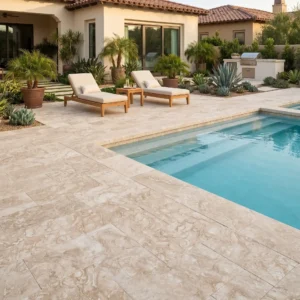
Travertine limestone tiles in Arizona have become a defining material in the state's most distinguished residential and commercial landscapes — and for good reason. Their warm ivory, walnut, and gold tones align naturally with Arizona's desert palette, while their naturally porous surface provides understated texture that complements both Santa Fe adobe aesthetics and contemporary desert-modern architecture. For designers and contractors specifying this material, finish selection — tumbled, brushed, or honed — plays a decisive role in how the tile reads against native plantings, stucco walls, and exposed aggregate surrounds. Citadel Stone Travertine Limestone Tiles in Arizona are sourced and stocked with regional design sensibilities in mind, available in formats suited to pool decks, courtyard pavers, and interior flooring applications across a range of project scales. What many specifiers underestimate is how tile thickness and surface treatment interact with Arizona's substrate conditions — a trade-off explored in detail throughout this guide. Citadel Stone stocks Travertine Limestone Tiles in varied finishes and thicknesses for Arizona projects across Phoenix, Tucson, and Scottsdale.

See & Feel the Quality – Free Arizona Stone Samples

Our stones are made for the Arizona sun. See how the colors hold up in your specific light.

Design Your Arizona Home with a Local Stone Expert

Get personalized advice on the best stone for Arizona's climate and your design style.

Premium Natural Stone — All Sizes & Thicknesses Available

From standard cuts to fully custom dimensions — our limestone, granite, basalt & shellstone
are cut to your exact specifications. Residential or commercial, we’ve got you covered.

Showing all 69 resultsSorted by popularity

Get Your Free Arizona Stone Quote

Transparent Pricing for Your Arizona Project

Elevate Your Arizona Property with Premium Stone, Priced for Value.

Unlock $10,000 Worth of Deals on Beautiful Paver, Tiles & Cobble Setts—For Free!

Invest in Arizona’s Landscape: Stone That Lasts a Lifetime.

100% Happiness Guarantee

Trust 50 Years of Expertise. Invest in Quality Limestone Tiles

Custom-Cut for Your Arizona Project: Any Size, Any Finish.

No-Obligation Consultation: Get Expert Advice for Your Arizona Home.

The Stone Supplier Trusted by Arizona's Leading Architects & Designers.

Arizona's Most Diverse Selection of Natural Stone.

Elevate Your AZ Property with Natural Stone Built for the Desert. Our expansive collection of Natural Stone brings timeless beauty and proven durability to both residential and commercial spaces across Arizona. As the state’s leading supplier, we offer a diverse palette of colors and finishes—from cool, light tones that reflect the sun to rich, earthy textures that complement the Southwest landscape. Transform your environment with limestone that stands up to the Arizona heat while providing the sophisticated aesthetic you desire.

Incredible Prices for Top-Quality Stone—Shop Citadel Stone Today!

Table of Contents

Travertine limestone tiles in Arizona perform best when you treat the aesthetic brief and the structural specification as a single integrated decision — not two separate conversations. The material’s inherent warmth, vein patterning, and surface texture connect directly to Arizona’s Southwestern design vocabulary, and that’s exactly where selection should begin. Get the shade palette and finish wrong for the surrounding landscape, and no amount of technical precision in the base preparation will save the project from looking out of place for the next two decades.

How Arizona’s Design Language Shapes Stone Selection

Arizona’s architectural traditions pull from Spanish Colonial, Territorial Adobe, Pueblo Revival, and contemporary desert modernism — and travertine limestone sits comfortably within all four. The material’s natural cream, ivory, and warm walnut tones echo the ochre and sand tones of the Sonoran Desert without forcing contrast. For projects in Scottsdale, where desert modernism dominates residential and commercial design alike, the linear vein patterns in honed travertine create a clean horizontal rhythm that complements flat-roof architecture and wide-eave detailing exceptionally well.

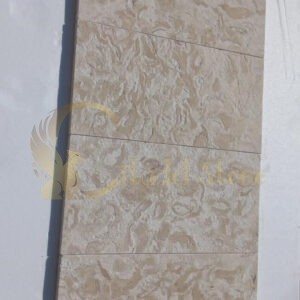
Finish selection matters as much as shade when you’re integrating stone into a landscape design. Brushed and tumbled finishes reinforce the handcrafted aesthetic of Pueblo-inspired courtyard spaces, while honed and filled finishes lean toward the precision expected in contemporary outdoor living areas. Cross-cut travertine, which reveals the material’s cloud-like vein patterns rather than the elongated linear flow, reads as more organic and naturalistic — a strong choice when the surrounding landscape uses native desert plantings and irregular boulder arrangements.

Citadel Stone stocks travertine limestone tiles in Arizona in standard formats including 12×12, 16×16, 18×18, 24×24, and 24×48 inches, with select cross-cut and vein-cut options available depending on current warehouse inventory. Requesting samples before committing to a large-format order gives you the chance to evaluate color matching under Arizona’s intense natural light, which reads warmer and higher-contrast than studio lighting conditions suggest.

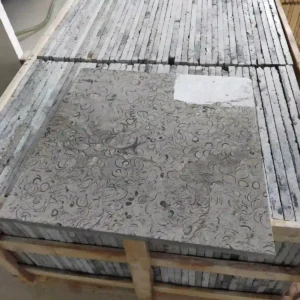
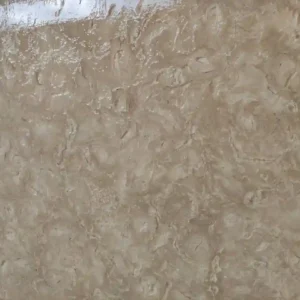
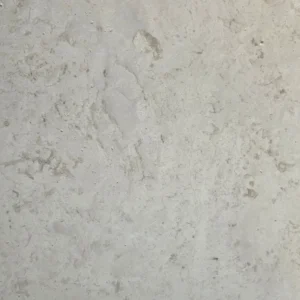
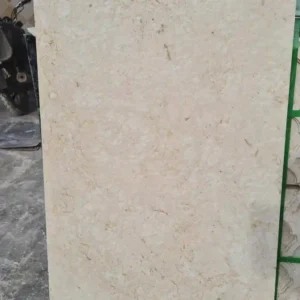
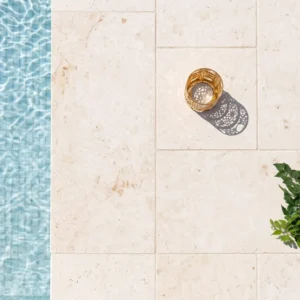
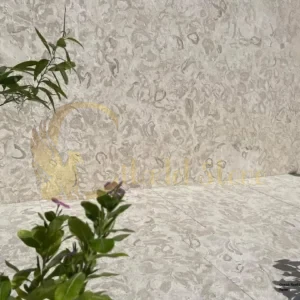
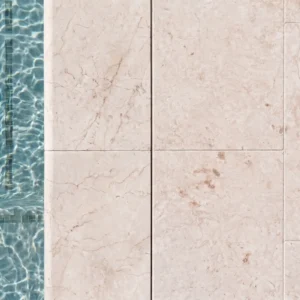
Light beige travertine with natural swirling patterns and veins.

Why Turkish Limestone Performs in Arizona’s Extreme Climate

Turkish limestone pavers in Arizona have earned a strong specification track record because the source geology delivers properties that happen to align well with desert performance demands. Turkish travertine quarried from the Denizli region forms under geothermal spring pressure, producing a dense yet porous matrix with an interconnected void structure that manages moisture movement without trapping hydrostatic pressure at the tile face. That distinction matters in Arizona’s monsoon season, when 1–3 inches of rain can fall within a few hours.

The thermal expansion coefficient of Turkish travertine runs approximately 4.8 to 5.3 × 10⁻⁶ per °F — meaningfully lower than most porcelain and ceramic tile alternatives. In Phoenix, where ground-level surface temperatures regularly exceed 140°F on exposed hardscape, that lower expansion rate translates directly into more forgiving joint behavior and reduced risk of tenting failures over time. You’ll still need to spec expansion joints at 10–12 feet on center in full-sun installations rather than the 15-foot spacing standard that applies in moderate climates — but the material’s inherent stability gives you a workable range.

Compressive strength for quality Turkish travertine runs between 8,000 and 12,000 PSI depending on vein orientation relative to the loading axis, which places it well above residential traffic requirements and comfortably within commercial outdoor standards. Cross-cut material oriented with the travertine’s natural layering perpendicular to the installed surface direction achieves the upper range of that figure and is the preferred orientation for pool deck and driveway applications.

Color Palette and Landscape Integration Across Arizona Regions

The regional color logic for travertine limestone tiles in Arizona shifts significantly between the low desert and the high country. In the Phoenix metropolitan area and in Tucson, the surrounding palette of buff sandstone, terracotta roofing tile, and warm stucco makes cream and ivory travertine an almost seamless material transition. The stone reads as native even when it isn’t — which is the hallmark of successful desert landscape integration.

Walnut and classic travertine shades introduce a slightly cooler brown undertone that works particularly well in shaded courtyard applications or covered patio environments where direct sun exposure is limited. That cooler tonal register prevents the visual fatigue that can develop when warm tones stack across every surface element in a single outdoor space. For projects where the surrounding planting palette includes silver-gray desert shrubs — brittlebush, desert sage, or palo verde — the walnut shade creates a more sophisticated contrast than the straight cream tones.

  • Cream and ivory travertine: ideal for open desert settings, south and west exposures, and projects where warm tonal continuity with the surrounding landscape is the design priority
  • Classic travertine: a versatile mid-tone that transitions between warm and cool adjacent materials without conflict
  • Walnut travertine: best suited for shaded spaces, water features, and contemporary designs where contrast is intentional
  • Silver travertine: a strong choice for modern desert architecture in higher elevation zones, particularly where the surrounding geology trends toward grey basalt and granite

Sourced from established quarry partners in Turkey and cross-checked for batch consistency at our facility, each shipment of travertine limestone tiles from Citadel Stone is reviewed against reference samples to ensure that the shade and veining character you approved in your sample set represents what arrives on your truck delivery. Color drift between batches is one of the most common specification problems on large-format projects, and proactive inventory management at the warehouse level is the most reliable mitigation strategy available.

Travertine Limestone Tiles: Format and Finish Selection for Arizona Applications

Format selection for travertine limestone pavers in Arizona follows application logic more than aesthetic preference. Larger formats — 24×24 and 24×48 — read as more monolithic and contemporary, and they perform well on flat, well-compacted substrates with consistent aggregate base depth. Smaller formats — 12×12 and 16×16 — provide more grout joint surface area, which actually improves drainage performance on slopes and reduces the visual impact of any minor settlement variation over time.

The filled-and-honed finish specification matters practically as well as aesthetically. Unfilled travertine, with its natural void structure open at the surface, provides excellent slip resistance and a tactile quality that suits pool surrounds and garden pathways under ASTM C1028 wet-surface standards. Filled travertine — where voids are grouted with matching material — presents a smoother surface that’s easier to maintain but requires more attention to sealing protocol to prevent moisture infiltration through the fill matrix in high-humidity monsoon periods.

  • Honed and filled: best for interior-to-exterior transitions, covered patios, and contemporary pool decks where a clean surface is a design requirement
  • Brushed and unfilled: the strongest choice for open-air garden paths, pool surrounds, and elevated terraces where drainage and natural texture are priorities
  • Tumbled edge: appropriate for informal Southwestern courtyard settings and pathway applications where a weathered, antique aesthetic is desired
  • Chiseled edge: a strong transitional option that bridges the tumbled and sawn-edge aesthetics within the same project

Turkish limestone tiles in Arizona outdoor applications benefit from specifying a minimum 2-inch nominal thickness for any ground-set application subject to vehicle overhang or light equipment traffic. The 1.25-inch nominal thickness performs reliably in pedestrian-only zones but shows long-term stress fracturing risk along natural vein planes under point loading above 800 PSI — a threshold that maintenance carts and ride-on landscape equipment regularly exceed.

Base Preparation and Installation Requirements for Arizona Conditions

The base preparation stage is where most Arizona travertine installations either earn their longevity or quietly accumulate the failure mechanisms that surface five to seven years later. Arizona soils are deceptive — the caliche layers that appear throughout the Phoenix basin and the expansive clay profiles common in parts of the Tucson metropolitan area create vastly different base conditions even within a single project site. You need a soil investigation, not an assumption, before you set base depth.

Expansive clay soils found across many southern Arizona locations require a minimum 6-inch compacted aggregate base, and in some locations a geotextile separation fabric between the native soil and the aggregate layer is worth the additional cost. Without the fabric, fines migration over time gradually contaminates the aggregate layer and reduces its load distribution capacity — which shows up as point settlement under heavier traffic areas well before the surface tiles show visible distress.

Setting bed choice between dry-set mortar and full-bed thin-set adhesive should be driven by the installed format size. For formats above 18×18 inches, a full-coverage thin-set mortar bed with back-buttering achieves the minimum 95% contact coverage required to prevent hollow spots that concentrate thermal stress. Dry-set sand installation works reliably for tumbled or brushed travertine limestone pavers in Arizona projects in the 12×16 to 16×16 range where the additional flexibility of a sand-set system accommodates minor differential movement without transmitting stress to the tile face. For guidance on navigating these installation decisions alongside your material procurement, Travertine Limestone Tiles from Citadel Stone provides additional technical detail on preparation sequences specific to Arizona residential and commercial projects — a useful companion reference when coordinating base specification with your general contractor or landscape architect.

Joint width for travertine limestone tile in full-sun Arizona installations should run a minimum of 3/16 inch for formats up to 18 inches and 1/4 inch for larger formats. The thermal mass of the tile and the substrate work together during daily heat cycling — the surface can swing 90–100°F between pre-dawn and peak afternoon — and undersized joints eliminate the accommodation space that prevents compressive edge fractures along the vein planes.

Sealing and Maintenance in Arizona Desert Conditions

Turkish limestone flooring in Arizona requires a penetrating sealer application within 72 hours of final installation cleaning, before the surface is exposed to any UV or monsoon conditions. The penetrating sealer — specifically a fluorocarbon impregnator rated for natural stone — fills the interconnected pore network without creating a surface film that traps moisture beneath it. Film-forming sealers are a persistent mistake in desert climates: the thermal cycling causes the film to micro-crack, which then channels moisture into the substrate more efficiently than unsealed stone would allow.

Resealing intervals for travertine limestone tiles in Arizona outdoor conditions run every 18–24 months for full-sun exposed surfaces and every 30–36 months for covered or shaded installations. The test is simple — drop water on the surface and observe. Absorption within 30 seconds indicates the sealer has depleted and reapplication is overdue. Absorption after 3–5 minutes is normal for a penetrating sealer in service and suggests another season remains before resealing is necessary.

  • Use pH-neutral stone cleaners only — pool acid, bleach, and alkaline degreasers all attack the calcium carbonate matrix of travertine and accelerate surface etching
  • Address efflorescence with a diluted phosphoric acid solution (not muriatic) and rinse immediately — the carbonate binder responds better to weaker acid concentrations
  • Inspect grout joints annually for sand migration in dry-set installations — refilling joint sand to 92–95% capacity prevents moisture infiltration and maintains the sand’s load distribution function
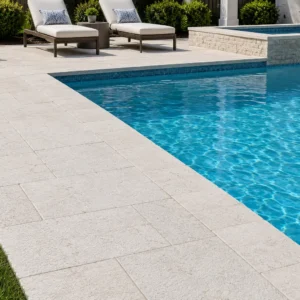
  • For pool coping travertine in Arizona, expect a 12–18 month resealing cycle due to the combined effect of pool chemistry, UV exposure, and thermal cycling
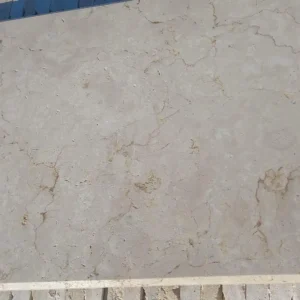
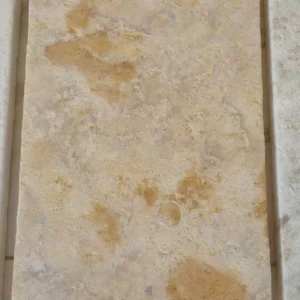
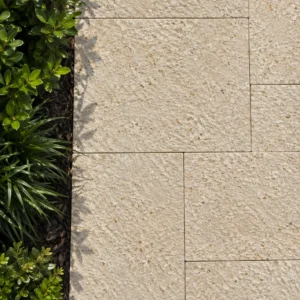
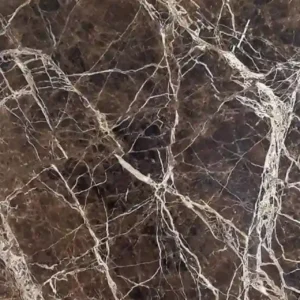
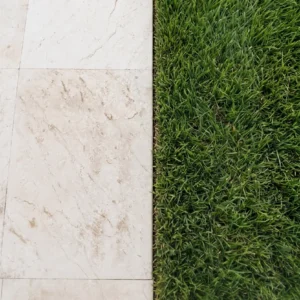
Close-up of a light-colored stone slab with swirling brown and cream veins.

Travertine Limestone Pavers in Arizona Outdoor Living Applications

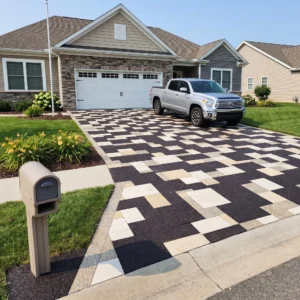
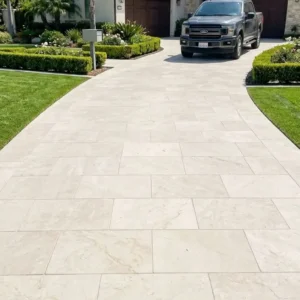
The application range for travertine limestone pavers in Arizona extends well beyond pool surrounds and patios — though those two applications represent the highest-volume specification contexts. Driveway approaches, motor court surfaces, and covered porte-cochere floors all represent viable applications when you match thickness specification to the expected load. For passenger vehicle traffic, a 3-cm (approximately 1.2-inch) nominal thickness on a compacted aggregate base handles the distributed load comfortably. For anything involving delivery trucks or frequent heavy vehicle access, stepping up to a 4-cm (1.6-inch) nominal thickness and deepening the aggregate base to 8 inches eliminates the risk profile almost entirely.

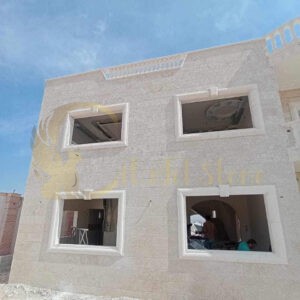
Vertical applications — feature walls, water wall cladding, and stacked stone veneer — represent a growing specification area for travertine limestone tiles in Arizona landscape design. Cross-cut travertine at 3/8-inch to 3/4-inch thickness, installed with full-coverage polymer-modified thin-set on a properly waterproofed substrate, delivers the vein pattern depth and texture that makes travertine a compelling vertical material. The key specification detail here is thermal movement accommodation at the perimeter of each cladded panel — vertical installations in full-sun Arizona exposure see the same temperature swings as horizontal surfaces, and the expansion forces have nowhere to go without perimeter relief joints.

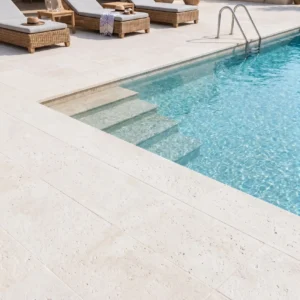
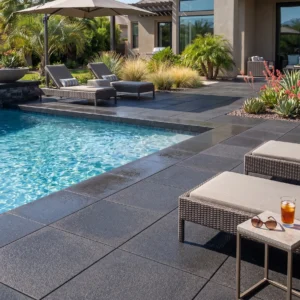
In Phoenix, where urban heat island effects amplify surface temperatures beyond what regional climate data suggests, light-colored travertine finishes provide measurable surface temperature benefits over dark stone alternatives — field measurements have documented 15–25°F cooler surface temperatures on cream travertine versus dark basalt or granite under identical midday sun exposure. That difference becomes a legitimate occupant comfort factor for outdoor living spaces where the goal is extending usable hours through the Arizona summer rather than simply accommodating peak use seasons. Turkish limestone pavers in Arizona light-toned finishes deliver this same thermal benefit, making them a practical as well as aesthetic specification choice for exposed motor courts and uncovered terrace areas.

Source Travertine Limestone Tiles from Citadel Stone

Citadel Stone supplies travertine limestone tiles in Arizona in formats ranging from 12×12 to 24×48 inches, in thicknesses from 3/8 inch for wall cladding applications through to 4 cm for heavy-traffic paving. Available finishes include honed and filled, brushed, tumbled, and chiseled edge — with cross-cut and vein-cut orientation options depending on the format and current warehouse stock levels. For trade accounts and wholesale enquiries, Citadel Stone’s project team can confirm lead times, provide thickness and finish specifications, and arrange sample delivery across Arizona. Standard in-stock material typically ships within 5–7 business days; custom cuts and non-standard formats typically require 3–4 weeks from order confirmation depending on truck scheduling and freight routing. You can reach the Citadel Stone team directly to request a quote, discuss volume pricing, or schedule a technical consultation for projects requiring detailed specification support.

As you finalize your material selections for Arizona hardscape and landscape projects, complementary stone elements are worth considering alongside your primary tile specification. Projects that involve broader site scope — perimeter walls, accent bouldering, or base course applications — can often be sourced through the same supply relationship to maintain consistent lead times and warehouse logistics. For projects involving broader stone scope, Bulk Limestone for Sale in Arizona covers limestone supply options that may serve base course, accent, or perimeter applications within the same project. Architects and builders in Flagstaff, Sedona, and Yuma specify Citadel Stone Travertine Limestone Tiles for Arizona outdoor installations.

Why Arizona’s Builders Choose Citadel Stone?

Free AZ Comparison: Citadel Stone vs. Other Suppliers—Find the Best Value!

FeaturesCitadel StoneOther Stone Suppliers
Exclusive ProductsOffers exclusive natural stones sourced from selected quarriesTypically offers more generic or widely available stone options
Quality and AuthenticityProvides high-grade, authentic natural stones with unique featuresQuality varies; may include synthetic or mixed-origin stone materials
Product VarietyWide range of premium productsProduct selection is usually more limited or generic
Global DistributionDistributes stones internationally, with a focus on providing consistent qualityOften limited to local or regional distribution
Sustainability CommitmentCommitted to eco-friendly sourcing and sustainable production processesSustainability efforts vary and may not prioritize eco-friendly sourcing
Customization OptionsOffers tailored stone solutions based on client needs and project specificationsCustomization may be limited, with fewer personalized options
Experience and ExpertiseHighly experienced in natural stone sourcing and distribution globallyExpertise varies significantly; some suppliers may lack specialized knowledge
Direct Sourcing – No MiddlemenWorks directly with quarries, cutting unnecessary costs and ensuring transparencyOften involves multiple intermediaries, leading to higher costs
Handpicked SelectionHandpicks blocks from quarries and hand select paver and tile post manufacture for quality and consistency. Ensuring only the best materials are chosenSelection standards vary, often relying on non-customized stock
Durability of ProductsStones are carefully selected for maximum durability and longevityDurability can be inconsistent depending on supplier quality control
Vigorous Packing ProcessesUtilizes durable packing methods for secure, damage-free transportPacking may be less rigorous, increasing the risk of damage during shipping
Citadel Stone OriginsKnown as the original source for unique limestone tiles from the Middle East, recognized for authenticityOrigin not always guaranteed, and unique limestone options are less common
Customer SupportDedicated to providing expert advice, assistance, and after-sales supportSupport quality varies, often limited to basic customer service
Competitive PricingOffers high-quality stones at competitive prices with a focus on valuePrice may be higher for similar quality or lower for lower-grade stones
Escrow ServiceOffers escrow services for secure transactions and peace of mindTypically does not provide escrow services, increasing payment risk
Fast Manufacturing and DeliveryDelivers orders up to 3x faster than typical industry timelines, ensuring swift serviceDelivery times often slower and less predictable, delaying project timelines

Extra Benefits

Choosing Citadel Stone offers unique advantages beyond premium stone quality:

Exclusive Access to Durable Stones

Citadel Stone specializes in unique, regionally exclusive stones, sourced directly from the Middle East.

Transparent Pricing – No Hidden Costs

With no middlemen, Citadel Stone provides direct, transparent pricing that reduces unnecessary costs.

Flexible Customization for Bespoke Projects

Tailor your order to precise specifications, from sizes to finishes, ensuring your project aligns perfectly with your vision.

Streamlined Delivery & Reliable Stock Availability

Benefit from fast production and delivery timelines, designed to minimize delays and ensure reliable availability.

The Preferred Stone Supplier for Luxury AZ Developments.

Scale Your Vision: We Support Arizona's Largest Projects with Reliable, Fast Delivery.

With unlimited tiles, pavers, cobble setts, curbstones, and the fastest delivery options, What’s not to love? Say goodbye to unnecessary hassles!

Leading AZ Stone Suppliers are Loving Citadel Stone!

Don’t Settle for Less. Source the Best Stone for Your Local Stone Expert.

DanielOwner
Thank you, Kareem. We received the order. The stones look great!
FrankOwner
You are a good businessman and I believe a good person. I admire your honesty, this is why I call you a good businessman.
Gemma C
Gemma CPrivate Project
Undoubtedly the price was the reason that we chose Citadel stone, in addition to the fact that you offer a white limestone that is hard to source. Your products are very good value for money by comparison with other companies. You have helped at every stage of the process and have been quick and reliable in your responses. It was a big risk for us to pay everything up front including shipping and not know the quality. You did make me feel that I could trust you and your company however and we are very happy with the tiles. They appear to have been finished to a very high quality of smoothness and I can't wait to see them once they have been laid. We need to see now how easy they are to fit and maintain, yet you also sealed them before shipment so we think that they will be very durable. Our building project has been delayed for a few months now so it may be sometime before we see them laid, but I promise that I will send photos as soon as we have them down. Thank you so much Kareem and your team, you have done a great job. I am hoping that we can pay for, and receive our second shipment in the not too far future, so that we can finish everything off. Wishing you well. Gemma
Molly McK
Molly McKPrivate Project
I appreciate the quality of product and care for the custom order in packaging each crate to minimize breakage as well as the flexibility with the order to help us make the most of shipping. The timely communications are impressive from the beginning and throughout the process. It's reassuring to have gone through one order to know what the process will be like in the future. I am glad to have had some guidance through the importing process and recommendations for shipping partners to assist. It's incredible to think about the journey the stone traveled to get to our site and I'm grateful to have made it to the next stage of the project relatively smoothly and with from what I can tell

Frequently Asked Questions

If your question is not listed, please email us at [email protected]

How does travertine limestone tile complement Arizona's dominant architectural and landscape styles?

Travertine limestone tiles integrate seamlessly with Arizona’s prevailing design traditions — from Southwestern adobe and Territorial-style homes to contemporary desert-modern builds. Their earthy, neutral tones echo the natural ochres, tans, and warm grays found throughout the Sonoran landscape, making them a cohesive choice for both interior and exterior applications. Designers working in Scottsdale, Tucson, and the greater Phoenix metro consistently turn to travertine because it bridges the gap between organic landscape elements and refined hardscape without looking forced or imported.

Travertine limestone tiles are commonly available in honed, polished, tumbled, and brushed finishes, each suited to different applications and aesthetic goals. For outdoor use in Arizona — particularly around pool decks, patios, and walkways — tumbled and brushed finishes are generally preferred because their textured surfaces provide better traction underfoot and disguise surface scuffs more effectively over time than polished options. Honed finishes work well in covered outdoor living areas and interior spaces where a cleaner, more refined appearance is the design objective.

For exterior applications such as patios and pool surrounds in Arizona, travertine limestone tiles are typically specified at 1¼ inches (approximately 30mm) to ensure adequate structural integrity over the substrate. Thinner 3/8-inch or ½-inch gauged tiles are better suited to interior flooring installations where they are set over a stable, level concrete slab. The key variable in Arizona projects is soil movement — expansive clay soils present in parts of the Phoenix and Tucson areas place greater demand on tile thickness and the underlying mortar bed, so substrate assessment before specifying thickness is essential.

Travertine limestone is a porous natural stone that should be sealed prior to installation and periodically maintained throughout its service life. In Arizona’s dry, sun-intense environment, a penetrating impregnating sealer is the professional standard — it protects against staining from irrigation minerals, pool chemicals, and organic debris without altering the tile’s natural appearance. Resealing frequency depends on foot traffic and exposure levels, but most residential installations benefit from resealing every two to three years, with high-traffic commercial surfaces requiring more frequent attention.

Travertine limestone offers a warmth, variation, and authenticity that manufactured porcelain pavers simply cannot replicate, making it the preferred material for projects where natural character and design integrity matter. Porcelain does offer higher resistance to staining and requires less maintenance, which makes it a practical alternative for high-use commercial environments or pool surrounds with aggressive chemical exposure. The trade-off with travertine is manageable with proper sealing and appropriate finish selection — for most Arizona residential landscape and courtyard projects, the aesthetic return on travertine far outweighs the marginal maintenance difference.

Citadel Stone’s depth of experience with natural stone selection translates directly into better material recommendations for architects, builders, and homeowners navigating travertine options. The team assists with finish, thickness, and format decisions based on specific project conditions — not just catalog defaults. Citadel Stone supplies Arizona projects of all scales, from single-pallet residential installations to multi-truckload commercial specifications, with consistent material availability across the state.