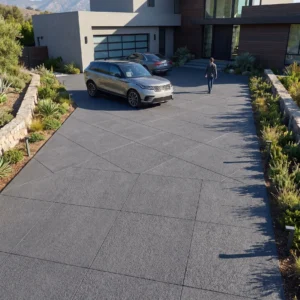
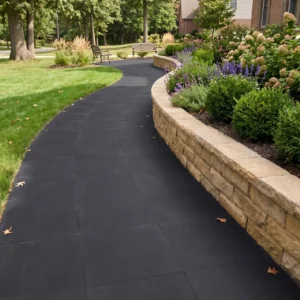
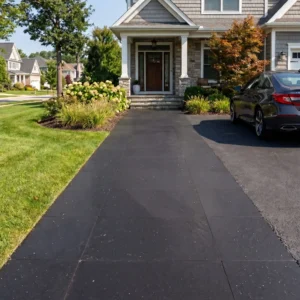
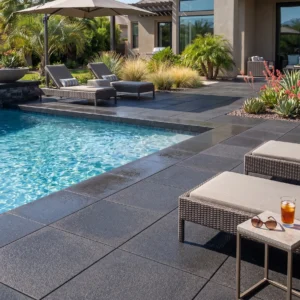





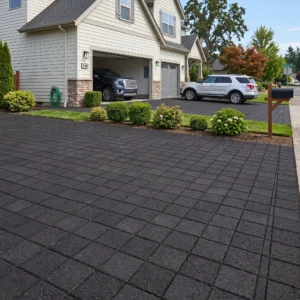
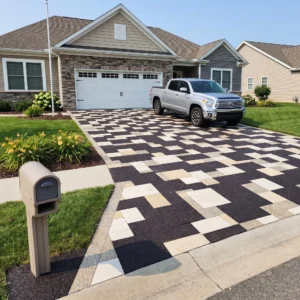

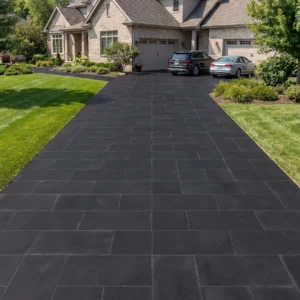
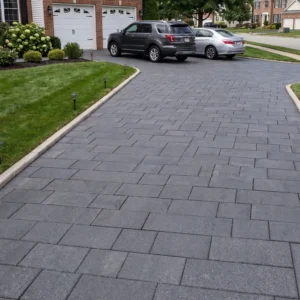

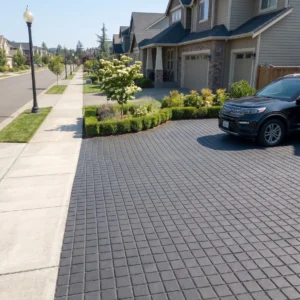
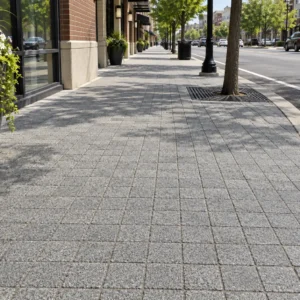
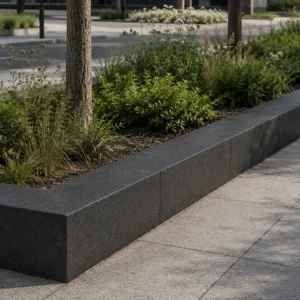
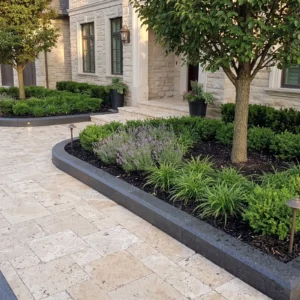
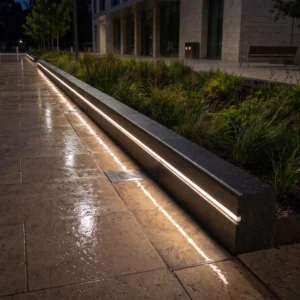




The color depth in premium black limestone paving comes down to iron and carbon content locked into the stone during sedimentary formation — and understanding that composition tells you exactly how the surface will weather over two decades. Most specifiers judge black limestone paving on the dry sample they hold in the yard, but the real test happens after the first year of wetting and drying cycles, when lower-grade material fades to a chalky charcoal while dense, well-sourced stone holds its saturated tone. You’ll get consistent performance when you match the stone’s absorption rate to your site’s moisture conditions rather than chasing the lowest price per square foot. That single distinction separates installations that still look sharp at year fifteen from ones that need a re-color treatment by year three.
What Makes Black Limestone Paving Perform
The performance of black limestone paving hinges on density and grain structure more than any surface treatment you apply later. Dense sedimentary stone with tight grain packing absorbs less water, which directly controls how the color reads once the surface is wet and how the stone handles seasonal moisture movement. You want material with a water absorption figure at the lower end of the limestone range, because that number predicts staining resistance, freeze durability, and long-term color stability all at once.
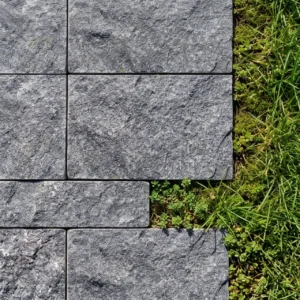
Here’s what most buyers overlook when comparing paving slabs black limestone options: the finish you choose changes the effective absorption at the surface. A honed face closes some of the microporosity and holds a darker, more even tone, while a natural riven or textured face reads slightly lighter and grips water in its valleys. Neither is wrong — but you should match the finish to whether the area stays wet or drains fast. Well-chosen paving slabs black limestone stock will list its absorption figure so you can spec confidently.
- Low-absorption stone holds saturated color longer and resists efflorescence bloom at the joints
- Honed finishes deliver even, deep tone but require attentive slip planning in wet zones
- Riven and textured faces improve grip and hide minor surface wear across high-traffic paths
- Consistent bed thickness matters more for point-load resistance than headline compressive strength
- Batch consistency in tone should be verified across pallets, not judged from a single slab
At Citadel Stone, we inspect each incoming batch for tonal consistency and edge condition before it reaches warehouse inventory, because color drift between pallets is the complaint we hear most from projects that sourced elsewhere. You can request thickness specifications and absorption data from our team before committing to a full order, which lets you spec against your actual site conditions rather than a generic datasheet. According to industry limestone specifications, absorption and density are the two variables that most reliably predict outdoor durability.
Reading Color and Shade Across Batches
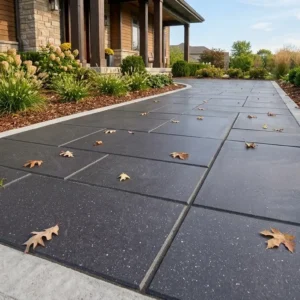
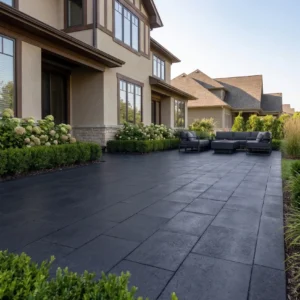
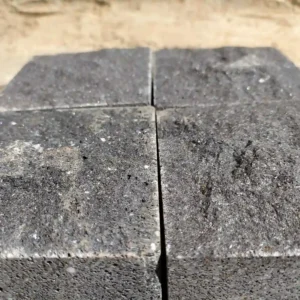
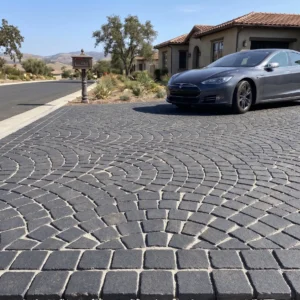
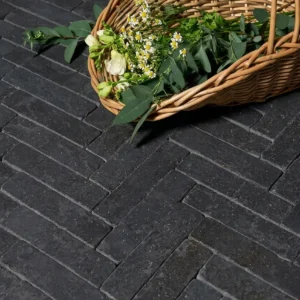
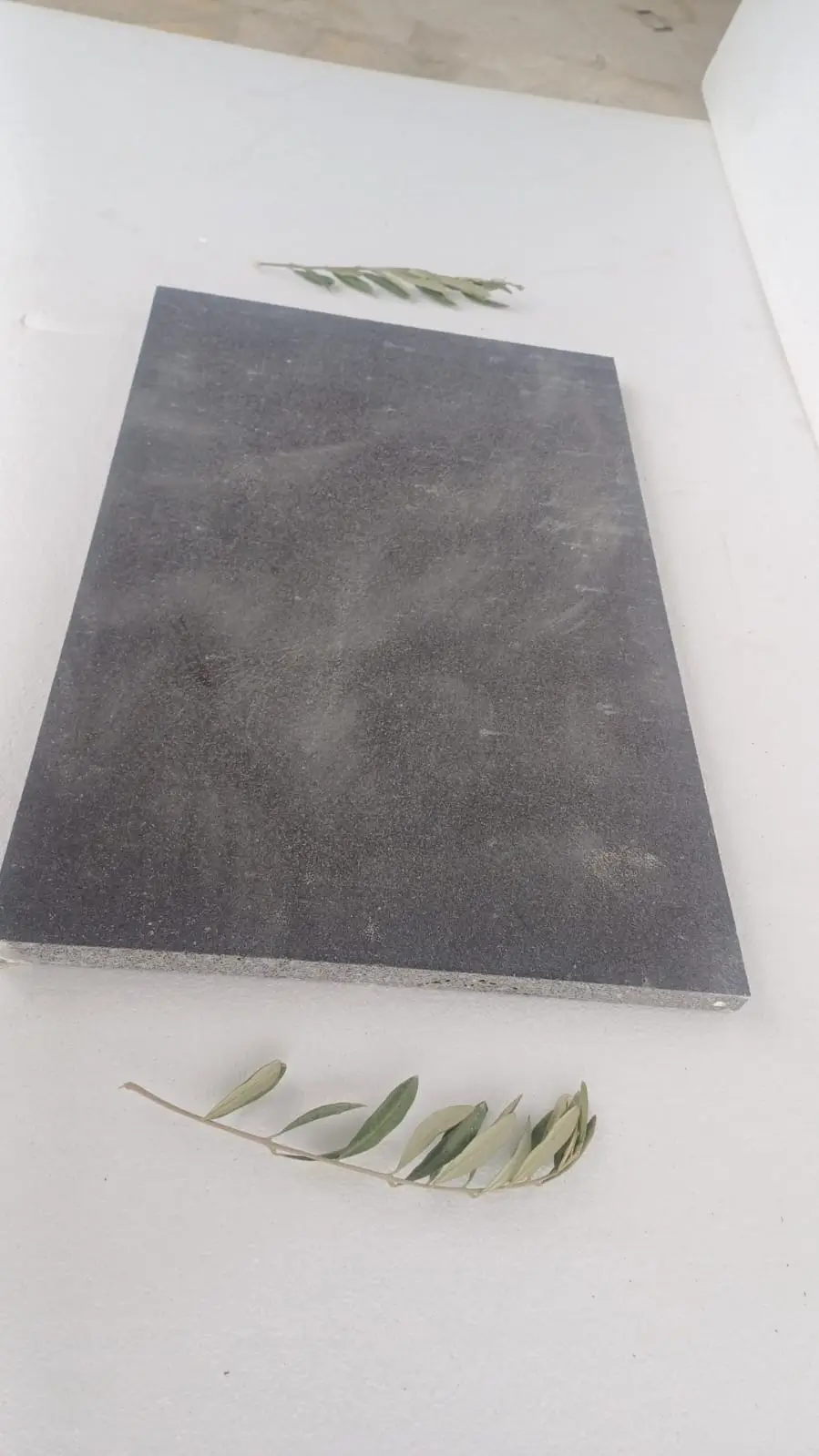
Natural black limestone paving is rarely a flat, uniform black — and that’s a feature, not a flaw, once you know how to read it. The tone ranges from deep charcoal through graphite to near-jet, with subtle silver and grey mineral veining that catches light differently as the sun moves. Buyers who expect factory-uniform darkness get surprised by natural variation; buyers who understand it specify a blend that looks intentional across the whole surface. That inherent character is exactly what makes natural black limestone read as genuine stone rather than a printed alternative.
You’ll find that dry-laid samples read two to three shades lighter than the installed, sealed result. That’s the single most common source of “this doesn’t match what I ordered” conversations. Wet a corner of the sample before you sign off — it shows you the saturated tone the stone will show after rain or sealing far more accurately than the dry face ever will.
- Order limestone black slabs from more than one pallet and mix across the field to distribute natural tone variation
- Wet-test samples to preview the sealed, saturated color before final selection
- Note that graphite and silver veining is inherent to the stone, not a defect
- Charcoal-toned batches suit contemporary schemes; deeper jet tones suit formal, high-contrast layouts
- Compare limestone black slabs side by side under both wet and dry conditions before ordering
When you buy black limestone paving for a large area, plan your layout so slabs from different pallets alternate rather than concentrating one pallet in a single zone. This simple sequencing prevents the patchwork effect that undermines an otherwise clean installation. For guidance on how tone reads across paving formats, limestone formation characteristics explain why sedimentary stone carries this inherent variation.
How Water Behavior Shapes Your Specification
Water is the variable that quietly decides whether black limestone paving succeeds or fails, and it deserves more attention than temperature in most projects. The way water moves across, through, and under your paving governs staining, joint stability, slip risk, and freeze durability all at once. Get the drainage geometry right and the stone performs for decades; get it wrong and even premium material shows problems within a few seasons.
Consider how your site sheds rainfall before you finalize slab layout. A minimum fall of roughly 1:80 across the surface moves standing water off the paving fast, which matters more for dark stone because pooled water accelerates efflorescence and leaves visible mineral rings on the darker background. In regions with heavy, concentrated rainfall or flooding risk, you should oversize your sub-base drainage and consider a permeable jointing approach rather than a rigid sealed joint that traps water beneath the slabs.
- Specify surface falls of at least 1:80 to prevent standing water on dark surfaces
- Size the sub-base to handle peak local rainfall, not average annual figures
- Use open-graded aggregate beneath the bedding layer in high-rainfall or freeze-thaw regions
- Route downpipe discharge away from the paving field rather than onto it
- Plan for subsurface drainage where clay-heavy soils hold water against the bedding layer
The detail that matters most in freeze-prone areas: water that sits in the joints or beneath the slabs expands as it freezes, and repeated cycles work slabs loose regardless of how well they were originally set. You break that cycle by keeping water moving out of the system. In hot, dry climates the concern flips — rapid surface drying can pull dissolved salts to the surface, so consistent low-absorption stone and clean drainage still pay off. Landscape drainage guidance from the landscape material performance resource reinforces why permeable detailing outperforms sealed systems in wet conditions.
Base Preparation and Installation Detail
The base you build under natural black limestone determines the lifespan of the finished surface far more than the stone grade itself. A perfect slab set on a poor base fails; a mid-grade slab on an excellent base outperforms it every time. Your subgrade, sub-base, and bedding layer each do a specific job, and skipping depth on any one of them transfers stress to the stone.
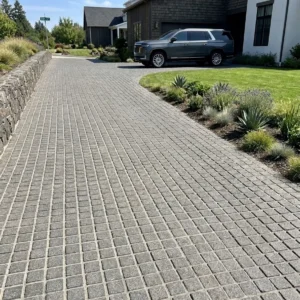
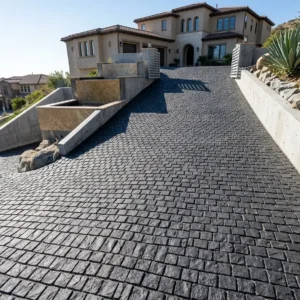
For pedestrian patios, a compacted sub-base of 100–150mm of well-graded aggregate handles the loads comfortably, while driveway applications need 150–200mm or more depending on soil bearing capacity. The interaction between compacted aggregate and clay-heavy soil expansion becomes critical here — clay swells and shrinks with moisture, so on expansive soils you extend sub-base depth and improve drainage to isolate the paving from ground movement.
- Compact the sub-base in layers no thicker than 75mm for reliable density throughout
- Use a full mortar bed rather than spot-dabs — voids under slabs collect water and crack the stone under load
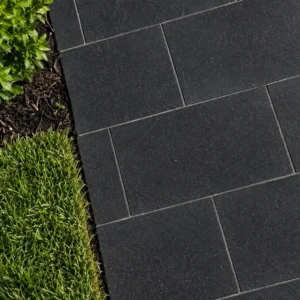
- Set slabs to a consistent 8–10mm joint for stable pointing and thermal movement room
- Prime the back of each slab where mortar bonding is critical to prevent picture-framing stains
- Allow the bed to cure before heavy foot traffic to avoid displacing freshly set units
Base preparation standards shift with soil composition and expected traffic, and the bedding approach you choose interacts directly with how you’ll maintain the surface later. For projects pairing paving with protective surface treatments, black limestone sealer covers sealing and specification details that apply to similar site conditions. Getting the subgrade and drainage right at this stage prevents the failures that no amount of surface treatment can later reverse.
Thickness and Format Selection
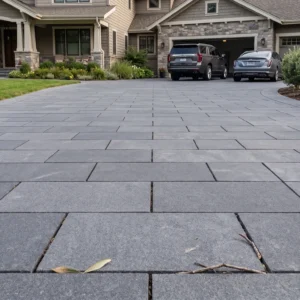
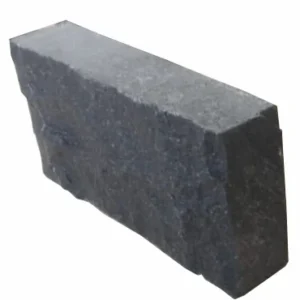
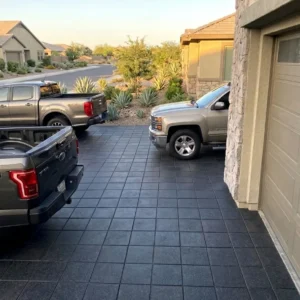
Format and thickness decisions come down to matching the stone to the load it carries and the look you’re after. Black limestone slabs in the 20mm range suit pedestrian patios and garden paths, while driveway and vehicular applications call for 30mm or a properly bedded thicker unit. Choosing the right thickness upfront saves you from the cracking that thin black limestone slabs suffer under point loads.
You have real flexibility in format. Large-format slabs create a clean, contemporary field with fewer joints, which reads as more open and modern. Smaller modular sizes and mixed-size patterns suit traditional layouts and handle irregular spaces better. Citadel Stone stocks natural black limestone paving in standard slab formats and can advise on non-standard cuts for borders, steps, and transitions.
- 20mm nominal thickness for pedestrian patios, courtyards, and low-traffic paths
- 30mm and above for driveways and areas carrying vehicle loads
- Large-format slabs reduce joint count for a cleaner contemporary appearance
- Mixed modular sizes suit heritage layouts and awkward site geometry
- Cut-to-order pieces handle steps, thresholds, and edge details cleanly
Both cut and irregular stock have their place. Sawn, calibrated slabs give you predictable joints and fast laying, while riven irregular pieces bring texture and natural character to informal garden schemes. When you specify black natural limestone paving for a mixed scheme, decide early which zones get the calibrated product and which get the irregular, because they lay to different tolerances and mixing them mid-project slows the crew. Well-planned black natural limestone paving layouts keep the calibrated and riven zones cleanly separated.
Comparing Black Limestone to Alternatives
Understanding where limestone black paving sits against other dark stone options helps you spec with confidence. Slate, basalt, and dark granite all compete in the dark-paving space, and each carries different trade-offs in cost, workability, and long-term appearance. Limestone black paving earns its place through workability, consistent bedding behavior, and a warmth of tone that harder igneous stones don’t match.
- Versus dark granite: limestone is easier to cut and set, though granite carries higher abrasion resistance for heavy traffic
- Versus slate: limestone offers more consistent thickness and fewer delamination concerns over time
- Versus basalt: limestone typically costs less and works more readily on-site, while basalt holds a denser jet tone
- Across all options: limestone’s sedimentary structure gives predictable bedding and reliable mortar bond
The honest trade-off with limestone paving black is that it benefits from sealing to hold its saturated tone and resist staining, where some denser alternatives can go unsealed. That’s not a weakness — it’s a maintenance choice you make knowingly. You can expect 20 to 30 years of strong performance with biennial resealing and clean drainage, which puts limestone paving black firmly in the long-term investment category rather than the disposable one.
Maintenance That Actually Preserves the Finish
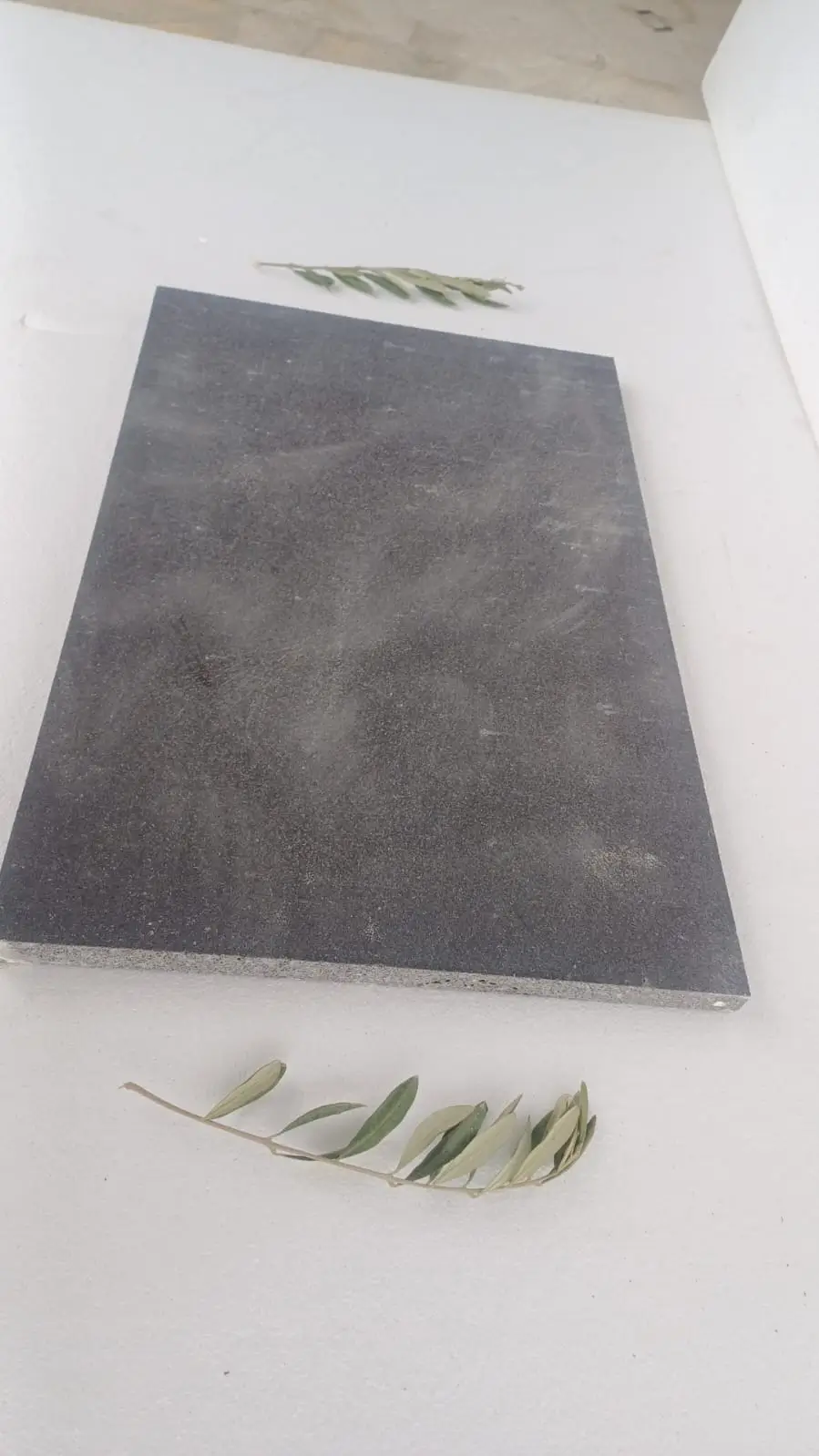
Maintenance for black limestone paving is straightforward once you accept that the goal is keeping water and salts moving rather than scrubbing the surface constantly. The most damaging thing you can do to dark limestone is let mineral-laden water pool and evaporate repeatedly, because that’s what leaves the pale efflorescence rings that ruin the tone. Keep the surface draining and most problems never start.
What often gets overlooked is sealer selection. An impregnating sealer that penetrates without forming a surface film lets the stone breathe while blocking staining and locking in the saturated color. A film-forming topical sealer looks great initially but can trap moisture, cloud unevenly, and peel over freeze-thaw cycles. For black limestone paving slabs, breathable impregnating products almost always outperform topical films outdoors.
- Sweep grit off regularly — abrasive debris under foot traffic dulls the surface over time
- Rinse with clean water and a pH-neutral cleaner; avoid acidic products that etch limestone
- Reseal every two to three years with a breathable impregnating sealer to hold saturated tone
- Address efflorescence early with a dedicated remover rather than aggressive scrubbing
- Keep joints intact — failed pointing lets water beneath the slabs where it does the most damage
Field data on cheap black limestone paving that fades early almost always traces back to two things: low-density stone with high absorption, and a skipped or wrong sealer. Even discounted or cheap black limestone paving performs well when the stone is genuinely dense — spend on the stone quality and the correct sealer, and the maintenance burden stays genuinely light for the life of the installation. Properly specified black limestone paving slabs reward that upfront care with decades of stable tone.
Planning Your Order and Delivery
Ordering natural black limestone well means accounting for wastage, batch matching, and delivery logistics before you place the order rather than after. You should add roughly 10% to your measured area for cuts and breakage, and more if your layout involves diagonal patterns or many curved edges. Under-ordering forces a top-up from a different batch, and matching tone across batches after the fact is difficult.
Your project’s truck access constraints affect how material gets delivered and staged. Tight urban sites and long garden approaches need palletized delivery planned around what the delivery truck can physically reach, and you’ll want a staging area that keeps pallets off soft ground. Citadel Stone maintains warehouse inventory nationwide, which typically shortens lead times to one or two weeks compared with the six-to-eight-week cycle that imported stock often carries.
- Add 10% wastage for standard layouts, 15% or more for complex cutting patterns
- Confirm warehouse stock levels before locking in project timelines
- Order all pallets from the same batch where possible for tonal consistency
- Plan truck access and a firm staging area to protect delivered pallets
- Verify slab thickness and finish on delivery against your original specification
Sourced from our selected premium quarries, each batch we handle is inspected for consistency before it ships, which is where sourcing black limestone slabs from a supplier with genuine quality control pays off over a purely price-driven purchase. Buyers looking for reliable black limestone slabs benefit most from that inspection step. For projects requiring custom cuts or non-standard formats, our team can advise on lead times and confirm what’s held in current warehouse inventory.
Source Premium Black Limestone Paving — Citadel Stone Supply
Citadel Stone stocks black limestone paving in standard slab formats from pedestrian-grade 20mm through vehicular-grade thicknesses, in both calibrated cut and riven irregular stock. You can buy black limestone paving with confidence by requesting sample slabs and full specification data — including absorption figures, thickness tolerances, and finish options — before you commit to a full order, so you spec against your real site conditions. Available finishes range from honed to natural riven faces to match contemporary or heritage schemes, and cut-to-order pieces cover steps, borders, and transitions. Whether you need premium or budget-conscious cheap black limestone paving, our team can match the stone to your project without cutting corners on density. Trade and wholesale enquiries are handled directly through our team, with pricing structured for both single-project and volume orders. With nationwide delivery drawn from regional warehouse inventory, lead times typically run one to two weeks rather than the months an import cycle demands. Request a quote or contact us to confirm current stock, schedule a consultation, and lock in delivery around your build program.
As you finalize your dark-paving specification, related stone applications can sharpen your material decisions across the whole project. For a broader look at complementary dark natural stone options, bluestone supply options for paving explores how another sedimentary stone performs in similar outdoor conditions. Contractors specify Black Limestone Paving from Citadel Stone, a sedimentary stone valued for its even, consistent tone, for residential and commercial sites.
See also: does black limestone fade.