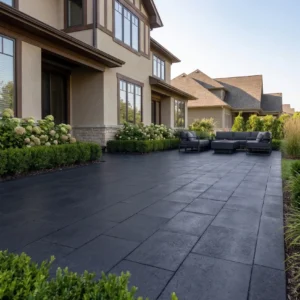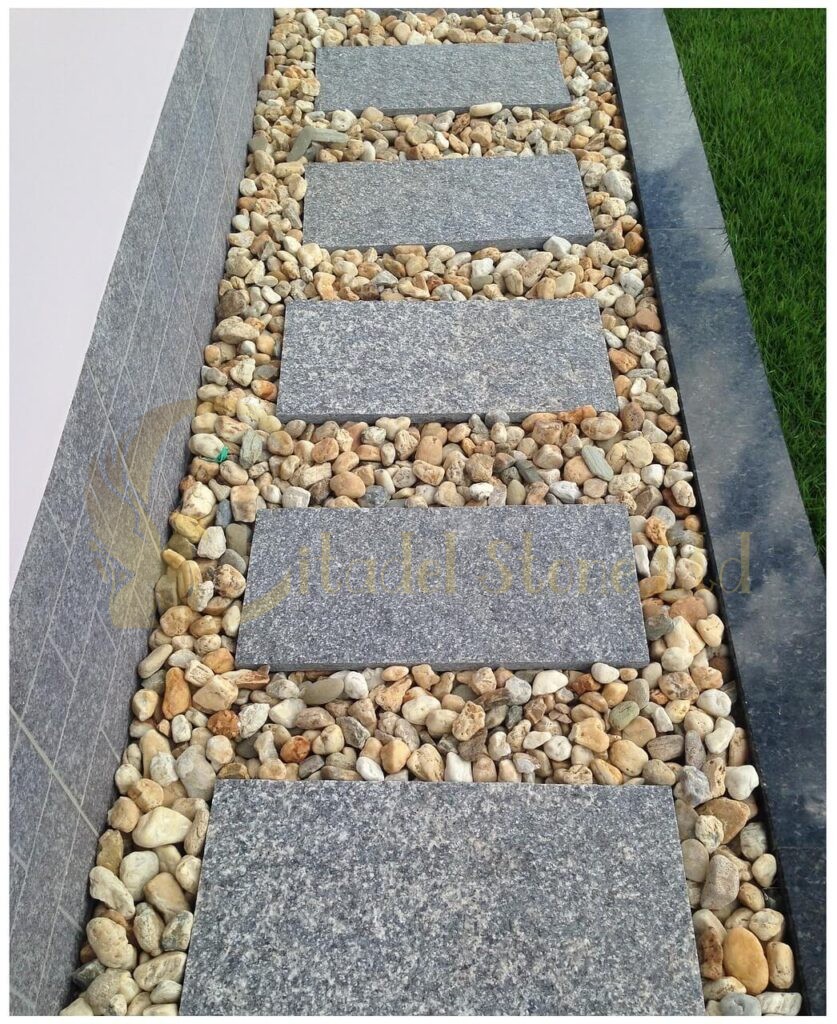
Base geometry determines more about the long-term performance of 24 x 24 black granite tile in Arizona than any surface finish or sealing protocol you’ll apply afterward. The state’s terrain variability — from the caliche-locked valley floors of the Sonoran Desert to the fractured basalt substrates near the Mogollon Rim — creates drainage and structural challenges that don’t show up in generic installation guides. Getting this right before you set the first tile is where the 20-year installations separate from the 10-year replacements.
How Arizona’s Elevation and Terrain Shape Your Drainage Design
Arizona’s elevation range spans roughly 70 feet at the Colorado River’s western edge to over 12,600 feet at the San Francisco Peaks near Flagstaff — and that spread isn’t just a climate variable. It directly controls soil density, frost depth, drainage velocity, and the structural demands your base must meet. For 24 x 24 black granite tile in Arizona, terrain classification should happen before you finalize your base depth specification. A 6-inch compacted aggregate base that performs well in a flat Phoenix residential courtyard will fail within two wet seasons on a sloped Prescott site where seasonal runoff achieves measurable velocity.
Drainage geometry is the dominant design variable at elevation. Your tile field needs a consistent cross-slope of 1.5% to 2% regardless of terrain — but at higher elevations, that slope must channel water decisively off the field, not toward a drainage point buried under seasonal frost. In Flagstaff, where freeze-thaw cycles occur 100+ days per year, hydrostatic pressure under an improperly drained tile field can generate enough uplift force to displace 20-pound granite tiles without any visible surface settlement preceding the failure.
The solution isn’t steeper slopes — it’s layered drainage architecture. A properly specified French drain system at the field perimeter, combined with open-graded aggregate at the base layer, gives water a path out before pressure builds. Citadel Stone’s technical team regularly advises on base specifications for elevated Arizona projects where drainage architecture is more complex than standard residential installation guides address.

Physical Properties That Make Black Granite Tile Perform Under Arizona Conditions
Black granite — particularly absolute black granite from established quarry sources — delivers compressive strength typically ranging from 19,000 to 25,000 PSI depending on mineralogical composition and quarry origin. For a 24 x 24 format, that structural density matters when you’re dealing with the point-load conditions created by outdoor furniture, vehicle access on residential pavers, or equipment traffic on commercial terraces.
The material’s low porosity (typically 0.3% to 0.6% water absorption for quality absolute black granite) creates a practical advantage in terrain-challenged Arizona sites. Lower absorption means less subsurface migration of moisture into the tile body — which directly reduces the freeze-thaw spalling risk that becomes critical at elevations above 4,500 feet. Here’s what often gets missed in standard specifications: even a low-absorption tile will fail if the mortar bed beneath it retains moisture against the tile’s underside. Your bedding material needs to match the drainage intent of your base system, not just meet minimum bond strength.
- Compressive strength: 19,000–25,000 PSI for quality absolute black granite tile 24×24 in Arizona applications
- Water absorption: 0.3%–0.6% — well below the 0.5% threshold where freeze-thaw damage risk increases sharply
- Thermal expansion coefficient: approximately 4.5–5.0 × 10⁻⁶ per °F, requiring expansion joints every 12–15 linear feet in exposed outdoor fields
- Flexural strength: 2,200–3,000 PSI — relevant when tiles span unsupported base voids caused by soil settling
- Surface hardness (Mohs): 6–7, making it highly resistant to abrasion from wind-driven grit common in Arizona’s desert terrain
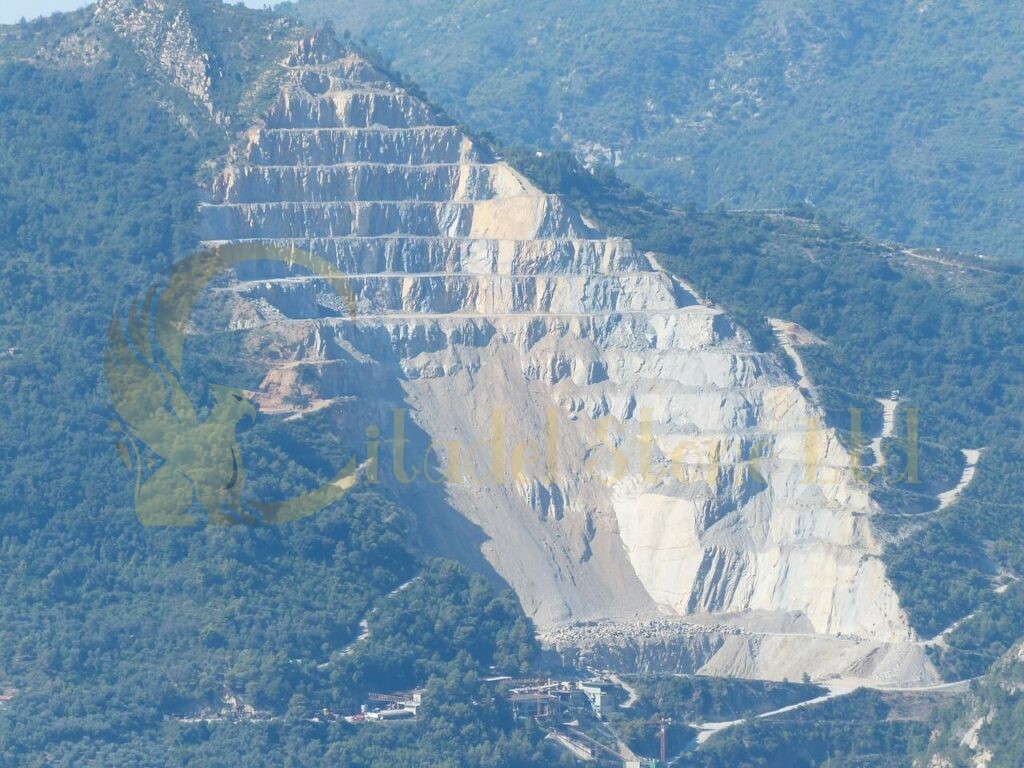
Citadel Stone sources absolute black granite tile from quarry partners with documented mineralogical consistency, and each warehouse batch is checked for shade uniformity before shipment — a quality step that matters more than most buyers realize when your 24 x 24 tiles are laid in an open field where tone variation becomes visible at distance.
Base Preparation for Arizona’s Terrain-Specific Site Conditions
Your base preparation strategy needs to start with a soil classification, not a depth assumption. Arizona’s valley floors frequently contain caliche hardpan — a calcium carbonate-cemented layer that can appear anywhere from 8 inches to 4 feet below grade. Caliche is actually structurally useful when it’s continuous and undisturbed, but a fractured or poorly graded caliche layer creates differential settlement that’s nearly impossible to correct after tile is set. In Mesa, caliche layers at 18–24 inches below grade are common, and experienced installers have learned to treat intact caliche as a natural sub-base — reducing aggregate depth requirements while improving long-term stability.
For sites without intact caliche, the standard base specification for 24 x 24 black granite tile in Arizona outdoor applications runs as follows:
- Sub-base compaction: achieve 95% Standard Proctor Density before any aggregate is placed
- Base aggregate: 4–6 inches of 3/4-inch clean crushed stone, compacted in 2-inch lifts — open-graded to support drainage on sloped terrain
- Setting bed: 1-inch screeded layer of coarse sand (ASTM C33) for dry-lay applications, or polymer-modified mortar for wet-set
- Slope tolerance: no single tile panel should deviate more than 1/8 inch over a 10-foot span before settlement is complete
- Expansion joint spacing: 12 feet maximum in outdoor fields exposed to direct sun — tighter than the 15–20 foot spacing some generic guides recommend for this climate
Sloped terrain adds a lateral drainage component that flat-site specs don’t address. You’ll want to install a continuous gravel drainage trench at the upslope edge of any tile field positioned to receive runoff — this intercepts water before it reaches the base layer rather than relying entirely on the tile field’s cross-slope to move it.
Choosing Between 24×24, 18×18, and 12×12 Formats for Your Application
Format selection for black granite tile is rarely just aesthetic — it has structural and installation efficiency implications that vary by site condition. The 24 x 24 black granite tile in Arizona format delivers maximum visual impact with fewer grout joints, but it demands a flatter, more precisely prepared base than smaller formats tolerate. Any base irregularity that a 12 x 12 black granite tile in Arizona installation might bridge without consequence will cause lippage or rocking in a 24-inch tile.
The 18×18 black granite tile in Arizona installations occupies a useful middle ground. It’s large enough to create a clean, expansive look on terraces and pool surrounds, but the shorter span reduces the leverage effect that amplifies base irregularities in larger formats. For sites where perfect base flatness isn’t achievable — steep terrain, complex drainage slopes, or sites with multiple elevation transitions — 18×18 often delivers more reliable results than the 24-inch format without sacrificing the material’s visual character.
- 24×24 format: best for large flat terraces, interior floors, and commercial lobbies where base preparation can be held to tight tolerances
- 18×18 black granite tile in Arizona: suited to pool decks, medium-scale patios, and sloped terrain where minor base variation is unavoidable
- 12×12 black granite tile in Arizona: appropriate for complex geometries, accent bands, step risers, and applications where cutting volume is high
- Black granite tile 12×24 in Arizona: an underused option that creates strong directional lines — useful on stair treads and terrace edge courses where 24-inch length spans supports while 12-inch width controls visual weight
For projects where you’re mixing formats across a larger site, you can request sample tiles and thickness specifications from Citadel Stone to verify that your selected formats share the same nominal thickness — critical for maintaining a continuous finished surface across format transitions.
Absolute Black Granite: Shade Consistency Across Large Format Tile Fields
The term “absolute black” in the granite tile market refers to a specific granite type — predominantly from quarries in India and Zimbabwe — characterized by near-uniform black coloration with minimal veining or flecking. What often surprises project managers sourcing absolute black granite tile 24×24 in Arizona for the first time is the shade variation that exists between quarry batches, even from the same source designation.
Absolute black granite tile 18×18 in Arizona installations on larger terraces make this variation more visible than small-format applications do. The 18-inch tile exposes more surface area per piece, and when you lay 200 tiles in an open courtyard, even subtle batch-to-batch variation in the depth of black creates visible striping that no amount of sealing corrects after the fact. The standard precaution is to order all tile for a single project from the same warehouse batch — verifying batch continuity before your truck delivery is scheduled rather than accepting split-batch shipments.
Absolute black granite tile 24×24 in Arizona large-scale commercial projects warrants a pre-installation dry-lay review: unpack 20–30% of your tiles and lay them dry in a representative section to visually confirm shade consistency before setting begins. This adds half a day to your installation timeline and saves weeks of remediation. For projects requiring guaranteed shade continuity across multiple truckloads, discuss batch-locking options with Citadel Stone’s team before your order is confirmed.

Sealing Protocols and Long-Term Maintenance on Arizona Terrain
Black granite’s low porosity means sealing is less about moisture exclusion and more about protecting the polished surface from alkaline efflorescence — mineral salts that migrate upward through grout joints and mortar beds, leaving white hazing that reads as maintenance failure on a black tile field. In terrain-challenged sites where drainage is managed rather than eliminated, the upward moisture pressure driving efflorescence is persistent. Your sealing protocol needs to address joint penetration, not just tile surface coverage.
Sealing recommendations for 24 x 24 black granite tile in Arizona outdoor applications:
- Use a penetrating impregnator sealer rather than a topical sealer — topical sealers trap moisture vapor under the tile surface in climates with significant diurnal temperature swings
- Apply sealer to all four tile edges and the grout joint face during installation, not just the top surface
- Allow mortar beds to cure a minimum of 28 days before final sealer application — premature sealing traps cure moisture
- Reapply sealer on a 2-year cycle for outdoor applications, 3-year for covered or interior installations
- In elevated Arizona locations with freeze-thaw exposure, inspect grout joints annually for cracking — compromised joints are the primary water infiltration path, not the tile body itself
In Scottsdale, where outdoor tile fields sit in direct sun with minimal canopy cover, UV degradation of topical sealers occurs measurably faster than in shaded installations — typically halving the effective sealer lifespan compared to manufacturer testing conditions. Penetrating impregnators avoid this issue because the active chemistry is below the tile surface rather than on it. For projects requiring complementary stone specification data, 24 x 24 Black Granite Tile from Citadel Stone covers additional details relevant to indoor and transitional applications where sealing and substrate conditions differ from fully exposed outdoor fields.
Thickness and Structural Loading: Getting the Numbers Right
Standard 24 x 24 black granite tile in Arizona is nominally available in 3/8-inch (10mm), 1/2-inch (12mm), and 3/4-inch (18–20mm) thicknesses. The right thickness for your project isn’t determined by budget — it’s determined by spanning capacity and expected load. A 3/8-inch tile set over a fully supported, flat mortar bed performs well under pedestrian traffic. That same tile set over a base with minor voids — common in terrain-challenged sites where soil shifting is ongoing — will crack under point loads that a 3/4-inch tile absorbs without consequence.
The practical threshold in Arizona outdoor applications: specify 3/4-inch (18–20mm) thickness for any installation where vehicle access is possible, where the base contains open-graded drainage aggregate (which inherently has less support continuity than dense-graded material), or where the site elevation is above 5,000 feet and frost depth reaches below your base layer. For purely pedestrian interior or covered installations, 1/2-inch (12mm) is typically sufficient if base flatness meets ±1/8-inch tolerance over 10 feet.
- 3/8 inch (10mm): interior floors with controlled substrate, low-traffic residential applications only
- 1/2 inch (12mm): standard residential outdoor patios, covered terraces, and pool surrounds with well-prepared bases
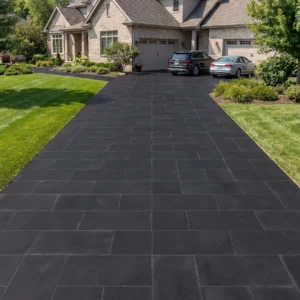
- 3/4 inch (18–20mm): vehicle-accessible driveways, commercial applications, elevated terrain sites with drainage aggregate bases, and any installation where substrate conditions cannot be guaranteed flat
Buy 24 x 24 Black Granite Tile Direct — Citadel Stone Arizona
Citadel Stone stocks 24 x 24 black granite tile in standard thicknesses — 1/2 inch and 3/4 inch — with absolute black and dark charcoal finish options available from current warehouse inventory. Format availability also includes black granite tile 12×24 in Arizona projects, 18×18 black granite tile in Arizona, and 12 x 12 black granite tile in Arizona for complementary applications or accent courses. You can request sample tiles and full thickness specifications before committing to a project order — a practical step for any installation where shade continuity across a large field is a design requirement. Trade and wholesale enquiries are handled directly, with pricing based on project volume and delivery location across Arizona. Lead times from warehouse stock typically run 1–2 weeks for standard formats, with custom-cut or non-standard specifications requiring an additional timeline discussion. Truck delivery is coordinated to your project site, and Citadel Stone’s team can advise on pallet configuration and offload requirements for sites with limited access. To discuss pricing, confirm batch availability, or schedule a consultation for a complex terrain project, contact Citadel Stone directly for a project-specific response.
As you finalize your Arizona stone specification, exploring Citadel Stone’s broader range of black granite products can sharpen your material decisions — Black Granite Tile in Arizona covers the full product context and regional performance data that supports specifications across the state’s varied terrain and elevation zones. 24 x 24 Black Granite Tile from Citadel Stone reaches project sites across Flagstaff, Sedona, and Yuma and throughout Arizona.