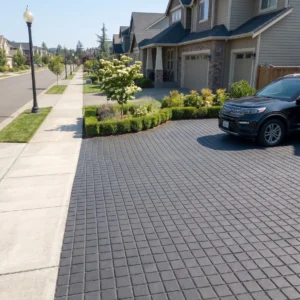
Basalt Pavers in Cold Climates: The Freeze-Thaw Performance Guide
Built for Winter — Every Basalt Format, One Certified Stone
Pavers, tiles, setts, treads and copings in the same lab-certified black basalt this guide describes — standard sizes or custom-cut to your exact dimensions. One pallet or full containers, residential or commercial, delivered across the USA and Canada.
Winter-Test a Basalt Sample
Plan Your Cold-Climate Project With an Expert
Every winter, homeowners across the northern United States and Canada watch their paving fail the same way: hairline cracks in January, flaking surfaces in March, loose and heaved units by spring. None of it is bad luck. Winter damage in pavers follows physics that can be measured in a lab before you ever place an order — and by those measurements, dense black basalt is one of the strongest cold-climate choices in natural stone.
The short version: installed on a proper base, Citadel Basalt rides through freeze-thaw winters without cracking — its certified 0.59–0.69% absorption leaves ice almost nothing to attack. The pavers that crack in freeze are the porous ones: sandstone above all, and the budget granite lots sold without certificates.
This guide explains exactly why, using our own certified test data rather than adjectives. It covers the freeze-thaw mechanism, deicing salt chemistry, snowplow wear, installation in frost country, and what winter maintenance actually looks like. If you are paving a driveway in Minneapolis, a walkway in Buffalo, or a courtyard in Calgary, this is the page to read before you choose a material.
☀ Paving for heat instead of frost? See our Cool-Surface Guide: pavers for hot climates — light limestone and shellstone for barefoot pool decks in desert and tropical sun.
Table of Contents
Why winter destroys pavers: the freeze-thaw mechanism
Water expands by roughly nine percent when it freezes. If water has soaked into the pores of a paver and the temperature drops, that expansion pushes outward against the stone or concrete from the inside. One freeze does little. But a northern winter is not one freeze — it is dozens of freeze-thaw cycles, and in chinook country like Calgary a single winter can deliver far more, as daytime melts refill the pores that the night then refreezes. Cycle after cycle, internal pressure opens micro-cracks, micro-cracks admit more water, and the damage compounds: surface flaking (spalling), edge chipping, and eventually cracked units.
Which means the fate of a paver in a cold climate is largely decided by a single laboratory number: how much water can get inside it.
Start here: the workhorse pavers
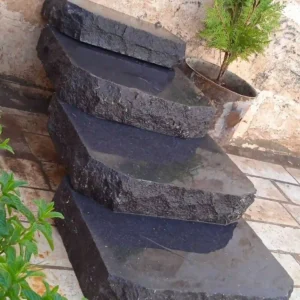
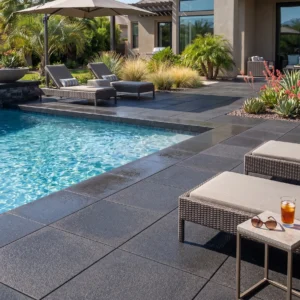
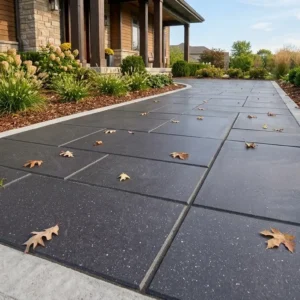
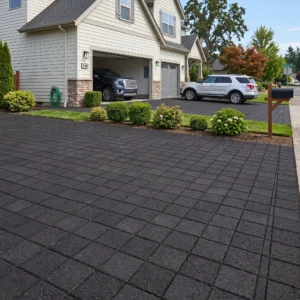
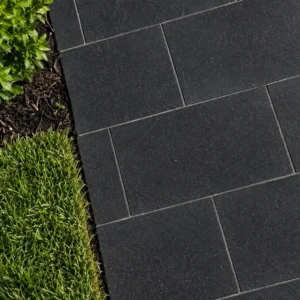
Brushed and bush-hammered finishes in Grigio and Nero Stellato — the textured, salt-ready surfaces most cold-climate projects specify.
The number that decides survival: water absorption
Citadel Stone’s black basalt has been tested across two independent production batches to S.N.S 1393, recording water absorption of 0.59% and 0.69%. There is simply very little room in this stone for water to occupy — which means very little ice pressure when temperatures fall.
Here is how that compares with the materials it competes against:
| Material | Water absorption | Basis |
|---|---|---|
| Citadel black basalt | 0.59–0.69% | Certified, S.N.S 1393, two batches — the only entry here with a per-batch certificate |
| Porcelain pavers | ≤ 0.5% (typical class) | ASTM C373 vitreous classification |
| Granite (commercial paving lots) | ≈ 0.2–0.8% — varies widely by lot | Type-level; ASTM C615 dimension grade caps at 0.40%, but paving lots are often sold without certificates |
| Concrete pavers | Up to 5% permitted | ASTM C936 allowable average |
| Limestone (tested in the same lab as our basalt) | 1.34–1.61% | S.N.S 1393, same method |
| Travertine | Notably higher; naturally porous unless filled and sealed | Type-level |
Two honest notes on that table, because honest is how we sell stone. First, the concrete figure is the *allowable maximum* under ASTM C936 — good manufacturers do better — but the standard itself permits roughly seven times the absorption our basalt certificates record. Second, porcelain genuinely matches basalt on absorption; where basalt pulls ahead is everywhere else that matters outdoors in winter: it is a thick, dense natural stone (3.01–3.06 g/cm³ certified density) with mass and repairability porcelain cannot offer — a chipped basalt unit can be honed or swapped, while a cracked porcelain panel is finished.
Granite deserves its own note: dense, dimension-grade granite performs well in freeze — but commercial paving lots vary enormously, and they rarely ship with batch certificates. That is the difference you are buying here: not a rock name, a certified number. The full comparison — granite, sandstone and other basalt — is further down this page.
For bluestone — the traditional cold-climate stone of the American Northeast — absorption varies significantly by quarry and grade, which is exactly why specifiers there insist on dense, full-color material. With basalt you are not gambling on grade: the density is a property of the volcanic rock itself, and we put the certificate behind it.
Deicing salt: the second winter killer — and basalt's quiet advantage
Freeze-thaw gets the headlines, but rock salt does at least as much damage in most northern hardscapes, through two different attacks. On concrete, dissolved deicing chemicals aggravate surface scaling — the familiar flaking that leaves aggregate exposed after a few winters, which is why concrete-paver standards include specific deicer scaling tests. On calcareous stones — limestone, travertine, marble — salt attacks the stone itself, because salts interact aggressively with carbonate minerals and crystallize inside their pores.
Basalt is neither. It is a silicate volcanic rock: sodium chloride does not chemically attack it, and at 0.59–0.69% absorption there is almost no pore space for salt crystals to grow in. You can treat an icy basalt walkway the way safety demands without slowly dissolving your investment. Practical caveats we give every northern customer: rinse residual salt off in spring (mainly to protect adjacent concrete, metal edging and plantings), and remember that jointing sand and bedding are not made of basalt — good drainage and topped-up joints matter regardless of stone.
Formats for every build
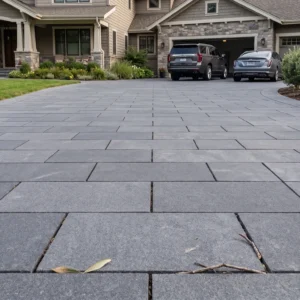
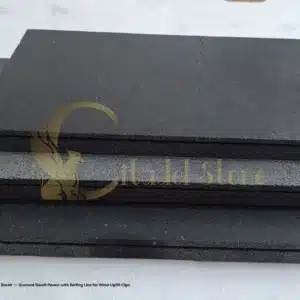
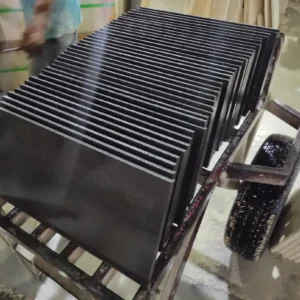
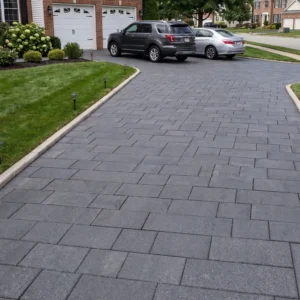
Large-format pavers, sawn slabs, French pattern, grooved and honed — the same certified stone in every shape a design calls for.
Snowplows, shovels and grit: the abrasion question
A northern paver spends five months a year being scraped — steel shovels, plow blades, and the sandpaper effect of traction grit ground underfoot. Abrasion resistance is measurable, and it is where our lab data is most striking. Under the Böhme abrasion test (DIN 52108, S.N.S 1169), our basalt recorded 0.87–0.91 mm of material loss across two batches, against 2.68 mm for the limestone tested in the same laboratory — roughly three times more abrasion-resistant, measured by the same method on the same bench. That is the difference between a surface that still shows its finish after a decade of plowing and one that visibly wears at the shovel lines.
For surfaces that will be plowed, specification details matter as much as the stone: choose sawn or honed flat formats rather than tumbled cobbles, set units flush with tight joints so no edge stands proud of its neighbor, and fit the plow with a rubber or polyurethane blade edge — advice we give for every paving material, but which very hard stone rewards most.
The same density shows up in bending strength: flexural values of 9.04–10.03 N/mm² (S.N.S 1394) across our two batches, roughly a quarter to a third higher than the limestones tested alongside — the property that resists cracking under a vehicle tire parked on a frost-stiffened base. Compressive strength for dense basalt of this type runs 100–300 N/mm² as a published type-level range — for perspective, ASTM C936 asks about 55 N/mm² of concrete pavers — and lot certificates are available with any quote.
Basalt tiles & finishes
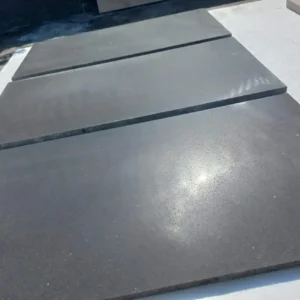
Honed, polished, antique and DuoFinish — the same certified basalt in everyday tile sizes from 12″ × 12″ to 24″ × 12″.
The black-stone advantage: pavers that help clear themselves
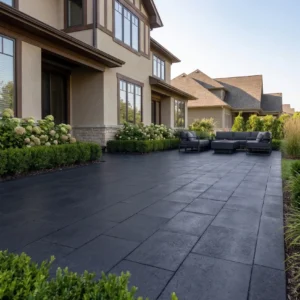
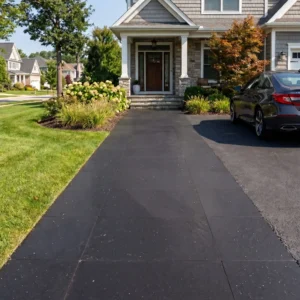
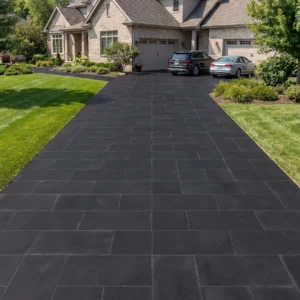
Here is a benefit no light-colored material can copy. Dark basalt absorbs winter sun, and on clear days after a snowfall a black surface warms and sheds its snow and ice noticeably sooner than pale concrete or light limestone beside it. It is not a substitute for shoveling — but it shortens how long ice lingers on a north-facing walk, and it reduces how much salt you reach for in the first place.
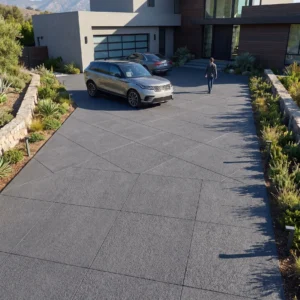
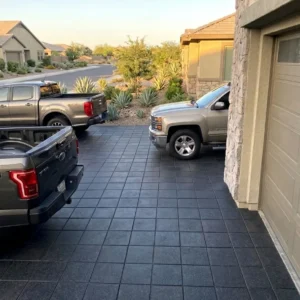
The same thermal behavior makes basalt a natural partner for hydronic snow-melt systems: dense, conductive stone over a heated base transfers warmth to the surface efficiently and shrugs off the constant thermal cycling that stresses lesser materials. If you are building a heated driveway in the snow belt, basalt is one of the few surfaces genuinely worthy of what is underneath it.
Basalt cobblestones & setts
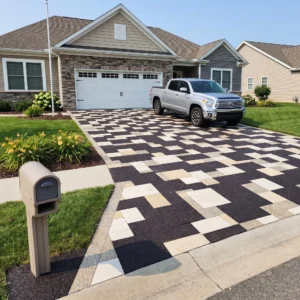
Aprons, borders and drives with old-world texture — cobbles that meet the plow blade first and shrug it off.
-

Black Basalt Belgian Block – Natural
$2.80 -
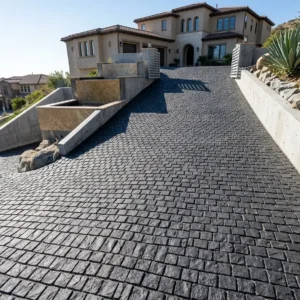
Black Basalt Split-Face Belgian Block
$2.90 -
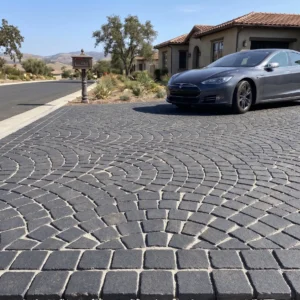
Black Basalt Cobbles – Sawn Finish
$2.80 -
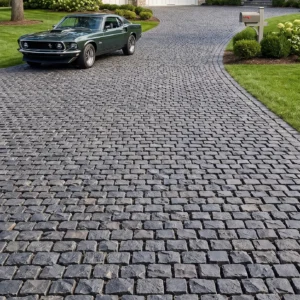
Black Basalt Split-Face Cobblestones
$2.90 -
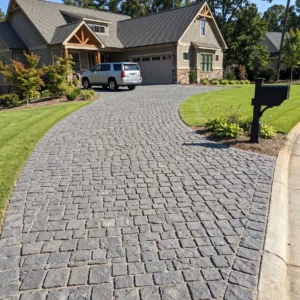
Black Basalt Chiseled Cobblestones
$2.90 -
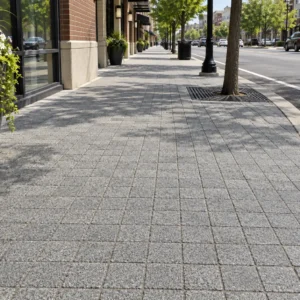
Black Basalt Natural Cobblestones
$2.80 -
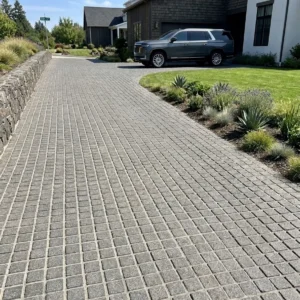
Black Basalt Bush-Hammered Cobblestones
$2.82 -
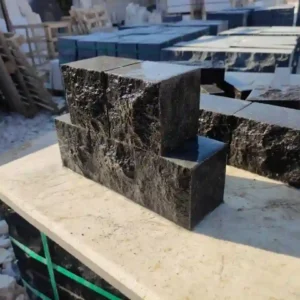
Black Basalt Split-Face Cobble Setts
$2.90 -
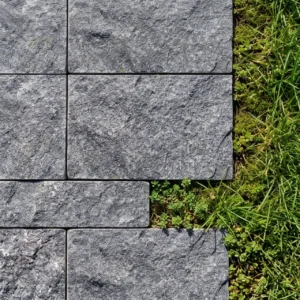
Graphite Grey Setts
$2.90 -
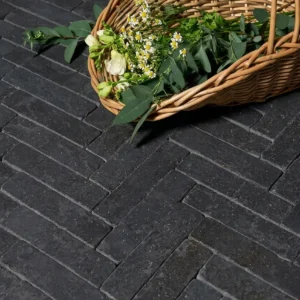
Black Basalt Plank Setts – Brushed (8″ × 2″ × 2″)
$3.20
Frost heave: why installation matters as much as the stone
A perfect paver on a bad base will still fail, because frost heave happens *under* the surface: water held in frost-susceptible soil freezes, expands, and lifts whatever sits above it. The stone is blameless and the fix is drainage. The principles that matter in freeze country: excavate out frost-susceptible fines and build on a well-drained, properly compacted aggregate base; keep water moving away from the pavement with correct slope; contain the field with solid edge restraints so seasonal movement cannot migrate units; and use jointing appropriate to the exposure, topped up each spring. Permeable installations — basalt over an open-graded stone base — are particularly effective in cold climates because water drains through and down instead of sitting in the freeze zone, and several northern municipalities now encourage exactly this build-up for stormwater reasons.
For driveways and any vehicular or commercial work, have the base designed by a qualified contractor or engineer for your soil and loads — no supplier’s web page, ours included, replaces that. What we can promise is the material half of the equation, with the certificates to prove it.
Basalt curbstones & edging
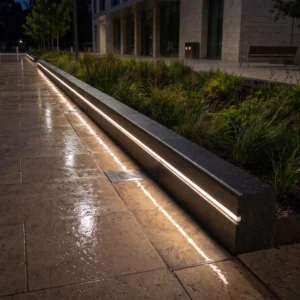
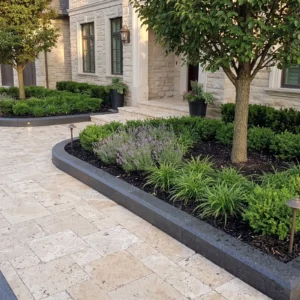
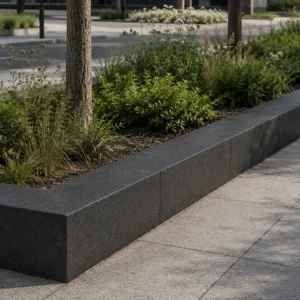
The line that holds the whole build together — plow-proof edging in the same certified basalt.
Winter care for basalt: what you'll actually do (very little)
At 0.59–0.69% absorption, sealing is generally unnecessary — an optional breathable penetrating sealer every three to five years only where staining risk is high. Routine winter care is: shovel or plow as normal, use deicer as safety requires, rinse salt residue off in spring, sweep joints and top up sand where needed, and check each spring for any unit that has moved so it can be re-levelled in minutes — the underrated virtue of modular stone over monolithic slabs. That is the whole list.
Steps, coping & specialty shapes
Bullnose pool coping, garden steps, hexagon pavers and natural slabs — the finishing pieces that complete a basalt build.
Basalt vs granite, sandstone — and other basalt
Sandstone is the classic freeze casualty: its absorption typically runs several times basalt’s, and the water it drinks becomes ice that pries the surface apart. When a client says their old patio flaked and cracked after two winters, it was very often sandstone — or concrete.
Granite is a better story, but an uneven one. Dense, sound granite survives northern winters; the failures contractors see usually trace to porous budget lots, micro-fissured stone or poor bedding. The lesson is not “granite is bad” — it is that the rock name on the invoice protects nobody; the batch certificate does. Citadel Basalt is denser than commercial granite (3.01–3.06 g/cm³ against granite’s typical 2.6–2.75) and every order can carry its laboratory certificates.
Other basalt is the comparison buyers skip — and should not, because this is where Citadel Basalt genuinely outperforms. Set our certified numbers against typical commodity basalt shipped from China, Vietnam or Egypt and the difference is measurable on paper: our density of 3.01–3.06 g/cm³ sits at the heavy end of the basalt spectrum and our 0.59–0.69% absorption at the low end, while commodity lots frequently arrive lighter, more porous or visibly vesicular — and almost never with a batch certificate. Ask any supplier for three numbers from a current batch certificate — density, water absorption and Böhme abrasion — and set them against ours: 3.01–3.06 g/cm³, 0.59–0.69%, 0.87–0.91 mm. If the certificate cannot be produced, that is your answer — and it is why we put ours in writing on every order.
Where this matters most: the North American freeze belt
If you are paving in New England, upstate New York, the Great Lakes states, the Upper Midwest, the Mountain West, or across Ontario, Quebec, the Prairies and Atlantic Canada, every section above is your buying checklist. The hardest test case on the continent is arguably Calgary, where chinook winds swing temperatures across the freezing line again and again in a single season — the precise cycling that punishes absorbent materials and that low-absorption basalt is built to ignore. Citadel Stone delivers door-to-door across all fifty U.S. states and Canada; request a free quote with your ZIP or postal code for delivered pricing.
❄ Building in New England and the Northeast? That region now has its own delivery guide — lead times, winter scheduling and landed-cost quoting for every ZIP from Connecticut to Maine.
❄ Working around the Great Lakes and Upper Midwest? That region has its own delivery guide — lake-effect winters, salt, and landed-cost quoting from Chicago to Minneapolis.
❄ Building in Ontario? The province has its own delivery guide — DDP customs handling, CAD quoting by postal code, and winter scheduling from Toronto to Ottawa.
❄ Building in the Mountain West? The region has its own delivery guide — chinook freeze-thaw cycling, altitude sun and landed-cost quoting from Denver to Bozeman.
❄ Building in Quebec? The province has its own delivery guide — DDP customs handling, CAD quoting by postal code, and winter scheduling from Montreal to Quebec City.
❄ Building in Alberta or the Prairies? The region has its own delivery guide — chinook cycling, deep freeze, DDP customs handling and CAD quoting from Calgary to Winnipeg.
❄ Building in Atlantic Canada? The coast has its own delivery guide — the most freeze-thaw crossings in the country, double salt exposure, DDP customs handling and CAD quoting from Halifax to St. John’s.
Ordering in the USA and Canada
One guide, both markets — the physics of freeze-thaw does not change at the border, and neither does our stone. What changes is logistics, and we handle it: USA — door-to-door delivery to all fifty states from US warehouse stock, quotes in USD by ZIP code. Canada — delivered-duty-paid (DDP) shipping with customs handled, quotes in CAD by postal code, routing via Toronto, Montreal and Vancouver. Either way, request a free quote and you get landed cost, not a surprise at the terminal.
Proof, not promises
Everything numeric on this page comes from independent laboratory certificates covering two separate production batches — density 3.01–3.06 g/cm³, absorption 0.59–0.69%, Böhme abrasion 0.87–0.91 mm, flexural strength 9.04–10.03 N/mm² — and we will attach the certificates to your quote on request. Our proof of delivery is equally real: read how we shipped two full containers — 6,884 sq ft in 32 crates — to a Las Vegas contractor in our delivery case study, and how we supplied over 70,000 sq ft across 21 containers to Creative Environments. We publish only real projects.
The fastest way to judge a stone for a hard climate is to hold it: order a sample of our basalt pavers — quarry-direct, hand-selected, in every size, thickness and finish — and put it in your freezer overnight if you like. It will not mind.
Get a Landed-Cost Quote for Your Winter Project
Frequently Asked Questions
If your question is not listed, please email us at kareem@citadelstone.us
Do basalt pavers crack in winter?
Properly installed dense basalt is among the most freeze-thaw-resistant paving stones available. Winter cracking in pavers is driven by absorbed water freezing and expanding; our basalt’s certified 0.59–0.69% water absorption (S.N.S 1393, two batches) leaves almost no room for water, so repeated freeze-thaw cycles have very little to work with. Field failures in cold climates are far more often base and drainage problems than stone problems — which is why installation matters as much as material.
Is it safe to use rock salt on basalt pavers?
Yes. Basalt is a silicate volcanic rock, so sodium chloride does not chemically attack it the way it degrades concrete surfaces and carbonate stones like limestone, travertine and marble — and its very low absorption gives salt crystals almost no pore space to grow in. Rinse residue off in spring to protect nearby concrete, metal and plantings, and keep joints topped up as part of normal seasonal care.
Can you snowplow basalt pavers?
Yes — basalt is one of the best natural stones to plow. Our lab data records 0.87–0.91 mm Böhme abrasion loss (DIN 52108) versus 2.68 mm for limestone tested by the same laboratory, roughly three times the wear resistance. For plowed surfaces, specify sawn or honed flat formats, set units flush with tight joints, and use a rubber- or polyurethane-edged blade.
Do basalt pavers need sealing in cold climates?
Generally no. At 0.59–0.69% certified absorption there is little for a sealer to improve. If you want extra stain protection in high-traffic or spill-prone areas, apply a breathable penetrating sealer every three to five years — never a film-forming sealer, which can trap moisture and become slippery in winter.
What kind of base do basalt pavers need where the ground freezes?
The stone is only half the system. In freeze-thaw climates the essentials are a well-drained, properly compacted aggregate base free of frost-susceptible fines, correct slope so water leaves the pavement, solid edge restraints, and maintained joints. Permeable build-ups over open-graded stone work especially well because water drains below the freeze zone instead of sitting in it. For driveways and commercial work, have the base designed by a qualified contractor or engineer for your soil and loads.
Do dark pavers really melt snow faster?
On sun-exposed areas, yes — dark basalt absorbs solar radiation and sheds snow and ice sooner than light-colored surfaces, which also tends to reduce how much deicer you use. It complements, rather than replaces, normal snow clearing, and it makes basalt an excellent surface over hydronic snow-melt systems.