


The detail that decides whether cobblestone pavers stay tight for twenty-five years or start rocking in year three is almost never the stone itself — it’s the bedding course and the perimeter restraint holding the field in compression. Granite and limestone setts have carried cart and wheel loads on European streets for centuries, so the unit has long since proved its case. What hasn’t proved its case is a thin sand bed dropped over an uncompacted subgrade in a freeze-prone region. What follows covers the specification decisions — unit tolerance, base depth, joint width, edge detail, code review — that separate those two outcomes.
How Cobblestone Pavers Are Cut and Graded
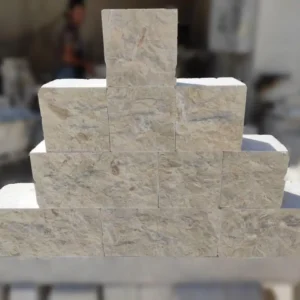
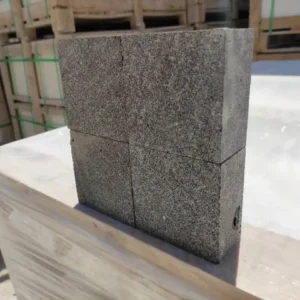
Three production methods dominate the market, and the one you pick sets your joint width before you open the first bag of jointing sand. Hand-split cubes carry natural fracture faces, so dimensional variance across a pallet typically runs a quarter to three-eighths of an inch. Sawn-six-sides units, cut on gang saws and then tumbled, hold much tighter tolerance and let you close joints to a consistent line.
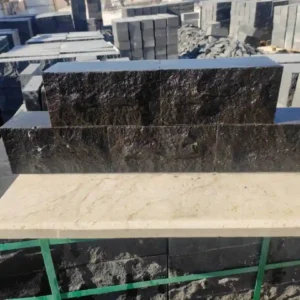
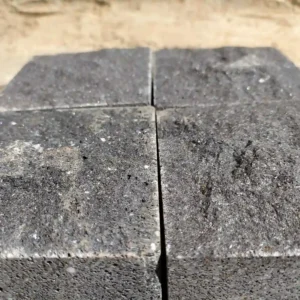
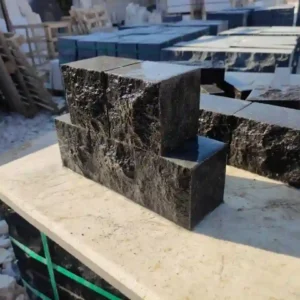
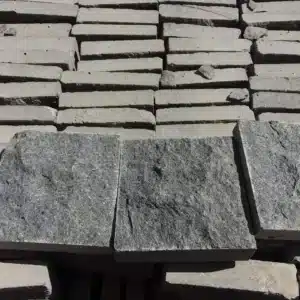
Finish sits on top of production method and changes both cost and behavior. A sawn top with tumbled arrises gives you a flat plane for furniture and a softened edge that reads traditional; a full split face keeps the quarry texture but hands you a surface that varies by a few millimeters from unit to unit; a bush-hammered or flamed top opens the texture on dense granite. Ask which faces carry which finish before you sign anything, because a sett described simply as tumbled is often tumbled on the top and arrises only, with sawn sides that show at the joint the moment you open the pattern wider than intended.
You’ll see the same product sold under half a dozen names, and most of that naming is regional rather than technical. Cobble pavers, setts, belgian block, english cobble pavers, roman cobblestone pavers — those terms describe format and finish conventions, not geology. Ask for actual face dimensions, the finish on each face, and the stone type before you line two quotes up against each other.
Granite remains the reference material for heavy-traffic cobbled paving, and industry granite specifications explain why a tightly interlocked crystal structure handles repeated point loading better than most soft sedimentary alternatives. Dense limestone performs well too, particularly in pedestrian settings where a warmer color range matters more than tire scuff. For any specific batch, a test report is available on request rather than a generic published figure.
Here’s what should be inspected before a shipment leaves the yard:
- Thickness range within the pallet, measured at several units rather than eyeballed off the top layer
- Color spread across multiple pallets from the same lot, since one pallet never predicts what the finished field looks like
- Fracture quality on split faces — feathered, sugary edges chip out fast under a plow blade
- Bottom bed flatness on sawn units, which controls how much bedding material you actually need
- Broken corners and hairline seams, both of which become obvious the moment sand is swept into the joints
At Citadel Stone, pallets are opened and spot-checked in the warehouse before release, because thickness drift inside a single lot causes more callbacks than any other defect. We quarry, template, manufacture and handle the material through one chain, which is what makes that check possible in the first place.
Sizes, Thicknesses, and Mesh-Backed Formats
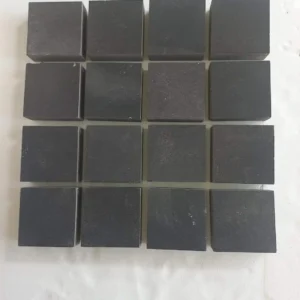
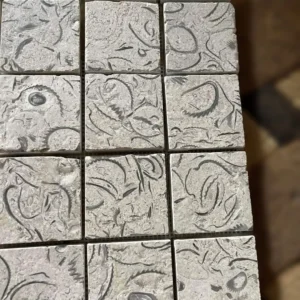
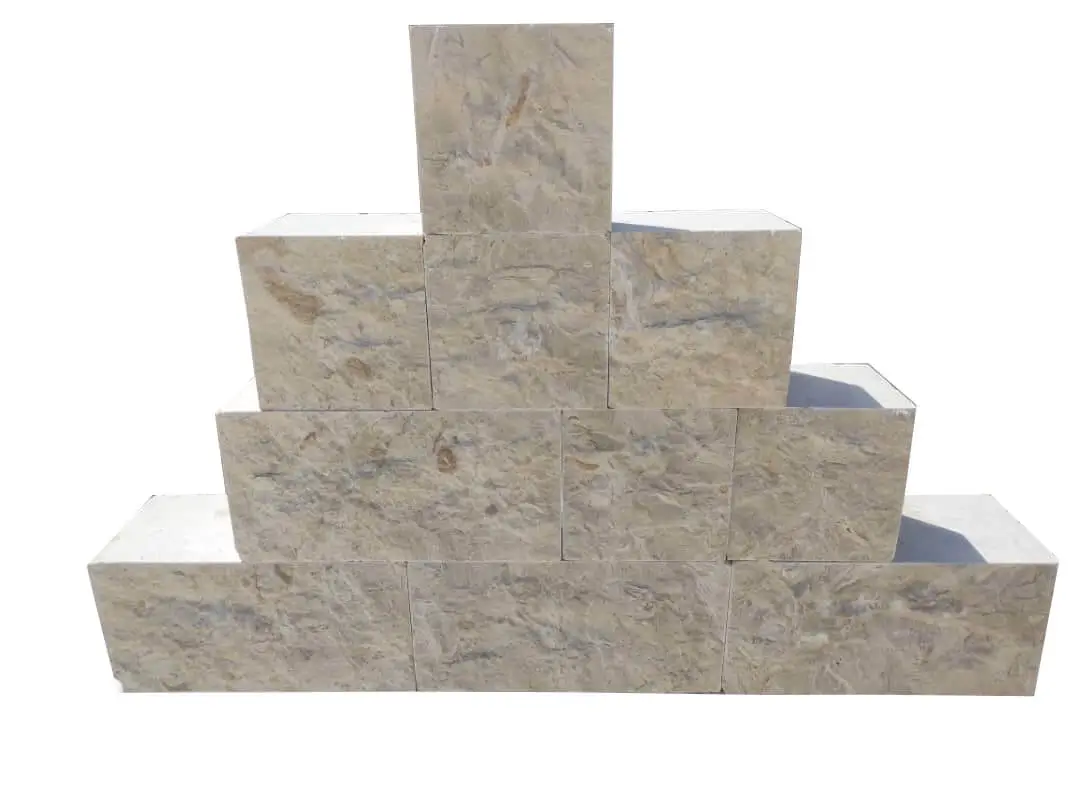
Format selection is a labor decision as much as an aesthetic one. Loose cubes lay slowly — a skilled crew might place 60 to 90 square feet a day by hand on a curved fan — while mesh-backed sheets cover ground several times faster and give you a repeatable joint. Cobblestone mesh pavers arrive as roughly square sheets, commonly around 12 by 12 inches face measure, with the units bonded to a polymer grid.
Common formats you’ll be quoting against:
- Small cubes near 4 x 4 inches face, 2 to 2.5 inches thick — patios, garden paths, tight radii
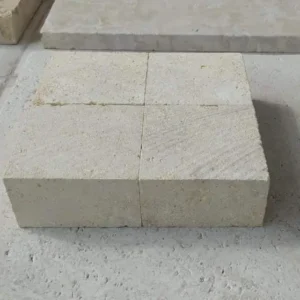
- Standard setts around 4 x 8 or 5 x 8 inches, 2.5 to 3 inches thick — the workhorse size for drives and aprons
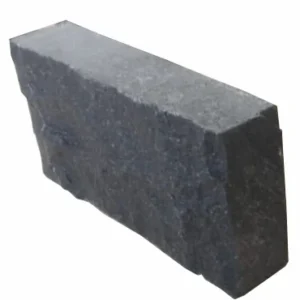
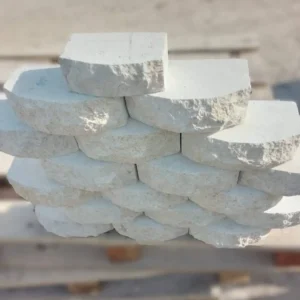
- Jumbo belgian block near 4 x 8 x 8 inches — borders, curbing, and low garden walls
- Cobblestone paving slabs in larger plan sizes with a cobbled face texture, used where you want the look with fewer joints
- Mesh-backed sheets in fan, arc, and running-bond layouts for fast coverage over a bound base
Mesh backing deserves a closer look before it lands on a spec sheet. The grid holds units at a fixed joint width, which is a real advantage for consistency, but it also means each sheet has to sit on a bed that supports the whole panel evenly — a bound base with a bonded setting bed on vehicular work, or a carefully screeded bedding layer on pedestrian work. Sheets need staggering so grid seams don’t line up across the field, and perimeter sheets almost always need cutting, so plan for a saw on site. Where a client wants a hand-laid look at mesh-laid speed, a mesh field framed by hand-laid soldier courses is the usual compromise, and it conceals the cut sheets at the same time.
Thickness drives structure. Cobblestone pavers carrying vehicles should be 2.5 inches minimum, and full-depth 4-inch units earn their cost on turning aprons where tires scrub sideways rather than roll. Cobblestone driveway pavers thinner than that can still work, but only over a bound concrete base with a bonded setting bed — not over open-graded aggregate.
One terminology note worth clearing up: cobblelock paving normally refers to interlocking concrete block rather than quarried stone. Natural units behave differently — heavier, more variable, no pigment to fade, and higher up front. Sample sets of any format, including wholesale cobblestone pavers volumes, can be requested from Citadel Stone before a spec sheet goes out to a client.
Color Selection Across Grey, Black, and Blended Ranges
Color on a cobbled field behaves differently than color on a large-format slab, because the eye averages thousands of small faces at once. A pallet that looks busy at ground level reads as a single calm tone from a second-floor window. That averaging effect is exactly why blending from three or four pallets simultaneously matters more here than on any other paving product.
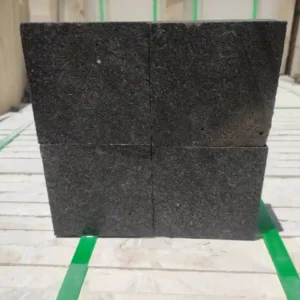
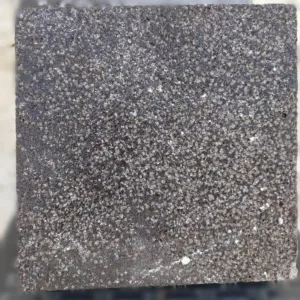
Grey cobblestone pavers cover the broadest range in practice — silver, mid grey, blue-grey, and charcoal all sit inside that description depending on the quarry block. Black cobblestone pavers, usually dark granite or basalt, deliver the sharpest contrast against green planting and light render, though dark surfaces gain more solar heat in hot, dry climates and that’s worth weighing for barefoot zones.
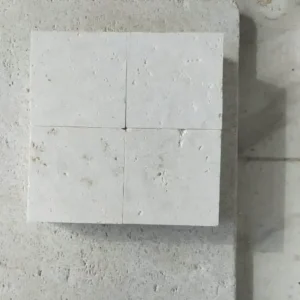
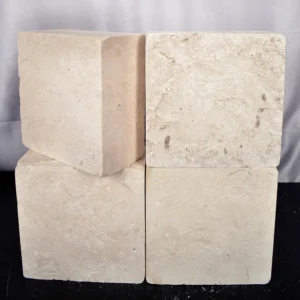
Warmer options run through cream, ivory, buff, and tan limestone, and tumbled belgian pavers in those tones soften a new build immediately rather than waiting a decade for patina. Cobblestone paving slabs in the same color family let you mix scale within one scheme without a visual break. In a cobblestone backyard where paving wraps planting beds and meets a lawn edge, mid-tone blends usually hold up best over time, since they neither show organic staining the way very pale limestone does nor flatten into a solid block the way the darkest granites can in full sun.
Practical color rules from the field:
- Look at every sample wet as well as dry — most stone darkens by a full shade when saturated
- Order the full quantity from one lot, including your cut allowance, rather than topping up later
- Add 5 to 8 percent overage on straight runs and 10 to 12 percent where fans, circles, or radius cuts dominate
- Open pallets from different positions in the load and mix them as you lay, never pallet by pallet
- Keep a partial pallet in dry storage for future repairs around utility trenches
Base Depth, Frost Lines, and Code Review
Code review belongs at the front of the process, not after the excavator arrives. Driveway aprons crossing a public right-of-way almost always fall under a municipal permit carrying its own base, slope, and material requirements, and the inspector will hold you to that document rather than to any supplier’s recommendation. Patios and walks usually escape permitting until steps, walls above a trigger height, or grade changes near a property line enter the drawing.
Frost depth is set locally through amendments to the model residential code, ranging from a few inches in mild zones to four feet or more in the coldest northern jurisdictions. Flexible paving doesn’t need footings carried to that depth the way a wall does, because the field is designed to move as a coherent unit. It does need a base that drains, since saturated fines heaving beneath natural stone cobblestone pavers telegraph every ice lens straight into the finished surface.
Typical build-ups for cobble paving by use:
- Pedestrian patios and walks: 4 to 6 inches of compacted aggregate over a prepared, proof-rolled subgrade
- Residential drives: 8 to 12 inches compacted, toward the upper end over plastic clay subgrades
- Delivery, boat, or RV loading areas: 12 inches minimum with a geotextile separation layer beneath the aggregate
- Compaction in lifts no thicker than 4 inches, each lift tested rather than assumed
- Finished pitch of 1.5 to 2 percent minimum, running away from structures toward a defined outlet
Permeable build-ups now earn regulatory credit under a growing number of stormwater ordinances, and open-graded joints between stone units infiltrate well when the sub-base is sized for storage rather than just support. Landscape architecture guidance on permeable paving surfaces is a useful reference when you’re making that case at a planning counter. Check the site coverage limits for hard, non-permeable surfaces before assuming a patio expansion is exempt.
Seismic exposure changes less than most people expect for a sand-set field, because a flexible assembly tolerates ground movement far better than a rigid slab does. The attached elements are where engineering attention belongs — mortared steps, mortared borders, and any retaining structure above the local trigger height generally need stamped drawings, proper drainage behind the wall, and movement joints coordinated with the paving layout.
Driveway Loads, Edge Restraint, and Border Details
Edge restraint fails more driveways than base depth does. A cobbled field is only as stable as the perimeter holding it in compression, and once that perimeter gives, the outer courses walk outward a fraction of an inch each season until joints open and units start to rock underfoot.
For vehicular work, concrete haunching along every free edge is the detail worth paying for — a continuous fillet poured tight against the outer course, carried down to the bottom of the bedding layer and back-sloped so soil and turf hide it. Spiked polymer restraint is fine on a patio; it will not hold a decade of turning loads on cobblestone driveway pavers.
Pattern selection is structural here, not decorative. Herringbone laid at 45 degrees to the direction of travel spreads braking and steering forces across the largest number of units, which is why it dominates municipal and port paving. Running bond looks cleaner but shifts more in wheel paths, so reserve it for light-duty aprons or bands.
A cobblestone edging driveway border earns its place even when the main surface stays asphalt or concrete: the stone band gives a ravelling edge something to lean against, defines the plow line, and takes the abuse from tires that overshoot. Plenty of homeowners researching cobbles driveway options actually want that band rather than a fully paved field, and it’s a far smaller budget conversation.
Setts are classified as dimension stone in federal statistics, and federal dimension stone production data shows paving and curbing has remained a steady end use for decades. Weight is the practical consequence you plan around: a full pallet commonly runs 2,500 to 3,500 pounds, so your site needs a route the delivery truck can reach and firm ground for offloading. Confirm turning radius and overhead clearance before the truck is dispatched from the warehouse, not on the morning it arrives.
Patios, Backyards, and Pool Surrounds
A cobblestone patio asks a different question than a driveway does — furniture stability and barefoot comfort. Raw split-face cubes rock a chair leg and tip a glass, so for seating zones specify sawn-and-tumbled tops with a flat plane, and keep joints narrow and fully filled. Cobbled paving with a rustic face still belongs in the scheme; just place it in circulation bands rather than under the dining table.
The strongest cobblestone backyard layouts rarely pave everything. Stone bands framing larger slabs, a cobbled apron at a door threshold, a border wrapping planting beds — that mix reads richer and costs less than a wall-to-wall field. Reserve full cobbled coverage for courtyards, side returns, and utility zones where the texture earns its keep.
Belgian block sizes suit boundaries and transitions particularly well. A belgian block patio border sets a hard, level datum for the field to close against, and a belgian block walkway laid in three or four courses gives a garden route that never needs re-cutting around curves. Tumbled belgian pavers in cream or buff keep that structure from feeling heavy in small gardens.
Pool work adds its own rules for cobblestone pavers:
- Grade the deck away from the shell and give runoff a defined outlet — never let it pond at the coping joint
- Choose jointing rated for constant wetting; standard sand washes out fastest at the water’s edge
- Salt systems and chlorinated splash-out call for jointing and setting materials selected for chemical exposure
- Surface finish is the variable that governs slipperiness on any wet deck, so specify the finish and reference ANSI A326.3 wet testing for the units you intend to use
- Keep a movement joint where the deck meets the shell rather than mortaring the two together rigidly
Setting cobblestone around pool decks in a sand-set assembly usually outperforms a rigid mortar bed over the long run, because the field can accommodate minor settlement without cracking. Where cobblestone around pool coping is mortared for code or client reasons, insist on a properly drained base and a full-coverage bond — hollow spots under a wet deck are where trouble starts.
Cobble Paving Designs and Laying Patterns
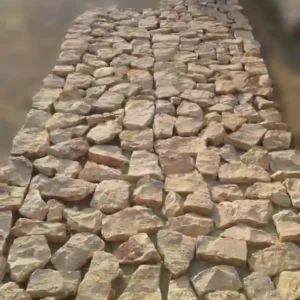
Pattern controls both the labor cost of laying cobblestone pavers and the visual scale of the finished surface, and the two rarely move together. Fans and arcs — the layout behind most roman cobblestone pavers installations — absorb dimensional variance beautifully because every course is slightly different anyway, which is why hand-split units suit them so well. Straight coursing does the opposite: it exposes every millimeter of variance in a long sightline.
Traditional layouts worth knowing before you draw:
- Segmental fan for courtyards and turning circles, forgiving of irregular units and curved boundaries
- Herringbone at 45 degrees for anything carrying vehicles, laid with cut closures against a restrained edge
- Running bond in soldier or stretcher courses for paths, driveway bands, and thresholds
- Basket weave with square-ish units for small terraces and formal garden squares
- Random coursing in mixed sizes, the look most associated with english cobble pavers and older village streets
Mixing patterns is where good schemes separate from ordinary ones. A cobblestone patio field in fans framed by two soldier courses reads far more intentional than a single pattern taken to the boundary, and the same trick works on drives where a cobblestone edging driveway band frames a herringbone center. The same discipline turns a belgian block patio border into a working datum rather than a decorative afterthought, since every closure cut in the field lands against a straight, level line. For layout dimensioning and setting-out geometry, cobblestone paver patterns works through the arithmetic that keeps a fan closing cleanly on a curved edge, which is exactly where most crews lose a day. Draw the pattern to scale before ordering, because pattern choice can swing your waste allowance by five percent.
Cobble paving designs also translate directly to mesh-backed production for larger areas — many mesh sheets replicate fan and arc geometry so a crew can lay a traditional look at modern speed. Buyers arriving from cobblelock paving searches are usually comparing exactly this: concrete block speed against stone longevity, with the mesh format sitting between them.
Joints, Maintenance, and Preventable Failure Modes
Joints do the structural work in a flexible assembly. Interlock develops when the joint is completely filled and stays filled, so the single highest-value maintenance task is checking sand levels annually and topping up before the surface loosens. Field experience on cobble pavers is consistent here: fields that hold sand at full depth run decades of service life, while fields left half-empty after a wet winter start moving inside three seasons.
Choose jointing to suit the exposure:
- Washed angular sand for wide-jointed rustic work with good drainage beneath
- Polymeric sand where wash-out, weeds, or heavy hose use are the concern, installed dry and watered exactly per the bag instructions
- Mortar joints on rigid concrete bases only, with movement joints planned at intervals rather than left to chance
- Resin-bound jointing on trafficked commercial fields where re-sanding access is difficult
- Open-graded chip on permeable systems designed to infiltrate rather than shed water
Winter maintenance causes most avoidable damage. Use a plow blade with a rubber or polymer edge, keep the blade shoe set slightly high, and skip granular de-icers that leave aggressive residues on the surface — sand for traction and a measured application of a milder de-icing product does less harm. On a cobbles driveway with mortar joints, the freeze-thaw damage almost always begins at a cracked joint that went unrepaired the previous spring.
Sealing is optional on stone cobbles and it is never a repair for a poorly built base. Where a client wants one — usually to deepen color or slow staining on a pale limestone terrace — use a breathable penetrating product, apply it only after efflorescence has finished cycling out, and re-coat on the manufacturer’s schedule rather than when the surface starts to look dull. Film-forming coatings on an exterior field trap moisture beneath the surface and peel; on a flexible assembly they also bridge the joints, which is the last thing you want when the joint has to stay open enough to shed water.
Efflorescence is the other predictable complaint. That white bloom is mineral salts migrating out of the setting materials, it typically fades within a year or two of weathering, and scrubbing it with acid usually does more harm than waiting. On a belgian block walkway or a cobbled paving band that stays shaded, expect biological growth instead — a low-pressure wash and a proprietary cleaner once a season handles it without stripping joint material.
Order Cobblestone Pavers from Citadel Stone — Nationwide Delivery
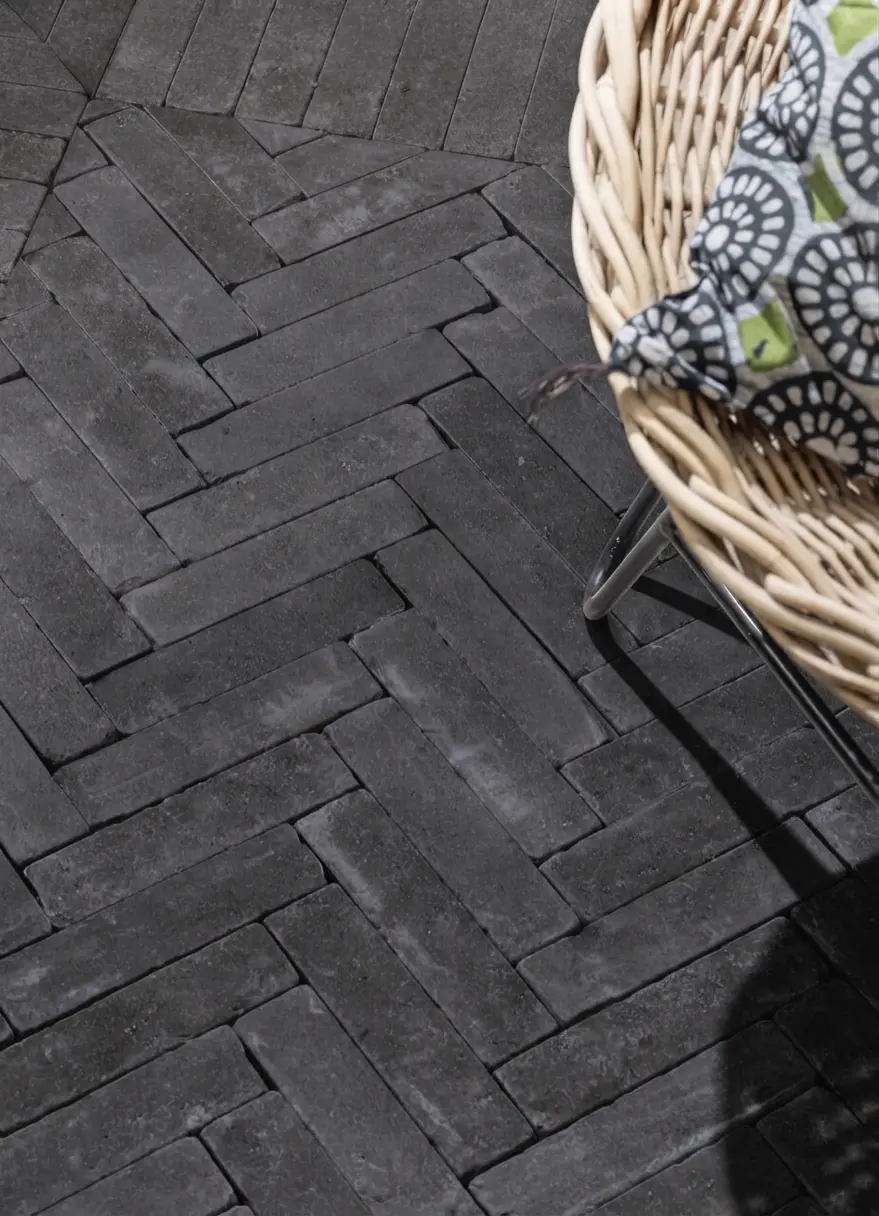
Stocked formats run from hand-split cubes and sawn-and-tumbled setts to jumbo belgian block for borders and cobblestone mesh pavers for fast coverage, in grey cobblestone pavers, black cobblestone pavers, and warmer limestone tones. Samples ship quickly so you can assess color wet and dry on site before pallets are committed, and material comes from our selected quarries in the Middle East with each batch checked for consistency. Layout help comes with the quote: send a sketch and you’ll get cobble paving designs dimensioned to the unit sizes you’re actually buying, whether the job is a drive, a courtyard, or cobblestone around pool decking.
Trade and wholesale cobblestone pavers pricing is volume-based, so send square footage, pattern, and joint width and you’ll get back a tonnage takeoff, pallet count, and a delivery window rather than a guess. Cobblestone pavers for sale ship from nationwide warehouse inventory, which typically means one to two weeks instead of a full import cycle, though custom sizes and thicknesses need earlier notice. Note that the cheapest pallet on a quote is rarely the cheapest installed square foot once tolerance and breakage are counted — buy on lot consistency, and confirm truck access before scheduling.
Beyond exterior cobbled work, many of the same projects need a finished surface for covered terraces or interiors, and travertine tile in a 6×12 format covers a different piece of the same specification puzzle. Citadel Stone delivers Cobblestone Pavers for exterior paving and hard landscaping, a compact unit stone laid in fans, courses and borders.
See also: how to install cobblestone pavers.