The travertine tile installation cost breakdown reveals something most project budgets get wrong from the start — the stone is rarely the dominant expense. Labor, substrate preparation, and material waste factors routinely push total installed costs 40–60% above the per-square-foot tile price alone. Understanding where those dollars actually go is what separates a realistic project budget from an expensive surprise mid-construction.
What Drives Travertine Installation Costs
Your total project cost isn’t a single number — it’s the sum of at least eight distinct cost centers, each with its own variables. Travertine tile installation cost depends heavily on application type (indoor flooring, outdoor terrace, shower surround), the finish you specify, and the complexity of the layout pattern. A straight-set 12×12 grid on a pre-leveled concrete slab is a fundamentally different job than a diagonal Versailles pattern on a wood-framed subfloor, and the cost difference reflects that.
The material grade also matters more than most buyers realize. Travertine is graded on fill quality, surface consistency, and vein distribution — and premium-grade tiles carry a price premium that ripples through the entire project. Understanding each cost driver lets you make deliberate trade-offs rather than discovering them after the crew is already on-site.
- Stone grade and fill quality: unfilled vs. filled travertine changes both material cost and labor time
- Surface finish: honed, brushed, or tumbled finishes require different installation prep
- Layout pattern: straight-set, diagonal, Versailles, or herringbone each affect cut waste and labor hours
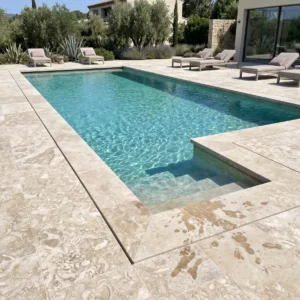
- Application context: interior flooring, exterior paving, wet areas, and pool surrounds all carry different installation requirements
- Project scale: mobilization costs spread over larger square footage, reducing per-unit labor rates
Travertine Tile Material Costs Per Square Foot
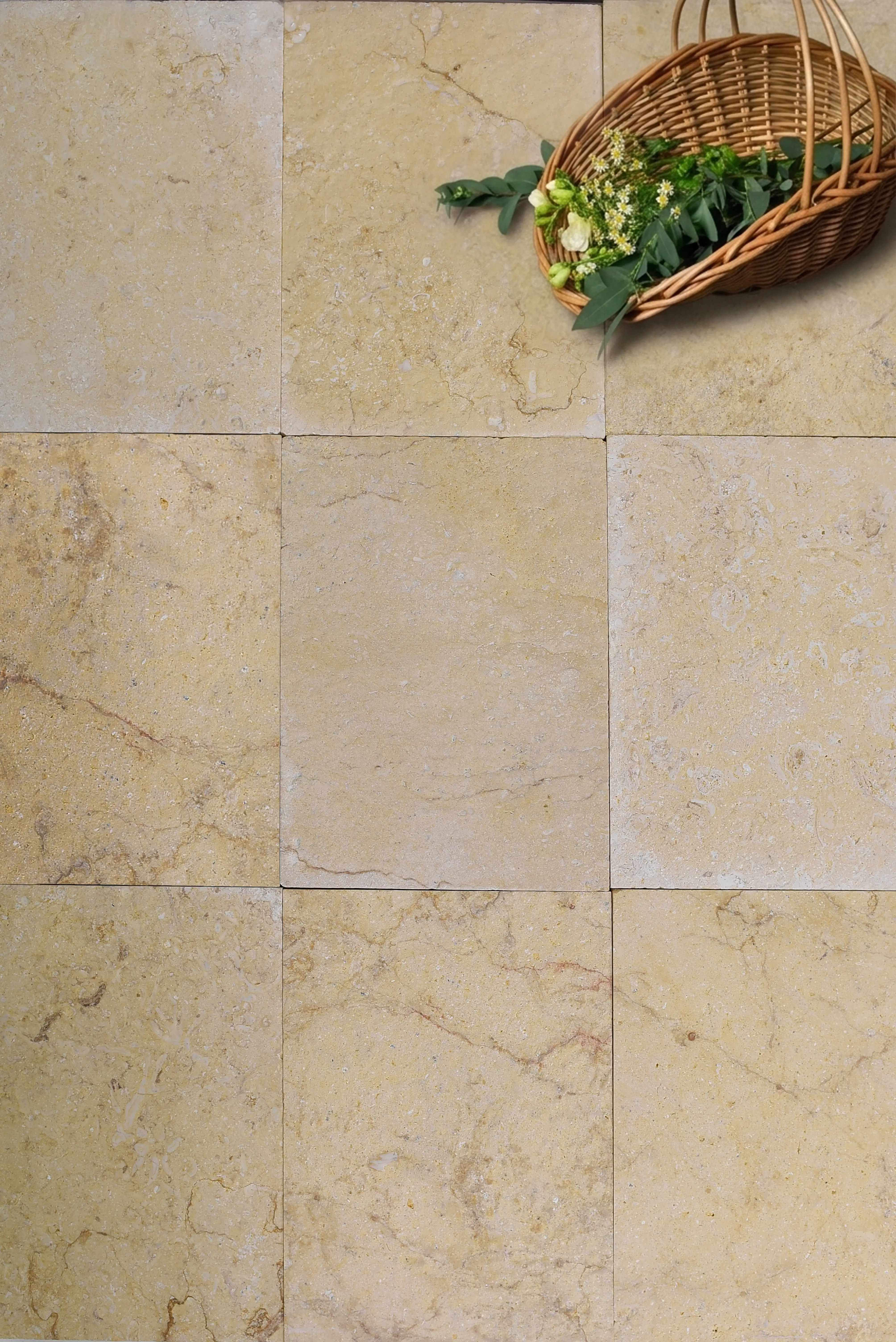
Travertine tile installation cost starts with the stone itself, and the price range is wider than most buyers expect. Standard commercial-grade filled-and-honed travertine typically runs $3–$7 per square foot for the tile alone. Premium architectural grades — tighter vein patterns, minimal pitting, consistent coloration — push into the $8–$14 range. Specialty formats like large-format 24×24 slabs or hand-cut Versailles sets can reach $15–$22 per square foot for the stone before a single tool is unpacked.
You’ll also need to account for waste factor in your material order. Standard straight-set layouts require a 10–12% overage. Diagonal patterns and Versailles layouts demand 15–20% extra material to cover cut waste at perimeters and corners. Ordering short on a premium-grade travertine is a real budget risk — matching dye lots from a second order isn’t always possible, particularly on stone sourced from Middle East quarries where batch consistency varies by extraction season.
According to ASTM C1527 travertine dimension stone standards, dimensional tolerances, absorption rates, and flexural strength thresholds all factor into grade classification — and these aren’t cosmetic distinctions. Lower-grade stone with higher absorption rates requires more sealer and performs less predictably in freeze-thaw or high-traffic conditions. Moving up a grade isn’t just paying for aesthetics.
- Standard filled-and-honed travertine: $3–$7 per square foot
- Premium architectural grade: $8–$14 per square foot
- Large-format or specialty cuts: $15–$22 per square foot
- Waste factor allowance: 10–12% straight-set, 15–20% diagonal or Versailles
- Freight and delivery: typically $0.50–$1.50 per square foot depending on order volume and truck access
Labor Costs and What Determines Them
Labor is where travertine tile installation cost diverges most sharply from generic tile installation pricing. Travertine’s natural variation in thickness — a characteristic of the material, not a defect — requires back-buttering every tile individually to achieve a flat, lippage-free surface. That step alone adds 15–25% to labor time compared to installing rectified porcelain of uniform thickness.
Standard labor rates for travertine installation range from $8–$14 per square foot for straightforward flat-floor applications in most markets. Complex pattern work — Versailles, herringbone, diagonal layouts — routinely runs $14–$22 per square foot. Wet-area installations (showers, steam rooms, pool surrounds) carry a further premium of $4–$8 per square foot because waterproofing membrane application and slope management add substantial time before the first tile is set.
The installer’s experience with natural stone specifically matters here. A crew experienced with rectified porcelain but inexperienced with unfilled travertine will burn time on fill inconsistencies and thickness variation that a seasoned natural stone installer handles automatically. That experience gap can turn a three-day job into a five-day job — and day rates don’t change based on how long the job runs.
- Standard flat-floor installation: $8–$14 per square foot labor only
- Complex pattern work (Versailles, herringbone): $14–$22 per square foot
- Wet-area premium: add $4–$8 per square foot for waterproofing and slope work
- Vertical surface installation (shower walls): $16–$28 per square foot
- Mobilization and setup: $200–$600 flat fee, often absorbed into larger projects
Substrate Preparation: The Cost Nobody Budgets For
Substrate preparation is the single most underestimated line item in any travertine tile installation cost breakdown. Travertine is rigid, brittle at thin cross-sections, and highly sensitive to substrate deflection. The Tile Council of North America specifies that substrate deflection must not exceed L/360 of the span — meaning a 10-foot span can flex no more than one-third of an inch under load. Wood-framed floors frequently don’t meet this threshold without reinforcement, and discovering that mid-project is a budget emergency.
Concrete slab prep typically involves grinding high spots, filling low areas with self-leveling compound, and sometimes applying a crack-isolation membrane. Budget $1.50–$4.00 per square foot for concrete prep depending on slab condition. Wood subfloor upgrades — adding a layer of cement backer board or an uncoupling membrane like Schluter Ditra — run $2.00–$5.00 per square foot in materials and labor combined. On projects where the subfloor needs structural reinforcement (sistering joists, adding blocking), costs climb significantly and should be assessed by a structural professional before stone installation begins.
According to the Tile Council of North America installation standards, proper substrate preparation is the foundational requirement for long-term natural stone performance — and failures traced back to inadequate substrate prep are not covered by stone manufacturer warranties. Your substrate investment is non-negotiable; it’s what your stone sits on for the next several decades.
- Concrete slab prep (grinding, leveling): $1.50–$4.00 per square foot
- Crack-isolation membrane application: $0.75–$1.50 per square foot
- Cement backer board installation (wood subfloors): $1.50–$3.00 per square foot
- Uncoupling membrane (Schluter Ditra or equivalent): $2.00–$4.00 per square foot installed
- Structural subfloor reinforcement: highly variable — get a structural assessment before budgeting
Soil and Subgrade Conditions for Exterior Installations
Outdoor travertine tile installation cost carries a variable that interior projects don’t face: the ground underneath moves. Soil composition affects how your base performs over time, and different soil types create fundamentally different engineering challenges for any stone installation.
Expansive clay soils — common across central and southwestern regions of the country — swell with moisture and shrink during dry periods, creating a substrate that cycles through vertical movement seasonally. Stone installed directly over an inadequately compacted clay base will develop differential settlement, leading to cracked tiles and failed grout joints within a few years. The fix is a properly engineered aggregate base: typically 6–8 inches of compacted crushed stone over a geotextile fabric layer, which isolates the pavement from soil movement below. That base adds $3–$6 per square foot to exterior installation cost, but it’s the difference between a durable installation and a recurring repair bill.
Sandy soils drain well but shift under load without adequate compaction and confinement. Rocky or caliche-heavy soils present the opposite challenge — excavation becomes expensive when equipment hits hardpan, and the cost per square foot of grading work can spike significantly in those conditions. At Citadel Stone, we advise project managers to commission a simple soil assessment before finalizing their exterior stone budget, because subgrade surprises after mobilization are far more expensive to address than a pre-project site evaluation.
- Expansive clay soils require engineered aggregate base: add $3–$6 per square foot for exterior projects
- Sandy soils need compaction verification and edge confinement to prevent lateral creep
- Caliche and rocky subgrades increase excavation costs — budget for equipment time
- Geotextile fabric layer beneath aggregate base: $0.30–$0.60 per square foot, essential for clay and silty soils
- Drainage slope design (minimum 1/8 inch per foot away from structures) affects grading labor cost
Grout, Mortar, and Setting Material Costs
Setting materials for travertine tile installation cost more than equivalent products specified for ceramic or porcelain. Travertine requires a polymer-modified, non-sag medium-bed mortar to accommodate its thickness variation and to achieve the back-butter coverage that prevents hollow spots. Standard thin-set is not an appropriate specification for travertine tiles larger than 12×12 — a detail that some installers overlook to their clients’ long-term detriment.
Medium-bed polymer mortars run $35–$55 per 50-pound bag, covering roughly 40–60 square feet at proper coverage depth. Your grout selection also matters: unsanded grout for joints under 1/8 inch, sanded epoxy or cement grout for wider joints. Epoxy grout — often specified for high-traffic or wet areas — runs considerably higher at $80–$130 per unit versus $15–$35 for cement-based products. Budget $1.00–$2.50 per square foot for all setting materials combined on a standard residential floor installation.
You can check current travertine tile costs at Citadel Stone to align your material budget with actual product pricing before finalizing your specification. Getting the stone cost confirmed early lets you allocate the remaining budget to setting materials, labor, and substrate prep with confidence.
Sealer Application Costs and Ongoing Maintenance
Sealer is a mandatory cost in every travertine installation, not an optional upgrade — and it belongs in your initial travertine tile installation cost breakdown, not as an afterthought. Travertine is a calcium carbonate-based stone with a naturally porous surface structure. The Natural Stone Institute’s guidance on travertine properties confirms that its absorption characteristics require penetrating impregnator sealers to prevent staining, efflorescence migration, and moisture-related surface degradation.
First-application sealing typically requires two coats applied within 24 hours of each other, after the mortar has fully cured (allow 28 days minimum for full cure on medium-bed mortars). Professional sealer application runs $0.75–$1.50 per square foot for labor and materials on first application. Budget for re-sealing every two to four years depending on traffic and exposure — exterior installations in high-rainfall regions or areas with heavy foot traffic will need more frequent attention than sheltered interior applications.
Unfilled travertine requires an additional step: filling the natural voids with grout or a stone-specific filler before sealing. That process adds $0.50–$1.25 per square foot in labor time and is often skipped by inexperienced crews, resulting in voids that trap debris and moisture over time. Specify filled travertine tile if you want to avoid that field step — or confirm explicitly that the installation crew has a proven void-filling protocol before work begins.
- Professional first-application sealing: $0.75–$1.50 per square foot
- Penetrating impregnator sealer (owner-purchased): $0.20–$0.60 per square foot in materials
- Void-filling for unfilled travertine: add $0.50–$1.25 per square foot
- Re-sealing interval: every 2–4 years depending on traffic and exposure conditions
- Efflorescence treatment (if present): $0.40–$0.80 per square foot for professional application
Pattern Complexity and Its Cost Impact
Layout pattern is one of the most direct levers you control in managing travertine tile installation cost — and the cost difference between a simple and complex pattern is larger than most project owners anticipate. A straight-set grid using a single tile size is the most efficient installation geometry: cuts are predictable, waste is minimal, and a skilled crew can move at a steady pace. Diagonal installations increase cut frequency at every perimeter and add roughly 20–30% to labor time on comparable square footage.
Versailles patterns — the four-size mixed format common in classical European-style installations — require precise layout planning, constant size verification during installation, and significantly higher cut complexity. Labor rates for Versailles work typically run 60–80% above straight-set rates for the same square footage. The waste factor also climbs: 18–22% is realistic for a well-executed Versailles layout, compared to 10–12% for a straight grid.
Decorative borders, medallions, and inlaid feature strips add further cost that should be estimated separately from field tile. A typical custom travertine border strip runs $25–$60 per linear foot installed, and a custom medallion can run $400–$2,000 depending on complexity and piece count. These are premium features worth budgeting explicitly rather than estimating as part of the field tile rate.
- Straight-set single size: baseline labor rate, 10–12% waste factor
- Diagonal pattern: add 20–30% to labor, 15–18% waste factor
- Versailles four-size pattern: add 60–80% to labor, 18–22% waste factor
- Custom border strips: $25–$60 per linear foot installed
- Custom medallions: $400–$2,000 depending on design complexity
Total Installed Cost Ranges by Project Type
Pulling all cost components together, total installed travertine tile installation cost typically falls in the following ranges by application type. These figures include stone material, setting materials, standard substrate preparation, labor, and first-application sealing — but not structural subfloor work, decorative pattern premiums, or extraordinary subgrade conditions.
Interior residential floors in a straight-set layout with standard-grade filled travertine: $14–$22 per square foot all-in. Premium-grade stone with a Versailles pattern: $26–$42 per square foot. Exterior terrace installations on a concrete slab with standard preparation: $18–$28 per square foot. Exterior installations requiring engineered aggregate base over expansive soil: $22–$35 per square foot. Wet-area shower installations with full waterproofing membrane: $28–$48 per square foot depending on surface complexity and tile size.
Citadel Stone maintains warehouse stock of travertine tile in standard formats, which reduces lead times significantly compared to special-order imports — typically 1–2 weeks from confirmed order to truck delivery versus 6–10 weeks for imported-to-order material. That lead-time advantage directly affects project scheduling, especially when contractor availability and installation windows are tight. Factor warehouse availability into your project timeline alongside the cost components — delays cost money in contractor holding fees and project overhead just as surely as material price per square foot does.
- Interior residential floor, standard grade, straight-set: $14–$22 per square foot all-in
- Interior floor, premium grade, Versailles pattern: $26–$42 per square foot
- Exterior terrace, concrete slab base: $18–$28 per square foot
- Exterior terrace, engineered aggregate base: $22–$35 per square foot
- Wet-area shower installation with waterproofing: $28–$48 per square foot
Building an Accurate Travertine Installation Budget
Getting a travertine tile installation cost breakdown right means accounting for every layer — from the soil beneath the slab to the sealer protecting the surface. The projects that finish on budget are almost always the ones where the substrate was assessed early, the pattern was chosen with full awareness of its labor implications, and the sealer and setting materials were specified alongside the stone rather than selected as afterthoughts at the job site. Skipping any of these steps doesn’t reduce the cost — it just delays it.
Your finish selection is another dimension worth exploring carefully before ordering. The finish affects both the installation protocol and the long-term maintenance requirement, which compounds over the life of the installation. For a detailed look at how polished finishes compare to honed and brushed options in terms of performance expectations and care protocols, polished travertine finish considerations covers the specification details worth reviewing before you commit to a surface type. Beyond the stone itself, Citadel Stone outlines how substrate prep, pattern complexity, and sealer application each add measurable labor cost to travertine installations.
Related reading: gray travertine tile ideas · travertine look porcelain tile comparison · how to seal travertine tile.