













50 Years Of Manufacturing & Delivering The Highest-Quality Natural Stone. Sourced & Hand-Picked From The Middle East.

Escrow Payment & Independent Verifying Agent For New Clients

Contact Me Personally For The Absolute Best Wholesale & Trade Prices:

USA & Worldwide Hassle-Free Delivery Options – Guaranteed.

Slate Flagstone in Arizona

Contractors and landscape architects specifying slate flagstone in Arizona will find direct supply through Citadel Stone, with gauged and irregular formats held in regional inventory to support both residential patios and large-scale commercial hardscape without extended lead times. Citadel Stone Slate Flagstone in Arizona is available in thickness profiles ranging from 3/4-inch to 1.5-inch, with cleft and honed surface options suited to the traction and aesthetic demands common across Phoenix, Tucson, and Scottsdale projects. What many buyers overlook before ordering is how Arizona's expansive clay and caliche-heavy soils directly influence the base depth and material thickness needed for long-term stability — a specification detail that affects both material cost and performance. Builders and designers in Phoenix, Tucson, and Scottsdale source Slate Flagstone through Citadel Stone for Arizona residential and commercial work.

See & Feel the Quality – Free Arizona Stone Samples

Our stones are made for the Arizona sun. See how the colors hold up in your specific light.

Design Your Arizona Home with a Local Stone Expert

Get personalized advice on the best stone for Arizona's climate and your design style.

Premium Natural Stone — All Sizes & Thicknesses Available

From standard cuts to fully custom dimensions — our limestone, granite, basalt & shellstone
are cut to your exact specifications. Residential or commercial, we’ve got you covered.

Showing all 69 resultsSorted by popularity

Get Your Free Arizona Stone Quote

Transparent Pricing for Your Arizona Project

Elevate Your Arizona Property with Premium Stone, Priced for Value.

Unlock $10,000 Worth of Deals on Beautiful Paver, Tiles & Cobble Setts—For Free!

Invest in Arizona’s Landscape: Stone That Lasts a Lifetime.

100% Happiness Guarantee

Trust 50 Years of Expertise. Invest in Quality Limestone Tiles

Custom-Cut for Your Arizona Project: Any Size, Any Finish.

No-Obligation Consultation: Get Expert Advice for Your Arizona Home.

The Stone Supplier Trusted by Arizona's Leading Architects & Designers.

Arizona's Most Diverse Selection of Natural Stone.

Elevate Your AZ Property with Natural Stone Built for the Desert. Our expansive collection of Natural Stone brings timeless beauty and proven durability to both residential and commercial spaces across Arizona. As the state’s leading supplier, we offer a diverse palette of colors and finishes—from cool, light tones that reflect the sun to rich, earthy textures that complement the Southwest landscape. Transform your environment with limestone that stands up to the Arizona heat while providing the sophisticated aesthetic you desire.

Incredible Prices for Top-Quality Stone—Shop Citadel Stone Today!

Table of Contents

Subgrade failure is the most common reason slate flagstone installations in Arizona underperform — and it almost never gets attributed correctly. Homeowners blame the stone, contractors blame the weather, but the real culprit is usually the soil underneath. Understanding how Arizona’s ground conditions interact with slate flagstone in Arizona from the moment you break ground determines whether your installation holds its geometry for two decades or starts rocking and separating within five years.

The soil profile across most of Arizona is deceptively challenging. Expansive clays sit beneath a thin surface layer in the Phoenix metro, decomposed granite dominates Scottsdale’s residential corridors, and caliche hardpan appears at unpredictable depths throughout southern Arizona. Each of these conditions creates a different failure mechanism for flagstone installations — and each requires a different base response. Before you finalize your specification, you need to know exactly what’s below grade on your specific site, not just what’s typical for your zip code.

Arizona Soil Conditions and How They Affect Slate Flagstone Performance

Slate flagstone in Arizona sits on one of three dominant soil profiles, and your installation method needs to match the one beneath your project — not a generic southwestern average. Expansive clay soils, which are common in the East Valley and parts of Tucson, absorb moisture and swell significantly. That vertical movement, even a fraction of an inch at the surface, is enough to pop mortar joints, crack grout lines, and lift individual flags unevenly. Slate’s laminated structure gives it good tensile behavior, but it’s not immune to hydraulic uplift from clay expansion below.

Decomposed granite — the reddish, gravelly subgrade you’ll encounter constantly across Scottsdale and Peoria — behaves better overall, but it has its own quirk: it compacts inconsistently. You can achieve 95% compaction in one area and drop to 87% just three feet away because of natural variation in particle size and organic content. That inconsistency translates directly into differential settlement under slate flag stones in Arizona, which creates those frustrating low spots and tilted flags that appear in the second or third year after installation. The fix isn’t more stone — it’s more rigorous subgrade testing before you lay a single piece.

Caliche hardpan is a different problem altogether. It looks like a stable base, and in dry conditions it performs adequately. But caliche is calcium carbonate, and it can soften under concentrated moisture — especially when irrigation runoff or seasonal rain saturates the zone. Flags installed over untreated caliche in poorly drained areas often sink into pockets rather than lifting uniformly, which creates a specific wavy-surface failure that’s difficult to repair without removing everything. Always scarify or fracture caliche layers before compacting your aggregate base on top.

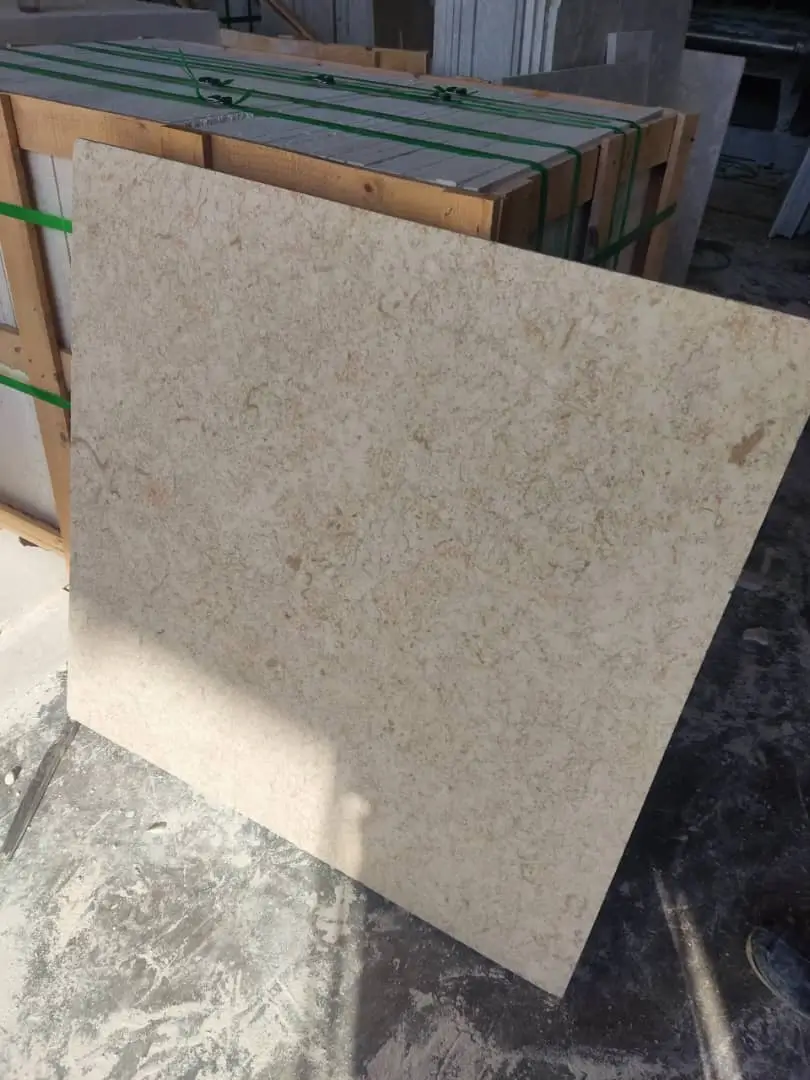
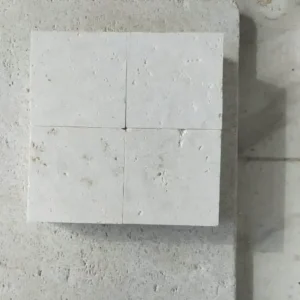
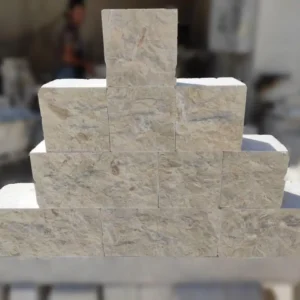
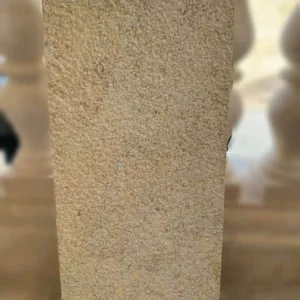
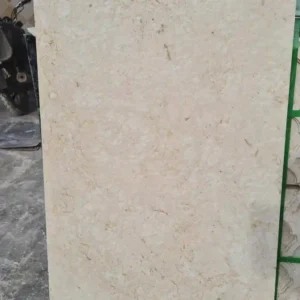
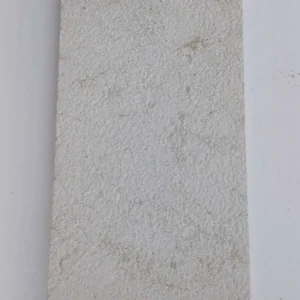
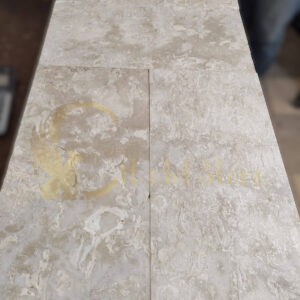
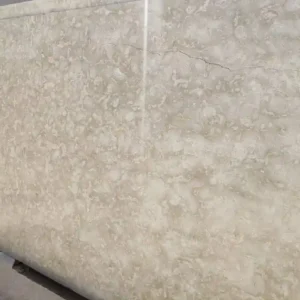
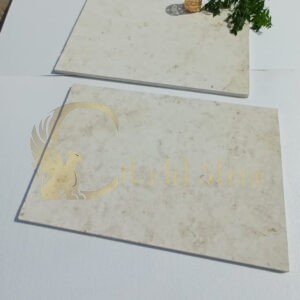
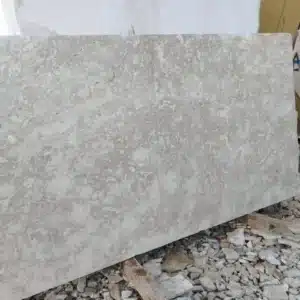
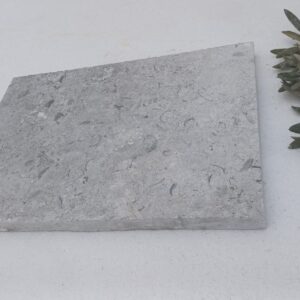
Close-up of a pale flagstone slab with natural veins and subtle texture.

Slate Flagstone Color Varieties and Finish Options for Arizona Projects

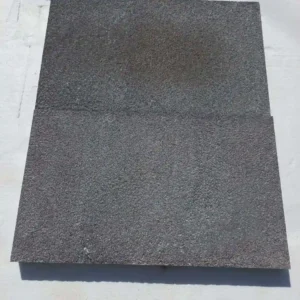
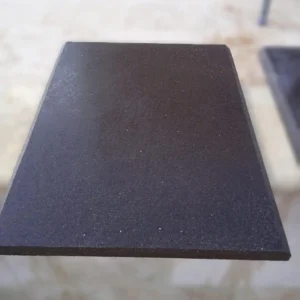
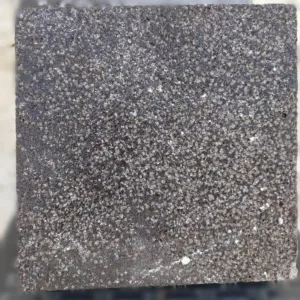
Natural slate flagstone in Arizona is available in a wider color range than most buyers expect when they first start sourcing. Black slate flagstone in Arizona projects tends to polarize specifiers — some love the dramatic contrast against desert landscaping, others worry about heat absorption. Both reactions are reasonable, but the thermal concern is more manageable than it sounds when you factor in finish selection and irrigation buffer zones. A natural cleft finish on black slate scatters radiant heat rather than concentrating it at the surface the way a honed finish does, which makes a meaningful difference in barefoot comfort during afternoon hours.

Blue slate flagstone in Arizona is one of the most requested color variants for contemporary residential patios, and for good reason. The cool blue-grey tones read as sophisticated against both desert-neutral stucco and warmer sandstone architectural palettes. Blue slate walkway installations in Arizona particularly benefit from this colorway — the visual contrast against surrounding decomposed granite landscaping stays sharp even after years of UV exposure because slate’s mineral pigmentation runs through the full depth of the stone rather than sitting at the surface like a coating.

Grey slate flagstones in Arizona and slate grey flagstone variants occupy the middle ground — versatile enough to work with almost any architectural context and popular enough that you’ll find good inventory availability in standard format sizes. Slate gray flagstone in Arizona is often the default choice for designers who want natural stone character without a strong directional color statement. For landscape slate slabs in garden applications, this neutral palette ages well because it doesn’t show the white efflorescence deposits that can make darker stones look unkempt during their first few wet seasons.

  • Black slate: maximum contrast, natural cleft finish recommended for heat management in full-sun exposures
  • Blue slate: cooler visual temperature, performs well in contemporary and transitional architectural contexts
  • Grey and slate-grey variants: broadest design compatibility, most commonly stocked in multiple thicknesses
  • Multi-color natural slate: blends red, green, and grey tones for a more organic, informal aesthetic suited to garden settings
  • Citadel Stone stocks these primary colorways in warehouse inventory to support consistent batch delivery across Arizona projects

According to slate’s metamorphic rock properties and paving durability data, the mineral composition responsible for slate’s characteristic cleavage planes — primarily fine-grained muscovite and chlorite — also produces the color differentiation that makes each slab visually distinct. That variability is a feature, not a defect. Managing expectations around natural color variation is worth addressing with clients early — no two slabs will be identical, and that’s precisely what separates natural slate flagstone from manufactured concrete alternatives.

Base Preparation and Drainage Engineering for Arizona Slate Installations

Your base specification needs to be more aggressive in Arizona than standard national guidelines suggest — because standard guidelines were written for more temperate soil conditions. The combination of expansive clay behavior, aggressive monsoon drainage events, and low ambient humidity that dries subgrade materials unevenly means that a 4-inch compacted aggregate base, while adequate in moderate climates, frequently undershoots what Arizona soil profiles demand.

For dry-lay outdoor slate paving slabs in Arizona over expansive clay subgrade, target a minimum 6-inch compacted class II aggregate base, tested to 95% modified Proctor density. On sites with documented high plasticity index values — anything above PI 15 — consider a 2-inch cement-treated base layer beneath the aggregate before you start building up. That extra step adds cost upfront but eliminates the most common failure mode in Arizona flagstone work. The cement stabilization prevents the clay from wicking moisture up into the aggregate layer during monsoon saturation events, which is when most base failures initiate.

Drainage geometry matters as much as base depth. A minimum 1.5% cross-slope on the flagstone surface is the floor for Arizona conditions — not the target. In areas that receive concentrated roof runoff or irrigation discharge, stepping up to 2% slope keeps water moving off the surface fast enough to prevent saturation of the joint material. For a blue slate walkway in Arizona that runs parallel to a building foundation, maintaining that slope consistently along the full run is critical because the foundation zone typically accumulates moisture from multiple sources simultaneously.

  • Minimum base depth: 6 inches compacted aggregate over expansive clay; 4 inches minimum over stable decomposed granite
  • Target compaction: 95% modified Proctor density, verified by nuclear gauge or sand-cone test — not estimated by feel
  • Geotextile fabric: place between native soil and aggregate on clay sites to prevent migration and contamination of the base layer
  • Cross-slope minimum: 1.5% for patios and garden slate paving slabs in Arizona, 2% for areas receiving concentrated runoff
  • Expansion joints: every 12 feet in mortar-set applications — not the 16-20 feet cited in generic specs designed for milder climates

Outdoor slate paving slabs set in mortar over a concrete slab require a different analysis entirely. The slab’s own thermal movement becomes the dominant force, and you need to verify that the concrete’s control joint layout aligns with your flagstone field joints. Misaligned joints mean the concrete’s crack pattern eventually reflects through the slate, typically within three to five seasonal cycles. This is one of the most preventable failures in slate flagstone flooring installations, and it’s also one of the most commonly overlooked details during installation planning.

Thickness Selection and Load Capacity for Outdoor Slate Slabs

Thickness selection for outdoor slate slabs in Arizona isn’t just a structural calculation — it’s also a soil interaction decision. Thinner slate in the 3/4-inch to 1-inch range behaves adequately over rigid concrete substrates, but over compacted aggregate it requires a tighter support spacing to prevent flex cracking under point loads. The soil’s bearing capacity directly determines how much of the load gets transferred to the stone itself versus distributed through the base.

For pedestrian-only applications over well-prepared aggregate bases, 1-inch nominal thickness is a reliable minimum for most slate flagstone specifications. For areas that see occasional vehicular access — golf carts, light service vehicles — step up to 1.5-inch minimum and verify that your aggregate base can sustain the load without localized compression. Flagstaff installations have an additional consideration: the higher elevation means freeze-thaw cycling is a real factor, and thicker slate outdoor paving slabs in Arizona with sealed edges handles ice lens formation more reliably than thinner, unsealed flags.

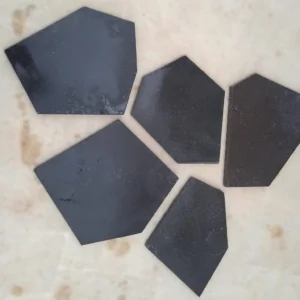
Irregular slate patio formats in Arizona — the random shapes that create that naturalistic, hand-laid aesthetic — introduce a specific thickness challenge. Because irregular pieces vary in both size and shape, their effective span between support points varies too. Larger irregular flags with unsupported spans exceeding 18 inches should be specified at 1.25-inch minimum thickness to account for bending stress at midspan. This is a detail that often gets missed when buying irregular slate paving slabs based purely on square footage without reviewing maximum piece dimensions.

  • 3/4 inch: indoor slate flagstone flooring only, or mortar-set over rigid concrete with full back-butter coverage
  • 1 inch nominal: standard pedestrian outdoor use over properly prepared aggregate base
  • 1.25 inch: irregular large-format pieces, high-traffic pedestrian zones, or areas with marginal soil bearing capacity
  • 1.5 inch and above: light vehicle traffic, commercial applications, or sites with known subgrade variability
  • Request thickness specification sheets from Citadel Stone before finalizing your order — available for all stocked slate flagstone formats

Dry-Lay vs. Mortar-Set: Choosing the Right Method for Arizona Ground Conditions

The choice between dry-lay and mortar-set for slate flagstone in Arizona comes down to one question more than any other: how confident are you in the subgrade stability beneath your project? Mortar-set installations deliver a rigid, stable surface with consistent joint widths and excellent aesthetics — but they’re unforgiving when the ground moves. A dry-lay installation over a well-prepared base absorbs modest subgrade settlement without cracking, at the cost of some joint consistency and the need for occasional releveling over time.

Arizona’s expansive clay zones genuinely favor dry-lay in many residential applications because the soil movement is ongoing and unpredictable. Even well-compacted clay subgrades experience seasonal volumetric change as moisture content fluctuates through the monsoon cycle. A dry-lay irregular slate patio in Arizona can accommodate that movement without visible damage; a mortar-set version will begin showing hairline cracks in joints within two to three years unless the base system effectively isolates the paving layer from soil movement.

For indoor slate flagstone flooring or covered outdoor spaces with a concrete slab substrate, mortar-set is clearly the better technical choice. The slab provides the rigid, stable base that mortar-set requires, and you get the full aesthetic benefit of consistent joint widths and a cleaner finished surface. Use a polymer-modified mortar mix rated for exterior stone applications, and never let your mortar bed exceed 1.25 inches in thickness without a mechanical key or bonding agent — otherwise you create a weak plane that delaminates under differential thermal movement. For projects requiring technical specification detail on slate products for Arizona conditions, Slate Flagstone from Citadel Stone provides maintenance and care guidance that directly informs both method selection and long-term upkeep planning — understanding what the material needs after installation helps you make a better decision about the setting method before installation begins.

Sealing Protocols and Joint Maintenance for Arizona’s Climate

Slate’s relatively low water absorption — typically 0.4–0.9% by weight for quality paving-grade material — makes it more resistant to moisture damage than many other natural stones. But that doesn’t mean sealing is optional in Arizona conditions. The real threat isn’t moisture absorption into the slate body; it’s the mineral salts dissolved in Arizona’s alkaline groundwater that migrate upward through joints and deposit as efflorescence on the stone surface. Sealing the joint perimeter and the stone face together is what interrupts that migration path.

Use a penetrating silane-siloxane sealer rather than a film-forming acrylic product for outdoor slate outdoor slabs in Arizona. Film-forming sealers trap moisture vapor that rises from the subgrade during temperature swings — and in Arizona, those swings are significant. When trapped vapor can’t escape, it creates hydrostatic pressure beneath the sealer film, causing peeling and blistering that accelerates rather than prevents surface degradation. A penetrating sealer allows vapor transmission while blocking liquid water intrusion, which is exactly the balance Arizona’s drying and rewetting cycles demand.

Joint sand in dry-lay slate flagstone installations needs attention every three to four years in Arizona — not the five to seven year cycle appropriate for more temperate climates. The combination of UV degradation of organic binders in polymeric sand, wind scour, and aggressive ant activity in the desert environment depletes joint fill faster here than anywhere else in the country. Keeping joints filled to 90–95% capacity prevents the edge chipping and flag wobble that compound over time into a full-scale releveling project.

  • Apply penetrating sealer within 30 days of installation completion, after joints have fully cured
  • Reapply sealer every two years in full-sun exposures, every three years in shaded or covered areas
  • Check joint fill depth annually — refill any joints that have dropped below 80% capacity
  • For mortar-set applications, inspect grout joints for hairline cracks every spring before monsoon season arrives
  • Clean slate flagstone surfaces with pH-neutral stone cleaner only — acidic cleaners etch the surface and open the pore structure to staining

The ASTM C629 standard specification for slate dimension stone establishes minimum absorption, modulus of rupture, and flexural strength thresholds that quality paving-grade slate should meet. Verifying that your slate source meets these benchmarks isn’t overcautious — it’s the baseline for any specification that’s expected to perform for twenty-plus years in demanding conditions.

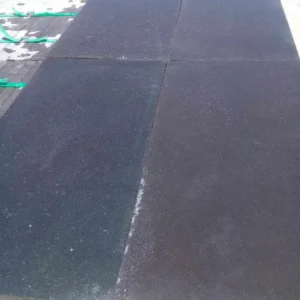
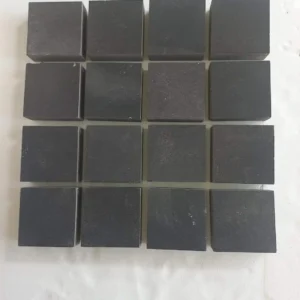
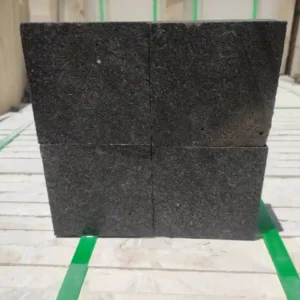
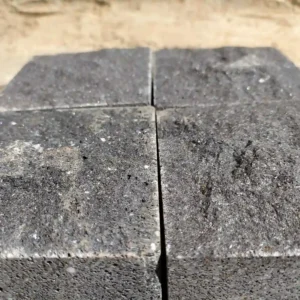
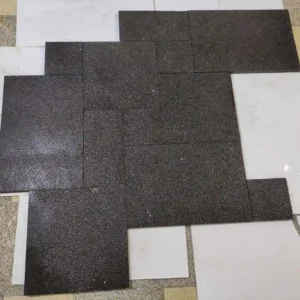
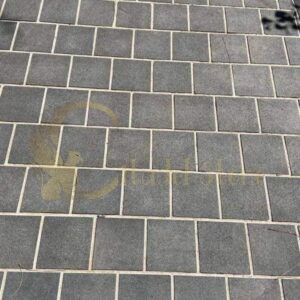
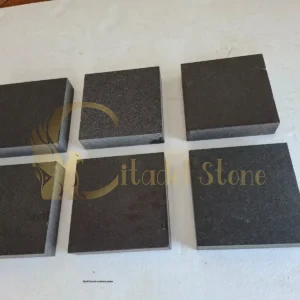
Dark grey stone pavers laid in a grid pattern outdoors

Landscape, Garden, and Walkway Applications Across Arizona

Outdoor slate slabs in Arizona appear in a wider range of applications than most specifiers initially consider. Beyond the standard patio or entry sequence, slate flagstone performs exceptionally well as garden slate paving slabs in Arizona’s drought-tolerant landscape installations — the irregular formats and natural texture integrate visually with decomposed granite mulch beds and native plantings in a way that manufactured concrete pavers simply can’t replicate. The material’s earthy color range spans naturally through the same visual palette as the surrounding desert environment.

A slate flagstone walkway in Arizona’s residential landscape settings benefits from the material’s natural cleft surface texture, which provides inherent slip resistance without requiring a factory-applied non-slip treatment. ASLA natural stone walkway design guidance reinforces the value of naturally textured surface finishes in reducing slip risk on outdoor walking surfaces — a relevant consideration for early morning installations when dew condensation briefly coats desert hardscapes before the heat burns it off. Setting stones at a consistent 1.5% slope toward the landscape ensures that brief moisture film drains quickly before foot traffic peaks.

In Mesa, where residential lot footprints tend to be generous and outdoor living spaces large, landscape slate slabs in Arizona are frequently specified in generous format sizes — pieces ranging from 18×24 inches up to 24×36 inches — to maintain visual scale in expansive patio contexts. Those larger formats demand careful base preparation because the increased span between support points amplifies any subgrade inconsistency. Sorting your slate delivery by piece size before installation and prioritizing larger flags for the best-prepared sections of base is a practical field technique that prevents premature cracking.

Slate flagstone floor tiles in covered outdoor rooms and transitional indoor-outdoor spaces represent one of the most technically interesting applications because you’re managing two different exposure environments simultaneously. The covered portion experiences minimal UV and moisture, while the uncovered portion takes full desert exposure. Specifying a consistent thickness across both zones and using the same sealer product with adjusted reapplication intervals — more frequent in the exposed section — keeps the visual and structural performance unified across the threshold. Slate flagstone flooring in these transitional settings also benefits from the same base depth standards applied to fully exposed outdoor areas, since the substrate beneath remains subject to Arizona’s soil movement regardless of overhead cover.

  • Garden slate paving slabs: irregular formats in 1-inch thickness work well with decomposed granite surrounds and native planting beds
  • Slate flagstone walkway: natural cleft finish provides adequate slip resistance without factory treatments in pedestrian-only applications
  • Landscape slate slabs in large-format outdoor rooms: verify base preparation quality matches piece size to prevent midspan flex cracking
  • Slate flagstone floor tiles in transitional indoor-outdoor spaces: uniform thickness specification with zone-adjusted maintenance schedules
  • Outdoor slate paving slabs in pool surrounds: verify non-slip rating meets local requirements and use appropriate poolside joint filler

Order Slate Flagstone in Arizona — Nationwide Delivery from Citadel Stone

Citadel Stone stocks slate flagstone in Arizona in the primary colorways — black, blue, grey, and natural multi-color — across standard thicknesses from 3/4 inch through 1.5 inch nominal. Formats range from regular cut pieces in standard dimensional sizes to genuine irregular flagstone suitable for naturalistic patio and garden applications. You can request sample tiles or thickness specification sheets before committing to a full project order, which is the right approach for any specification involving natural stone where batch color consistency and precise thickness tolerances matter. Our team inspects incoming shipments from established quarry partners for surface integrity, thickness consistency, and color uniformity before product enters warehouse inventory — so what you receive matches what you specified.

Trade and wholesale enquiries are welcome. Contractors, landscape architects, and designers working on large-format projects can request project-specific pricing and discuss material allocation from current warehouse inventory. Lead times for stocked colorways and thicknesses typically run one to two weeks from order confirmation to truck delivery across Arizona — significantly shorter than the six to eight week import lead time most projects face when sourcing directly overseas. For projects requiring non-standard sizes, custom cuts, or specialty finishes, Citadel Stone’s team can advise on lead time adjustments and minimum order quantities before you finalize your project schedule.

Coverage across Arizona includes metro Phoenix, Tucson, and all regional markets. Slate flagstones for sale in Arizona through Citadel Stone are available for both trade accounts and direct residential projects — you can contact the team to request a quote, discuss your specification, or schedule a consultation for projects with complex layout or volume requirements. Planning your slate flagstone order around confirmed warehouse availability — rather than estimated import timelines — keeps your project schedule protected through the critical installation window. As you develop your full Arizona hardscape specification, limestone flagstone options in Arizona offer a complementary product family worth reviewing when client preferences span multiple stone types across Sedona hospitality projects, Yuma commercial installations, or Flagstaff residential work where elevation and freeze-thaw considerations influence material selection. Slate Flagstone from Citadel Stone reaches project sites across Flagstaff, Sedona, and Yuma and throughout Arizona.

Why Arizona’s Builders Choose Citadel Stone?

Free AZ Comparison: Citadel Stone vs. Other Suppliers—Find the Best Value!

FeaturesCitadel StoneOther Stone Suppliers
Exclusive ProductsOffers exclusive natural stones sourced from selected quarriesTypically offers more generic or widely available stone options
Quality and AuthenticityProvides high-grade, authentic natural stones with unique featuresQuality varies; may include synthetic or mixed-origin stone materials
Product VarietyWide range of premium productsProduct selection is usually more limited or generic
Global DistributionDistributes stones internationally, with a focus on providing consistent qualityOften limited to local or regional distribution
Sustainability CommitmentCommitted to eco-friendly sourcing and sustainable production processesSustainability efforts vary and may not prioritize eco-friendly sourcing
Customization OptionsOffers tailored stone solutions based on client needs and project specificationsCustomization may be limited, with fewer personalized options
Experience and ExpertiseHighly experienced in natural stone sourcing and distribution globallyExpertise varies significantly; some suppliers may lack specialized knowledge
Direct Sourcing – No MiddlemenWorks directly with quarries, cutting unnecessary costs and ensuring transparencyOften involves multiple intermediaries, leading to higher costs
Handpicked SelectionHandpicks blocks from quarries and hand select paver and tile post manufacture for quality and consistency. Ensuring only the best materials are chosenSelection standards vary, often relying on non-customized stock
Durability of ProductsStones are carefully selected for maximum durability and longevityDurability can be inconsistent depending on supplier quality control
Vigorous Packing ProcessesUtilizes durable packing methods for secure, damage-free transportPacking may be less rigorous, increasing the risk of damage during shipping
Citadel Stone OriginsKnown as the original source for unique limestone tiles from the Middle East, recognized for authenticityOrigin not always guaranteed, and unique limestone options are less common
Customer SupportDedicated to providing expert advice, assistance, and after-sales supportSupport quality varies, often limited to basic customer service
Competitive PricingOffers high-quality stones at competitive prices with a focus on valuePrice may be higher for similar quality or lower for lower-grade stones
Escrow ServiceOffers escrow services for secure transactions and peace of mindTypically does not provide escrow services, increasing payment risk
Fast Manufacturing and DeliveryDelivers orders up to 3x faster than typical industry timelines, ensuring swift serviceDelivery times often slower and less predictable, delaying project timelines

Extra Benefits

Choosing Citadel Stone offers unique advantages beyond premium stone quality:

Exclusive Access to Durable Stones

Citadel Stone specializes in unique, regionally exclusive stones, sourced directly from the Middle East.

Transparent Pricing – No Hidden Costs

With no middlemen, Citadel Stone provides direct, transparent pricing that reduces unnecessary costs.

Flexible Customization for Bespoke Projects

Tailor your order to precise specifications, from sizes to finishes, ensuring your project aligns perfectly with your vision.

Streamlined Delivery & Reliable Stock Availability

Benefit from fast production and delivery timelines, designed to minimize delays and ensure reliable availability.

The Preferred Stone Supplier for Luxury AZ Developments.

Scale Your Vision: We Support Arizona's Largest Projects with Reliable, Fast Delivery.

With unlimited tiles, pavers, cobble setts, curbstones, and the fastest delivery options, What’s not to love? Say goodbye to unnecessary hassles!

Leading AZ Stone Suppliers are Loving Citadel Stone!

Don’t Settle for Less. Source the Best Stone for Your Local Stone Expert.

DanielOwner
Thank you, Kareem. We received the order. The stones look great!
FrankOwner
You are a good businessman and I believe a good person. I admire your honesty, this is why I call you a good businessman.
Gemma C
Gemma CPrivate Project
Undoubtedly the price was the reason that we chose Citadel stone, in addition to the fact that you offer a white limestone that is hard to source. Your products are very good value for money by comparison with other companies. You have helped at every stage of the process and have been quick and reliable in your responses. It was a big risk for us to pay everything up front including shipping and not know the quality. You did make me feel that I could trust you and your company however and we are very happy with the tiles. They appear to have been finished to a very high quality of smoothness and I can't wait to see them once they have been laid. We need to see now how easy they are to fit and maintain, yet you also sealed them before shipment so we think that they will be very durable. Our building project has been delayed for a few months now so it may be sometime before we see them laid, but I promise that I will send photos as soon as we have them down. Thank you so much Kareem and your team, you have done a great job. I am hoping that we can pay for, and receive our second shipment in the not too far future, so that we can finish everything off. Wishing you well. Gemma
Molly McK
Molly McKPrivate Project
I appreciate the quality of product and care for the custom order in packaging each crate to minimize breakage as well as the flexibility with the order to help us make the most of shipping. The timely communications are impressive from the beginning and throughout the process. It's reassuring to have gone through one order to know what the process will be like in the future. I am glad to have had some guidance through the importing process and recommendations for shipping partners to assist. It's incredible to think about the journey the stone traveled to get to our site and I'm grateful to have made it to the next stage of the project relatively smoothly and with from what I can tell

Frequently Asked Questions

If your question is not listed, please email us at [email protected]

How do Arizona's soil conditions affect slate flagstone installation?

Arizona’s ground composition — particularly the caliche hardpan and expansive clay soils common across the Phoenix basin and Tucson foothills — creates subgrade instability that directly impacts flagstone performance. Caliche layers resist drainage and can cause moisture to pool beneath the stone, while expansive clay swells and contracts seasonally, shifting slabs over time. Proper installation requires breaking through caliche, compacting a stable aggregate base, and in some areas, installing a sand or gravel drainage layer before setting stone. Skipping these steps is the most common reason slate flagstone installations in Arizona fail prematurely.

For residential pedestrian applications in Arizona, a minimum thickness of 3/4 inch to 1 inch is standard, while driveways or areas subject to vehicle load typically require 1.5 inches or greater. Thicker slabs also provide an advantage in environments with unstable subgrades, as they distribute weight more evenly and are less prone to cracking under point loads. The specific soil classification on a site — whether sandy, clay-heavy, or caliche-bound — should inform both the slab thickness and the depth of compacted base material beneath it.

Slate flagstone with a natural cleft finish is commonly used around Arizona pools because the textured surface provides meaningful slip resistance when wet. However, slate is a layered metamorphic stone, and prolonged saturation combined with repeated wet-dry cycles can cause delamination in lower-density material over time. Selecting a dense, high-quality slate and ensuring adequate drainage slope — typically a minimum 1/8 inch per foot away from structures — reduces moisture retention and extends the lifespan of the installation significantly.

Slate offers a harder, denser surface than most sandstone varieties, making it more resistant to surface wear in high-traffic areas, though it carries a more directional, layered aesthetic. Travertine is a popular Arizona choice for its lighter tones, but its porous structure requires sealing and ongoing maintenance in outdoor settings exposed to organic debris and pool chemicals. Slate’s relatively low porosity reduces the frequency of sealing required, though colour variation and split-face texture make it a different visual proposition — the right choice depends on aesthetic priorities, maintenance tolerance, and site drainage conditions.

Sealing slate in Arizona helps protect the surface from UV-related colour fade, dust infiltration into the cleft texture, and moisture ingress during monsoon season. A penetrating impregnating sealer is generally preferred over a topical coating for outdoor slate, as it preserves the natural texture without creating a slick film that can peel under direct sun exposure. Most Arizona installations benefit from an initial seal after the mortar or setting compound has fully cured — typically 28 days — with reapplication assessed annually based on water bead behaviour on the surface.

With fifty years of experience manufacturing and supplying natural stone, Citadel Stone’s team brings material knowledge that translates directly into better specification decisions — particularly around thickness selection and format sizing for Arizona’s variable subgrade conditions. Arizona contractors benefit from direct warehouse access to Citadel Stone’s slate flagstone inventory, bypassing import brokers and container minimums that slow procurement on time-sensitive jobs. Citadel Stone maintains consistent supply coverage across Arizona, giving buyers dependable access to the formats and finishes needed from project start through completion.