St. Kitts kept its railway when the sugar went: the narrow-gauge loop built to haul cane to the Basseterre mill, reborn as the scenic railway — open-sided carriages circling the island through cane-gone-green countryside, ghaut bridges and village crossings, with Nevis Peak and the Atlantic trading places out the windows. The corridor is the island’s heritage spine, and the ground along it — stations, crossings, viewpoints, village edges — is a stone chapter of its own. Here is the corridor guide.
Industrial heritage on the move
The railway is working industrial heritage — the region’s last operating narrow-gauge — and its conservation runs mechanical and civil at once: bridge abutments and culvert masonry from the sugar century maintained on the estate-heritage manners, station ground at the working-heritage balance — passenger duty inside historic fabric — and the corridor’s stone structures respected as the engineering-witness principle prescribes: the abutments that carried a century of cane trains outrank the timetable.
Station and boarding craft
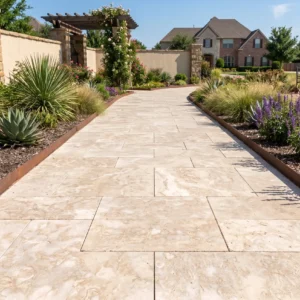
The passenger operation runs cruise-scale surges through heritage settings: boarding platforms on the excursion-arithmetic disciplines — step-free, queue-generous, shade-provided — arrival courts where coach fleets marshal on crowd-duty surfaces, hospitality moments (the rum punch is part of the gauge) on spill-forgiving stone, and the dual-audience manners where stations sit inside living villages: the excursion passes through; the village stays home.
- Design the trackside surface for a surge of passengers, not a trickle.
- Keep circulation wide where a full train unloads at one point.
- Use robust material on the boarding areas and save detail for the edges.
- Provide shade along the waiting areas rather than only at the station.
Ghauts, bridges and the mountain’s plumbing
The line crosses the island’s ghauts — the ravines that carry the volcano’s rains seaward in sudden, serious volume — and corridor works run drainage-first: culvert and bridge masonry sized to cloudburst honesty, scour protection at footings on armor-grade logic applied inland, embankment walls in the island’s dark volcanic register, and inspection rhythm keyed to the storm-season calendar: the mountain tests the corridor annually, and each wet season’s report card is written in the ghauts.
The corridor as address
Trackside is becoming frontage: villas and small resorts on the ex-estate lands composing views around the passing train — the whistle is an amenity twice a day and a location fact always — crossings serving new neighborhoods on the community-crossing manners, boundary walls holding the corridor’s line in the old estate coursing, and the vervet-country realities along the green corridor shaping every garden the rails pass. The train made the island small once for sugar; it is doing it again for scenery.
- Frame the view rather than screening the line, since the train is the attraction.
- Keep planting low along the sight line so the corridor stays legible.
- Detail the boundary to read well from a moving carriage.
- Avoid reflective surfaces facing the track, which flare in afternoon light.
Viewpoints and the photographed island
The corridor curates the island’s portraits — the Atlantic cliff moments, the cane-green sweeps to Nevis Peak, the village waves — and its public moments earn infrastructure: viewpoint pull-offs on the observation-craft rules, platform ends composed for the phone-camera century, interpretive settings on conservation-grade ground, and lighting nowhere: the corridor’s luxury is unspoiled country, and the dark-margin instinct keeps it so. The railway sells the island to every passenger; the ground at its windows is the brochure.
Serving the spine
Corridor work blends registers found nowhere else — operating railway, industrial monument, excursion product, village neighbor — and its supply runs accordingly: heritage-matched masonry for the sugar-century structures, crowd-duty station stone, armor-grade ghaut work, all landed on the federation supply line. The islands’ supply guide serves the spine with the mix the corridor demands — because the little train that outlived its industry now carries the island’s story, and the stone along the line keeps the story running on time.
The crossing keeper’s file: where road meets rail
A living railway threading a living island crosses its roads dozens of times, and the corridor’s safety craft concentrates at those meetings. The crossings’ engineering is ground craft first: approach surfaces that give drivers clear sight-triangles and honest braking texture, the rail seat itself paved flush so cars, cycles and the corridor’s farm traffic cross without jolt or snag, drainage that keeps the crossing’s geometry true through the ghaut-country rains, and the signage-and-marking layer maintained with the seriousness a moving train commands. The operational layer completes it: the railway’s published schedule keeps the island’s drivers calibrated, train crews work the horn discipline at every masked approach, and the crossings nearest villages get the fuller treatment — gates or flagging at event times, school-run awareness in the timetable’s planning.
New development along the corridor inherits crossing duties: the freed-land subdivisions whose access meets the line negotiate their junctions with the operator early — geometry, sightlines and surfacing to the corridor’s standard — and private crossings for estate parcels carry maintenance covenants the deeds should state plainly. The heritage dimension adds its manners: crossing works respect the sugar-century masonry where the line’s original culverts and abutments frame the road, and repairs match rather than modernize the corridor’s visible fabric.
The file’s habit is the safety system: each crossing documented — geometry, surfacing, signage, last inspection — and walked on a calendar, because a tourist railway’s license to charm is a working railway’s discipline about steel meeting asphalt. The island’s little train earns its affection at every crossing it treats seriously; the ground where road meets rail is where the affection is underwritten, in stone, paint and punctual paperwork.
The industry the line was built to serve
The railway exists because of sugar, and the ground beside it still behaves like cane land. Data in the First Biennial Update Report of the Government of St. Kitts and Nevis records the decision to close a 300 year old sugar industry after the 2005 harvest, describes vegetation succession spreading across the former sugar lands and an expansion of secondary forest on the lower slopes, and notes the Central Forest Reserve covering roughly 1,250 acres as the last undisturbed tropical forest on the island.
- Expect deeply worked agricultural soils rather than undisturbed ground.
- Allow for old field drains that no current survey records.
- Plan for fast vegetation regrowth along any corridor left open.
- Read the lower slopes as recovering land rather than as stable ground.
- Treat the corridor as a linear boundary with two different land uses either side.
Bedding a surface next to a working line
Trackside ground takes vibration, occasional maintenance vehicles and periodic soaking. The overview from Use Natural Stone on paving detailing sets out mortar-set over a rigid base, sand-set over compacted aggregate and pedestal-set over structure. Beside a narrow gauge line the honest answer is usually zoned, with the vehicle routes treated quite differently from the visitor areas.
- Sand-set the areas nearest the track so a section can be lifted and relaid.
- Mortar-set only where a rigid surface is genuinely required.
- Expect vibration to loosen rigid joints faster than the datasheet suggests.
- Set zone boundaries on visible lines so a later repair reads as intentional.
Drainage in cane country
Sugar estates were drained for cane, not for buildings, and the old channels are still doing their job in a landscape that now carries houses and a tourist railway. Water arrives fast off the slopes and finds the routes it always used, which is rarely where the modern plan expects it.
- Trace the historic drainage before designing a new falls arrangement.
- Keep ghauts and old channels clear rather than building across them.
- Oversize the drainage, since runoff off worked slopes is quick and heavy.
- Expect standing water where the ground was leveled for cane.
Railway corridor stone beside a line that still runs
Trackside ground on St. Kitts is old cane land carrying a working tourist railway. Read the agricultural drainage, expect recovering vegetation, zone the bedding so repairs stay simple, and design the boundary to look right from a moving carriage. Our St. Kitts and Nevis stone supply guide sets out the formats, finishes and lead times that suit this federation. The line outlasted the industry that built it, and the surfaces beside it should be specified with the same ambition.