Nevis holds the Caribbean’s most complete plantation-inn tradition: sugar-era great houses and their grounds, reborn across generations as small hotels of world reputation and private estates of deep character — stone-built mills still standing in their gardens, three-century masonry framing breakfast terraces, history not preserved behind glass but slept in, dined on, married beside. Working stone into these settings is the cluster’s most delicate brief and among its most rewarding, and this is its guide.
Reading the sugar-era fabric
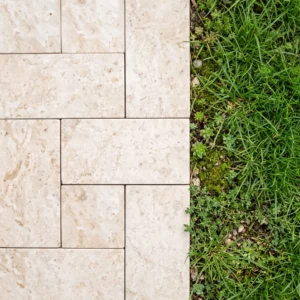
The estates’ surviving masonry — mill towers, boiling-house walls, cut-stone foundations — was built from the islands’ own volcanic stone by hands whose skill still shows, and it sets the site’s tonal law: dark, weathered, lichen-softened, absolutely in charge. New stonework enters as a guest: warm pale tones that converse with the dark fabric rather than competing, honest textures over any polish, formats modest enough to respect hand-laid predecessors, and the heritage craft rules — breathing junctions, honest levels, patina as the goal — applied with three centuries of reasons.
The mill in the garden
A standing mill tower is the most charismatic garden feature in the Caribbean, and the ground around one deserves design worthy of it: paving held back from historic foundations with planted margins doing the transition, level changes negotiated by drawn steps rather than regraded earth against old walls, and the tower given the space its silhouette commands — approached, framed, lit on the grazing rules, never crowded. Where guests dine or marry beside the mills, the surrounding stone runs hospitality-grade beneath its deference: dense, textured, serviceable — the heritage register engineered for two hundred dinners a year.
- Stabilize the tower before landscaping around it rather than afterward.
- Keep new ground clear of the base so the structure can be inspected.
- Use lime based mortars where new work meets original rubble.
- Light the tower from a distance rather than fixing anything to it.
The inn’s working gardens
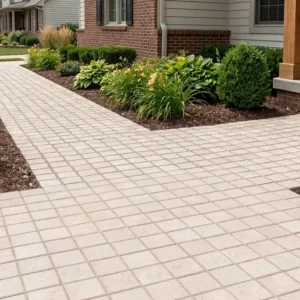
Plantation inns live through their grounds — breakfast on the great-house veranda, croquet lawns, wedding lawns, pool gardens folded into old walls — and the stone package serves a working hospitality estate wearing historic dress: paths that carry luggage barrows and evening heels with equal grace, terraces on the small-hotel duty logic, pool surrounds deferring to the masonry that frames them, and the service circulation threaded invisibly per the backstage rules. Phasing respects the calendar: low-season works, zone by zone, with the gardens never wholly closed — these properties’ guests return annually and notice everything.
Private estates: living with history
Nevis’ private plantation estates run the same conversation domestically: family terraces beside boiling-house walls, pools in old provision grounds, drives climbing under mango allees the sugar era planted. The design freedoms are broader — private taste, private pace — and the responsibilities identical, plus one: continuity. Estates change hands across generations, and stonework chosen for patina, documented with batch records, and repaired from attic stock keeps a property’s built story coherent across owners the way the mills have stayed coherent across centuries.
- Treat surviving boiling house walls as the organizing element of the garden.
- Set terraces off the ruin rather than up against it.
- Match new coursing to the old rather than to a modern block module.
- Leave the ruin legible, since that is what gives the property its value.
Craft beside craft
The islands’ masons descend from the tradition that built the mills, and heritage projects here get built with visible pride when the package honors the craft: drawn details for every junction of new and old, specials — steps, caps, thresholds — cut to reviewed drawings, mock-up panels approved beside the actual fabric, and tolerance for the pace careful work beside irreplaceable walls demands. The supplier’s contribution is preparation; the island supplies the hands, and they are excellent.
The tradition’s quiet lesson
What the plantation belt teaches every property in this cluster is durability as culture: these estates have been continuously inhabited, adapted and loved for three centuries because they were built of stone, by craft, for generations — the exact philosophy this cluster preaches in every modern register. New work that joins the tradition inherits its logic: build once, defer to what stands, document for whoever comes next. The federation supply guide prepares plantation-belt packages as a specialty — samples viewed against the mill wall they will live beside, always.
Events among the ruins: weddings and gatherings on heritage ground
The plantation belt’s most enchanted business is hosting life’s occasions against three centuries of backdrop — weddings beneath mill towers, anniversary dinners on great-house lawns, gatherings where the setting does half the toasting — and heritage properties that host well pair the romance with quiet infrastructure. The ceremony-hosting craft translates to heritage pitch with its rules intact and its manners heightened: level ceremony ground established without regrading against historic walls, aisle and gathering surfaces that carry heels and years with equal grace, power and water reaching the lawn through dressed points rather than cables across old thresholds, and the vendor circuit routed so catering never crosses the axis between vows and mill tower.
The heritage layer adds its non-negotiables: crowd loading kept honest around fragile fabric — a wall that stood three centuries deserves not to meet a sound rig’s anchor — event lighting grazing the monuments rather than drilling them, marquee fixings landing in designed sockets rather than improvised holes, and the morning-after reset returning the grounds to gallery standard because tomorrow’s tour arrives at nine. Done properly, the events business and the conservation duty reinforce each other: hosting revenue funds the maintenance that keeps the fabric hostable, the stone infrastructure — platforms, paths, dressed services — serves both daily hospitality and occasion days, and every wedding photographed against the mill recruits the next season’s bookings. The estates have hosted the islands’ occasions since the great houses were young; the modern craft simply lets them do it without cost to the centuries.
What the island fortresses were actually built from
The masonry tradition on these islands is documented at the highest level. The World Heritage listing for Brimstone Hill Fortress National Park records a 15.37 hectare property inscribed in 1999, standing on a hill 230 meters above the sea, built over roughly a century from the 1690s by enslaved African labor to British military design. Crucially for anyone repairing estate fabric, it describes construction in dressed basalt blocks with a rubble core, with local limestone used for quoins and for facing around doorways and embrasures, quarried on the middle and lower slopes of the hill itself.
- Read the basalt and limestone pairing as the local structural grammar.
- Reserve the finer limestone for openings and corners, as the original builders did.
- Expect a rubble core behind a dressed face rather than solid masonry throughout.
- Repair like with like, since a hard modern patch fails around softer stone.
- Treat the quarry proximity as the reason the detailing looks the way it does.
Choosing limestone that will sit beside three hundred year old work
New stone next to estate fabric has to weather toward it rather than away from it. The reference from the Natural Stone Institute on limestone gives the properties that decide that: absorption running from below one percent to above ten across the family, dolomitic varieties denser with lower absorption and higher abrasion resistance, and the whole family vulnerable to alteration by mild acids. On a Nevis estate that combination points firmly toward the lower absorption end.
- Specify lower absorption where paths stay damp under estate canopy.
- Prefer dolomitic material for the routes that take service traffic.
- Keep acidic cleaners off the maintenance schedule entirely.
- Choose stone with visible variation, since a flawless floor looks wrong here.
Working on ground that is also a record
Estate land carries buried evidence as well as standing ruins: cistern lines, cart tracks, animal mills, foundations of buildings long gone. Excavation on these sites turns things up, and the projects that go well are the ones that expected it and had a plan rather than a delay.
- Assume the ground holds structures that no survey has recorded.
- Agree in advance who is called when something is uncovered.
- Keep foundations shallow where the archaeology is likely to be dense.
- Record what is found, because that record adds to the property rather than costing it.
Plantation heritage stone that respects what is already standing
An estate on Nevis is a working record of how these islands were built, and new stone joins a conversation that started three centuries ago. Match the basalt and limestone logic, keep absorption low, use lime where new meets old, and treat the ground as an archive. Our St. Kitts and Nevis stone supply guide sets out the formats, finishes and lead times that suit this federation. The ruins are the reason anyone wants the property, so the only sensible ambition is to leave them looking untouched.