Between the new international resorts and the private villas sits the accommodation layer that has always carried Grenada: family-run guesthouses, small hotels of a dozen rooms, apartments above a garden that guests return to for decades. These properties compete on warmth and character rather than spa menus — and they win — but the resort generation has raised the island’s finish expectations, and small properties feel it in their reviews. The good news: stone upgrades are the small hotel’s highest-leverage investment, because they concentrate exactly where guests look.
The photographed trio
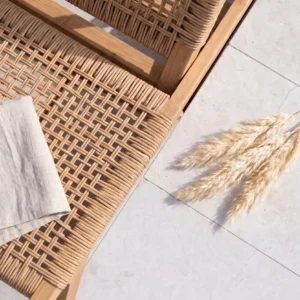
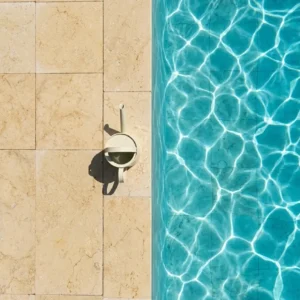
Guests decide from photographs, and three frames dominate every listing: the arrival, the breakfast terrace, the pool. Those are also, conveniently, small areas — an entrance threshold and path, a terrace of modest square meters, a pool surround — which means the small hotel can buy resort-grade stone for its three defining images at guesthouse-scale cost. A pale limestone terrace under the breakfast almond tree, a proper stone threshold replacing cracked concrete at the gate, a re-edged pool with clean coping: each transforms its photograph, and the photographs transform the booking rate. Spending anywhere else first is decorating the linen cupboard.
Upgrading a property that never closes
Small hotels cannot shut for a season, so the upgrade is a phasing exercise: one zone per low season, worked in weekday windows, with dust and noise managed like the neighbors matter — because at a guesthouse, the neighbors are sleeping guests. Stone suits the constraint unusually well: small phased orders travel economically by groupage freight, a terrace re-lays in days not months, and the finished zone opens immediately — no curing rooms, no paint smell. The sequence that works: arrival first (every guest sees it from day one), terrace second, pool third, back-of-house whenever. Batch continuity across the phases is the one discipline that keeps a three-year plan photographing as one property.
- One zone per low season, worked in weekday windows agreed with the front desk.
- Cutting done off site, because noise is the thing guests complain about first.
- Dust screens and a clean route kept between rooms and breakfast throughout.
- Materials delivered in small batches that can be stored out of sight.
- A finish date that leaves a buffer before the first arrivals, not the day of.
Durability per guest-night
Small-hotel surfaces work harder than villa surfaces — daily luggage wheels, furniture drag at breakfast turnover, mop cycles, sunscreen and rum punch — and the specification should think in guest-nights: dense stone that shrugs abrasion, eased edges that survive dropped bags, mid-tones and texture that carry the day’s traffic invisibly between cleans, and the repairable-surface principle with a modest attic stock, because a chipped threshold at a twelve-room property is one stone and one hour, not a renovation. This is also where honest budget zoning earns money: premium material at the photographed trio and the touch points, straightforward stone in service yards, and no pretense that guests inspect the laundry path.
- Dense stone that shrugs off abrasion from luggage wheels and dragged furniture.
- Eased edges that survive dropped bags and trolley corners.
- Mid-tones and texture that carry a day of traffic without looking tired by lunchtime.
- Finishes chosen for a mop cycle rather than for a photo shoot.
- Spares from the same batch, because one broken unit should never mean relaying a terrace.
Character the flags cannot copy
The small hotel’s trump card is Grenadian identity, and stone plays it naturally: the island’s volcanic-and-limestone pairing — dark local volcanic walls, pale imported floors — reads as authentically of-this-place in a way no imported brand language can. A guesthouse courtyard with a volcanic wall, a limestone floor and the owner’s grandmother’s garden is a composition Silversands cannot buy. The upgrades should amplify that character, not sand it off: keep the mature trees and the family furniture, and give them a floor and an edge worthy of the photograph guests will take anyway.
The arithmetic of small and good
The small hotel’s stone order is modest by definition — tens of square meters per phase — and the mechanics scale down gracefully: samples first (viewed against the property’s actual walls and shade), a cutting list for thresholds, copings and steps, groupage freight, and the same escrow protections at small scale that large orders enjoy. What does not scale down is the return: for a property whose entire marketing is photographs and reviews, a few dozen square meters of well-chosen stone at the right three places is plausibly the highest-return renovation available. The supplier guide for Grenada handles small orders as a matter of course — the island’s best guesthouses were built a room at a time, and their stone can be too.
Proving the upgrade: photographs and reviews
The upgrade only earns when the market sees it, so the final phase of any guesthouse stone project is documentation. Reshoot the listing the week the work completes — morning light for the terrace, golden hour for the pool, the arrival sequence walked with the camera at guest height — and lead every platform’s gallery with the new frames; stale photography under a fresh terrace is money left invisible. Before-and-after pairs belong on the property’s own channels, where returning guests share them for you, and the renovation itself is a story worth a paragraph on the website: guests choose family properties partly for the sense of ongoing care. Then watch the reviews do the quiet work. Guests rarely name the stone, but they name what it does — solid, cool underfoot, beautifully kept, feels like a boutique hotel now — and those phrases become the marketing copy no budget buys. Keep one discipline for the years after: the photographed trio stays photograph-ready, because the images that lifted the booking rate have made a promise every arrival now checks.
Breakfast service: the terrace at its working hour
The breakfast terrace earns the guesthouse’s warmest reviews and takes its hardest daily shift, and the stone plan should honor the working hour as much as the photograph. Service reality first: breakfast runs on repeated trips from kitchen to table, so the route wants flush thresholds, no surprise step with a loaded tray, and width for a server and a wandering guest to pass — the back-of-house logic applied to the property’s front stage. The floor works under chair scrape from the day’s first seating, dropped cutlery, syrup and coffee — arguing for the dense, eased-edge, mid-textured specification that wipes clean between seatings and hides the morning’s traffic until the proper clean after service. Shade choreography matters at this hour specifically: the terrace must be comfortable at eight, which means reading the morning sun in the site study and placing trees, sails or pergola accordingly — afternoon shade on a breakfast terrace is scenery for nobody. Small stone touches lift the service itself: a buffet or coffee station on its own level pad, drainage that lets the terrace be hosed the moment the last plate clears, and a corner of the floor where the resident cat can hold court, since every great guesthouse has one and guests photograph it more than the architecture. Breakfast done well is marketing that recurs daily; the floor is its stage crew.
Grip in the three places guests actually slip
A small hotel carries a duty of care it cannot insure its way out of, and almost all of the risk sits in three wet areas. The current standard and its limits are explained in this account of friction testing on stone walking surfaces.
- ANSI A326.3 measures dynamic coefficient of friction and can be run in place as well as in a laboratory.
- Its 0.42 benchmark applies to level interior surfaces walked on wet, which is the bathroom case.
- No exterior threshold is specified, so the pool surround and entrance need a specifier judgment.
- Polished finishes generally fail the benchmark and belong in none of the three areas.
- Test the actual specimen and finish, since variation within a stone variety is wide.
The datasheet a small property should still ask for
Buying twenty square meters does not mean buying blind. The Natural Stone Institute publishes the scope of methods used in dimension stone testing, and asking for three or four values costs nothing.
- ASTM C1353 for abrasion resistance, the number that predicts how a terrace looks in year five.
- ASTM C97 for absorption and density, which drives staining from sunscreen and drinks.
- ASTM C880 for flexural strength on treads, copings and any unsupported edge.
- ANSI A326.3 for slip resistance on the finish actually being laid.
- Batch reference recorded with the values, so a later phase can match this one.
Sequencing the upgrade for the best return
With a small budget, order of work matters more than total spend, because each completed zone earns money toward the next.
- Arrival first, since it appears in every listing photograph and sets the price expectation.
- Breakfast terrace second, because it is where guests spend the most waking time.
- Pool surround third, where comfort and safety both improve at once.
- Bathroom floors as rooms come out of service, one at a time.
- Back-of-house last, using the same batch so nothing looks borrowed.
Guesthouse stone upgrades that pay for themselves
Small properties do not compete with the flags on scale, and they should not try. They compete on warmth, character and the three photographs that sell a room, and all three are small enough areas that real stone is affordable. Choose dense material with texture, phase one zone per low season, ask for the test values anyone would ask for on a larger job, and keep spares from the batch. The result reads as care, which is exactly what a guesthouse sells. For material selection and order stages, our Grenada stone supply guide covers the practical path. Spend where the camera and the bare foot both land, and the rest can wait.