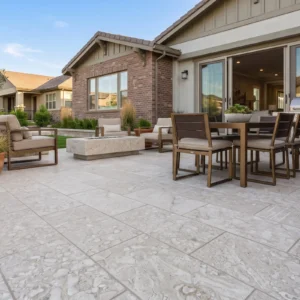
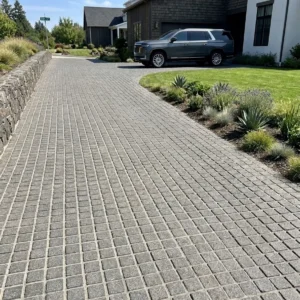
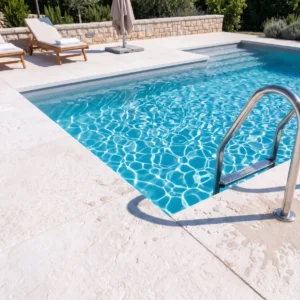
Most stone writing serves the villa. This piece serves the other clients — the restaurant forecourt, the campus walk, the church court, the waterfront promenade, the small commercial plaza — places where hundreds or thousands of feet cross daily and the specification questions change entirely. Grenada’s walkable places are part of its charm, and the island’s institutions and businesses periodically rebuild them. Here is what high-traffic stone must actually withstand, and how to buy it.
What crowds really do to paving
Traffic is not just footfall. It is abrasion concentrated along desire lines that never vary; point loads from delivery trollies and the service vehicle that was never supposed to drive there but does weekly; chair scrape across café zones; edge strikes at curbs and steps; and the grime cycle of gum, spills and tropical organic fallout. The specification answers are mechanical: dense, low-absorption stone with proven abrasion resistance; thickness stepped up on any line a vehicle can reach; eased arrises everywhere edges meet traffic; and mid-tones that carry a week’s grime with dignity between cleans. The villa’s delicate pale perfection is the wrong instrument here, and choosing it anyway is how public projects end up looking tired in a year.
- Abrasion concentrated along desire lines that never vary from one year to the next.
- Point loads from delivery trolleys and the service vehicle that was never meant to drive there.
- Chair scrape across cafe zones, which wears a finish faster than feet do.
- Edge damage at thresholds, drains and any unit that stands slightly proud.
- Cleaning regimes that are harsher and more frequent than any domestic floor sees.
Wet grip as a duty of care
Grenada rains hard and often, and a commercial or public floor owes its users safe passage in every shower. That means wet-tested slip performance on the walking field — textured, honed-not-polished surfaces as the baseline — falls that clear standing water fast, and transition thinking at entrances where wet stone meets interior floors: mats, texture changes, covered thresholds. Steps in public settings deserve the full discipline — consistent risers, visible nosings, textured treads — because the stair-geometry discipline stop being courtesy and start being liability management the day the public walks them.
Pattern that organizes people
At public scale, paving is quiet wayfinding. Banding and borders steer movement along intended routes; tonal zones separate café seating from walking streams; curb-contrast lines mark level changes for eyes that need the help; and a change of module tells feet they are entering a different kind of space. None of it needs signage or expense — it is the same stone in organized tones and formats, drawn deliberately. Grenada’s own townscape demonstrates the tradition: the best of St. George’s manages crowds with masonry lines a century old, a habit worth continuing in the town’s manner.
Design for the repair decade
Public paving is judged in year ten, not week one, and year ten belongs to maintenance design. Unit paving beats monolithic surfaces here precisely because it repairs invisibly: a cracked stone lifts and replaces in an hour if — and only if — attic stock from the original batch exists and the format is modular. So the specification includes its own future: spare percentage held by the owner, jointing chosen for re-workability, service covers dressed in matching stone so utility access stops being demolition, and a maintenance regime (scheduled washing, joint top-ups, prompt gum and stain response) written down and priced from day one. Institutions that budget the regime keep their plazas; those that do not, replace them.
Buying at institutional scale
Procurement for public and commercial work runs on documentation, and stone should arrive with its paperwork in order: datasheets with the relevant test values, slip results for the specified finish, samples retained against delivery, staged deliveries matched to phased works, and the batch records that make a two-phase project match. The contractor’s field guide covers trade mechanics; Grenadian specifics — port, brokerage, phased groupage — run through the supply guide. The result, done well, is infrastructure in the proper sense: a floor the town uses daily for decades and thinks about never.
- Datasheets carrying the relevant test values for the material actually supplied.
- Slip results for the specified finish, not for a polished sample of the same stone.
- Retained samples held against delivery, labeled and stored by the client.
- Staged deliveries matched to phased works, so nothing is stored on a live site.
- Batch records that make a two-phase project look like one project.
The event-day floor
Grenada’s public spaces earn their keep on event days — markets, festivals, the carnival season’s crowds — and paving that hosts them needs a working-day specification behind its everyday face. Temporary loads arrive on small wheels and pointed feet: market stalls, staging, mobile bars and cool-boxes concentrate weight in ways daily footfall never does, and the dense, well-bedded specification carries them where a decorative one would print and crack. Fixings deserve forethought — flush sockets for stall frames, banner poles and barriers, set at planned stations and dressed with matching stone caps when empty, spare the surface a history of improvised drilling. Services follow the same logic: event power and water at dressed access points rather than cables taped across walking routes. And the day after is a specification item too — surfaces chosen for honest cleanability, falls that let a wash-down finish the job, joints that tolerate the pressure washer’s annual visit. A plaza designed for its busiest day is effortless the other three hundred; designed only for the quiet days, it ages one festival at a time.
Accessibility done properly, not performatively
Public paving’s deepest obligation is the user it was not casually designed for, and genuine accessibility is specification, not signage. Gradients first: ramped routes at honest slopes with rest landings, always alongside — never instead of — well-made steps, because different users need different routes and dignity means both are front doors. Surface discipline next: firm, even, tightly-jointed stone that a wheelchair, a walker and a white cane all read reliably; lippage tolerances tightened beyond the decorative standard; and gratings, joints and drainage slots dimensioned so they cannot trap a wheel or a stick tip. Tactile guidance belongs where decisions happen — hazard warnings at crossings and stair heads, directional texture where a route turns — installed as purpose-made units in contrasting tone, integrated into the paving composition rather than glued on in municipal yellow as an afterthought. Visual contrast completes the kit: step nosings, curb lines and level changes marked by real tonal difference, which serves low vision and, at dusk, everyone. None of this compromises beauty; composed well it reads as the design’s quiet intelligence. And the commercial truth deserves saying plainly: the island’s visitors skew older every year, and the plaza that welcomes every knee and wheel is the one whose café tables stay full.
The test values a specification should name
Commercial and public paving is bought on documents, and the documents are only useful if they name the right standards. The Natural Stone Institute publishes the scope of methods used for dimension stone testing, and a high-traffic specification usually calls up the same short list.
- ASTM C1353 for abrasion resistance, which is the number that predicts a decade of footfall.
- ASTM C170 for compressive strength, relevant wherever service vehicles cross.
- ASTM C880 for flexural strength, governing units that span soft spots or sit on pedestals.
- ASTM C97 for absorption and density, which drives staining and cleaning behavior.
- ANSI A326.3 for dynamic coefficient of friction, tested on the delivered finish.
Wet grip, and what the standard does not cover
Slip resistance in a public space is a duty-of-care matter, so it pays to know exactly what a test result means. This account of friction testing on stone walking surfaces is clear about the boundaries.
- ANSI A326.3 measures dynamic coefficient of friction and supports in-place testing as well as laboratory work.
- Its 0.42 benchmark applies to level interior surfaces walked on wet, and nothing else.
- No threshold is specified for exterior or ramped surfaces, so the specifier carries that judgment.
- Polished finishes generally fail the benchmark and are unsuitable for public floors.
- Harder, denser stones often test lower than softer ones in the same finish, so test the specimen.
Cleaning regimes the floor has to survive
The fastest way to age a commercial stone floor is to clean it the way a contractor finds convenient. Writing the regime into the handover pack protects the investment.
- Neutral cleaners specified by name, with acidic products explicitly excluded on carbonate stone.
- Dilution rates and machine types stated, since a wrong pad wears a finish in months.
- Grit control at entrances, because tracked-in sand does most of the abrasion.
- A written schedule for deep cleans, matched to the traffic rather than to the calendar.
- A named contact for reordering units, with the batch reference already recorded.
High traffic stone paving that still looks right in year ten
Public and commercial floors are judged late, not early. What decides the verdict is abrasion resistance chosen from real test data, a finish that grips when it rains, a modular format that can be repaired invisibly, attic stock from the original batch, and a cleaning regime written down before handover. None of that is glamorous and all of it is cheaper than replacement. Where the project also has to sit within a historic setting, the palette guidance in our heritage stone notes for St. George applies alongside. Specify for the tenth year and the first nine take care of themselves.