St. George’s regularly makes the shortlist of the Caribbean’s loveliest towns, and the reasons are specific: an amphitheater of warm-toned buildings around a working harbor, fish-scale roofs stepping down the hillsides, masonry and brick that record three centuries of weather. Anyone building or renovating within its bowl inherits a responsibility and an advantage — the town itself is the design brief, and projects that read it well gain a settled quality money cannot otherwise buy. Stone choices carry much of that reading.
Reading the town’s palette
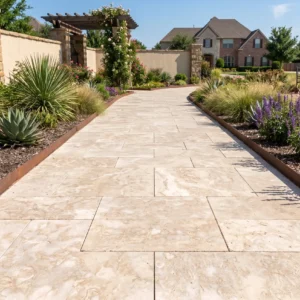
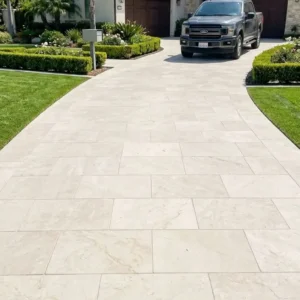
The St. George’s eye is warm: ochres, creams, brick reds, weathered renders, dark volcanic foundations glimpsed at street level. New stonework that converses with it starts by renouncing starkness — soft creams and warm buffs over brilliant white, honed and brushed finishes over anything polished, tones that will deepen agreeably with weather rather than fight it. The two-stone logic has been the town’s own for centuries — dark local stone in bases and walls, lighter material above and underfoot — and following it is less imitation than continuation.
- Soft creams and warm buffs in preference to brilliant white, which reads as an intrusion here.
- Dark volcanic tones kept for bases and walls, echoing what the street already shows.
- Joint color matched to the old mortar rather than to the new stone.
- Unit sizes drawn from the surrounding fabric, since scale gives a scheme away faster than color.
- Texture that will weather, because a flawless surface looks wrong beside two-century masonry.
Courtyards behind old walls
The town’s building stock hides its best spaces inside the block: courtyards behind merchant houses, terraces carved into the hill, gardens above street walls. Renovating them is detail work. Old masonry moves and breathes, so new paving should meet it with margins and movement joints rather than hard cement contact, and ground levels against historic walls deserve respect — raising a courtyard floor against old fabric traps moisture where centuries of builders kept it clear. Levels, drainage and the odd archaeology surprise make these projects slower per square meter than new builds, and worth every hour: a well-renovated St. George’s courtyard is among the most atmospheric outdoor rooms in the region.
Modern work, done politely
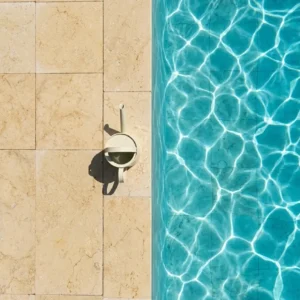
Not every project inside a historic bowl should wear costume. A crisp contemporary terrace or a clean-lined pool court can sit beautifully behind old walls — the politeness lives in palette and scale rather than pastiche. Warm-toned stone in generous calm formats, detailed simply, lets a modern insertion converse with old fabric instead of shouting over it; the dishonest alternative, distressed new material pretending to be old, fools nobody and ages badly. The rule of thumb that serves best: match the town’s tones and textures, express your own era in the lines.
The practical file
Building in and above the town brings practicalities the countryside skips. Planning sensitivity around landmarks and streetscapes means design conversations start early and neighbors are close. Access is real logistics: steep narrow streets, tight corners and scarce staging mean smaller crates, more handling and sometimes hand-carry distances that belong in the quote rather than the surprises column — the delivery-planning guide covers the mechanics. And program respects the town’s rhythm: carnival season, harbor events and cruise days all change what a delivery truck can do before nine in the morning.
- Planning conversations started early, since landmarks and streetscapes attract scrutiny.
- Neighbors consulted in person, because everyone here is close and the work is loud.
- Smaller crates specified for steep, narrow streets and tight corners.
- A staging position agreed in writing, as street space is scarce and shared.
- Hand-carry allowed for in the program, which changes both cost and sequence.
Patina as the finish line
The goal of heritage-adjacent stonework is not to look new for as long as possible; it is to join the town’s long weathering gracefully. That changes small decisions: seal sparingly or not at all where use allows, let foot traffic and rain begin their polishing, choose stone whose fifth-year face you would be proud of rather than its first-week one. Within a few seasons a well-chosen terrace stops reading as an addition and starts reading as always-there — the highest compliment St. George’s pays. The main Grenada supplier guide starts the selection with samples worth viewing against the town’s own walls.
The stair streets
St. George’s is a town that climbs, and its character lives as much in the stepped lanes and stairs between streets as in the harbor front. Private properties that open onto these vertical routes inherit a specific detailing job: thresholds and entry steps that negotiate between the public stair’s geometry and the property’s own levels, handrails and gate posts fixed into stonework that must shrug decades of hands and weather, and drainage manners that never send a roof’s water sheeting down a public stair. The town’s old steps teach the standards — consistent risers cut for real legs, treads with worn but honest texture, landings where the climb pauses — and new private work beside them should meet those standards rather than import suburban geometry. Where a property’s entrance sequence includes its own stair to the street, the full step discipline applies with the town’s materials accent: warm-toned treads, dark local stone in the flanking walls, and the patina ambition that lets the new flight join the town’s three-century collection gracefully.
Three palettes, one town: color studies from the streets
Advice to “match the town’s warmth” becomes concrete the moment specific streets are read as palettes. Study the harbor front first: weathered brick reds and deep ochres over dark volcanic bases, with white reserved for trim rather than fields — a scheme that suggests warm buff paving with dark stone borders and accents, never an all-white terrace. Climb next to the church streets: softened pastels and lime-washed renders against gray-brown masonry, teaching a gentler mix — cream and pale-honey stone with mid-gray details sits beautifully behind such walls. Finish on the residential ridges: green everywhere, roofs stepping down the hill, where the working contrast is simply light floor against dark structure and the lesson is restraint — two stones, well chosen, beat five. The practical method for any renovation: photograph the project’s own street at morning and late afternoon, pin the stone samples to a board against those photographs, and choose in that company rather than in a showroom’s neutral light. Color decisions made inside the town’s actual conversation age into belonging; decisions made against white paper age into explanations. The town has been running this seminar for three centuries — attendance is free, and the field trip takes an afternoon.
What the planning system actually asks for
Work in and around a historic town is not a matter of taste alone; it is regulated, and the regulation is published. Grenada’s Physical Planning and Development Control Act sets the framework, and reading the definitions saves a great deal of argument later.
- Development is defined broadly, covering building, engineering and other operations, material change of use and subdivision.
- No development may be carried out without the prior written permission of the Authority.
- Preparatory work such as clearing or leveling land counts as having started development.
- Building operations include demolition, rebuilding, structural alteration and incidental road or drainage works.
- Engineering operations include roads, drains, culverts, retention structures, earthworks and landfilling.
- Maintenance that does not materially affect external appearance is exempted.
Choosing a stone that will weather like its neighbors
Matching a historic street is partly a color decision and mostly a durability decision, because the stone has to age at a pace the setting recognizes. The Natural Stone Institute records that limestone varies widely, with absorption from below one percent to above ten, and dolomitic varieties generally denser, less absorbent and more abrasion resistant.
- Lower absorption where paving sits open to rain and runoff from old roofs.
- More open, softer stone reserved for sheltered courtyards where patina is the point.
- Acid sensitivity respected, since carbonate stone reacts to mild acids and to some cleaning habits.
- Abrasion resistance considered on street-adjacent thresholds that take constant traffic.
- A finish that will gather character rather than one that must be defended from it.
Meeting old masonry without damaging it
Most heritage failures are not aesthetic; they are physical, and they happen where new work is bonded too tightly to old.
- Movement joints wherever new paving meets historic walls, since the two will never move together.
- Bedding and jointing chosen to be softer than the old fabric, so the historic material is not the sacrificial one.
- Drainage kept away from wall bases, which is where damp damage concentrates.
- No fixings drilled into original masonry without a considered detail behind them.
- Recording photographs taken before work starts, which protects everyone if a question arises.
Heritage building stone that joins the town rather than interrupting it
The test in St. George is simple and unforgiving: in ten years, will a visitor be able to tell which surfaces are new? Warm tones, familiar scale, honest texture and joints that echo the old mortar will pass it. Brilliant white, oversized formats and a sealed finish that refuses to weather will not. Add early planning conversations, smaller crates for the streets, and details that let old masonry keep moving, and a modern project can sit inside the historic bowl without apologizing for itself. On material selection, our Grenada stone supply guide covers palette and format. Aim to be unnoticed in ten years, and the work will be right today.