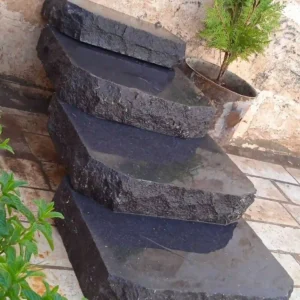
Steps concentrate everything hard about exterior stone: safety, geometry, drainage and looks, all in a few square meters. In Jamaica’s rain they are also the first place a bad specification shows. Here is how to get them permanently right.
Geometry people can trust
Outdoor steps read best shallower and deeper than indoor stairs:
- Risers around 140–165 mm
- Treads 300 mm or more, which feels generous and safe in a landscape
- Identical geometry step to step, because feet memorize the first riser and stumble on variation
- Full-depth single-piece treads, which look and perform better than pieced surfaces
The nosing decision
A slight overhang — 20–40 mm — throws a crisp shadow line and sheds water clear of the riser. Pair it with an eased or half-bullnose edge: sharp arrises chip on the corner everyone kicks. This is the same profile logic as pool coping, and cutting treads and copings from the same stone ties garden and pool together.
Grip is non-negotiable
Wet stone steps demand texture. Specify brushed or bush-hammered faces on every tread — the texture is cut into the stone and cannot wear off. If the design insists on a smoother look elsewhere, keep it off the stairs; steps are where grip is cheapest to buy and costliest to skip.
Drainage built into the detail
Each tread wants a small forward fall (about 1%) so water sheets off the nosing instead of ponding against the riser. On longer flights, a landing every eight or so risers gives water — and people — a break. Where steps meet planted slopes, side upstands keep soil wash off the treads.
Installation method matters as much as the stone itself. Industry guidance separates mortar-set work, sand-set exterior paving and pedestal systems, and stresses that drainage, movement and substrate condition drive long-term performance more than the material name does — the detailing guidance is worth reading before you specify.
Material and light
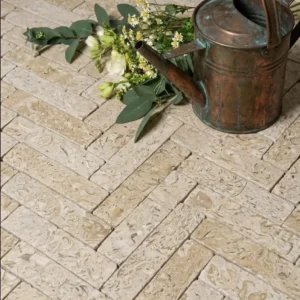
Light limestone treads keep barefoot garden paths comfortable and make evening steps visible without a lamp on every riser; basalt risers under limestone treads give crisp contrast that reads the step edge for you. Density matters here as everywhere outdoors — treads take point loads and weather simultaneously.
Ordering treads correctly
Treads are specials: send rise-and-going dimensions, flight widths and your nosing choice, and they are cut to order with the rest of the package. Samples in 3 working days; freight to Kingston or Montego Bay, escrow and the ordering path are in the Jamaica supplier guide.
Setting out a flight without surprises
Steps punish improvisation, so set out on paper first:
- Total rise divided into equal risers within the 140–165 mm band
- Treads at 300 mm plus
- The golden check — twice the riser plus the tread landing between 600 and 650 mm, which keeps the stride natural
- Odd totals resolved at the bottom step, never the top
Any landing resets the rhythm, so treat each run separately.
Building on concrete, masonry or ground
Two structures carry almost every flight:
- A concrete or blockwork core — treads bedded in full mortar on the leveled core, risers facing the vertical, and the core’s falls carrying water off each tread
- Compacted granular pads on grade for garden flights — generous, well-drained, and edged so the pad cannot migrate
In both cases the stone is the finish; the structure beneath is what the flight actually stands on.
Absorption is the number that separates one limestone from another. The Natural Stone Institute records a range running from under one percent to over ten across the family, and notes that dolomitic stones generally carry higher density, lower absorption and better abrasion resistance — the industry variety data sets this out. That spread is why two stones sold under the same broad name can behave nothing alike underfoot.
Lighting and the safety details that disappear
Good step lighting is invisible until dusk — low-level washes under nosings or from side walls that shade each tread edge without glare. Light stone halves the job, since treads stay legible in moonlight alone. Two other safety details belong here:
- A handrail wherever a flight exceeds a few risers, which is a code-and-common-sense question rather than an aesthetic one
- A simple powder-coated or timber rail on discreet posts, which serves without fighting the stone
Curved, cantilevered and feature flights
Stone handles drama gracefully when the geometry is drawn honestly: curved flights use radius-cut treads (each numbered to its own arc, exactly like radius pool coping); floating looks come from steel or concrete cantilevers dressed in stone rather than from asking stone to fly; and wide feature stairs — the entry statement — simply scale the same rules up, with the same textures and falls. The material is ready for ambition; it only asks that the structure underneath be as honest as the finish.
Steps as the garden’s connective design
Treat every level change on the property as one family: same stone, same nosing profile, same texture — from the entry flight to the two garden steps down to the lawn to the pool’s wet-edge stair. That continuity is what makes a landscape feel designed rather than accumulated, and it costs nothing extra: the treads are cut from the same blocks either way. Order the whole family together with the main package and every rise on the property will match for decades.
Ramps, thresholds and step-free moments
Modern Jamaican projects increasingly pair steps with step-free routes — for luggage trolleys, accessibility, and simple daily convenience. Stone handles both vocabularies: ramps in the same field stone at gentle gradients with coarse texture full-width; flush thresholds where terrace meets interior (the water managed by slot drains, not steps); and where levels force a choice, a generous step flight beside a discreet ramp keeps every user in the same material language. Design the routes together and neither reads as an afterthought.
Freestanding garden stairs: the landscape flight
Away from buildings, garden flights climb planted slopes and construction shifts to landscape mode:
- Each tread a generous slab seated on its own compacted, drained pad
- Risers formed by the tread edges themselves, or by low stone uprights
- Planting allowed to soften the flanks, but never the going
The look is informal; the geometry rules are not, because ankles do not grade a flight on charm.
Water on flights: the details that shed a downpour
Stairs are drainage paths whether designed as one or not, and a Jamaican cell will find them. Three details keep a flight safe:
- A 1 percent forward fall on every tread — standing water on stairs is the island’s most avoidable hazard
- Open or channelled joints at flight edges, so water exits sideways on long runs
- A dispersal apron or drain at the base, so the collected flow does not carve the ground it lands on
What outdoor stone steps in Jamaica have to survive
Steps concentrate wear, and stone concentrates repairability: a chipped nosing dresses back to an eased profile in minutes; a cracked tread lifts and swaps from attic stock without touching its neighbors; a flight resurfaced decades on simply re-beds the same stones on refreshed mortar. Keep two spare treads with the original order and the property’s hardest-working stone becomes its easiest-kept — the exact inversion concrete steps offer, where the first spall is forever. A flight that feels safe wet is a flight built right.