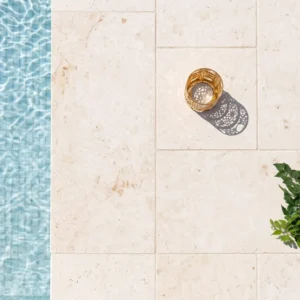
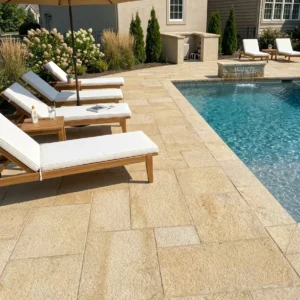
The coping is the most touched, most looked-at, most safety-critical stone on a Jamaican pool — and the piece most often left to whatever the pool contractor had available. Getting it right is not expensive; it is just a set of decisions made in the right order.
Material: solid stone or precast concrete
Precast concrete coping is everywhere in the region because it is available and consistent. Its weaknesses arrive with age: worn edges exposing aggregate, chips showing gray under the tint, and dark units that scorch bare feet. Natural limestone coping is the same material through its full thickness — chips dress out invisibly, the color cannot delaminate, and a light stone stays comfortable at noon. See white limestone pool coping for what cut-to-order looks like.
Profile: bullnose, square or eased
Three profiles cover almost every Jamaican pool:
- Bullnose, fully rounded — the family-friendly classic: soft to grip, kind to skin
- Square-edge — the crisp line modern villa architecture wants, specified with a lightly eased arris so it stays kind to hands
- Chamfered, sitting between the two
Cut to order means the profile follows your design rather than a mold catalog.
The dimensions that matter
Coping typically runs 300–600 mm front-to-back and 30–50 mm thick, but two functional details outrank any dimension:
- A slight fall away from the water, so splash drains to the deck
- An overhang with a drip groove underneath, so water releases cleanly instead of tracking back toward the shell
Texture: the wettest stone on the property
Smooth coping is a slip hazard the day it is installed. Specify a brushed or bush-hammered face — every texture in our range is photographed on real production stock in the Stone Finishes Gallery — and save honed faces for indoors.
Heat: the Jamaican noon test
Dark coping in full sun genuinely burns. Light limestone reflects rather than absorbs, which is why it dominates our Caribbean coping orders. If you are unsure, run the test: leave a light and a dark sample in the sun for an hour, then place a palm on each.
Absorption is the number that separates one limestone from another. The Natural Stone Institute records a range running from under one percent to over ten across the family, and notes that dolomitic stones generally carry higher density, lower absorption and better abrasion resistance — the industry variety data sets this out. That spread is why two stones sold under the same broad name can behave nothing alike underfoot.
Recoping an existing pool
Swapping tired precast coping is one of the highest-impact villa upgrades in Jamaica: the shell stays, the edge changes, the whole pool reads as new. Pair it with matching deck stone and the surround becomes one design instead of an assembly.
For delivery to Kingston or Montego Bay, samples and escrow, start at the Jamaica supplier guide.
How coping is actually fixed — and why it matters at the edge
Coping fails at installation more often than at manufacture, so it pays to know what good looks like:
- Each unit bedded on a full mortar bed — voids become drummy spots that crack under a heel
- Joints of consistent width, pointed or sealed depending on the system
- A flexible sealant at the shell junction, never rigid mortar
Radius coping for freeform pools
Jamaican villas love freeform pools, and curves raise a cutting question: straight coping units laid around a radius open pie-slice joints on the outside edge. The answer is radius-cut units — coping sawn to the curve’s geometry — for tight curves, and slightly narrower straight units where the radius is gentle enough for joints to stay tidy. This is exactly where cut-to-order supply outruns catalog product: send the pool drawing, and the coping schedule comes back with each curved segment numbered, cut to its own radius, and labeled for the installer.
Installation method matters as much as the stone itself. Industry guidance separates mortar-set work, sand-set exterior paving and pedestal systems, and stresses that drainage, movement and substrate condition drive long-term performance more than the material name does — the detailing guidance is worth reading before you specify.
The spa, the steps and the details that finish the job
Pools rarely travel alone. Raised spas want matching coping on their walls — usually a narrower unit of the same profile; entry steps read best with the coping profile carried down each tread nose; and swim-outs and tanning ledges deserve the same edge treatment as the perimeter so the whole watershape speaks one language. Ordering these details with the main coping run costs little and avoids the mismatched afterthought look that photographs badly and annoys daily.
Budgeting coping like a professional
Coping is priced per linear meter, and the drivers are profile complexity (bullnose costs more machine time than eased square), unit depth, thickness and stone choice. As a sanity check, coping for a typical villa pool is a small fraction of the deck budget — which is why value-engineering the coping first is usually false economy: it is the most touched, most visible stone on the property. Spend there, save on the far lounging field if you must. And order two or three spare units with the original run; a matched spare five years later is worth ten times its freight.
Coping questions worth asking any supplier
Whoever you buy from, five questions expose quality fast:
- Is the coping cut from the same batch as the deck stone?
- What profile options exist beyond the catalog default?
- How are curved segments handled?
- What is the texture of the top face when wet?
- Can chips be dressed on site?
For solid limestone the last answer is yes; for anything coated or precast, the honest answer is no.
Saltwater pools and coping chemistry
Jamaican villas increasingly run saltwater chlorination, and the coping meets that chemistry daily. The practical guidance: dense limestone handles pool-side exposure well precisely because so little water enters it, but rinse-downs matter more with salt systems, sealant joints at the shell earn their keep, and an impregnating sealer on the coping line is cheap insurance where salt spray concentrates. Whatever the sanitizer, the rule is the same one this guide keeps repeating: keep water moving off the stone, not sitting on it.
A recoping weekend, hour by hour
For an existing pool, here is what the job actually looks like:
- Day one — old coping lifted, since precast usually pops in units; shell edge cleaned and checked; levels strung
- Day two — new limestone coping dry-laid for joints and overhang, then bedded in sequence, with the shell junction left open for sealant
- Day three — joints pointed, flexible sealant at the shell, wash-down, and the pool is back in service
Three days, no shell works, and the oldest-looking part of the property becomes the newest.
The coping maintenance rhythm
Coping asks for little, on a schedule:
- A rinse whenever the deck gets one
- Sealant joints at the shell inspected annually — they are consumables, so recut and renew when they crack rather than letting water behind the line
- The drip groove kept clear of debris, so it can do its one job
- Any arris chip dressed early, while it is still cosmetic
Ten minutes per season keeps the edge crisp for decades.
Getting pool coping in Jamaica right the first time
Family pools reward two quiet design choices at the coping stage: profiles without sharp arrises where small hands grip (the bullnose and eased families), and texture that keeps wet feet planted at the exact line where everyone pushes off. Neither costs extra when cut to order; both are retrofit headaches. If the villa hosts children — yours or guests’ — say so when ordering, and the profile recommendation will already have them in mind.