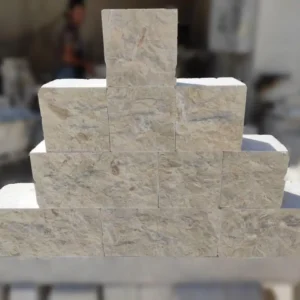
For a Jamaican contractor or developer, imported stone is a procurement exercise: land the right material, on program, at a landed cost you fixed before committing. This is the field guide to doing exactly that with us.
Wholesale means the factory price
Quarry-direct supply removes the distribution stack — no regional warehouse margin, no dealer markup. Contractors buying at volume get wholesale pricing quoted per square foot against the exact cutting list, and the price on the quote is the price: material and freight terms stated so your broker can fix landed cost before sailing.
The cutting list is the contract
Send quantities by format, thickness and finish — including copings, treads and specials — and that list drives production. Cut-to-order means two things:
- Zero compromise formats, because nothing is chosen from what a warehouse happens to hold
- Zero waste buying, because you order what the drawings need plus an agreed cuts-and-breakage margin
Batch consistency at scale
On a resort corridor job, color drift between deliveries is a defect. Project orders are supplied from a single batch, hand-inspected piece by piece after manufacturing, so phase three matches phase one. Keep an attic stock from the same batch for future repairs — clients notice.
Program integration
Stone is a long-lead item: order at design freeze, not at screed. Kareem confirms production and sailing dates against Kingston or Montego Bay schedules with the quote, and the order tracks to arrival. Crates land labeled against the packing list so site teams sequence work without opening everything — the fifteen-minute arrival inspection (count, photograph, sample-check one crate per type) keeps claims clean.
The paperwork list is published rather than improvised: bill of lading, an authentic supplier invoice, any applicable permit, tax compliance and registration numbers, a certificate of origin where a trade agreement applies, and a C73 form where a broker acts on your behalf — the Customs Agency lists what an entry requires. Missing one line is the most common reason a container sits.
Payment terms that de-risk the first job
New accounts can run through escrow: funds release when the order is verified. After a first job proves the pipeline, repeat programs run on straightforward terms. Either way you are dealing with the principal — kareem@citadelstone.us — not a sales layer.
What to standardize across jobs
Smart contractors standardize a small palette — a light limestone, a basalt accent, two finishes — and reuse it across projects. Familiar material, predictable installation rates, interchangeable attic stock, and samples that sell the next client. Start the palette with samples in 3 working days via the Jamaica supplier guide; deck and coping specifics live in our deck and coping guides.
Reading a stone quote like a bill of materials
A professional stone quote itemizes:
- Field stone by format, thickness and finish, with unit and total prices
- Specials — copings, treads, sills — by linear meter and profile
- Cutting and finishing charges, if any
- Crating and export packing
- Freight to your named port, with terms stated
- The margin line for cuts and breakage
If a quote arrives as one blended number per square meter, ask for the breakdown before comparing it with anything.
Payment structures that respect both sides
Cross-border stone typically runs deposit-against-production with balance before shipment, or escrow for new relationships — funds held by a neutral party and released on verification. Both models protect the buyer from paying for undelivered goods and the producer from cutting bespoke stone that never ships. What no serious supplier does is run production on promises; conversely, what no serious buyer should do is prepay in full to an unknown counterpart without escrow. The structures exist so neither side has to trust blindly — use them.
Absorption is the number that separates one limestone from another. The Natural Stone Institute records a range running from under one percent to over ten across the family, and notes that dolomitic stones generally carry higher density, lower absorption and better abrasion resistance — the industry variety data sets this out. That spread is why two stones sold under the same broad name can behave nothing alike underfoot.
Samples, mock-ups and sign-off at trade scale
For contractor work the sample stage graduates: range samples showing the stone’s natural variation (never a single hero piece), a client sign-off recorded against those samples, and on larger jobs a laid mock-up panel — a square meter on real bedding — that becomes the standard every delivery is checked against. This paperwork feels bureaucratic until the day a client questions variation; then the signed range sample is the cheapest document ever filed.
Handling stone on a Jamaican site
Stone arrives as forklift cargo, so plan the offload before the truck does — machine, ground conditions, and a crate stack area on level ground. Then:
- Store crates closed until each zone starts, because opened crates invite chips and tempt borrowing between zones
- Issue stone to the crew crate by crate against the packing list
- Keep offcuts sorted by size, for closures and repairs
- Protect finished floors from following trades
Building the repeatable palette
The contractors who profit most from stone treat it as a system: one light limestone field, one basalt accent, two finishes, standard coping profiles — priced, sampled and photographed once, then resold across projects with confident numbers and a portfolio that matches what clients will receive. Add a standing attic-stock habit and a relationship where the supplier knows your defaults, and stone stops being procurement risk and becomes a margin line you control.
Pricing jobs with stone confidence
Contractors lose margin on stone two ways: quoting from guesses, or padding from fear. The fix is a standing cost model built on four live numbers:
- Your laid rate per square meter for each format-and-pattern combination, tracked from real jobs
- The current material quote against a cutting list
- Freight per mode, from the freight guide’s math
- A waste margin set by pattern rather than habit
With those four, a villa terrace prices in twenty minutes.
The subcontract chain: keeping quality through other hands
Main contractors often lay stone through paving subs, and quality survives the handoff when three artifacts travel with the package:
- The signed range sample, which defines what variation is normal
- The laying drawing — pattern, origin, joints
- The crate manifest, which sets the issue sequence
Add a first-morning presence and inspect at the first square meter rather than the first hundred.
Warranty, callbacks and the stone that protects you
Every contractor prices future callbacks whether they admit it or not, and stone shifts that math favorably:
- Failures are local and cheap — relay a rocker, re-sand a joint
- Attic stock turns damage calls into hour-long visits
- The material never delivers the classic year-three calls of tinted surfaces: fading, flaking, pattern wear
What wholesale stone buying in Jamaica comes down to
The contractors who extract the most from this supply chain graduate along a path: first job (escrow, standard formats, learning the pipeline), portfolio standardization (the palette, the laid-rate model, attic-stock habit), then partner status — briefing Kareem on upcoming tenders early enough that cutting lists and reserved batches strengthen the bid itself. At that stage stone stops being a line you buy and becomes a capability you sell — the island’s clients notice the difference, and so does the margin.