A Jamaican pool deck lives two lives: postcard surface by morning, frying pan by noon — unless the stone is chosen for the physics of the place. Here is how to specify a deck that stays barefoot-friendly through the hottest hours.
Color is thermal engineering
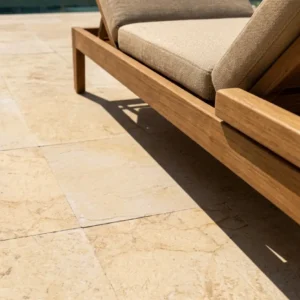
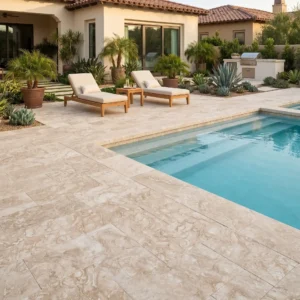
Surface temperature tracks absorbed sunlight, and absorption tracks color. Dark stone soaks heat; light stone reflects it. The difference at 1 p.m. is not subtle — it decides whether guests cross the deck comfortably or sprint. This is why light limestone dominates Caribbean pool decks: white limestone stays usable when darker surfaces are not.
Texture is traction
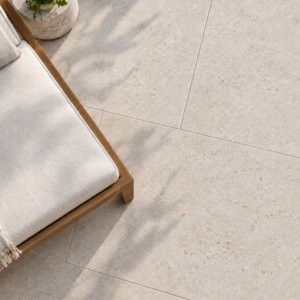
Pool decks are wet by definition. Smooth stone plus water equals a hazard, so deck surfaces want texture: our brushed grades — from rustic 16 grit to velvet-fine 80 — or bush-hammered faces, the most slip-resistant finish we make. All are photographed on real stock in the Stone Finishes Gallery. The finish question is really a zoning question: grip in splash zones, softer textures where loungers live.
Format and layout
Format is a design decision with practical consequences:
- Larger formats, 24 x 24 in up to 36 x 36 in, mean fewer joints, a calmer surface and faster laying
- Smaller formats handle curves around freeform pools more gracefully
Run pavers with a consistent joint and a slight fall away from the pool so rain and splash drain fast. Matching coping in the same stone is what makes deck and edge read as one design.
Thickness and the sub-base
On a properly prepared base, 3 cm is the exterior standard for pedestrian decks; sand-set or pedestal systems have their own requirements your installer will confirm. Thickness beyond need only adds freight weight — dense limestone runs roughly 80 kg per square meter at 3 cm.
Absorption is the number that separates one limestone from another. The Natural Stone Institute records a range running from under one percent to over ten across the family, and notes that dolomitic stones generally carry higher density, lower absorption and better abrasion resistance — the industry variety data sets this out. That spread is why two stones sold under the same broad name can behave nothing alike underfoot.
Shellstone: the barefoot alternative
Ocean Reef shellstone deserves its Caribbean reputation: fossil-textured, naturally grippy, and famously comfortable underfoot in sun. Where the design wants beach-house character rather than crisp white, it is the deck stone to sample first.
Test before you commit
Order samples, leave them in full sun for an hour, then stand on them barefoot and splash them. Ten minutes of testing answers every question this article raises — in your climate, not a brochure’s. Delivery, escrow and ordering are covered in the Jamaica supplier guide.
Reading a deck like a thermal map
Design the deck as zones with different thermal jobs:
- The wet ring — coping and the first course around the water — wants maximum grip and minimum temperature: light stone, coarse texture
- The transit field — the paths feet actually travel between loungers, steps and bar — carries the cool-underfoot requirement hardest, because nobody hops across it on tiptoe carrying drinks
- The furniture zones can take a finer finish, since pads and feet sit on them rather than soles
Shade structures change the stone math
Pergolas, sails and umbrellas do more than comfort guests — they redraw the thermal map. Stone under permanent shade can safely go finer in texture and, if the design wants it, deeper in tone; stone at the sun line should stay light because guests judge the deck by its hottest square meter, not its average. If a future pergola is even possible, run the deck stone continuously beneath its footprint now: retrofitting posts onto a finished deck is easy; matching stone added years later is not.
Installation method matters as much as the stone itself. Industry guidance separates mortar-set work, sand-set exterior paving and pedestal systems, and stresses that drainage, movement and substrate condition drive long-term performance more than the material name does — the detailing guidance is worth reading before you specify.
Night: the deck’s second shift
Caribbean decks live long evenings, and stone choice decides how little lighting they need:
- Light limestone returns moonlight and low-level LED washes so effectively that path and step lighting can be sparse and warm
- Dark stone swallows light and demands more fixtures to stay safe
Fewer fittings, softer scenes, safer steps — the pale deck wins the night as decisively as it wins noon.
Drainage detailing guests never notice
A deck that sheds water invisibly feels effortless, and three details do it:
- Falls of 1.5–2 percent away from the water, carrying splash and rain to planted edges or slot drains
- Joints tight and flush, so bare feet never catch
- A flush stone edge where deck meets lawn or planting, doubling as a mowing strip and a clean visual stop
On the wettest decks, permeable joints over an open-graded base take the squall without a drain at all.
A specification you can copy
For a Jamaican villa deck, this baseline serves almost every project:
- 3 cm dense white limestone, 24 x 24 in field, stack bond, tight joints
- coarse brushed or bush-hammered wet ring and external steps
- Finer brushed transit and furniture zones
- Matching bullnose or square coping
- Falls of 1.5–2 percent to planted edges
- Attic stock at 3 percent
Adjust format up to 36 x 36 in where the deck has room, and swap in shellstone where the brief wants texture over crispness.
Re-decking over an existing slab
Many Jamaican pools sit in sound concrete surrounds that look tired, and full demolition is rarely necessary — a bonded overlay of 2 cm stone on the existing slab, levels permitting, or a full 3 cm re-lay on fresh screed. Three survey questions decide which:
- Level headroom at doors and at the coping line
- Slab soundness, with hollow-sounding zones repaired first
- Falls, because inherited puddles must be corrected in the screed rather than hidden under stone
Coordinating deck stone with waterline tile
The deck meets the pool’s interior finish at the waterline, and the pairing deserves ten deliberate minutes: pale decks flatter both classic blue waterline tiles and the fashionable darker interiors; what jars is competition — a busy patterned waterline against a heavily veined deck. Bring a deck sample to the tile decision (or vice versa) and view both wet, in sun, together. One look answers what no catalog can, and the pool reads as designed rather than assembled from separate decisions.
Fixing things to a stone deck, without regret
Umbrella bases, shade-sail anchors, handrails and outdoor-shower frames all want fixing to the deck eventually. Plan it the honest way:
- Core-drilled sockets and stainless fixings at known points, rather than improvised drilling later
- Sleeves cast into the screed during construction, which is best of all
- Surface-standing solutions — weighted bases on protective pads — where loads allow, sparing the stone entirely
The decisions that define a pool deck in Jamaica
Seasonal rhythm for the finished deck: through the drier months, the weekly sweep and monthly rinse carry everything; as the wetter season builds, walk the falls and drains once so the first cell finds them clear; after any big blow, rinse the salt film off and clear debris before it stains; and once a year, deep-clean and re-inspect textures in the wet ring — traffic slowly polishes, and a light re-texture (or course swap from attic stock) restores day-one grip where the years concentrate. A deck maintained on this loop simply does not age on any schedule guests can see.