Jamaica imports building materials every day of the year — stone is routine cargo, not an exotic project. Here is the honest sequence for getting natural stone from our factory to a Jamaican site, and the decisions that control what you pay.
Choose your port like a local
Jamaica gives you two serious options, and the right one is usually decided by the site rather than the rate:
- Kingston serves the capital, the south coast and anything reachable off the A1 and A2 corridors — the island’s main container hub, with the deepest sailing schedule
- Montego Bay serves the north-coast resort corridor from Negril to Ocho Rios, and can save a north-coast project the cross-island truck leg entirely
Freight is quoted to a named port, so name the right one before comparing numbers.
Samples before specification
Approve physical samples first — at your door within 3 working days. Judge them in Jamaican light, wet and dry, beside whatever they will meet on site: render, timber, existing tile. Every expensive stone mistake we have ever seen started with someone specifying from a photograph.
Pallet, groupage or container
Three shapes of shipment, chosen by volume:
- Palletized or shared-container groupage — a patio or pool surround, smaller volume at a sensible rate
- Full container — resort and development work, roughly 24–26 metric tons each, which at 3 cm is on the order of 280–320 square meters arriving as one inspected, sequenced delivery
- Split consignments — occasionally right for phased sites, though each extra sailing adds handling
What actually drives cost
Sea freight prices by weight and volume, and dense limestone runs roughly 80 kg per square meter at 3 cm. Thickness is therefore the main lever:
- 2 cm for covered interiors
- 3 cm as the exterior standard
- 5 cm under vehicles
Specify what the application needs and no more. The other lever is completeness: measure carefully, add a cutting-and-breakage margin, and ship once.
Customs without surprises
We prepare export documentation and a clear commercial invoice; your Jamaican customs broker handles clearance, duties and local charges. Bring the broker in at quote stage — with our paperwork they can calculate your landed cost before the vessel sails, which is exactly when you want to know it.
Clearance in Jamaica runs on a documented system rather than local habit. All commercial goods are declared on an electronic Single Administrative Document through ASYCUDA, and consignments above US$5,000 in value must be cleared by a licensed customs broker rather than self-cleared — the Customs Agency sets out the commercial process in full. Almost every stone order crosses that threshold, so engage the broker at quote stage rather than at the port.
When the crates land
Fifteen minutes of discipline: count crates against the packing list, photograph any visible transit damage before crates move, and open one crate per stone type to confirm the material matches your approved samples. That keeps any freight claim simple and your installation sequence intact.
Materials, finishes and the full Jamaica picture are in our Jamaica stone supplier guide. New clients can pay through escrow — funds release only after the order is verified.
A worked example: pricing a 60 m² pool surround
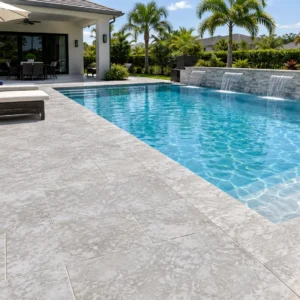
Numbers make freight real, so walk through a typical villa job: a 60 square meter pool surround plus 18 linear meters of coping, in 3 cm white limestone. The stone weighs roughly 80 kg per square meter, so the field is about 4.8 metric tons; coping adds several hundred kilograms more. That is comfortably a palletized or groupage shipment — nowhere near container territory — and it means your freight conversation is about pallet count, port handling and clearance, not vessel chartering. Now scale the same math to a 12-villa development at 150 m² each: 1,800 m² is roughly 144 metric tons, or six containers — and suddenly phasing call-offs against the construction program matters more than any single price line. The point of the arithmetic is not precision; it is that quantity decides the shipping mode, and the shipping mode decides half the logistics conversation. Where that stone lands is a separate calculation, and the cool-underfoot deck specification is where most villa quantities come from.
The paperwork, named piece by piece
First-time importers relax once the documents have names. The commercial invoice states what the goods are, their value and the terms — it is the document duty is assessed against. The packing list itemizes every crate: contents, dimensions, weights — your installer will bless a good one. The bill of lading is the contract of carriage and the document that releases the cargo at Kingston or Montego Bay. Depending on the order there may also be a certificate of origin. We produce all of these as a matter of routine; your broker tells us anything Jamaica-specific they want stated, and the file they receive is the file that clears.
Absorption is the number that separates one limestone from another. The Natural Stone Institute records a range running from under one percent to over ten across the family, and notes that dolomitic stones generally carry higher density, lower absorption and better abrasion resistance — the industry variety data sets this out. That spread is why two stones sold under the same broad name can behave nothing alike underfoot.
Working with a Jamaican customs broker
If you build regularly you already have a broker; if this is your first import, ask your contractor or freight forwarder to recommend one, because brokerage is a competitive professional trade here and rates for a straightforward stone consignment are modest. Send the proforma invoice at quote stage and ask two questions:
- What will the total landed cost be?
- Is there anything you want stated on the paperwork?
Ten minutes of that conversation prevents most clearance surprises.
Insurance, damage and the claims reality
Marine cargo insurance on a stone shipment is inexpensive and worth carrying, but the practical protection is procedural:
- Crates engineered for stone, with edge protection and face separation inside
- A fifteen-minute inspection at arrival
- Photographs of anything questionable before crates leave the port or the gate
Documented promptly, transit damage resolves as an insurance line. Discovered three weeks later on site, it becomes an argument.
Timing around the Jamaican calendar
Two calendar realities are worth planning around:
- Hurricane season, June to November, rarely stops commerce, but a named storm can shift vessel schedules by days — order earlier in those months and hold a buffer between arrival and installation
- The winter tourist high season, which means north-coast villas want exterior works finished by November
Counting backwards through installation, clearance and sailing puts the comfortable order date earlier than most owners expect.
After arrival: from port to laid floor
Crates travel inland by flatbed; agree lifting equipment at site in advance because stone crates are forklift or crane cargo, not manpower cargo. Store crates on level ground, opened progressively as installation advances rather than all at once, and keep the packing list with the site file so each crate opens where its contents are needed. From this point your installer takes over — and a good Jamaican paving crew, given calibrated stone and a labeled delivery, will make the imported-versus-local question feel academic within a week.
Money across the water: paying for imported stone
Stone exports quote in US dollars, which suits Jamaican projects that already budget hard currency. The payment mechanics are unremarkable — international wire against invoice — but the structure matters: a deposit that commits production, balance before shipment, or full escrow for a first relationship, with funds released only on verification. What to avoid is equally simple: paying anyone in full, up front, with no escrow, on a first order — no legitimate supplier requires it, and the ones who insist are answering your due-diligence question for you.
Installation method matters as much as the stone itself. Industry guidance separates mortar-set work, sand-set exterior paving and pedestal systems, and stresses that drainage, movement and substrate condition drive long-term performance more than the material name does — the detailing guidance is worth reading before you specify.
Red flags in a freight quote
Comparing forwarder or consolidator quotes, watch for the classics:
- A headline rate that excludes destination charges — ask explicitly what is payable at the port before release
- Vagueness about transit time versus sailing frequency, because a cheap service sailing monthly can cost a program more than it saves
- No mention of how stone-weight cargo is handled and secured
The best freight quote is rarely the lowest line.
Documentation errors that actually cause delays
Clearance dramas are almost never exotic — they are typos:
- Invoice values that disagree with the packing list
- Descriptions too vague to classify, such as “stone” instead of “finished limestone floor tiles”
- Missing consignee details
- A bill of lading naming the wrong notify party
File discipline exists precisely to prevent these, and your broker’s pre-check catches the rest.
What shipping stone to Jamaica really asks of you
Jamaica’s masons and paving crews are excellent, and imported calibrated stone is easier to lay than what many learned on — but a short briefing aligns expectations: calibrated thickness means consistent bedding depth (no thickness-chasing); the crate labels map to the packing list, so stone is issued zone by zone; finished faces stay protected until grouting is done; and offcuts are sorted, not skipped, because closures and future repairs live there. One toolbox talk on day one, and the crew’s craft plus the stone’s consistency produce the floor both were capable of. The full materials and freight picture sits in the Jamaica stone supplier guide. Freight is a solved problem when it is planned rather than discovered.