St. Lucia marries people for a living. The island ranks among the world’s leading destination-wedding addresses — the Pitons officiate over more vows than most cathedrals — and a meaningful slice of its villa and small-hotel economy runs on ceremonies: elopements for two, family weddings for sixty, vow renewals every season. A property that hosts weddings well earns event fees, peak-rate bookings and a photograph that markets it forever. Hosting well is substantially a stonework question, because a wedding is choreography, and choreography needs a floor.
The ceremony platform
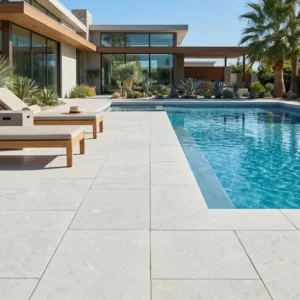
The vows need a stage: a level stone platform composed against the property’s best backdrop — sea horizon, garden green or the Pitons themselves — sized honestly for the couple, celebrant and first two rows, with the view-edge discipline keeping the frame clean behind them. Two working measurements matter more than any styling: dead-level footing for people standing still in formal shoes for forty minutes, and an aisle approach without a single surprise step — brides walk toward the view, not toward their feet. Pale stone earns its place twice here: it photographs luminously in the ceremony hour and stays cool under an afternoon sun that formal dress does not forgive.
Choreography in stone
A wedding moves in processions — aisle walk, recessional, cocktail drift, dinner seating, first dance — and the venue’s stonework either carries the flow or fights it. The aisle line wants generous width and flush joints (heels are the day’s engineering constraint: wide raked joints and polished surfaces both fail the shoe test that textured honed stone passes); transitions between ceremony, cocktail and dinner zones want ramps or full-width steps rather than pinch points; and the dance floor — the night’s destination — wants smooth dense stone, level to a standard the DJ’s speaker stands will test. The event-day specification applies in celebration dress: point loads from staging and bars, sockets for arches and lighting rigs dressed with matching stone caps, power and water reaching the lawn edge through sleeves laid at build.
- An aisle line with generous width and flush joints, since heels are the day’s engineering constraint.
- A recessional route that does not double back through seated guests.
- Cocktail drift space between ceremony and dinner, surfaced to the same standard.
- Dinner seating on ground level enough that no table needs packing under a leg.
- A dance area detailed for hard soles, with no lipped joint anywhere on it.
Sixty guests, one evening, no trace
Event hosting is logistics wearing flowers, and the service side decides whether the villa survives its own success. Caterers need a route from drive to kitchen to garden that never crosses the ceremony sightline — the service-circulation rules at their most theatrical — with hardstanding for the truck, hose-down aprons for the clean-up, and surfaces throughout that shrug a hundred chair feet and a spilled case of red. The morning-after test is the specification’s real exam: dense, textured, mid-toned stone rinses back to villa condition overnight, which is precisely what lets a property host monthly without aging yearly.
- A caterer route from drive to kitchen to garden that never crosses the ceremony sightline.
- Hardstanding for the truck, sized for a loaded vehicle rather than an empty one.
- Power, water and waste points positioned where the marquee and bar will actually stand.
- Bin and glassware routes kept behind planting and out of every photograph.
- A hose-down surface at the service end, so the property resets overnight.
The golden hour is the product
Wedding venues are bought from photographs, and the photographs are made at dusk: the couple against the horizon, the party under first lights, the stone terrace glowing warm. The lighting playbook becomes commercial infrastructure here — layered scenes that move the evening from ceremony brightness to dinner intimacy to dance-floor energy without a single cold fixture — and the sunset-facing logic scales from table-for-two to ceremony-for-sixty unchanged: face the light, hold it in pale stone, keep the edge clean. Properties should shoot their own spaces at golden hour each season; the portfolio is the sales team.
Building the wedding business case
For owners weighing the investment, the arithmetic stacks: a ceremony platform, upgraded circulation and event services are modest capital against event fees that repeat, peak-season wedding-party bookings that fill every room, and the marketing gravity of being photographed professionally, for free, every month. The build sequence suits phasing — platform and aisle first, service infrastructure second, lighting third — on the low-season upgrade rhythm, with batch continuity keeping the venue coherent as it grows. The St. Lucia stone page has the ceremony platform on its standard specials list; on this island, that is not a niche request.
The elopement product: two guests, full theater
Below the sixty-guest wedding sits the category that fits every property: the elopement — a couple, a celebrant, a photographer, and the island doing the rest. St. Lucia’s marriage formalities are famously manageable, the elopement package is a small hotel’s highest-margin product, and its infrastructure demands are exactly a romance-grade property’s existing assets pointed at a ceremony: the sunset terrace as platform for four, the couple’s dinner nook as reception venue, the golden-hour lighting as the photography studio. What the elopement adds is choreographic polish at miniature scale — a short approach that still reads as an aisle, a composed spot for the vows with the view behind and the sun placed, and the photographer’s circuit considered in advance so every frame finds clean stone and open horizon. Properties running the product well keep a simple ceremony kit — arch sockets dressed into the terrace, a signing table’s level spot — and sell the same stonework twice: once as a honeymoon, once as the wedding that starts it.
The vendor circuit: hosting the professionals
Every wedding arrives with its own workforce — florist, caterer, band or DJ, photographer, planner — and the venue that hosts professionals well gets chosen by them, which is how wedding properties actually fill their calendars: planners book venues that make their day easy. The infrastructure reads like hospitality for trades. Vendor arrival wants its own window and route: hardstanding for two or three vans, an unloading zone with trolley-flat access to the event lawn, and the service circulation that never crosses the ceremony sightline even during setup hours. The florist needs water and a shaded staging table; the caterer needs the hose-down apron and honest bin logistics; the band needs power at the dressed outlets this guide already specifies, plus a level, dry platform for equipment that cost more than the stone under it. The photographer’s needs are spatial — the golden-hour circuit kept clear of drying racks and cable runs — and the planner’s are temporal: a venue whose setup can start early because the working zones are separate from the guest zones. After the last dance, the strike runs the same routes in reverse, at midnight, in the dark — which is why the service lighting circuit earns its place. Properties that document this circuit in a one-page vendor pack find it circulating among the island’s planners within a season; in the wedding trade, the venue’s best marketing is a caterer saying it was easy.
Choosing a stone that photographs and performs
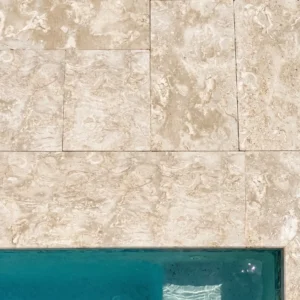
A wedding surface has two jobs on the same evening: look flawless in low light and take sixty pairs of hard shoes without marking. The Natural Stone Institute notes that limestone varies widely, with absorption from below one percent to above ten and dolomitic varieties generally denser, stronger and more abrasion resistant.
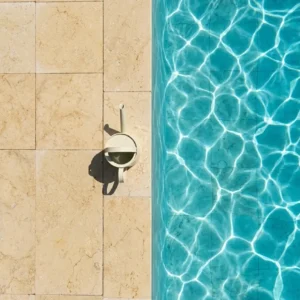
- Warm buff and cream tones, which render beautifully at golden hour and under warm lighting.
- Low absorption on dining and bar zones, where wine and canapes land all evening.
- Higher abrasion resistance on the aisle and dance area, which take concentrated wear.
- Acid-sensitive stone kept away from citrus service and cocktail stations.
- One batch across the ceremony platform, so nothing reads as patched in photographs.
Building a platform that stays dead level
A ceremony platform is judged by whether a chair rocks and whether a heel catches, which makes the construction beneath it the whole story. This overview of detailing natural stone paving covers the systems available.
- Mortar-set construction where the platform must not move under crowd loading.
- Sand-set paving kept to garden approaches rather than the ceremony area itself.
- Pedestal systems where a terrace sits over structure and must drain beneath.
- A written lippage tolerance, measured rather than judged by eye at handover.
- Base depth designed for a full guest load plus staging, not for domestic foot traffic.
Wet weather and the plan B nobody wants to need
Every tropical wedding venue needs an alternative that does not feel like a compromise.
- A covered area large enough for the ceremony, not just for the bar.
- Marquee anchor points designed into the paving and capped when not in use.
- Drainage that clears a downpour in minutes rather than hours.
- A dry route from parking to cover, since guests arrive dressed for photographs.
- Surfaces that stay grippy wet, because the plan B evening is the one with the risk.
Wedding venue stone that earns its investment
A ceremony is an hour long and the surfaces have to be right for all of it: level enough for chairs, flush enough for heels, warm enough to photograph at dusk, grippy enough if it rains, and served by a route that keeps caterers invisible. The capital is modest against repeat event fees, and the same upgrades improve the property for every other guest. Where the service side has to carry it, our villa service area design guide sets out the routes. Build the platform for the walk down the aisle and the whole evening follows.