St. George’s wears a title no Caribbean rival can claim: the oldest continuously inhabited English town in the New World — four centuries of crooked lanes, stepped gables and harbor walls holding UNESCO World Heritage standing, still lived-in, still trading, still burying its parishioners from the same churches. The town is Bermuda’s deep past kept walkable, and its conservation craft — streets, squares, thresholds — is the island’s most careful stone chapter. Here is the old town’s guide.
Four centuries underfoot
The town’s ground is its document: lanes laid to seventeenth-century widths, King’s Square where the town’s civic theater — replica stocks included — plays to visitors, steps and alleys negotiating the harbor slope, and surfaces accreted era by era. Conservation reads before it renews: the UNESCO-quarter disciplines apply in English dress — significance mapped, materials matched, every intervention reversible in principle and documented in fact — and the lane-scale manners govern works in streets a cart was measured for.
The living-town balance
St. George’s is no museum: residents park, shops trade, the ferry lands day crowds, and the conservation brief carries the dual-audience craft at heritage pitch: accessible routes threaded through historic levels without falsifying them, modern services buried on the discreet-retrofit wisdom, surfaces rated for delivery vans in lanes designed for handcarts, and the daily economy’s needs — the small-premises honesty of pubs, galleries and grocers — served inside conservation rules. The town survives by being used; the craft keeps use from consuming it.
- Establish the listing status of the specific building before any design work starts.
- Record existing fabric thoroughly, because that record cannot be recovered afterward.
- Keep interventions reversible where original material is the asset.
- Use lime-compatible mortars wherever new work meets historic masonry.
Churches, forts and the monument register
The town’s anchor buildings — St. Peter’s in its churchyard centuries deep, the unfinished church’s poetic ruin, the fort ring the naval-heritage chapter completes — run conservation at monument grade: ruin stabilization on the arrest-not-restore philosophy, churchyard paths and memorial settings maintained with archival care, and interpretation infrastructure — rails, viewing ground, discreet lighting — added on the visitor-safety disciplines without costuming the past. The monuments are the town’s witnesses; works around them stay silent company.
Harbor walls and the waterfront
The old harbor still works — ferries, yachts, the season’s visiting fleet — and its stone edge runs the working-harbor craft under heritage duty: quay walls conserved and strengthened marine-grade, ordnance and bollard heritage kept in service, waterfront promenades on the harbor-walk registers, and sea-level honesty — the Atlantic’s storms test the town’s oldest engineering, and each repair banks the island’s storm curriculum into fabric that has already survived four hundred years of it.
The parish-town palette
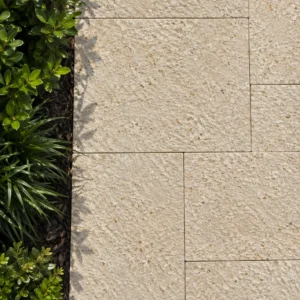
The town’s color rules are gentler than the capital’s but no less governing: whitewashed stepped roofs, walls in weathered pastels, and ground surfaces holding the vase-discipline restraint in a subtler key — gray-and-buff stone fields, worn thresholds kept worn, and new material chosen to age into company rather than arrive announcing itself. The town’s beauty is accumulated, not designed; conservation’s art is adding years without adding noise.
- Choose stone that will weather toward the surrounding fabric rather than away from it.
- Avoid artificially aged finishes, which read as false beside genuinely old material.
- Keep new work legible as new so the historic fabric is never in doubt.
- Match bedding and joint width to the original rather than to a modern standard.
Serving the old town
Works in St. George’s run the cluster’s most patient procurement: conservation officers consulted early, materials matched to fabric older than the supply chain, small orders at heritage tolerance, and logistics on the island supply discipline scaled to lanes that refuse lorries. The island supply guide serves the register with conservation-grade counsel: matched stone, archival documentation, and the humility the town teaches everyone who works in it — four centuries built this ground; the job is always to hand it on longer than we found it.
Under the lane: when works meet four centuries
Dig anywhere in St. George’s and the town’s past answers: every service trench, drainage renewal and threshold repair in a four-hundred-year settlement is potential archaeology, and the working protocol is settled. Works in sensitive ground proceed with watching briefs — an archaeologist’s eye on the open trench — and the finds culture is cooperative rather than adversarial: the clay pipe stems and ballast flints that surface routinely get recorded and returned or archived, the significant surprises — earlier surfaces, wall footings, the occasional cache — get the pause-and-assess their rarity deserves, and the program absorbs the delay because the alternative, on this island, is cultural vandalism with a completion date. Contractors who work the old town price the rhythm in and keep the museum’s number saved; the ones who treat the past as spoil find their next tender politely unsuccessful.
The practical craft minimizes the encounters: shallow-dig methods where services allow, shared trenches negotiated so the lane is opened once rather than serially, reinstatement in the town’s own coursing from recorded sections — the surface returned as found, which in St. George’s means returned as documented. Property owners meet the same logic at their thresholds: the worn step that renewal would replace may itself be the artifact, and conservation counsel before commitment is the cheap version of every subsequent conversation.
None of this burdens the town so much as defines it: the lanes are walkable archive, the works culture is curation with excavators, and the stone that goes back — matched, recorded, honestly new where new — joins the stratigraphy politely. Four centuries built downward as much as upward here; the town’s builders learned to work as guests of both dimensions, and the UNESCO listing is, in part, a review of their manners.
What the World Heritage listing covers
St George is protected at the highest level available. The World Heritage listing for the Historic Town of St George and Related Fortifications records inscription in 2000 across 257.5 hectares, with approximately 176 listed buildings in the town itself, protecting what it calls an authentic and the earliest example of the English colonial town in the New World alongside fortifications running from the 1620s to the twentieth century. Protection operates through the Development and Planning Act of 1974 and the Bermuda Plan, with Historic Protection Areas at four fort sites.
- Assume the listing applies to the setting as well as the individual building.
- Expect a heritage process rather than an ordinary permit where protected fabric is touched.
- Read the fortifications as part of the same property, since they are inscribed together.
- Coordinate with the management plan, which runs on annual action plans and progress reports.
- Budget real time, because approval on inscribed fabric does not compress to suit a schedule.
Why the buildings look the way they do
The listing is explicit that Bermudian architecture has changed little in its basic elements since the end of the seventeenth century: mostly one or two stories, white-washed walls of local soft limestone, under white roofs pitched specifically to collect rainwater into cisterns through gutters and conduits. The National Museum of Bermuda on limestone adds the practical side, recording that the stone hardens as it is quarried and that its porosity helps filter the water the roof collects.
- Understand the white roof as functional infrastructure rather than as a heritage aesthetic.
- Keep new work to one or two stories, since that is the recorded character of the town.
- Respect the soft limestone tradition rather than substituting a harder imported stone.
- Match limewash and render practice, because the finish is part of what is protected.
- Treat the water system as a constraint on any alteration to a roof or elevation.
Working on a street that has been there for four centuries
The practical difficulty in St George is not the approvals, it is the access. Lanes were laid out for foot traffic and carts, buildings sit directly on the street with no setback, and there is nowhere to stand a pallet. Every project here is a logistics problem before it is a design one, and the projects that go well are the ones that admitted that at the start.
- Survey the delivery route before ordering, since format follows access here.
- Size units so two people can carry them, because machinery frequently cannot reach.
- Split deliveries into small drops rather than one large one.
- Agree loading arrangements with neighbors and the authority well in advance.
Historic town stone that the listing will accept
Working inside an inscribed town is a privilege with paperwork attached. Reversible detailing, lime-compatible mortars, material that weathers toward its neighbors, formats sized for lanes that machinery cannot enter, and a record of everything before the first stone moves. Our Bermuda stone supply guide sets out the formats, finishes and lead times that suit this island. St George has stood for four hundred years, and the only sensible ambition is to leave it looking as though nothing happened.