Bermuda sits alone in the Atlantic’s storm lane and has been keeping notes for four centuries: hurricanes arriving without an island chain to blunt them, a building culture hardened by repetition — the stepped stone roofs, the massive walls, the shutters that are furniture rather than afterthought — and a modern record the region studies: category-strength landfalls absorbed with the power back on in days. The island’s storm curriculum is its deepest building lesson, and stone is a core subject. Here is what the storms taught.
The vernacular’s syllabus
Bermudian tradition is storm engineering as heritage: roofs in mortared stone slates stepped against uplift — the same roofs the rain-harvest chapter celebrates — walls of coral block at masses modern codes rediscover, small protected openings, and siting wisdom accumulated hollow by hollow. The vernacular-intelligence principle runs at full Atlantic pitch: the island’s old houses are its test archive, and the new build that reads them inherits four hundred storm seasons of peer review.
Ground surfaces as storm assets
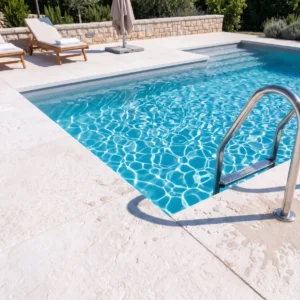
The curriculum’s stone chapter is quietly decisive: paved ground that neither lifts nor becomes debris while lighter surfaces strip and fly, terraces that shed storm water into the drainage the seasonal craft engineered, walls that windbreak year-round then earn their mass in the event, and the post-storm dividend — stone courts hosting generators, tarps and repair staging as the recovery-infrastructure lesson teaches. The landscape that survives is the recovery’s workshop; the one that shreds is its first job.
- Restrain every free edge mechanically rather than relying on bedding or adhesive.
- Use heavier units on exposed corners, where uplift concentrates during a storm.
- Keep joints tight and filled so wind-driven water cannot get beneath the surface.
- Fix anything raised, since unattached items become projectiles at storm wind speeds.
Preparation as choreography
The island’s storm week runs rehearsed: shutter days sequenced, furniture plans executed — the pool-court protocols sinking what sinks and strapping what stays — service yards cleared, cisterns topped, and the absent-owner playbook activating for the properties whose owners watch from abroad. Design serves the choreography: hardware pre-fitted, storage sized for the loose-item census, and thresholds that let the house close like a sea chest in an afternoon.
The insurance-capital standard
The island that reinsures the world’s catastrophes builds to persuade its own actuaries: premises on the continuity-grade specification, mitigation documented for the pricing conversation, materials chosen on the evidence-culture logic — and stone’s file reads well: no uplift risk, no debris contribution, no post-storm replacement queue. The premium arithmetic the latitude chapter escapes by geography, Bermuda answers by engineering — and prices the difference into every survey.
Repair rhythm and the long record
After the storm the island runs its recovery muscle: damage triaged, the compressed-works discipline applied to repair calendars, heritage fabric — the old town’s four centuries included — mended on conservation manners, and each event’s lessons banked: details revised, specifications tightened, the curriculum extended. The record is the point: an island that cannot evacuate builds so it does not need to, and every rebuilt edge is the next storm’s exam answer.
- Design so a damaged section can be lifted and relaid rather than fully rebuilt.
- Hold matched spares on the island for the areas most likely to be hit.
- Keep a documented setting-out grid so a reinstated area lines up exactly.
- Photograph the finished work, because that record speeds any insurance discussion.
Specifying from the curriculum
The storm-lesson kit is the cluster’s law at Atlantic strength: dense stone massed where mass matters, marine fixings without exception, drainage engineered for the deluge inside the wind, debris-free landscapes, and documentation the insurance culture rewards. The island supply guide serves the curriculum natively — storm-grade materials, hardware-ready details, spares against the repair season — because Bermuda’s deepest lesson is the one it teaches calmly: the storm is not the exception here; it is the client.
Retrofitting the cottage: small works against big wind
Most of Bermuda’s housing stock predates its current codes, and the storm curriculum’s practical application for owners is the retrofit ladder — the sequence of small works that raise an older cottage’s resilience without a rebuild’s budget. The ladder climbs by return on risk: roof first, always — the mortared-slate tradition inspected and repointed, ridge and eave courses secured, because the roof that stays keeps the house; openings next — shutters restored to working order or fitted where absent, hardware upgraded to positive latching, the garage door (the modern stock’s weak point) braced or replaced; then the envelope’s edges — flashings, vents and the small penetrations wind exploits; and finally the grounds — the debris audit applied to an older garden’s accumulated furniture, the trees crown-thinned, the drainage restored to its designed falls.
The stone opportunities recur throughout: failing timber decks replaced in ground-set stone retire a maintenance cycle and a debris source in one decision; loose boundary walls re-bedded and capped return to windbreak duty; and the cottage’s aprons and paths, renewed with honest falls, move water away from the fabric the wind will drive rain against. Documentation converts the ladder to money: each rung photographed and filed feeds the insurance conversation, and the island’s underwriters price visible mitigation with unusual literacy.
The retrofit’s philosophy is the vernacular’s own, resumed: the old builders hardened incrementally, storm by storm, and the modern owner climbing the ladder is continuing their method with better fasteners. A cottage brought up the ladder rides the next event as its ancestors rode theirs — tight, shuttered, and standing — and the works that got it there rarely cost more, in total, than the first uninsured repair they prevented.
Three centuries of learning, written into the code
Bermuda did not adopt storm-resistant building from a manual, it arrived at it the hard way. Research published by Moody’s on Bermuda disaster resilience traces the vernacular to a run of four hurricanes in 1712, 1713 and 1715, after which timber gave way to walls of massive reef limestone blocks under roofs tiled with thick slabs of coral stone. The island now operates what that assessment calls a robust and well-policed building code ensuring adequate wind resistance for all new construction.
- Read the tradition as engineering rather than as heritage styling.
- Expect the code to be enforced rather than advisory, which raises the evidence required.
- Assume fixings and restraint will be inspected, since wind resistance is the priority.
- Design hard landscaping to the same standard as the building, not to a lesser one.
- Treat the code as a value driver, because it is a large part of why buildings here survive.
The record that shows it works
The outcomes are measurable. The same assessment records Hurricane Nicole in 2016 producing maximum measured wind speeds close to 120 mph with no casualties, damage confined largely to fallen trees, debris, some boats and downed utility poles, and recovery inside 72 hours despite 90 percent of the island 27,000 houses losing power, half of them reconnected by the following morning. Hurricane Fabian in 2003 caused around 300 million dollars of damage, roughly 650 million in current terms, and Gonzalo in 2014 about half that.
- Note that a 120 mph event produced no casualties, which is the point of the code.
- Expect utility disruption rather than structural loss, since that is the recorded pattern.
- Design for rapid reinstatement, because recovery here is measured in days.
- Understand that the damage figures are dominated by trees and services rather than fabric.
- Budget for post-storm cleanup as an operational cost rather than a rebuild.
How often it actually happens
Frequency matters as much as severity when deciding how far to go. The National Hurricane Center climatology records the Atlantic season as June 1 to November 30, with activity concentrated from mid-August to mid-October and a statistical peak around September 10, producing roughly fourteen named storms, seven hurricanes and three major hurricanes in an average year. Bermuda sits directly in that track, which is precisely why its standards sit where they do.
- Plan works to finish before the peak weeks rather than running through them.
- Land material ahead of the season, since a delayed sailing during it compounds quickly.
- Keep the site securable at short notice through the whole season.
- Schedule the annual inspection for early summer, before the season rather than after it.
Hurricane hardening stone and what storms actually expose
Storms find the unrestrained edge, the loose item and the joint that was never properly filled. Three centuries here produced a code that closes all three, and hard landscaping should meet the same standard as the walls behind it. Our Bermuda stone supply guide sets out the formats, finishes and lead times that suit this island. The island proved in 2016 that a 120 mph storm can pass with no casualties, and that outcome is built rather than lucky.