
















50 Years Of Manufacturing & Delivering The Highest-Quality Natural Stone. Sourced & Hand-Picked From The Middle East.

Escrow Payment & Independent Verifying Agent For New Clients

Contact Me Personally For The Absolute Best Wholesale & Trade Prices:

USA & Worldwide Hassle-Free Delivery Options – Guaranteed.

Hexagon Limestone Tile in Arizona

Hexagon limestone tile in Arizona performs best when the subgrade beneath it is properly evaluated and prepared — a step that catches many installers off guard given the state's variable soil conditions, from expansive clay-heavy profiles in the Phoenix metro to sandy desert soils found across rural stretches of the Sonoran landscape. Limestone's natural density and weight distribution make it particularly sensitive to ground movement, meaning a poorly stabilized base can lead to lippage, cracking, or joint separation within the first few seasonal cycles. Citadel Stone Hexagon Limestone Tile in Arizona is available in multiple formats and thicknesses suited to both interior and exterior applications, with specification support available for contractors navigating site-specific base requirements. The full article covers how soil classification, compaction depth, and mortar bed selection interact — details that determine long-term performance far more than the tile choice itself. Citadel Stone supplies Hexagon Limestone Tile sourced from quarries across the Mediterranean and Middle East to projects in Phoenix, Tucson, and Scottsdale, Arizona.

See & Feel the Quality – Free Arizona Stone Samples

Our stones are made for the Arizona sun. See how the colors hold up in your specific light.

Design Your Arizona Home with a Local Stone Expert

Get personalized advice on the best stone for Arizona's climate and your design style.

Premium Natural Stone — All Sizes & Thicknesses Available

From standard cuts to fully custom dimensions — our limestone, granite, basalt & shellstone
are cut to your exact specifications. Residential or commercial, we’ve got you covered.

Showing all 69 resultsSorted by popularity

Get Your Free Arizona Stone Quote

Transparent Pricing for Your Arizona Project

Elevate Your Arizona Property with Premium Stone, Priced for Value.

Unlock $10,000 Worth of Deals on Beautiful Paver, Tiles & Cobble Setts—For Free!

Invest in Arizona’s Landscape: Stone That Lasts a Lifetime.

100% Happiness Guarantee

Trust 50 Years of Expertise. Invest in Quality Limestone Tiles

Custom-Cut for Your Arizona Project: Any Size, Any Finish.

No-Obligation Consultation: Get Expert Advice for Your Arizona Home.

The Stone Supplier Trusted by Arizona's Leading Architects & Designers.

Arizona's Most Diverse Selection of Natural Stone.

Elevate Your AZ Property with Natural Stone Built for the Desert. Our expansive collection of Natural Stone brings timeless beauty and proven durability to both residential and commercial spaces across Arizona. As the state’s leading supplier, we offer a diverse palette of colors and finishes—from cool, light tones that reflect the sun to rich, earthy textures that complement the Southwest landscape. Transform your environment with limestone that stands up to the Arizona heat while providing the sophisticated aesthetic you desire.

Incredible Prices for Top-Quality Stone—Shop Citadel Stone Today!

Table of Contents

Base composition in Arizona tells you more about long-term hexagon limestone tile performance than almost any other single variable — and most specifications get it wrong before a single tile is laid. The expansive clay soils common across Phoenix’s suburban fringe and the caliche hardpan that shows up unexpectedly in Scottsdale developments create completely different subgrade challenges, each demanding a different base treatment strategy. Citadel Stone’s technical team regularly consults on these ground conditions before warehouse orders are confirmed, because catching soil instability issues at the planning stage prevents the most expensive callbacks this industry produces.

Arizona Soil Conditions and What They Mean for Hexagon Limestone Tile

The ground beneath your hexagon limestone tile installation doesn’t behave uniformly across Arizona. You’ll encounter three distinct soil profiles depending on location and elevation: expansive montmorillonite clay, sandy alluvial deposits, and calcified hardpan known locally as caliche. Each one interacts with your base aggregate and your limestone differently, and each demands a specific response before you compact a single inch of base material.

Expansive clay soils are the most problematic for hexagon limestone floor tiles because they respond to moisture fluctuations with volumetric change. In Phoenix’s west side and parts of Tempe, clay expansion can generate uplift pressures between 2,000 and 4,000 PSF — enough to displace even properly mortared tile beds over two or three wet seasons. The field fix isn’t simply adding more aggregate depth; it’s replacing the top 8–12 inches of expansive soil with non-expansive material before any base construction begins.

Caliche is a different story. Projects in Scottsdale frequently encounter caliche hardpan at 18–24 inches below grade, which actually provides a structurally excellent sub-base when properly broken up and recompacted at 95% Proctor density. The challenge is that caliche layers vary in thickness and continuity — you can have solid hardpan on one side of a 20-foot courtyard and loose sandy material on the other. That differential compaction potential is the real threat to your hexagonal limestone tile pattern.

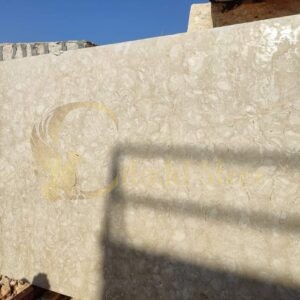
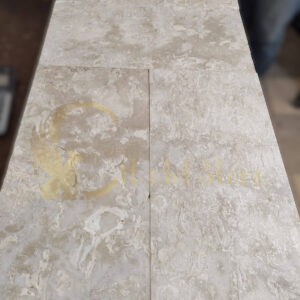
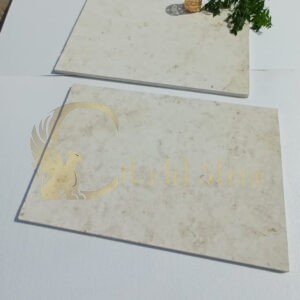
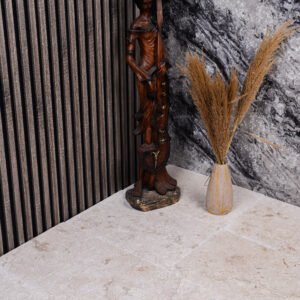
Two light beige stone slabs, one with a decorative gold cylinder and green leaves.

Base Preparation Standards for Hexagon Limestone Tiles in Arizona

Getting your base right is non-negotiable when you’re specifying hexagon limestone tiles in Arizona. The geometric precision of the hexagonal format amplifies any differential settlement — a 3mm height variance that might go unnoticed in a running-bond rectangular pattern becomes visually obvious when it breaks the rotational symmetry of a hex tile field. Here’s the preparation sequence that field performance consistently supports:

  • Excavate to minimum 10 inches below finished surface grade for residential pedestrian applications, 14 inches for vehicular or mixed-use areas
  • Remove all organic material and expansive soil within the excavation zone, replacing with select fill compacted in 4-inch lifts
  • Install a minimum 6-inch compacted aggregate base using 3/4-inch crushed stone or road base aggregate at 95% modified Proctor density
  • Add a 1-inch screeded bedding sand layer for setting, maintaining consistent thickness across the entire field
  • Allow 24–48 hours after any rain event before laying limestone hexagon tiles — wet bedding sand shifts under load and undermines joint alignment
  • Verify sub-base moisture content stays below 12% before placing mortar or adhesive in non-sand-set installations

For mortared installations using limestone hexagon floor tile, your mortar mix consistency matters more than many installers acknowledge. A mortar that’s too wet will shrink on cure and create micro-voids beneath the tile center — the hex geometry distributes load through the center of the tile more than the edges, so a hollow center is a stress fracture waiting to happen. Target a dry-pack mortar with water content just sufficient to hold its shape when squeezed in the hand.

Drainage Geometry and Limestone Hexagon Floor Tiles

Your drainage specification for limestone hexagon floor tiles in Arizona needs to account for two separate water events: the slow capillary moisture movement from subgrade and the sudden high-volume sheet flow from monsoon rain. Both affect your tile installation differently, and your base design has to address both simultaneously.

Capillary moisture rising through sandy alluvial soils is the quieter threat. Limestone is a naturally porous material with interconnected pore structures that can wick moisture upward when vapor pressure differentials exist between subgrade and surface. For exterior limestone hexagon pavers in areas with high water table or seasonal saturation — portions of the Salt River corridor through Tempe being a relevant example — a capillary break membrane between compacted base and bedding layer substantially reduces salt efflorescence and spalling risk over a 10–15 year horizon.

Monsoon sheet flow is the more immediately visible problem. Arizona’s summer storms deliver rainfall intensities that can exceed 2 inches per hour, and flat or near-flat hexagonal tile fields pool water at grout joints. The minimum cross-slope you should specify for any exterior limestone hexagon tile installation is 1/8 inch per foot — but in monsoon-exposed conditions, 3/16 inch per foot is a more defensible specification. That slight additional pitch keeps water moving toward your drainage collection points without creating an obvious grade change visible to the eye.

Limestone Herringbone vs. Hexagon: Pattern Selection for Arizona Ground Conditions

The choice between limestone herringbone tiles and hexagon tiles isn’t purely aesthetic — it has structural implications tied directly to the soil conditions you’re working with. Understanding the mechanical difference helps you make the right call for the specific site.

Limestone herringbone tiles in Arizona interlock directionally, which means differential settlement tends to propagate along the tile rows rather than radiating outward. For sites with predictable linear settlement patterns — sloped alluvial sites where soil creep occurs in a consistent downhill direction — limestone herringbone tiles can actually self-correct minor movement better than hexagonal patterns. The 45-degree offset joint in classic herringbone also provides a natural interruption to hairline crack propagation that runs parallel to the setting bed.

Hexagon limestone tiles distribute load omnidirectionally across six contact points, which makes them more resilient on sites with random settlement variation — the kind you encounter when caliche layer depth is inconsistent across a site. The trade-off is that the hex pattern is visually unforgiving when two adjacent tiles develop a height differential, because the human eye immediately detects asymmetry in a geometric pattern. For sites with variable sub-base conditions, invest in the extra base preparation rather than switching to a more visually forgiving pattern format.

  • Hexagon limestone tiles: best suited to sites with uniform, well-characterized sub-base conditions
  • Limestone herringbone tiles: more tolerant of directional or linear ground movement patterns
  • Limestone square tiles in Arizona: offer the widest joint spacing options, making them more forgiving in expansive clay zones where movement is moderate but unpredictable
  • Paver hexagonal formats in larger sizes (12-inch nominal): reduce the total joint count and are less sensitive to minor base irregularities than small-format hex mosaics

Material Specification for Hexagon Limestone Pavers in Arizona Conditions

Limestone hexagon pavers for Arizona exterior use should meet a minimum compressive strength of 7,500 PSI and an absorption rate no greater than 7% by weight per ASTM C568 classification requirements. Those aren’t arbitrary numbers — they reflect the minimum performance threshold for materials that will cycle through 300+ days of UV exposure annually and occasional freeze events at elevation.

Thickness selection for limestone hexagon tiles deserves more attention than it typically receives in residential specs. The standard 3/4-inch nominal tile thickness is appropriate for interior floors and covered outdoor areas with pedestrian-only traffic. For exposed exterior applications in Arizona, move to 1-1/4 inch minimum — the additional mass improves thermal stability through the tile body, reducing the micro-cracking that develops when thin tiles experience rapid surface-to-substrate temperature differentials during July monsoon events when cold rain hits tile surfaces heated to 140°F or above.

For complementary project elements, Hexagon Limestone Tile from Citadel Stone details the full specification range available for Arizona climates, including finish options and thickness grades suited to both interior and exterior applications across the state. Sourced from established quarry partners, each batch that moves through Citadel Stone’s warehouse inventory is inspected for color consistency and surface integrity before it ships to your project.

Finish Options and Their Impact on Arizona Performance

Surface finish selection for hexagon limestone tiles in Arizona involves a trade-off between aesthetics and functional performance that changes depending on application context. The four finishes most relevant to Arizona projects each behave differently under the region’s specific combination of intense UV, high temperatures, and occasional heavy precipitation.

  • Honed finish: provides a smooth, matte surface with consistent light reflection — performs well in covered exterior spaces but shows water spotting and organic staining more readily in exposed conditions
  • Brushed or antiqued finish: creates micro-texture through mechanical abrasion, improving wet traction and concealing minor surface wear — a strong choice for pool surrounds and outdoor dining areas
  • Tumbled finish: rounded edges and varied surface depth add visual warmth and substantially improve slip resistance ratings, often meeting ASTM C1028 dynamic coefficient of friction targets above 0.60 without additional coating
  • Sandblasted finish: maximum texture for high-traffic areas, though the open surface requires more frequent resealing in Arizona’s dusty environment — plan for annual rather than biennial sealer application cycles

Citadel Stone stocks hexagon limestone tiles in Arizona in standard formats including 8-inch and 12-inch hex nominal sizes across honed, brushed, and tumbled finishes, with additional options available depending on current warehouse inventory levels. You can request sample tiles or thickness specifications before committing to your final order — a step that’s genuinely worth the lead time on any project where color matching across a large field installation matters.

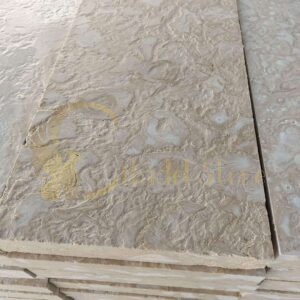
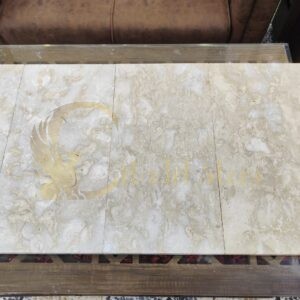
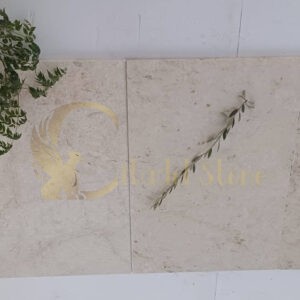
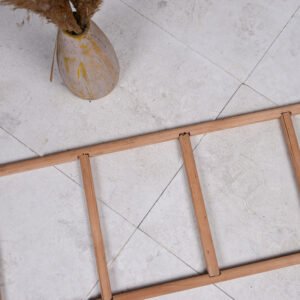
Two pale stone slabs with a decorative lantern and greenery

Sealing and Long-Term Maintenance for Arizona Limestone Hexagon Tile

Sealing protocols for limestone hexagon pavers in Arizona differ from standard concrete maintenance because you’re managing both surface protection and vapor transmission simultaneously. A fully impermeable topical sealer on an exterior limestone installation traps moisture vapor driven upward from subgrade — in Arizona’s monsoon season, that trapped vapor creates hydrostatic pressure at the tile-to-mortar interface that can lift tiles from below. The right product is a penetrating impregnator that repels liquid water while allowing vapor to move through the tile body.

Your initial seal should happen 28 days after installation completion — not sooner, regardless of what the sealer manufacturer’s data sheet suggests. Limestone needs that cure period to stabilize dimensional moisture content before you introduce a surface treatment. Apply two coats with a 4–6 hour inter-coat dry time, then plan for resealing every 18–24 months on exposed exterior installations. At elevation, like projects in Flagstaff where freeze-thaw cycles introduce additional mechanical stress on the sealed surface, annual resealing is the defensible maintenance interval.

Joint sand maintenance is one of the most overlooked aspects of long-term hexagonal tile performance. Maintain polymeric joint sand at 90–95% of joint depth — allowing it to erode below 80% creates an entry point for organic material, ant activity, and the micro-vegetation roots that physically widen joints over time. In Arizona’s dust-heavy environment, joint sand levels drop faster than in humid climates because wind erosion removes loose surface particles. Budget for annual joint sand inspection and top-up as part of your maintenance schedule rather than treating it as a reactive repair item.

Buy Hexagon Limestone Tile — Wholesale from Citadel Stone

Citadel Stone supplies hexagon limestone tiles across Arizona from regional warehouse inventory, with standard lead times of 1–2 weeks for stocked formats and 4–6 weeks for non-standard sizes or specialty finishes. Available formats include 8-inch hex, 12-inch hex, and paver hexagonal formats in 2-inch nominal thickness for exterior applications, plus 3/4-inch tile thickness for interior and covered use. Trade and wholesale accounts receive project-specific pricing with volume minimums starting at 200 square feet — contact Citadel Stone directly to confirm current availability and schedule a sample request before finalizing your specification.

For custom cuts, pattern matching across large field installations, or non-standard thickness requirements, Citadel Stone’s technical team can advise on lead times and quarry availability from the source. Delivery coverage extends across Arizona including Phoenix, Tucson, Mesa, Gilbert, Chandler, Peoria, Yuma, and surrounding areas, with truck scheduling coordinated around your site access requirements and project timeline. You can reach the team for a quote, sample request, or specification consultation through the Citadel Stone contact page — bringing your soil report or geotechnical summary to that conversation will help narrow down the right base specification for your specific site conditions.

As your Arizona stone project develops, related hardscape applications may factor into your overall material palette. Complementary limestone options within the Citadel Stone range pair well with hexagonal tile installations across both residential and commercial Arizona contexts, and Dijon Limestone Pavers in Arizona covers another product in that lineup suited to the same demanding climate conditions. Stone selections for Arizona projects in Flagstaff, Sedona, and Yuma include Hexagon Limestone Tile supplied direct from Citadel Stone.

Why Arizona’s Builders Choose Citadel Stone?

Free AZ Comparison: Citadel Stone vs. Other Suppliers—Find the Best Value!

FeaturesCitadel StoneOther Stone Suppliers
Exclusive ProductsOffers exclusive natural stones sourced from selected quarriesTypically offers more generic or widely available stone options
Quality and AuthenticityProvides high-grade, authentic natural stones with unique featuresQuality varies; may include synthetic or mixed-origin stone materials
Product VarietyWide range of premium productsProduct selection is usually more limited or generic
Global DistributionDistributes stones internationally, with a focus on providing consistent qualityOften limited to local or regional distribution
Sustainability CommitmentCommitted to eco-friendly sourcing and sustainable production processesSustainability efforts vary and may not prioritize eco-friendly sourcing
Customization OptionsOffers tailored stone solutions based on client needs and project specificationsCustomization may be limited, with fewer personalized options
Experience and ExpertiseHighly experienced in natural stone sourcing and distribution globallyExpertise varies significantly; some suppliers may lack specialized knowledge
Direct Sourcing – No MiddlemenWorks directly with quarries, cutting unnecessary costs and ensuring transparencyOften involves multiple intermediaries, leading to higher costs
Handpicked SelectionHandpicks blocks from quarries and hand select paver and tile post manufacture for quality and consistency. Ensuring only the best materials are chosenSelection standards vary, often relying on non-customized stock
Durability of ProductsStones are carefully selected for maximum durability and longevityDurability can be inconsistent depending on supplier quality control
Vigorous Packing ProcessesUtilizes durable packing methods for secure, damage-free transportPacking may be less rigorous, increasing the risk of damage during shipping
Citadel Stone OriginsKnown as the original source for unique limestone tiles from the Middle East, recognized for authenticityOrigin not always guaranteed, and unique limestone options are less common
Customer SupportDedicated to providing expert advice, assistance, and after-sales supportSupport quality varies, often limited to basic customer service
Competitive PricingOffers high-quality stones at competitive prices with a focus on valuePrice may be higher for similar quality or lower for lower-grade stones
Escrow ServiceOffers escrow services for secure transactions and peace of mindTypically does not provide escrow services, increasing payment risk
Fast Manufacturing and DeliveryDelivers orders up to 3x faster than typical industry timelines, ensuring swift serviceDelivery times often slower and less predictable, delaying project timelines

Extra Benefits

Choosing Citadel Stone offers unique advantages beyond premium stone quality:

Exclusive Access to Durable Stones

Citadel Stone specializes in unique, regionally exclusive stones, sourced directly from the Middle East.

Transparent Pricing – No Hidden Costs

With no middlemen, Citadel Stone provides direct, transparent pricing that reduces unnecessary costs.

Flexible Customization for Bespoke Projects

Tailor your order to precise specifications, from sizes to finishes, ensuring your project aligns perfectly with your vision.

Streamlined Delivery & Reliable Stock Availability

Benefit from fast production and delivery timelines, designed to minimize delays and ensure reliable availability.

The Preferred Stone Supplier for Luxury AZ Developments.

Scale Your Vision: We Support Arizona's Largest Projects with Reliable, Fast Delivery.

With unlimited tiles, pavers, cobble setts, curbstones, and the fastest delivery options, What’s not to love? Say goodbye to unnecessary hassles!

Leading AZ Stone Suppliers are Loving Citadel Stone!

Don’t Settle for Less. Source the Best Stone for Your Local Stone Expert.

DanielOwner
Thank you, Kareem. We received the order. The stones look great!
FrankOwner
You are a good businessman and I believe a good person. I admire your honesty, this is why I call you a good businessman.
Gemma C
Gemma CPrivate Project
Undoubtedly the price was the reason that we chose Citadel stone, in addition to the fact that you offer a white limestone that is hard to source. Your products are very good value for money by comparison with other companies. You have helped at every stage of the process and have been quick and reliable in your responses. It was a big risk for us to pay everything up front including shipping and not know the quality. You did make me feel that I could trust you and your company however and we are very happy with the tiles. They appear to have been finished to a very high quality of smoothness and I can't wait to see them once they have been laid. We need to see now how easy they are to fit and maintain, yet you also sealed them before shipment so we think that they will be very durable. Our building project has been delayed for a few months now so it may be sometime before we see them laid, but I promise that I will send photos as soon as we have them down. Thank you so much Kareem and your team, you have done a great job. I am hoping that we can pay for, and receive our second shipment in the not too far future, so that we can finish everything off. Wishing you well. Gemma
Molly McK
Molly McKPrivate Project
I appreciate the quality of product and care for the custom order in packaging each crate to minimize breakage as well as the flexibility with the order to help us make the most of shipping. The timely communications are impressive from the beginning and throughout the process. It's reassuring to have gone through one order to know what the process will be like in the future. I am glad to have had some guidance through the importing process and recommendations for shipping partners to assist. It's incredible to think about the journey the stone traveled to get to our site and I'm grateful to have made it to the next stage of the project relatively smoothly and with from what I can tell

Frequently Asked Questions

If your question is not listed, please email us at [email protected]

How do Arizona's expansive clay soils affect hexagon limestone tile installation?

Expansive clay soils, common across the Phoenix basin and parts of the Tucson valley, can swell and contract significantly with moisture changes — placing stress on rigid materials like limestone. For hexagon tile installations over these soil profiles, a compacted granular sub-base or reinforced concrete slab is typically required to isolate the tile from ground movement. Skipping this step is the most common cause of joint failure and surface cracking in Arizona limestone projects.

For exterior applications such as patios, pool surrounds, and covered outdoor rooms in Arizona, a minimum tile thickness of 3/4 inch (18–20mm) is generally advised to handle foot traffic, furniture loads, and thermal cycling. Thinner tiles are better suited to interior floors where subgrade movement is minimal and controlled. The hexagonal geometry distributes point loads differently than rectangular formats, so thickness becomes especially important at narrow grout joints where tile edges are more exposed to stress.

Hexagon limestone tile can work well on Arizona pool decks when a honed or brushed finish is selected — these surface treatments provide adequate slip resistance when wet without compromising the stone’s appearance. Polished limestone should be avoided in pool environments due to reduced traction and increased sensitivity to chemical exposure from pool water. A penetrating sealer rated for wet-area natural stone is essential and should be reapplied on a schedule appropriate to the product’s wear rating and Arizona’s UV exposure levels.

The hexagonal tile format requires more precise layout planning than square or rectangular field tile because any misalignment compounds visually across multiple rows. In Arizona installations, tile setters typically dry-lay a portion of the pattern first to confirm joint consistency and adjust for dimensional variation between individual pieces — a standard practice with natural stone. Wider grout joints of 3/16 to 1/4 inch are commonly used with limestone hexagons to accommodate natural edge variation and simplify future repairs if spot replacement becomes necessary.

Limestone is a calcium carbonate-based stone that requires a pH-neutral cleaner to avoid etching — a consideration worth reinforcing in Arizona where hard water deposits are common and acidic cleaners are frequently misapplied by homeowners. A quality penetrating sealer should be applied after installation and inspected annually, as intense UV exposure and thermal cycling can degrade sealer performance faster than in milder climates. Prompt removal of efflorescence, which can occur in new installations over concrete substrates, helps preserve the stone’s surface clarity long term.

Citadel Stone’s hexagon limestone tile is sourced directly from established quarries across the Mediterranean and Middle East, giving the company direct oversight of material selection and quality grading before product reaches the warehouse — a meaningful distinction from distributors relying on intermediary import channels. Warehouse inventory in standard hexagon formats means Arizona contractors and specifiers can confirm availability at the time of bid rather than working around unpredictable lead times. Arizona professionals benefit from Citadel Stone’s responsive project coordination, with support available from initial specification through final delivery to keep schedules intact.