


50 Years Of Manufacturing & Delivering The Highest-Quality Limestone & Black Basalt. Sourced & Hand-Picked From The Middle East.

Escrow Payment & Independent Verifying Agent For New Clients

Contact Me Personally For The Absolute Best Wholesale & Trade Prices:

USA & Worldwide Hassle-Free Delivery Options – Guaranteed.

Hex Pavers in Arizona

Hex pavers in Arizona perform best when the subgrade beneath them is properly engineered — and that starts with understanding the soil. Much of Arizona's ground is composed of expansive clay, decomposed granite, or caliche hardpan, each of which responds differently to moisture fluctuation and load bearing. Without the right base preparation for your specific soil type, even a well-laid hex paver installation can shift, crack, or develop uneven settling over time. Citadel Stone Hex Pavers in Arizona are specified with these ground conditions in mind, and the team can advise on material thickness and format selection to match your site's subgrade requirements. Citadel Stone supplies hex pavers in a range of finishes and thickness options, with product availability confirmed before your project timeline is committed. The full cost and specification guide below breaks down how soil classification directly influences base depth, compaction standards, and overall installation budget. Citadel Stone offers Hex Pavers in multiple finishes and thicknesses for Arizona projects across Phoenix, Tucson, and Scottsdale.

See & Feel the Quality – Free Arizona Stone Samples

Our stones are made for the Arizona sun. See how the colors hold up in your specific light.

Design Your Arizona Home with a Local Stone Expert

Get personalized advice on the best stone for Arizona's climate and your design style.

Premium Natural Stone — All Sizes & Thicknesses Available

From standard cuts to fully custom dimensions — our limestone, granite, basalt & shellstone
are cut to your exact specifications. Residential or commercial, we’ve got you covered.

Get Your Free Arizona Stone Quote

Transparent Pricing for Your Arizona Project

Elevate Your Arizona Property with Premium Stone, Priced for Value.

Unlock $10,000 Worth of Deals on Beautiful Paver, Tiles & Cobble Setts—For Free!

Invest in Arizona’s Landscape: Stone That Lasts a Lifetime.

100% Happiness Guarantee

Trust 50 Years of Expertise. Invest in Quality Limestone Tiles

Custom-Cut for Your Arizona Project: Any Size, Any Finish.

No-Obligation Consultation: Get Expert Advice for Your Arizona Home.

The Stone Supplier Trusted by Arizona's Leading Architects & Designers.

Trusted by Top Stone Experts Around the Globe

Arizona's Most Diverse Selection of Limestone Tiles.

Elevate Your AZ Property with Limestone Built for the Desert. Our expansive collection of limestone tiles brings timeless beauty and proven durability to both residential and commercial spaces across Arizona. As the state’s leading supplier, we offer a diverse palette of colors and finishes—from cool, light tones that reflect the sun to rich, earthy textures that complement the Southwest landscape. Transform your environment with limestone that stands up to the Arizona heat while providing the sophisticated aesthetic you desire.

Explore Arizona-Tough Alternative Stones

Product NameDescriptionPrice per Square Foot
Travertine TilesBeautiful natural stone with unique textures$8.00 - $12.00
Marble TilesLuxurious and elegant, available in various colors.$10.00 - $15.00
Granite TilesExtremely durable and perfect for high-traffic areas.$7.00 - $12.00
Slate TilesRich colors and textures; ideal for wet areas.$6.00 - $10.00
Porcelain TilesVersatile and low-maintenance, mimicking natural stone.$4.00 - $8.00
Ceramic TilesAffordable with a wide variety of designs.$3.00 - $6.00
Quartzite TilesStrong and beautiful, resistant to stains.$9.00 - $14.00
Concrete PaversCustomizable for patios; durable and cost-effective.$5.00 - $9.00
Glass TilesStylish, reflective, and brightening.$15.00 - $25.00
Composite TilesEco-friendly options made from recycled materials.$5.00 - $10.00

Incredible Prices for Top-Quality Stone—Shop Citadel Stone Today!

Table of Contents

Specifying hex pavers in Arizona without accounting for the ground beneath them is where most installations start going wrong before the first unit is even set. The soil composition across Arizona’s major metro areas varies dramatically — from the expansive clays in the East Valley to the caliche-laden hardpan spreading through the Phoenix basin — and each soil type demands a fundamentally different base preparation strategy. Get the subgrade wrong and even the most carefully selected hexagonal paving slabs will shift, rock, and fail within three to five years regardless of their material quality.

Your first consultation with Citadel Stone’s technical team should cover site soil conditions alongside material selection. At Citadel Stone, we routinely walk through base preparation requirements with customers before confirming material orders, because a hex paver specified for the wrong base system is a spec that’s already compromised. Citadel Stone stocks hexagon patio pavers in standard formats including 12-inch and 18-inch face dimensions, with thickness options from 1.5 inches up to 2.75 inches depending on load class.

Arizona Soil Conditions and What They Mean for Hex Paver Performance

The most underestimated factor in any hexagonal block paving installation across Arizona is the native soil’s volumetric behavior under moisture fluctuation. Arizona soils aren’t uniform — the state contains at least four distinct pedological zones that behave completely differently under a paved surface. Understanding which zone your project sits in determines your base depth, your drainage geometry, and ultimately whether your hexagon patio blocks stay level after the first monsoon season.

Expansive clay soils are widespread across the Phoenix metro and portions of the Tucson basin. These soils absorb moisture and swell vertically — sometimes by as much as four percent of their volume — then shrink and crack as they dry. Under a rigid or semi-rigid hexagon landscape pavers system, that differential movement telegraphs directly to the surface plane. You’ll see individual units heaving asymmetrically, joint sand disappearing into substrate voids, and edge restraints popping free at corners. The fix isn’t selecting a thicker paver — it’s treating the subgrade before you build the base.

  • Expansive Vertisols and Adobe clays in Phoenix, Mesa, and Gilbert zones require subgrade stabilization with Class II base aggregate or lime treatment before any base course is installed
  • Caliche hardpan common in the Salt River Valley provides excellent bearing capacity but must be scarified and releveled — uneven caliche creates localized high spots that crack base aggregate layers under point loads
  • Sandy desert soils in western Arizona near Yuma and Goodyear offer low swell potential but require compaction to 95% modified Proctor density to prevent paver migration under lateral force
  • Alluvial fan deposits near foothills in Scottsdale and north Phoenix contain mixed gradations that drain well but need geotextile fabric separation to prevent fines migration into the aggregate base
  • Volcanic cinder soils around Flagstaff are free-draining but inconsistent in bearing — you’ll need to verify uniformity across the full installation footprint before laying base

Projects in Mesa frequently encounter caliche hardpan at 18 to 24 inches below finish grade, which actually provides a stable bearing layer when properly prepared. The issue isn’t the caliche itself — it’s the transition zone between loose surface soil and the hardpan, which compresses unevenly. Scarify the top four to six inches of caliche, remove loose material, and bring the layer to a consistent grade before placing your aggregate base. That transition management step is what separates stable hexagon landscape pavers from ones that need releveling within two years.

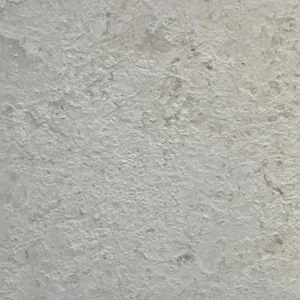
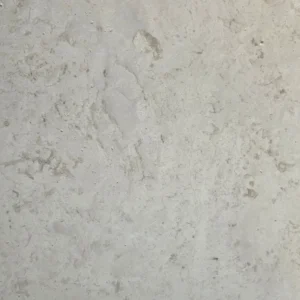
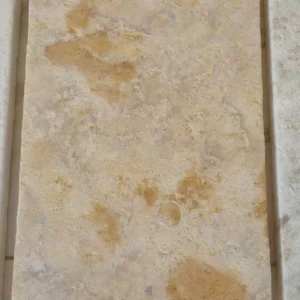
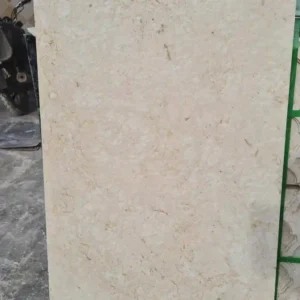
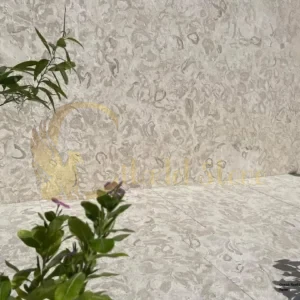
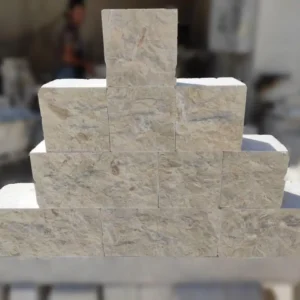
Close-up of a rough textured off-white stone slab with subtle pitting.

Base Preparation Standards for Hexagonal Paving Slabs in Arizona

The base system beneath your hexagonal paving slabs is doing most of the structural work — the paver itself just provides the wearing surface. In Arizona’s climate, the base also has to manage the concentrated storm drainage that comes with monsoon events, where a two-inch rainfall can occur in under 30 minutes. Your drainage geometry and base permeability need to handle that hydraulic load without saturating the subgrade and triggering the clay swell cycle described above.

Standard practice in Arizona calls for a minimum four-inch compacted aggregate base for residential patio applications using hexagon patio pavers, and six inches minimum for driveway or vehicle-access applications. Those figures assume a stable, non-expansive subgrade. On expansive clay, you’re looking at six to eight inches of aggregate over a compacted, lime-treated subgrade — and some engineers in the Phoenix basin specify a full subbase plus base system totaling ten to twelve inches for heavy-use commercial applications. Request thickness specifications from Citadel Stone before finalizing your base design, because the correct spec depends on your paver thickness and load class simultaneously.

  • Use 3/4-inch crushed limestone aggregate for base courses — the angular particle shape achieves better interlock and resists lateral creep under hex units compared to rounded river gravel
  • Compact in two-inch lifts, not all at once — single-lift compaction of four or six inches produces a compaction gradient with a loose bottom layer that migrates under load
  • Install geotextile fabric on the subgrade surface before placing aggregate, particularly over clay soils — this prevents fines infiltration that degrades base drainage over time
  • Slope your base a minimum 1.5% away from structures — hex pavers in Arizona intercept substantial monsoon runoff and need positive drainage built into the substrate, not just the surface
  • Setting bed depth for hexagonal paving slabs should be consistent at one inch of compacted bedding sand — irregular setting bed depth is the leading cause of early surface irregularity in hexagon walkway pavers installations

The setting bed material matters more than most specifiers acknowledge. Coarse washed concrete sand — ASTM C33 gradation — compacts to a stable, non-migrating layer under the angular geometry of hexagon shape pavers. Avoid masonry sand or fine-graded sand for the setting bed; the finer particles migrate into joints during thermal cycling, causing the setting bed to thin unevenly over one to two seasons. You’ll end up with a surface that sounds hollow in patches, which in Arizona’s heat signals a setting bed that’s already lost contact with the paver base.

How Hexagon Shape Paver Geometry Affects Installation in Expansive Soil Zones

The hexagon shape paving slab pattern has a structural advantage that isn’t immediately obvious — the six-point contact geometry distributes load across a larger subgrade footprint than a square or rectangular unit of equivalent face area. That means each hex unit transfers vertical force to the base at multiple contact angles rather than concentrating stress at four corners, which is particularly valuable over Arizona soils that have variable bearing capacity across short distances.

That same geometry creates a specific challenge during installation on sloped sites. Because hex units tile at 60-degree internal angles rather than 90 degrees, edge cuts on irregular boundaries require more precision to maintain consistent joint width around the perimeter. In Arizona’s heat, those edge cuts also need to account for thermal expansion — hexagon outdoor pavers exposed to direct sun in Phoenix will reach surface temperatures above 160°F on summer afternoons, and the material itself experiences dimensional change across that temperature range. Your edge restraint system needs to accommodate that movement without cracking perimeter units. For complementary guidance on scheduling and maintenance intervals specific to this climate, Hex Pavers from Citadel Stone provides a detailed maintenance framework aligned to Arizona’s seasonal conditions that helps you plan service visits around the weather calendar.

  • Maintain consistent joint width of 1/8 to 3/16 inch for natural stone hexagonal paving slabs — wider joints allow joint sand migration during monsoon infiltration events
  • Install edge restraints that are spiked into the aggregate base at 12-inch intervals, not just the perimeter — Arizona’s thermal expansion loads can buckle improperly anchored restraints mid-run
  • Use polymeric joint sand with a silica aggregate content above 80% — standard swept sand in Arizona’s dry climate desiccates and blows out within one season, leaving joints open to weed germination and ant colony establishment
  • For hex paver patio applications on sloped sites, work uphill from the low point — this ensures each unit seats against the resistance of the previously placed unit rather than sliding toward it
  • Check for lippage across every third row during installation — the compound angles of hexagon shaped pavers amplify small bedding inconsistencies into visible surface irregularity that’s difficult to correct after jointing

Sourced from established quarry partners, each batch of Citadel Stone’s hexagonal garden paving slabs is inspected for dimensional tolerance before leaving the warehouse. Thickness variation within a delivery affects setting bed consistency, so knowing your tolerance spec before installation starts prevents mid-project adjustments. You can request sample units and tolerance documentation from Citadel Stone before committing to a project quantity — that verification step is particularly valuable when specifying hexagon shaped paving slabs for large-area patio or courtyard applications where any dimensional inconsistency will be visible across the surface plane.

Material Selection for Hexagonal Outdoor Pavers in Arizona’s Climate Zones

Arizona’s climate spans multiple performance zones, and the material you specify for hexagon patio pavers in Flagstaff is a genuinely different calculation than what works in Yuma. Flagstaff sits above 6,900 feet with a freeze-thaw cycle that exceeds 100 days annually — you need a paver with absorption below 0.75% and a freeze-thaw durability rating that matches ASTM C67 cycling requirements. Yuma’s challenge is entirely different: maximum UV exposure, surface temperatures that regularly exceed 170°F on dark materials, and virtually zero freeze risk.

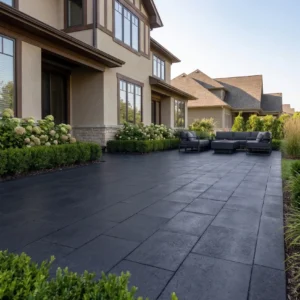
Natural stone hex pavers in Arizona’s low desert perform best when the material’s thermal mass is used deliberately. Dense, light-colored stone — white or cream limestone, buff travertine, or light basalt — reflects a meaningful portion of solar radiation rather than absorbing and re-radiating it as heat hours after sunset. Darker materials, while visually striking in photographs, create a radiant heat environment in outdoor living spaces that reduces usability during the nine months of warm weather when you actually want to use the space. This isn’t a subjective preference — it’s a thermal performance decision that affects occupant comfort across the usable life of the installation.

  • Travertine hexagon paving stones: excellent thermal performance in low desert zones, absorption rates in the 1.5 to 3% range require sealing on a two-year cycle, open-vein fill surface offers natural slip resistance even when wet
  • Limestone hexagonal garden paving slabs: denser than travertine with absorption below 2% in tight-grained selections, excellent compressive strength above 8,000 PSI for vehicle-use areas, UV-stable coloring that doesn’t bleach in Arizona’s intense solar exposure
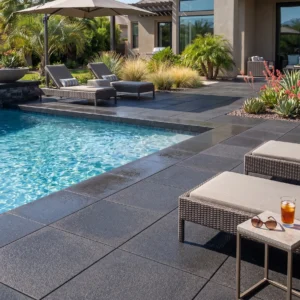
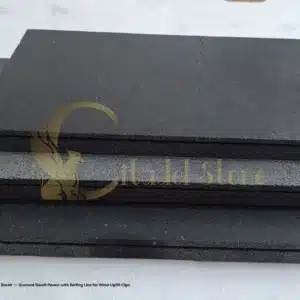
  • Basalt hexagon shape pavers: highest density and lowest absorption in the natural stone category at under 0.5%, excellent for pool surrounds and wet areas, available in dark grey and charcoal colorways but requires careful surface temperature management in full-sun installations
  • Sandstone hexagonal slabs outdoor: warm color palette suits desert architecture but absorption rates of 4 to 6% require aggressive sealing schedules in Arizona — annual sealing is not excessive in high-UV zones
  • Concrete hex pavers: dimensional precision simplifies installation on geometric patterns but lower thermal mass than natural stone and color fade acceleration under Arizona UV is a documented performance limitation

In Flagstaff, the freeze-thaw cycle demands a fundamentally different material specification than any low-desert project. Porous natural stone units that perform acceptably in Phoenix will absorb snowmelt, freeze overnight, and spall within two to three seasons at elevation. For Flagstaff hex paver patio installations, specify natural stone with ASTM C1195 freeze-thaw durability certification and absorption below 0.75% — the small additional cost at specification protects a much larger installation investment over a 20-year service life.

Drainage Design for Hexagon Walkway Pavers and Patio Systems

Drainage design for hexagon walkway pavers in Arizona isn’t a secondary consideration — it’s a primary structural requirement driven by the monsoon precipitation pattern. Arizona’s summer thunderstorms deliver intense, localized rainfall that your paver system and surrounding landscape cannot absorb in real time. The water has to go somewhere, and your drainage design determines whether it goes where you intend or whether it undermines your base system, saturates your subgrade, and starts the clay expansion cycle you worked to prevent during base preparation.

Permeable joint systems work well for residential hexagonal patio paving installations in sandy or alluvial soil zones where the subgrade has adequate percolation capacity. On expansive clay, deliberately permeable joints can be counterproductive — you’re channeling monsoon water directly to the material most sensitive to moisture. In those situations, a surface-drainage-first design with positive slope to collection points and sealed joints outperforms a permeable joint system by keeping the subgrade moisture content as stable as possible through seasonal cycles.

  • Minimum finished surface slope of 1% for hexagonal patio paving in all Arizona soil zones — the 0.5% slope sometimes specified in non-desert climates doesn’t move water fast enough ahead of a monsoon event
  • Size catch basins and linear drains for a ten-year storm event minimum — Phoenix’s ten-year, one-hour storm intensity exceeds 2.5 inches, which your drainage infrastructure needs to handle without backing up onto the paved surface
  • Place drainage collection at the lowest point of the hex paver patio, not at the perimeter — perimeter drainage captures only sheet flow, while interior collection intercepts concentrated flow from any localized depression
  • Inspect drainage outlets annually before monsoon season — Arizona’s blowing dust and desert debris accumulate in drain grates through the dry spring period, and a blocked outlet during the first monsoon event can flood the base course overnight

The joint sand system in hexagonal paving stones installations also contributes to the drainage performance profile. Standard dry-swept sand joints allow some vertical infiltration but are largely impermeable under compaction — they behave more like a sealed joint than a permeable one in practice. Polymeric joint sand performs similarly. True permeable hex pavers systems in Arizona require an open-graded base and aggregate joint fill rather than sand, which is a fundamentally different base design that needs to be specified from the ground up, not retrofitted.

Sealing and Maintenance Requirements for Hexagonal Paving Slabs in Arizona

The sealing schedule for hexagonal paving slabs in Arizona is more demanding than the generic manufacturer recommendations written for temperate climates suggest. Arizona’s UV intensity — measured at roughly twice the daily UV index of northern states during peak summer — degrades penetrating sealer polymer chains faster than the two- to three-year reapplication cycles specified for moderate climates. In Phoenix and Scottsdale, plan for annual sealer inspection and a reapplication cycle of 18 to 24 months for most natural stone hex pavers in Arizona.

The type of sealer matters significantly in Arizona’s climate. Solvent-based penetrating sealers with a fluoropolymer chemistry outperform water-based acrylic sealers in both UV resistance and heat stability — acrylic sealers can soften and become tacky on very dark materials under direct afternoon sun in summer, which then traps fine dust and degrades surface appearance. For a hex paver patio in Arizona’s low desert, a high-solids penetrating sealer with a minimum 20% solids content provides adequate protection with a natural-finish appearance that doesn’t alter the stone’s color or texture profile.

  • Apply sealer only to clean, dry stone — Arizona’s evaporation rate is fast enough that many specifiers skip drying time verification, but residual moisture trapped under sealer creates efflorescence pathways that are difficult to correct after the fact
  • Seal new hexagon outdoor pavers installations after 30 days minimum — fresh stone needs time to release installation moisture before sealer is applied, otherwise you’ll trap that moisture and see staining within the first season
  • Re-sand polymeric joints before resealing — the sealing process itself can displace loose joint sand, and sealing over depleted joints locks in the deficiency rather than correcting it
  • Test sealer performance with a water droplet test annually — if water absorbs into the stone surface within 60 seconds rather than beading, the sealer has degraded and reapplication is due

Projects in Scottsdale, where residential outdoor living spaces are often used year-round, benefit from an accelerated maintenance inspection schedule. The combination of intense solar exposure, frequent foot traffic from outdoor entertaining, and the aesthetic standard expected in high-value residential settings means that maintenance lapses become visible faster than in comparable climates. Building a biennial professional maintenance visit into the project’s long-term cost planning gives you a realistic total cost of ownership figure for hexagon paving stones installations in premium residential contexts.

A saw cuts through large, light-colored stone blocks, creating dust.

Hex Paving Slab Applications: Residential Patios, Walkways, and Commercial Plazas

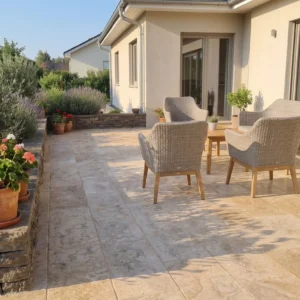
The hexagon format translates effectively across multiple application contexts that differ significantly in their structural and aesthetic demands. Residential hex paver patio installations prioritize aesthetic cohesion with the home’s architectural language and practical usability — smooth, sealed surfaces that are comfortable for bare feet, resistant to outdoor furniture leg indentation, and visually aligned with the landscape design. Commercial plaza applications using hexagonal block paving prioritize load-bearing performance, replaceability of individual units, and slip resistance ratings that meet ADA requirements and ASTM C1028 wet dynamic coefficient of friction thresholds above 0.60.

Hexagon paving slabs in the 18-inch face dimension work particularly well for large-scale residential patio fields and commercial forecourt applications where a bold geometric pattern is appropriate. Smaller 12-inch units suit walkway and garden path applications, where the pattern scale reads correctly relative to the path width. Mixing face dimensions within a single installation is possible but requires careful joint alignment to avoid visual confusion — the natural tessellation geometry of hexagons means that mismatched unit sizes don’t produce a coherent joint pattern, which reads as an installation error rather than a design choice.

  • Residential hex paver patio: 1.5 to 2-inch thickness over compacted aggregate base, sealed natural stone, 12 to 18-inch face dimension, polymeric joint sand
  • Hexagon walkway pavers: 1.5-inch minimum thickness for pedestrian-only applications, 2-inch recommended where maintenance vehicles access the path, consistent joint width critical for accessible routes
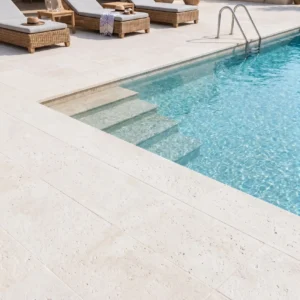
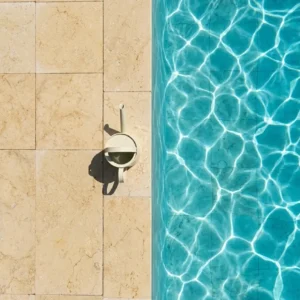
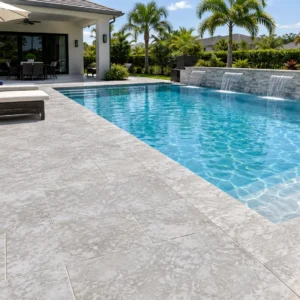
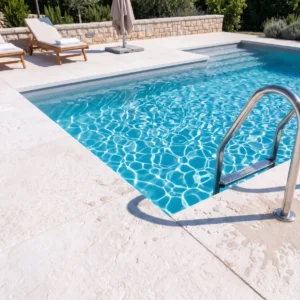
  • Pool surrounds using hexagonal slabs outdoor: specify honed or brushed finish over polished — polished stone becomes dangerously slippery when wet, a performance failure that standard stone certification doesn’t always flag for the Arizona water feature context
  • Commercial hexagonal paving slabs for heavy pedestrian zones: 2.75-inch minimum thickness, verify compressive strength above 10,000 PSI, confirm slip resistance rating with wet DCOF test results before specifying
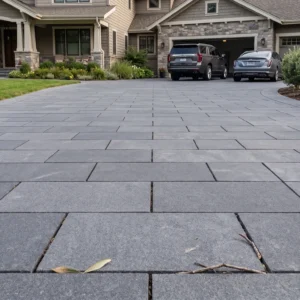
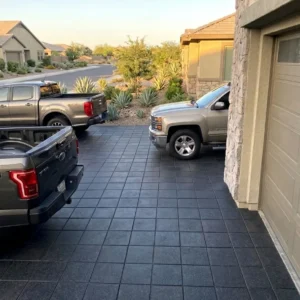
  • Driveway hexagon paving stones: 3-inch thickness for standard passenger vehicle loads, 4-inch for SUV or light truck loads, six-inch compacted aggregate base minimum regardless of soil type

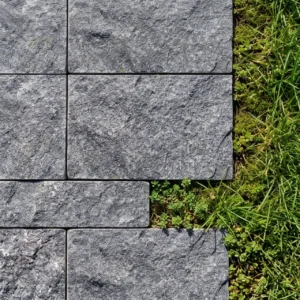
Hexagon garden slabs in Arizona’s courtyard and xeriscape applications present a specific design-performance intersection worth noting. Arizona landscape architects increasingly specify hexagonal garden paving slabs in decomposed granite surrounds, creating a hybrid hardscape-softscape surface that manages storm drainage while maintaining the geometric formality of an all-paved court. The key specification detail in those applications is edge restraint at every paver-to-DG transition — without a physical restraint, the DG migrates under the hex units during monsoon events and creates a progressive settlement problem at every joint in the border zone.

Order Hex Pavers in Arizona — Arizona Delivery Available

Citadel Stone stocks hex pavers in Arizona in standard face dimensions of 12 inches and 18 inches, with thickness options at 1.5 inches, 2 inches, 2.375 inches, and 2.75 inches to match residential, commercial, and heavy-use applications. Available finishes include natural split, honed, brushed, and tumbled — with color options spanning cream, buff, grey, charcoal, and blended multi-tone selections that complement Arizona’s desert architectural palette. You can request sample units and full thickness tolerance documentation before committing to a project quantity, which is particularly useful for large patio or commercial plaza specifications where material consistency directly affects installation quality.

Delivery logistics across Arizona depend on your truck access conditions and project timing. Citadel Stone ships hex pavers across Arizona from regional warehouse inventory, which typically reduces lead times to one to two weeks for standard stock items compared to the six- to eight-week import cycle that specialty formats require. For projects with restricted truck access — gated communities, tight residential lots, or downtown commercial locations — confirming delivery equipment and offload requirements at the quoting stage prevents scheduling complications. For projects requiring custom cuts, non-standard face dimensions, or oversized format hexagonal paving stones, the technical team at Citadel Stone can advise on lead times and sourcing options at the consultation stage.

Trade and wholesale enquiries are handled through Citadel Stone’s project services team, who can provide pricing schedules, material scheduling coordination, and specification support for multi-phase commercial projects. Residential customers sourcing hexagon patio blocks in Arizona for single-phase installations can request a direct material quote with delivery confirmation to their project zip code. As you plan your Arizona stone project, related hardscape elements can inform your broader material decisions — European Cobblestone in Arizona explores how traditional European stone formats perform in Arizona conditions, offering a complementary perspective on natural stone paving across different regional applications. Homeowners in Flagstaff, Sedona, and Yuma source Hex Pavers through Citadel Stone for Arizona residential and commercial installations.

Why Arizona’s Builders Choose Citadel Stone?

Free AZ Comparison: Citadel Stone vs. Other Suppliers—Find the Best Value!

FeaturesCitadel StoneOther Stone Suppliers
Exclusive ProductsOffers exclusive Ocean Reef pavers, Shellstone pavers, basalt, and white limestone sourced from SyriaTypically offers more generic or widely available stone options
Quality and AuthenticityProvides high-grade, authentic natural stones with unique featuresQuality varies; may include synthetic or mixed-origin stone materials
Product VarietyWide range of premium products: Shellstone, Basalt, White Limestone, and moreProduct selection is usually more limited or generic
Global DistributionDistributes stones internationally, with a focus on providing consistent qualityOften limited to local or regional distribution
Sustainability CommitmentCommitted to eco-friendly sourcing and sustainable production processesSustainability efforts vary and may not prioritize eco-friendly sourcing
Customization OptionsOffers tailored stone solutions based on client needs and project specificationsCustomization may be limited, with fewer personalized options
Experience and ExpertiseHighly experienced in natural stone sourcing and distribution globallyExpertise varies significantly; some suppliers may lack specialized knowledge
Direct Sourcing – No MiddlemenWorks directly with quarries, cutting unnecessary costs and ensuring transparencyOften involves multiple intermediaries, leading to higher costs
Handpicked SelectionHandpicks blocks and tiles for quality and consistency, ensuring only the best materials are chosenSelection standards vary, often relying on non-customized stock
Durability of ProductsStones are carefully selected for maximum durability and longevityDurability can be inconsistent depending on supplier quality control
Vigorous Packing ProcessesUtilizes durable packing methods for secure, damage-free transportPacking may be less rigorous, increasing the risk of damage during shipping
Citadel Stone OriginsKnown as the original source for unique limestone tiles from the Middle East, recognized for authenticityOrigin not always guaranteed, and unique limestone options are less common
Customer SupportDedicated to providing expert advice, assistance, and after-sales supportSupport quality varies, often limited to basic customer service
Competitive PricingOffers high-quality stones at competitive prices with a focus on valuePrice may be higher for similar quality or lower for lower-grade stones
Escrow ServiceOffers escrow services for secure transactions and peace of mindTypically does not provide escrow services, increasing payment risk
Fast Manufacturing and DeliveryDelivers orders up to 3x faster than typical industry timelines, ensuring swift serviceDelivery times often slower and less predictable, delaying project timelines

Extra Benefits

Choosing Citadel Stone offers unique advantages beyond premium stone quality:

Exclusive Access to Durable Stones

Citadel Stone specializes in unique, regionally exclusive stones, sourced directly from the Middle East.

Transparent Pricing – No Hidden Costs

With no middlemen, Citadel Stone provides direct, transparent pricing that reduces unnecessary costs.

Flexible Customization for Bespoke Projects

Tailor your order to precise specifications, from sizes to finishes, ensuring your project aligns perfectly with your vision.

Streamlined Delivery & Reliable Stock Availability

Benefit from fast production and delivery timelines, designed to minimize delays and ensure reliable availability.

The Preferred Stone Supplier for Luxury AZ Developments.

Scale Your Vision: We Support Arizona's Largest Projects with Reliable, Fast Delivery.

With unlimited tiles, pavers, cobble setts, curbstones, and the fastest delivery options, What’s not to love? Say goodbye to unnecessary hassles!

Leading AZ Stone Suppliers are Loving Citadel Stone!

Don’t Settle for Less. Source the Best Stone for Your Local Stone Expert.

DanielOwner
Thank you, Kareem. We received the order. The stones look great!
FrankOwner
You are a good businessman and I believe a good person. I admire your honesty, this is why I call you a good businessman.
Gemma C
Gemma CPrivate Project
Undoubtedly the price was the reason that we chose Citadel stone, in addition to the fact that you offer a white limestone that is hard to source. Your products are very good value for money by comparison with other companies. You have helped at every stage of the process and have been quick and reliable in your responses. It was a big risk for us to pay everything up front including shipping and not know the quality. You did make me feel that I could trust you and your company however and we are very happy with the tiles. They appear to have been finished to a very high quality of smoothness and I can't wait to see them once they have been laid. We need to see now how easy they are to fit and maintain, yet you also sealed them before shipment so we think that they will be very durable. Our building project has been delayed for a few months now so it may be sometime before we see them laid, but I promise that I will send photos as soon as we have them down. Thank you so much Kareem and your team, you have done a great job. I am hoping that we can pay for, and receive our second shipment in the not too far future, so that we can finish everything off. Wishing you well. Gemma
Molly McK
Molly McKPrivate Project
I appreciate the quality of product and care for the custom order in packaging each crate to minimize breakage as well as the flexibility with the order to help us make the most of shipping. The timely communications are impressive from the beginning and throughout the process. It's reassuring to have gone through one order to know what the process will be like in the future. I am glad to have had some guidance through the importing process and recommendations for shipping partners to assist. It's incredible to think about the journey the stone traveled to get to our site and I'm grateful to have made it to the next stage of the project relatively smoothly and with from what I can tell

Frequently Asked Questions

If your question is not listed, please email us at [email protected]

How does Arizona's soil composition affect hex paver installation?

Arizona’s soil varies considerably by region — from expansive clay in lower elevations to decomposed granite in foothills areas and dense caliche hardpan across much of the desert floor. Each soil type demands a different approach to base preparation: expansive clay requires adequate compacted fill and drainage provisions to prevent frost-free heave from moisture cycling, while caliche may need mechanical breaking before a stable subbase can be established. Skipping proper soil assessment before installation is one of the most common reasons hex paver projects develop settlement or joint separation within the first few years.

For residential applications on stabilized soil, a compacted aggregate base of 4 to 6 inches is generally standard, though sites with clay-heavy or poorly draining soils may require 6 to 8 inches or more depending on the intended load. Commercial driveways, parking areas, or applications with vehicle traffic will require thicker bases and may need geotextile fabric installation beneath the aggregate to prevent subgrade migration. A soil assessment prior to base design is advisable rather than applying a uniform depth across all site conditions.

Hex pavers are well-suited for both applications, provided the installation accounts for Arizona’s ground movement patterns and sun exposure. For pool decks, a textured or brushed finish improves slip resistance in wet conditions, while the geometric interlocking nature of the hex format provides structural stability that performs well under foot traffic and patio furniture loads. For driveways, material thickness — typically 2.375 inches or greater for vehicular use — and a properly compacted aggregate base are the determining factors for long-term performance.

The hex paver format, when laid with appropriate joint spacing and sand infill, allows for controlled surface drainage that can manage moderate storm runoff more effectively than solid impervious surfaces. That said, the drainage performance of any paver system depends as much on the slope and grade of the installation as on the paver format itself. In areas with caliche subsoil — which sheds water rather than absorbing it — ensuring positive drainage away from structures is especially important during monsoon events, when rainfall intensity can exceed what even well-graded surfaces handle quickly.

Hex pavers in Arizona generally require less maintenance than many homeowners expect, but periodic attention keeps the installation performing well over time. Joint sand should be inspected annually and replenished where wind or water erosion has displaced it, as depleted joints can allow paver movement and edge creep. Sealing is optional but can reduce sand loss, limit weed establishment in joints, and preserve finish appearance — particularly for tumbled or textured surfaces exposed to UV and airborne dust. Checking the perimeter edging restraint after significant monsoon events is also worthwhile, as saturated soil can allow edge restraints to shift if they weren’t anchored to adequate depth.

Contractors working in Arizona’s fast-moving construction market consistently cite material availability as a project risk — and that’s where Citadel Stone’s inventory model makes a tangible difference. Citadel Stone plans stock levels with Arizona’s regional building cycles in mind, meaning hex pavers in standard sizes and finishes are available for confirmation before schedules are locked. From Phoenix metro to Tucson and Scottsdale, Arizona contractors can rely on Citadel Stone’s supply network for dependable access without the lead-time uncertainty common with import-to-order suppliers.