







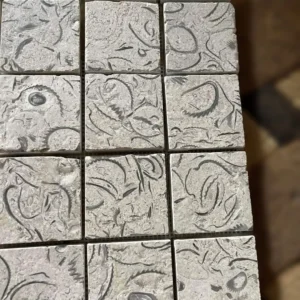
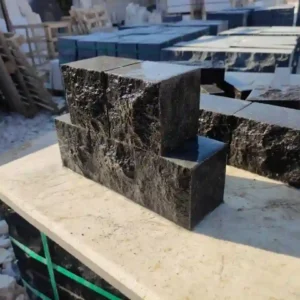
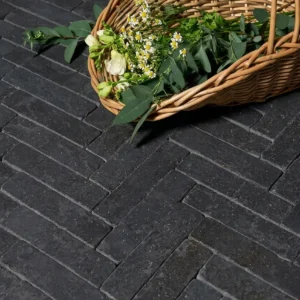
50 Years Of Manufacturing & Delivering The Highest-Quality Limestone & Black Basalt. Sourced & Hand-Picked From The Middle East.

Escrow Payment & Independent Verifying Agent For New Clients

Contact Me Personally For The Absolute Best Wholesale & Trade Prices:

USA & Worldwide Hassle-Free Delivery Options – Guaranteed.

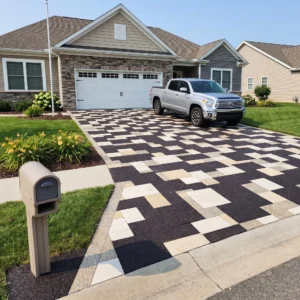
Driveway Pavers in Arizona

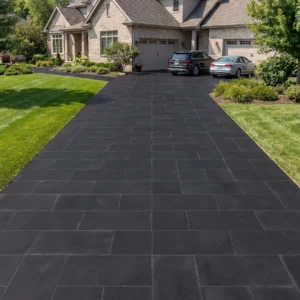
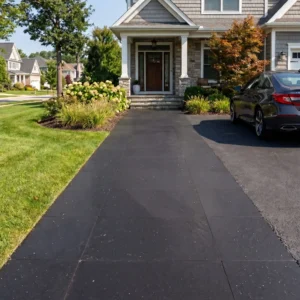
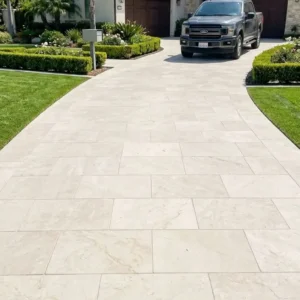
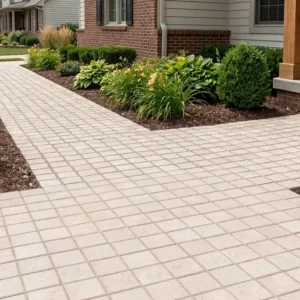
Driveway pavers in Arizona face one of the most demanding UV environments in North America — sustained solar radiation at high elevation accelerates surface oxidation, color bleaching, and surface spalling in materials not engineered for prolonged light exposure. Pavers with lower UV resistance can show visible fading within two to three seasons, making material selection a critical long-term decision rather than an aesthetic afterthought. Citadel Stone Arizona driveway pavers are available in a range of formats, finishes, and stone types specifically evaluated for Arizona's UV intensity and decomposed granite soil profiles, with specification support available for both residential and commercial projects. Understanding how surface density and finish type influence a paver's resistance to UV weathering is one of the most consequential decisions covered in the guidance below. Citadel Stone provides Arizona homeowners and contractors with quality driveway pavers suited to the region's climate, soil conditions, and aesthetic standards.

See & Feel the Quality – Free Arizona Stone Samples

Our stones are made for the Arizona sun. See how the colors hold up in your specific light.

Design Your Arizona Home with a Local Stone Expert

Get personalized advice on the best stone for Arizona's climate and your design style.

Premium Natural Stone — All Sizes & Thicknesses Available

From standard cuts to fully custom dimensions — our limestone, granite, basalt & shellstone
are cut to your exact specifications. Residential or commercial, we’ve got you covered.

Get Your Free Arizona Stone Quote

Transparent Pricing for Your Arizona Project

Elevate Your Arizona Property with Premium Stone, Priced for Value.

Unlock $10,000 Worth of Deals on Beautiful Paver, Tiles & Cobble Setts—For Free!

Invest in Arizona’s Landscape: Stone That Lasts a Lifetime.

100% Happiness Guarantee

Trust 50 Years of Expertise. Invest in Quality Limestone Tiles

Custom-Cut for Your Arizona Project: Any Size, Any Finish.

No-Obligation Consultation: Get Expert Advice for Your Arizona Home.

The Stone Supplier Trusted by Arizona's Leading Architects & Designers.

Trusted by Top Stone Experts Around the Globe

Arizona's Most Diverse Selection of Limestone Tiles.

Elevate Your AZ Property with Limestone Built for the Desert. Our expansive collection of limestone tiles brings timeless beauty and proven durability to both residential and commercial spaces across Arizona. As the state’s leading supplier, we offer a diverse palette of colors and finishes—from cool, light tones that reflect the sun to rich, earthy textures that complement the Southwest landscape. Transform your environment with limestone that stands up to the Arizona heat while providing the sophisticated aesthetic you desire.

Explore Arizona-Tough Alternative Stones

Product NameDescriptionPrice per Square Foot
Travertine TilesBeautiful natural stone with unique textures$8.00 - $12.00
Marble TilesLuxurious and elegant, available in various colors.$10.00 - $15.00
Granite TilesExtremely durable and perfect for high-traffic areas.$7.00 - $12.00
Slate TilesRich colors and textures; ideal for wet areas.$6.00 - $10.00
Porcelain TilesVersatile and low-maintenance, mimicking natural stone.$4.00 - $8.00
Ceramic TilesAffordable with a wide variety of designs.$3.00 - $6.00
Quartzite TilesStrong and beautiful, resistant to stains.$9.00 - $14.00
Concrete PaversCustomizable for patios; durable and cost-effective.$5.00 - $9.00
Glass TilesStylish, reflective, and brightening.$15.00 - $25.00
Composite TilesEco-friendly options made from recycled materials.$5.00 - $10.00

Incredible Prices for Top-Quality Stone—Shop Citadel Stone Today!

Table of Contents

Arizona’s UV index regularly peaks between 10 and 12 during summer months — a radiation load that degrades surface finish, alters mineral crystallography, and accelerates oxidation in ways that pure heat alone doesn’t explain. Choosing the right driveway pavers in Arizona means understanding how photochemical degradation acts on stone surfaces differently than thermal stress does, and specifying materials whose mineralogical composition resists that process over decades rather than years. The difference between a driveway that looks installed last season after fifteen years and one that looks weathered after three comes down almost entirely to UV performance, not just load-bearing capacity.

How UV Exposure Affects Driveway Paver Performance in Arizona

Arizona’s solar radiation doesn’t just fade color — it initiates a slow oxidation process at the mineral grain boundaries of certain stone types. Silicate-rich materials like granite and certain sandstones experience surface spalling over time as iron-bearing minerals oxidize and expand microscopically. Natural stone pavers with lower iron content, particularly travertine and limestone varieties, hold their surface integrity significantly better under sustained UV bombardment. You’ll notice this most clearly on driveway installations in Scottsdale, where driveways facing southwest receive uninterrupted afternoon sun at the highest UV angles — the color shift on unprotected, iron-rich stone can become visible within eighteen to twenty-four months.

The mechanism worth understanding is photooxidative degradation: UV-B wavelengths between 280 and 315 nanometers break molecular bonds in organic sealers and attack iron compounds in stone. This is why color fading in Arizona driveways isn’t uniform — it concentrates on exposed horizontal faces and tracks along micro-fractures where UV penetrates deeper. Specifying a stone with an albedo above 0.4 doesn’t just reduce surface temperature; it actively limits the UV absorption that drives oxidative change at the crystal level.

  • Travertine and limestone exhibit lower iron-mineral content, reducing photochemical oxidation rates by an estimated 40–60% compared to iron-rich sandstone under equivalent exposure
  • Surface finish type directly influences UV penetration depth — honed finishes absorb more UV than tumbled or brushed finishes due to reduced micro-surface scattering
  • UV-induced sealer degradation accelerates dramatically above 7,000 BTU/ft²/day, which Arizona’s low desert regularly exceeds from April through September
  • Color stability in driveway pavers in Arizona correlates strongly with calcium carbonate content — materials above 85% CaCO₃ show measurably slower color shift under spectrophotometric testing
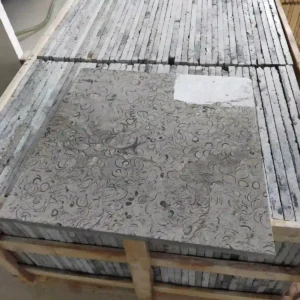
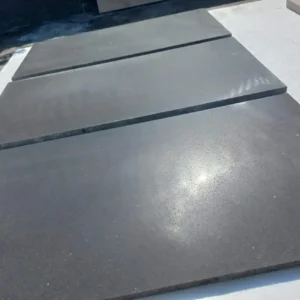
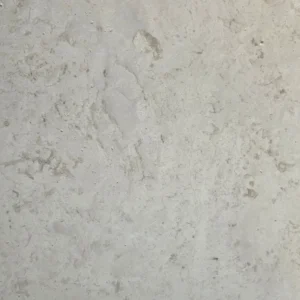
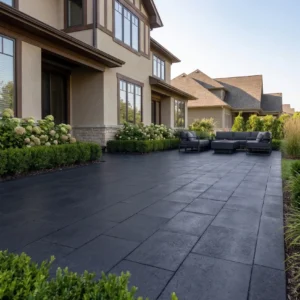
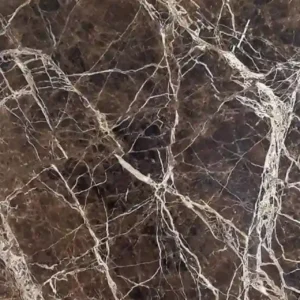
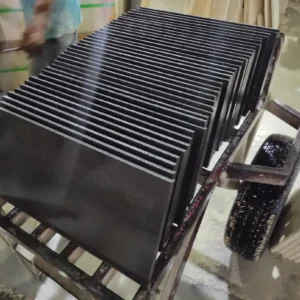
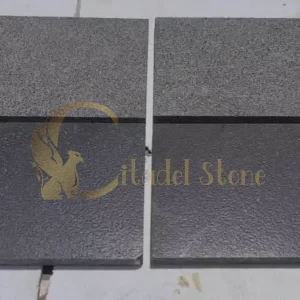
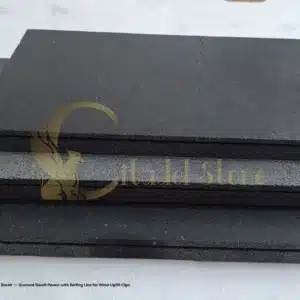
A close-up view of a dark, textured stone slab with visible granular speckling.

Natural Stone Paver Types for Arizona Driveways

Natural stone driveway pavers in Arizona aren’t a one-size category. Each material type carries a distinct UV performance profile, and understanding those differences before you specify saves you from costly replacement cycles. Citadel Stone sources driveway stone from established quarry partners, with each batch inspected for density consistency, surface finish uniformity, and mineral composition — the three variables that determine how a stone responds to Arizona’s radiation environment over the long term.

Travertine remains the top-performing natural stone for Arizona driveway applications across most project types. Its interconnected pore structure — when properly filled and sealed — creates a surface that scatters rather than absorbs UV wavelengths. Travertine driveway pavers maintain color stability over fifteen to twenty-five years when you apply a penetrating UV-inhibiting sealer on an eighteen-month cycle. Limestone offers comparable UV performance with greater compressive strength, typically ranging from 4,000 to 8,000 PSI depending on the quarry source, which makes it particularly well-suited for heavier vehicle loads on residential driveways.

  • Travertine: excellent UV color stability, 1.75″–2″ thickness for standard residential driveways, requires filled-and-honed or brushed finish for traction
  • Limestone: compressive strength 4,000–8,000 PSI, low iron content, available in cream, buff, and grey tones that retain chromatic stability under sustained UV
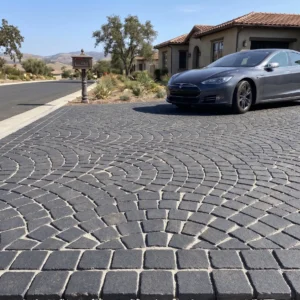
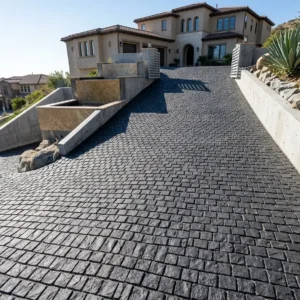
  • Cobblestone: high-density igneous options provide extreme durability, though darker basalt cobbles absorb more UV and can experience surface oxidation — specify lighter granite cobblestone for UV-exposed applications
  • Flagstone: irregular format works well for decorative driveway borders and aprons, with thickness typically ranging from 1.5″ to 2.5″ depending on vehicle load requirements
  • Brick pavers: fired clay maintains color through UV exposure better than most materials, though brick driveway installations require tighter joint management to prevent sand loss in Arizona’s wind conditions

You can request sample tiles and full specification sheets from Citadel Stone before committing to a material for your project — this is particularly useful when you’re comparing travertine versus limestone for a UV-critical driveway application where color stability over time matters as much as initial appearance.

Block Paving Formats, Patterns, and Layout Considerations

Block paving driveway installations in Arizona perform differently depending on pattern geometry — and this isn’t just an aesthetic decision. Driveway pavers laid in a herringbone pattern distribute vehicular load across a greater number of joint interfaces, which reduces point stress on individual units and limits the microcracking that UV exposure accelerates once it penetrates stress fractures. For most residential driveways in Arizona, driveway pavers herringbone at 45 degrees to the primary traffic direction is the specification that holds up best under combined UV and load cycling.

Running bond and stack bond patterns are common in contemporary driveway pavers designs, but they create continuous joint lines that run parallel to traffic direction. Under repeated load, these linear joints can open slightly — and in Arizona’s UV environment, those micro-gaps allow UV-B penetration to reach the bedding layer, where it degrades organic content in your setting material. A 45-degree herringbone interrupts this failure mechanism by distributing joint gaps across multiple load vectors.

  • Herringbone 45°: optimal for driveways with frequent vehicle traffic, maximum interlock efficiency, standard spec for driveway block paving in Arizona
  • Herringbone 90°: slightly easier to cut around complex borders, marginally reduced interlock compared to 45°, acceptable for lighter residential use
  • Running bond: appropriate for driveway border pavers, walkway aprons, and decorative band courses within a larger herringbone field
  • Random ashlar: works well for flagstone driveway sections and natural stone paver aprons where irregular format stone is specified
  • Cobblestone fan pattern: traditional option for cobblestone driveway designs with high visual character — requires skilled installation for consistent joint width

Modern driveway pavers designs in Arizona have trended toward larger format blocks in 12″×24″ and 16″×16″ sizes, particularly for contemporary driveway pavers applications in newer developments in Phoenix. Larger format stone reduces the number of visible joints, creates a cleaner contemporary aesthetic, and requires less grout material that can UV-degrade over time. The trade-off is that larger units are heavier to handle and less forgiving of minor base settlement — your base preparation needs to be more precise, not less.

Driveway Edging, Border Pavers, and Perimeter Details

Driveway edging blocks and driveway edging stones often get specified as an afterthought, but in Arizona they carry a structural function that becomes critical under UV and thermal conditions. Edge restraints in block paving driveway installations prevent lateral spread — without them, thermal expansion over Arizona’s extreme temperature differentials causes the field pavers to migrate outward, opening central joints that accelerate UV penetration to the base layer. Specify a mechanically fixed edge system, not just a mortared curb, for any driveway installation expecting regular vehicle overrun.

Driveway border pavers serve a dual purpose in Arizona driveway design: they define the perimeter aesthetically while providing a contrasting material zone that can be replaced independently if UV fading or surface wear becomes pronounced at the edges first — which it often does, since driveway edges receive direct lateral UV exposure rather than overhead-only radiation. Choosing a border material one shade darker than your field stone creates a color transition that ages more gracefully than a light-on-light combination where differential fading becomes immediately visible.

  • Driveway edging stones should be a minimum 4″ depth below finish grade to resist the lateral forces generated by vehicle overrun and thermal expansion
  • Contrasting border pavers in a darker complementary stone add visual definition while absorbing differential fading more gracefully
  • Driveway blocks used for edge courses should match the field paver thickness within 3mm to prevent trip hazards as both materials settle
  • Mechanical edge restraints (steel or aluminum) outperform mortared concrete edges in Arizona because they accommodate thermal movement without cracking
  • For cobblestone driveway designs, a granite sett border with a consistent rectangular profile provides clean geometric contrast against tumbled field cobbles

Base Preparation and Sub-Base Specification for Arizona Driveways

Base preparation is where most Arizona driveway paver failures originate — not at the surface. The irony is that UV gets the blame for driveway deterioration that actually started below grade. Inadequate compaction or insufficient base depth allows micro-settlement that opens surface joints, creating the UV entry points that then accelerate stone degradation from above. Your compacted aggregate base should be a minimum of 6″ for passenger vehicle driveways and 8–10″ for driveways expecting delivery trucks or RV-class vehicles.

Arizona’s desert soils present specific base challenges. Caliche — the calcium carbonate hardpan layer found across much of the Sonoran Desert — can be an asset or a problem depending on depth and consistency. In Tucson and the surrounding low desert, caliche layers at 18–30″ depth typically provide excellent natural sub-base stability. Shallower caliche at 6–10″ depth creates a drainage problem because it’s impermeable — you’ll need either a drainage aggregate layer above the caliche or perforated drainage channels to prevent hydrostatic buildup during monsoon events, which can heave pavers and compromise joint integrity.

Getting the base right also means thinking about what happens after truck deliveries during the installation phase. You should verify warehouse stock levels before committing to project timelines, then sequence your truck deliveries to coincide with completed subgrade compaction — driving loaded material delivery trucks across a freshly graded base compacts it unevenly and creates differential settlement zones that will telegraph to the surface paver layer within twelve to eighteen months.

  • Minimum 6″ compacted Class II base aggregate for residential driveways, 8–10″ for heavy vehicle access
  • Compact base in 3″ lifts at 95% Modified Proctor Density — do not attempt single-lift compaction of 6″ or greater depths
  • Install 1″ bedding sand layer over compacted base — do not exceed 1″ as thicker bedding sand layers compress unevenly under load
  • For driveways above caliche hardpan at 10″ depth or less, install a French drain system or slotted perimeter trench before laying base aggregate
  • Allow 24-hour minimum cure time after final compaction before laying bedding sand — this permits any residual moisture to redistribute evenly

Sealing and UV Protection Protocols for Arizona Driveway Pavers

Sealing natural stone driveway pavers in Arizona isn’t optional — it’s the primary UV protection mechanism for the stone surface. The key specification decision is sealer chemistry. Silane-siloxane penetrating sealers protect against moisture while leaving the surface breathable, but they offer limited UV-inhibiting properties on their own. For Arizona driveway pavers applications, you need a penetrating sealer with UV-blocking additives or a two-coat system: penetrating silane-siloxane as the primary coat, followed by a UV-stable acrylic topcoat at 15–20% solids content.

Resealing frequency is where most Arizona homeowners underestimate their maintenance commitment. Standard resealing recommendations of every three to five years assume a mid-latitude UV environment. In Arizona’s low desert, where UV index regularly exceeds 10 from March through October, the effective sealer lifespan on a horizontal driveway surface is eighteen to twenty-four months before UV-B degradation of the sealer film begins to allow photochemical access to the stone. For a comprehensive review of driveway paver materials and options relevant to Arizona’s maintenance cycles, the specification details there complement what’s outlined in this section. Plan your sealing schedule around the UV calendar, not the calendar year.

  • Apply first sealer coat within 30 days of installation, after joint sand has stabilized through at least one irrigation cycle
  • Reseal every 18–24 months for travertine and limestone driveways in low-desert Arizona (Phoenix metro, Tucson, Yuma region)
  • Reseal every 24–36 months for installations at higher elevations where UV index is lower and temperature extremes are greater — Flagstaff-area projects fall into this category
  • Never apply sealer to a surface above 90°F — the solvent flashes too quickly, leaving a streaked, uneven film that traps rather than blocks UV
  • Test sealer adhesion on a 12″×12″ sample area 48 hours before full application when changing sealer brands or formulations
Delivery truck loaded with secured crates of driveway pavers in Arizona ready for transport and distribution.

Cobblestone and Brick Driveway Options for Arizona Properties

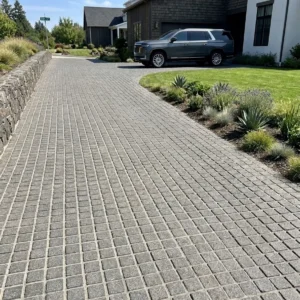
Cobblestone driveway installations in Arizona have surged in popularity for high-end residential and commercial entry applications — and the performance data supports the trend. Cobblestone driveway designs using natural granite setts exhibit exceptional UV resistance because fired and quarried igneous stone has already undergone extreme heat and pressure that renders it largely immune to photochemical surface change. A granite cobblestone driveway in Arizona’s desert environment will outlast most other material types by a significant margin if properly installed, with color change over twenty-five years being primarily a surface patina rather than structural degradation.

Brick driveway installations offer a different UV performance profile. Fired clay brick pavers resist UV fading through the same mechanism as high-temperature ceramics — the iron oxides that create brick’s characteristic red and buff tones are already fully oxidized during firing, so there’s no additional oxidation for UV to initiate. The practical limitation of a brick driveway in Arizona is surface temperature: dark-toned brick can reach surface temperatures of 160–175°F under peak summer radiation, which isn’t a UV issue but does affect barefoot comfort and adjacent landscape health. Specifying lighter buff or cream brick tones for driveway brick pavers in Arizona mitigates this without sacrificing UV performance.

  • Granite cobblestone: highest UV resistance of all driveway paver types, pre-oxidized mineralogy prevents photochemical surface change, specify 4″×4″×4″ cubed setts for maximum installation density
  • Basalt cobblestone: extremely dense and durable but absorbs UV radiation aggressively — reserve for shaded driveways or northern exposures
  • Buff or cream brick driveway pavers: excellent UV color stability in Arizona, surface temperatures 15–20°F cooler than red brick equivalents under identical sun exposure
  • Tumbled cobblestone: the textured surface created by tumbling scatters UV wavelengths rather than absorbing them, making tumbled finishes slightly more UV-stable than sawn-face cobbles

Flagstone Driveways and Contemporary Design Approaches in Arizona

Flagstone driveway pavers work particularly well for approaches, aprons, and the decorative sections of Arizona driveways where irregular format natural stone creates organic visual character. Driveway flagstone pavers in standard 1.5″–2.5″ thickness perform structurally for passenger vehicles when properly bedded, though you’ll want to step up to 2.5″–3″ thickness in areas where delivery trucks or occasional heavy vehicle access is expected. The key selection criterion for driveway flagstone pavers in Arizona is the iron content of the source stone — warm-toned flagstone with visible iron banding will shift toward grey-orange over time under UV exposure, while blue-grey and buff-tone flagstone with low iron concentration holds its color profile more consistently.

Contemporary driveway pavers designs in Arizona have moved toward large-format limestone or travertine slabs — sometimes called driveway slabs — in sizes ranging from 24″×24″ to 24″×48″. These modern driveway pavers formats create the clean, horizontal aesthetic that works with current architectural styles across high-end residential areas in Chandler, Peoria, and Gilbert. The specification challenge with large-format contemporary driveway pavers is joint management: fewer joints mean less interlock, so your base preparation has to be more precise to prevent differential settlement that creates visible lippage between adjacent slabs. A tolerance of no more than 1/8″ lippage is achievable with properly compacted base and calibrated stone thickness, and it’s the standard you should hold your installer to.

  • Flagstone driveway pavers: specify a minimum 2″ thickness for passenger vehicle traffic zones, 2.5″ for mixed passenger and delivery traffic
  • Large-format contemporary driveway pavers: 24″×48″ slabs require base compaction to 98% Modified Proctor — tighter than standard block paving specifications
  • For modern driveway pavers designs that combine formats (slab field with cobblestone borders), coordinate thickness across materials to within 3mm at all transitions
  • Best driveway pavers performance in UV-intensive Arizona environments comes from light-toned calcium carbonate stones — limestone, travertine, and light granite — rather than iron-rich sandstone or dark basalt
  • Driveway slabs in honed finish provide better UV diffusion than polished finishes, which create specular UV reflection that doesn’t reduce absorption

Order Driveway Pavers in Arizona — Citadel Stone

Citadel Stone stocks driveway pavers across a full range of formats for Arizona residential and commercial projects, including travertine in 12″×12″, 16″×16″, 12″×24″, and custom-cut sizes, limestone in standard driveway thicknesses of 1.75″ and 2″, cobblestone setts in both granite and basalt, brick pavers in standard and oversized modular formats, and large-format contemporary slabs in 24″×24″ and 24″×48″. Natural stone driveway pavers are available in filled-and-honed, brushed, tumbled, and sawn-face finishes depending on your traction and aesthetic requirements. At Citadel Stone, we maintain warehouse inventory across Arizona that typically keeps lead times to one to two weeks for standard stock items — significantly faster than the six to eight week import cycle that project managers often encounter when sourcing independently.

You can request sample tiles, technical data sheets, and thickness specifications before committing to a material — this is standard practice for trade and commercial accounts, and the Citadel Stone team can advise on lead times for non-standard formats or custom cuts that require additional quarry coordination. Wholesale and trade enquiries are welcome for projects requiring consistent batch sourcing across multiple truck deliveries over an extended installation schedule. Delivery coverage extends across Arizona, including the greater Phoenix metro, Tucson, Scottsdale, Mesa, and outlying areas. Contact Citadel Stone directly to request a project quote, schedule a material consultation, or obtain specification documentation for architect and contractor submissions. As your Arizona project comes together, you may also find value in reviewing related hardscape options — Outdoor Paving Slabs in Arizona covers complementary stone slab applications that Citadel Stone supplies for outdoor environments beyond the driveway itself. For durable, climate-appropriate driveway pavers across Arizona, Citadel Stone offers knowledgeable guidance and a reliable selection to meet residential and commercial project requirements.

Why Arizona’s Builders Choose Citadel Stone?

Free AZ Comparison: Citadel Stone vs. Other Suppliers—Find the Best Value!

FeaturesCitadel StoneOther Stone Suppliers
Exclusive ProductsOffers exclusive Ocean Reef pavers, Shellstone pavers, basalt, and white limestone sourced from SyriaTypically offers more generic or widely available stone options
Quality and AuthenticityProvides high-grade, authentic natural stones with unique featuresQuality varies; may include synthetic or mixed-origin stone materials
Product VarietyWide range of premium products: Shellstone, Basalt, White Limestone, and moreProduct selection is usually more limited or generic
Global DistributionDistributes stones internationally, with a focus on providing consistent qualityOften limited to local or regional distribution
Sustainability CommitmentCommitted to eco-friendly sourcing and sustainable production processesSustainability efforts vary and may not prioritize eco-friendly sourcing
Customization OptionsOffers tailored stone solutions based on client needs and project specificationsCustomization may be limited, with fewer personalized options
Experience and ExpertiseHighly experienced in natural stone sourcing and distribution globallyExpertise varies significantly; some suppliers may lack specialized knowledge
Direct Sourcing – No MiddlemenWorks directly with quarries, cutting unnecessary costs and ensuring transparencyOften involves multiple intermediaries, leading to higher costs
Handpicked SelectionHandpicks blocks and tiles for quality and consistency, ensuring only the best materials are chosenSelection standards vary, often relying on non-customized stock
Durability of ProductsStones are carefully selected for maximum durability and longevityDurability can be inconsistent depending on supplier quality control
Vigorous Packing ProcessesUtilizes durable packing methods for secure, damage-free transportPacking may be less rigorous, increasing the risk of damage during shipping
Citadel Stone OriginsKnown as the original source for unique limestone tiles from the Middle East, recognized for authenticityOrigin not always guaranteed, and unique limestone options are less common
Customer SupportDedicated to providing expert advice, assistance, and after-sales supportSupport quality varies, often limited to basic customer service
Competitive PricingOffers high-quality stones at competitive prices with a focus on valuePrice may be higher for similar quality or lower for lower-grade stones
Escrow ServiceOffers escrow services for secure transactions and peace of mindTypically does not provide escrow services, increasing payment risk
Fast Manufacturing and DeliveryDelivers orders up to 3x faster than typical industry timelines, ensuring swift serviceDelivery times often slower and less predictable, delaying project timelines

Extra Benefits

Choosing Citadel Stone offers unique advantages beyond premium stone quality:

Exclusive Access to Durable Stones

Citadel Stone specializes in unique, regionally exclusive stones, sourced directly from the Middle East.

Transparent Pricing – No Hidden Costs

With no middlemen, Citadel Stone provides direct, transparent pricing that reduces unnecessary costs.

Flexible Customization for Bespoke Projects

Tailor your order to precise specifications, from sizes to finishes, ensuring your project aligns perfectly with your vision.

Streamlined Delivery & Reliable Stock Availability

Benefit from fast production and delivery timelines, designed to minimize delays and ensure reliable availability.

The Preferred Stone Supplier for Luxury AZ Developments.

Scale Your Vision: We Support Arizona's Largest Projects with Reliable, Fast Delivery.

With unlimited tiles, pavers, cobble setts, curbstones, and the fastest delivery options, What’s not to love? Say goodbye to unnecessary hassles!

Leading AZ Stone Suppliers are Loving Citadel Stone!

Don’t Settle for Less. Source the Best Stone for Your Local Stone Expert.

DanielOwner
Thank you, Kareem. We received the order. The stones look great!
FrankOwner
You are a good businessman and I believe a good person. I admire your honesty, this is why I call you a good businessman.
Gemma C
Gemma CPrivate Project
Undoubtedly the price was the reason that we chose Citadel stone, in addition to the fact that you offer a white limestone that is hard to source. Your products are very good value for money by comparison with other companies. You have helped at every stage of the process and have been quick and reliable in your responses. It was a big risk for us to pay everything up front including shipping and not know the quality. You did make me feel that I could trust you and your company however and we are very happy with the tiles. They appear to have been finished to a very high quality of smoothness and I can't wait to see them once they have been laid. We need to see now how easy they are to fit and maintain, yet you also sealed them before shipment so we think that they will be very durable. Our building project has been delayed for a few months now so it may be sometime before we see them laid, but I promise that I will send photos as soon as we have them down. Thank you so much Kareem and your team, you have done a great job. I am hoping that we can pay for, and receive our second shipment in the not too far future, so that we can finish everything off. Wishing you well. Gemma
Molly McK
Molly McKPrivate Project
I appreciate the quality of product and care for the custom order in packaging each crate to minimize breakage as well as the flexibility with the order to help us make the most of shipping. The timely communications are impressive from the beginning and throughout the process. It's reassuring to have gone through one order to know what the process will be like in the future. I am glad to have had some guidance through the importing process and recommendations for shipping partners to assist. It's incredible to think about the journey the stone traveled to get to our site and I'm grateful to have made it to the next stage of the project relatively smoothly and with from what I can tell

Frequently Asked Questions

If your question is not listed, please email us at [email protected]

How does UV exposure affect driveway pavers in Arizona over time?

Prolonged UV radiation in Arizona breaks down pigment bonds in many manufactured and natural stone pavers, causing progressive color fading, surface oxidation, and in some cases micro-fracturing on less dense materials. Natural stones with high mineral density — such as basalt or dense limestone — retain structural integrity and surface tone significantly better than lower-density alternatives. Selecting a paver with documented UV resistance rather than relying on general climate ratings is the most reliable way to protect long-term appearance and performance.

Arizona’s soils vary considerably by region — from expansive clay in the lower valleys to decomposed granite and caliche hardpan in higher elevations — and each type demands a different base approach. Caliche layers can create drainage blockages that undermine compacted aggregate bases over time, while expansive soils require deeper compaction depths to prevent paver movement after seasonal ground shifts. A geotechnical assessment of your specific site conditions before laying any base material is strongly recommended, particularly for driveways bearing vehicle loads.

Natural stone pavers generally outperform concrete alternatives in UV resistance because their color is integral to the mineral composition rather than surface-applied pigment, meaning they do not fade in the same way under Arizona’s high solar load. Concrete pavers can be cost-effective and offer consistent sizing, but they typically require sealing to slow UV-induced color degradation and surface dusting. For driveways in high-sun exposures, natural stone’s inherent UV stability makes it a more durable long-term choice despite a higher initial material cost.

In Arizona’s climate, sealing frequency depends primarily on UV exposure intensity and foot or vehicle traffic rather than moisture alone. A penetrating sealer applied to natural stone pavers every two to three years helps protect against UV-accelerated surface oxidation and prevents staining from vehicle fluids. Inspecting grout lines and joint sand annually is equally important, as UV exposure combined with thermal cycling can loosen jointing material and allow weed encroachment or ant activity to destabilize the surface.

For standard residential driveways accommodating passenger vehicles, a minimum paver thickness of 60mm (approximately 2.375 inches) is the widely accepted industry benchmark, providing sufficient load distribution across a properly compacted base. In Arizona specifically, the combination of thermal expansion and contraction — driven in part by surface temperatures amplified by intense solar radiation — favors slightly thicker pavers where budget allows, as they are less prone to edge chipping under repeated stress cycles. Driveways intended for heavier vehicles such as RVs or service trucks should use 80mm pavers with an engineered sub-base.

Citadel Stone’s natural stone pavers are sourced and quality-controlled through a manufacturing heritage spanning 50 years — meaning the material consistency, dimensional tolerances, and surface characteristics meet the standards that demanding driveway applications require. Arizona contractors benefit from Citadel Stone’s regional warehouse positioning, which keeps fulfillment lead times shorter than import-to-order suppliers and supports tighter project scheduling. From product selection through specification support, Citadel Stone actively supplies driveway paver projects across Arizona with material ready to move when project timelines demand it.