How Arizona Soil Conditions Affect Limestone Paving Stone Performance
Soil composition is the variable that determines whether your limestone paving stones in Arizona last 8 years or 28 years — and it’s the one most contractors underestimate. Arizona’s ground is far from uniform: you’ll encounter expansive clay in the east valley, decomposed granite in the high desert, and calcium-rich caliche hardpan across much of the Phoenix and Tucson basins. Each of these demands a different base preparation strategy, and limestone’s relatively low modulus of rupture (typically 1,200–1,800 PSI for sedimentary limestones) means it will telegraph subgrade movement faster than denser materials like basalt or granite. Getting the ground right before a single paver is set is the specification decision that matters most.
Caliche is the soil condition that catches most Arizona installers off guard. This calcium carbonate hardpan layer sits between 12 and 36 inches below grade in many low-desert locations, and while it sounds like a convenient sub-base, its irregular surface creates point-loading stress on pavers above it. You need to scarify and re-compact caliche or excavate through it entirely to reach a stable, consistent bearing layer before placing your compacted aggregate base. Skipping this step is the primary reason limestone patio stones in Arizona crack within the first two years, not heat or UV exposure.
Base Preparation Standards for Limestone Pavers in Arizona
The aggregate base depth you specify should be driven by your soil’s bearing capacity, not a generic guideline. For standard residential foot traffic on decomposed granite soils, a 4-inch compacted Class II base is workable. On expansive clay — which is common across parts of Mesa and the east valley — you’re looking at a minimum 6-inch base with a filter fabric separation layer to prevent clay migration into the aggregate over time. Vehicular applications, including a limestone paver driveway in Arizona, require 8 inches of compacted base at minimum, with a geotextile layer wherever clay subsoil is present within 36 inches of finished grade.
Compaction density matters as much as depth. Target 95% standard proctor density at the subgrade and 98% at the aggregate base layer. Anything below these thresholds allows differential settlement that will crack or displace even the thickest paving stone. For projects where you’re specifying 1.25-inch nominal limestone slabs for landscaping in Arizona, this differential settlement risk is amplified — thinner material has less structural redundancy, so the base has to do all the work.
- Minimum 4 inches compacted aggregate base for pedestrian applications on stable soil
- Minimum 6 inches with geotextile fabric on expansive clay subsoils
- Minimum 8 inches for vehicular traffic, including driveway applications
- Scarify and re-compact caliche layers before base installation
- Verify 95% proctor density at subgrade before placing aggregate
- Install drainage fabric where clay migration risk exists within 36 inches of finished grade
Drainage Slope and Surface Water Management for Limestone Patio Stones in Arizona
Arizona’s monsoon season delivers intense short-duration rainfall — often 1.5 to 2 inches in under 45 minutes — that overwhelms poorly graded paved surfaces in ways that mild-climate installations never experience. Limestone patio stones in Arizona need a minimum 1.5% cross-slope (roughly 3/16 inch per foot) to evacuate water before it saturates joints and undermines bedding. In practice, 2% is the target on residential patios; steeper slopes reduce standing water but can create uncomfortable walking surfaces on larger format stones above 24 × 24 inches.
Joint design plays a secondary but important role. Dry-set limestone installations with open sand joints allow infiltration that relieves surface water pressure, but in clay-heavy subsoils that same infiltration carries fines upward through capillary action, progressively contaminating your base. In those conditions, you’re better served by a polymeric jointing compound that stabilizes the joint without completely sealing it. Projects in Tucson often deal with both caliche and clay in the same soil profile, which makes drainage design more complex — you need surface runoff managed by slope AND subsurface drainage managed by base permeability and joint sealing strategy working together. For complementary specification support, Limestone Paving Stones from Citadel Stone covers technical criteria that apply directly to Arizona drainage and base preparation conditions, and the team can advise on thickness selection and finish options that match your drainage strategy before materials leave the warehouse.
Selecting Limestone Format and Thickness for Arizona Applications
Thickness selection for limestone rock pavers in Arizona follows a straightforward rule once you understand the load and base conditions: 1.25 inches for foot-traffic-only residential use on a stable prepared base, 1.5 to 2 inches for mixed use or where base preparation is constrained, and 2.5 to 3 inches for vehicular applications. The middle range is where most projects land — 1.5-inch nominal limestone handles the reality of Arizona residential use, where a patio transitions to a side yard that occasionally sees delivery vehicles or riding mowers.
Format size affects both performance and visual weight. Larger formats (24 × 24 and above) are more susceptible to flexural stress from minor subgrade movement, which is why they demand better base preparation than smaller modular units. Smaller modular formats — 12 × 12 or the classic 6 × 9 brick pattern — distribute loads more effectively and accommodate minor settlement without visible cracking. Limestone paver walkway projects in Arizona often benefit from a 12 × 24 running bond layout, which provides visual length while keeping format size manageable over the ground movement typical of desert soils.
- 1.25-inch thickness: pedestrian-only, stable prepared base, residential patio
- 1.5-inch thickness: standard residential mixed use, recommended for most Arizona projects
- 2-inch thickness: higher traffic areas, constrained base preparation conditions
- 2.5 to 3-inch thickness: vehicular driveways, commercial entry applications
- Larger formats (24×24 and above) require superior base preparation to resist flexural cracking
- Modular formats distribute point loads more effectively on variable subgrade conditions
Finish Options and Surface Performance for Limestone Paving Stones in Arizona
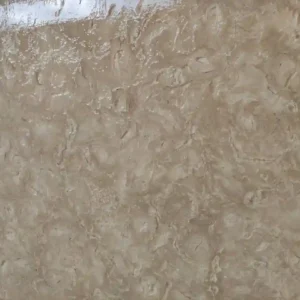
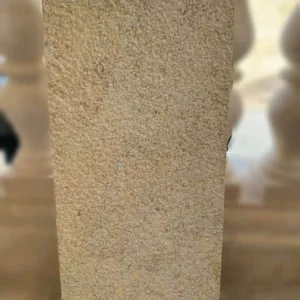
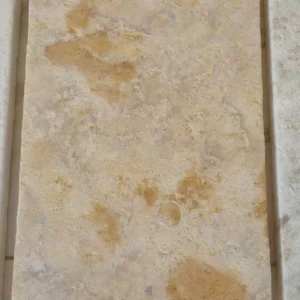
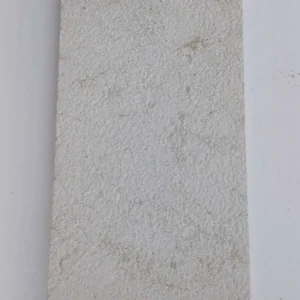
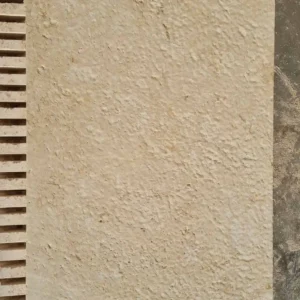
Surface finish determines both the aesthetic character and the slip-resistance rating of your installation — and in Arizona’s climate, the two don’t always point in the same direction. Tumbled and brushed limestone finishes provide the highest natural slip resistance (typically meeting or exceeding ASTM C1028’s 0.6 wet COF threshold) and their textured surfaces diffuse light rather than creating glare under direct Arizona sun. Honed finishes deliver a smoother surface that reads more contemporary, but the wet coefficient of friction drops to 0.4–0.5 range, which is marginal for pool surrounds or monsoon-season walkways without an applied non-slip sealer.
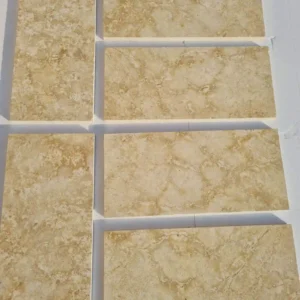
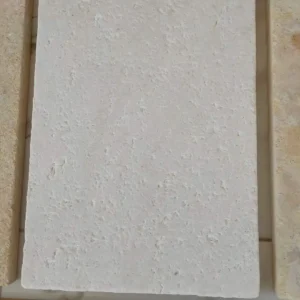
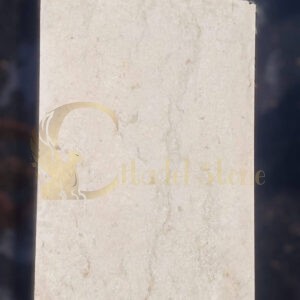
Sawn-cut limestone finishes are the default for limestone slabs used in landscaping in Arizona and offer the most dimensional consistency — critical when you’re setting large format material on a compacted bedding layer and need predictable joint lines. Citadel Stone sources limestone from established quarry partners where thickness tolerance is held to ±1/16 inch on sawn material, which makes a real difference when you’re bedding in screeded stone dust rather than a thicker mortar bed. Sample tiles are available from Citadel Stone to verify finish texture and thickness consistency before committing to full project quantities.
Thermal Expansion Management and Joint Spacing for Arizona Limestone
Arizona’s temperature range — from summer highs above 115°F in Phoenix to overnight lows that occasionally touch 28°F in the low desert — creates thermal cycling demands that most limestone installations are not detailed to handle. Limestone’s linear thermal expansion coefficient runs approximately 4.4 × 10⁻⁶ per °F. Across a 20-foot run of paving at a 90°F seasonal temperature differential, that translates to roughly 0.095 inches of cumulative movement — enough to buckle a rigid installation without properly spaced expansion joints.
Soft expansion joints should be specified at 12- to 15-foot intervals in both directions for dry-set installations, and at 10-foot intervals for mortar-set applications. This is tighter than the 20-foot spacing you’ll see in generic masonry guidelines, but Arizona’s daily temperature swings — not just seasonal ones — mean the material is cycling repeatedly throughout the year. Projects in Scottsdale have logged surface temperature differentials of 70°F between pre-dawn and mid-afternoon during summer, which means expansion joint design needs to account for daily, not just seasonal, movement.
- Limestone thermal expansion: approximately 4.4 × 10⁻⁶ per °F
- Specify expansion joints at 12–15 foot intervals for dry-set applications
- Reduce to 10-foot intervals for mortar-set installations
- Compressible foam backer rod plus polyurethane sealant for exterior joint detailing
- Daily temperature cycling in the low desert creates movement demands beyond seasonal calculations
Sealing and Maintenance Protocols for Limestone Rock Pavers in Arizona
Limestone’s interconnected pore structure — porosity values typically ranging 5–15% for sedimentary limestones — means unsealed material in Arizona will absorb mineral-rich water and surface contaminants at a rate that produces visible staining within one monsoon season. The right sealer for Arizona isn’t the same as what works in humid climates: a penetrating silane-siloxane blend outperforms film-forming acrylics, because film-forming sealers trap heat at the surface and can blister or delaminate at pavement temperatures above 160°F, which Arizona summer stone surfaces routinely exceed.
Apply sealer to clean, dry stone — ideally 48 hours after installation and after a light pre-wet and dry cycle to equalize porosity. Reapplication frequency in the low desert should be every 18 to 24 months, not the 3- to 5-year cycle marketed on most sealer products. Arizona’s UV intensity degrades siloxane bonds faster than the labeling accounts for. In Flagstaff and higher-elevation installations above 5,000 feet, freeze-thaw cycling becomes a real factor — water infiltration into unsealed limestone pores that subsequently freezes can cause spalling within a few seasons, so sealing is non-negotiable at elevation regardless of aesthetic preference.
Limestone Walkway and Driveway Applications Across Arizona
A limestone paver walkway in Arizona functions differently from a patio installation in one critical respect: foot traffic patterns create concentrated wear lines. Specify a minimum 1.5-inch nominal thickness for walkway applications and use a honed or brushed finish rather than polished, which will show wear patterns within a couple of years on high-traffic paths. For a limestone paver driveway in Arizona, the 2.5-inch minimum thickness guideline applies without exception — passenger vehicle tire loads create point pressures that thinner material simply can’t distribute over an aggregate base without cracking at joint lines.
Driveway applications also require a concrete edge restraint system, not just plastic or aluminum edging. Vehicular loads generate lateral thrust that plastic edging cannot contain over a 10-year period, and limestone pavers without proper edge confinement will migrate outward by 0.25 to 0.5 inches per year in Arizona’s expansive soil conditions. A 4-inch concrete curb poured integrally with the base slab provides the edge stability that keeps your driveway geometry intact. Citadel Stone ships limestone paving stones in Arizona from regional inventory, with truck delivery to Phoenix, Tucson, and Scottsdale typically running 7 to 10 business days for standard stocked formats.
- Walkway applications: minimum 1.5-inch thickness, brushed or tumbled finish preferred
- Driveway applications: minimum 2.5-inch thickness, concrete edge restraint required
- Lateral thrust from vehicles requires rigid edge confinement — avoid plastic edging on driveways
- Vehicular traffic on expansive soil demands geotextile base separation and 8-inch compacted aggregate
- Standard truck delivery to major Arizona metro areas within 7–10 business days from warehouse stock
Buy Limestone Paving Stones for Your Arizona Project
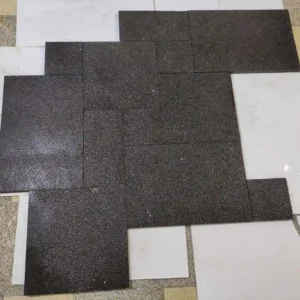
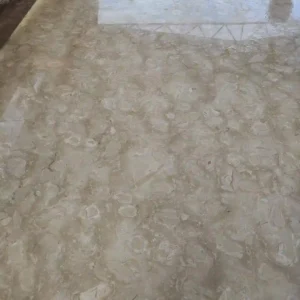
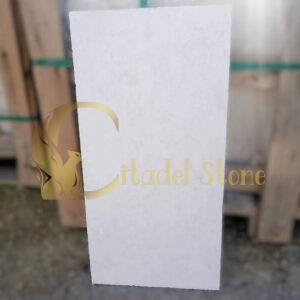
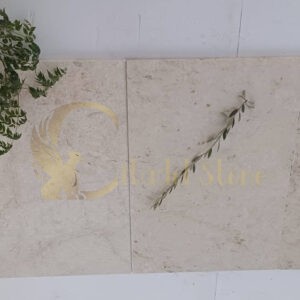
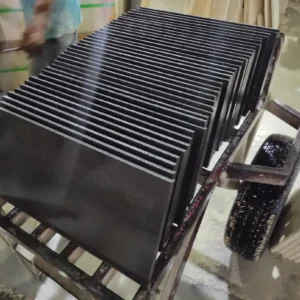
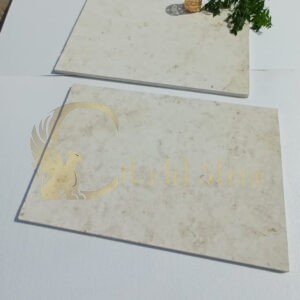
Citadel Stone stocks limestone paving stones in Arizona-ready formats including 12 × 12, 12 × 24, 16 × 16, and 24 × 24 nominal sizes, with thickness options from 1.25 inches through 3 inches for vehicular applications. Finish options include sawn, brushed, tumbled, and honed surfaces across cream, buff, and grey limestone varieties. For projects requiring custom cut sizes, non-standard thicknesses, or volume pricing on commercial quantities, the Citadel Stone team can confirm lead times and arrange project-specific consultations — contact us directly for wholesale and trade account inquiries.
Sample tiles are available before committing to full quantities, which is strongly recommended when matching limestone to existing hardscape elements or specifying a finish that needs to meet a specific slip-resistance threshold. Sourced from established quarry partners, each batch arriving at the warehouse undergoes consistency checks for thickness tolerance, surface finish, and colour range before it ships. Trade contractors and landscape architects working on recurring Arizona projects can establish account pricing that streamlines the ordering and truck delivery process for multiple installations throughout the season. As you plan your overall Arizona hardscape scope, complementary stone applications can inform related material decisions — Landscape pavers in Arizona covers additional Citadel Stone materials suited to Arizona residential and commercial projects across the same regions. Homeowners in Flagstaff, Sedona, and Yuma source Limestone Paving Stones through Citadel Stone for Arizona residential and commercial installations.