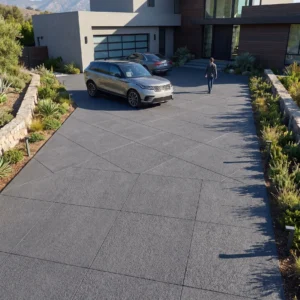
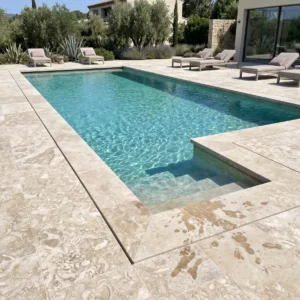
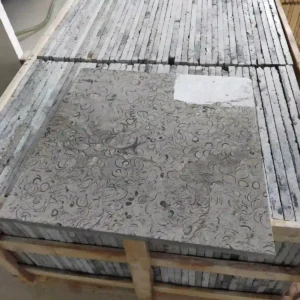
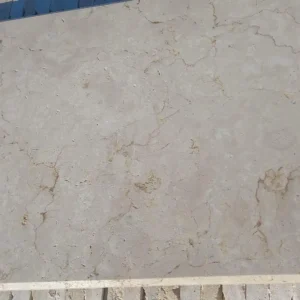

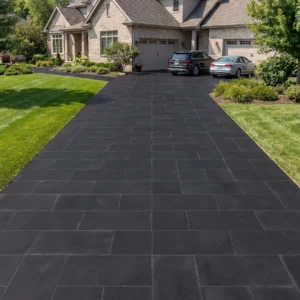
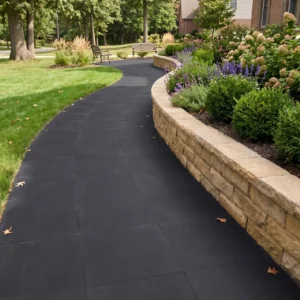
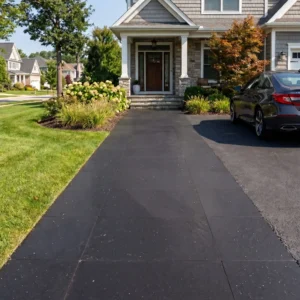
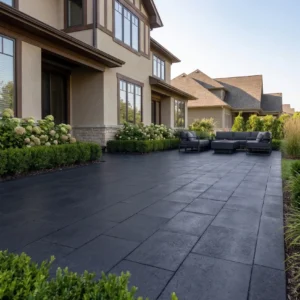



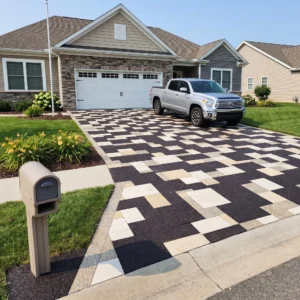
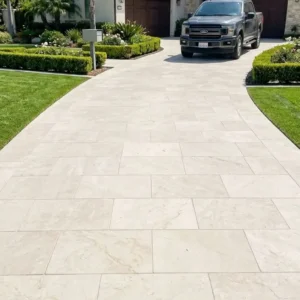
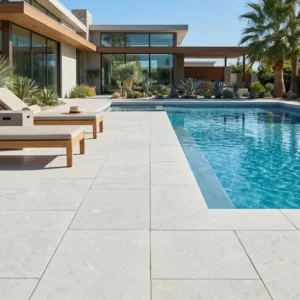





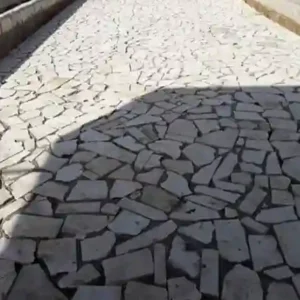
Square driveway pavers in Arizona fail at a predictable point — not because of heat load, but because the subgrade beneath them was never properly understood before the first paver was set. The expansion and contraction of poorly stabilized native soil creates differential settlement that no amount of quality stone can overcome. Getting your base preparation right from the start determines whether your square driveway pavers in Arizona hold up for two decades or start rocking within three years.
Arizona Soil Conditions and What They Mean for Square Driveway Pavers
Arizona’s soil profile is more varied than most buyers realize, and the differences matter enormously when you’re setting square driveway pavers. In the low desert valleys, you’ll encounter expansive clay soils — sometimes mixed with caliche — that swell predictably when wet and contract sharply during dry cycles. That movement range can exceed half an inch per linear foot in untreated native soils, which is more than enough to pop individual pavers out of alignment and open joints to erosion. The key is recognizing what’s under your feet before the first base material goes down.
Caliche, the calcium carbonate hardpan common across the greater Phoenix basin, presents a counterintuitive opportunity. At Mesa job sites where caliche sits at 18–24 inches below grade, that layer actually functions as a stable sub-base platform once it’s scarified and leveled — dramatically reducing the aggregate base depth you’d otherwise need. The challenge is that caliche is highly impermeable, so drainage routing becomes critical. Without deliberate drainage planning at the design stage, water pools above the hardpan and saturates whatever base material you’ve placed on top.
Citadel Stone’s technical team regularly consults on site-specific base specifications before material orders are finalized — it’s one of the practical advantages of working with a supplier that understands Arizona ground conditions, not just the stone itself.
Base Preparation Standards That Actually Hold in Arizona
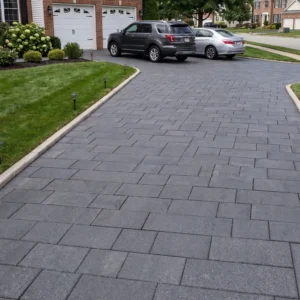
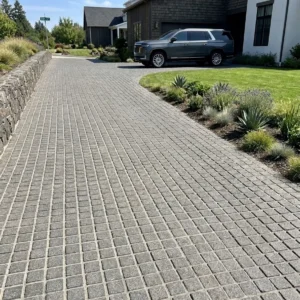
The aggregate base depth for a residential driveway using square driveway blocks in Arizona typically runs 6–8 inches of compacted Class II base material for standard passenger vehicle loads. That depth increases to 10–12 inches when you’re designing for truck access or heavy SUV traffic on expansive clay soils. Skimping here is the single most common reason square paver driveway in Arizona installations develop long-term problems.
Compaction matters as much as depth. Your base should reach 95% modified Proctor density — verified by a nuclear density gauge, not eyeballed by how firm it feels underfoot. Each lift should be no more than 4 inches of loose material before compaction. Rushing the lifts is tempting on large projects, but it guarantees the kind of consolidation settlement that reopens joints and unlevel surfaces within the first couple of wet seasons.
- Native soil subgrade must be compacted to 90% modified Proctor before any aggregate base is placed
- Expansive clay subgrades should receive a geotextile separation fabric between native soil and base aggregate
- Caliche hardpan should be scarified to 4 inches, leveled, and re-compacted before base aggregate placement
- Aggregate base should be Class II crushed rock with a maximum particle size of 3/4 inch
- Bedding sand layer should be 1 inch of coarse, angular sand — never fine play sand, which migrates under load
- Compaction equipment should include a plate compactor for the sand layer, applied after initial paver setting
For projects requiring complementary stone elements across similar site conditions, square paver blocks Arizona covers design and specification details that apply to the same base preparation logic outlined here. Getting subgrade compaction and drainage geometry resolved before surface material decisions are made is what separates durable driveway installations from chronic maintenance problems.
Selecting the Right Square Paver Format for Driveway Applications
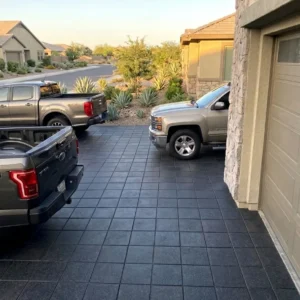
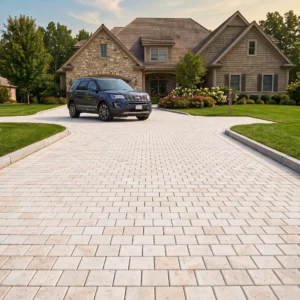
Format selection goes beyond aesthetics when you’re spec’ing a driveway surface. For square driveway pavers in Arizona, the two dominant thickness ranges are 2 3/8-inch and 3 1/8-inch nominal. The 2 3/8-inch format handles residential passenger vehicle loads comfortably when your base is properly prepared. Move up to 3 1/8-inch thickness when truck delivery access, RV use, or heavier commercial traffic is part of the expected load scenario.
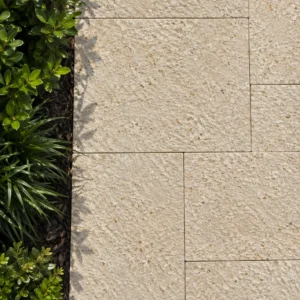
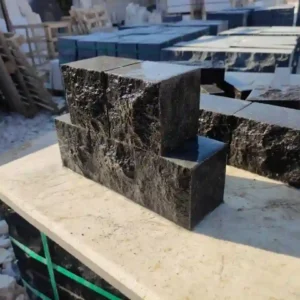
Surface texture is a performance variable, not just an aesthetic one. A honed or polished face increases surface temperature and reduces traction when wet — not ideal for a driveway slope. Tumbled finishes and split-face textures run cooler than honed equivalents under direct exposure, and they hold traction better through Arizona’s monsoon rains — request the wet DCOF test report for the finish you specify. The square paver driveway in Arizona projects that perform best long-term consistently use textured surface finishes rather than smooth ones.
- 2 3/8-inch thickness: suitable for residential passenger vehicle driveways with compacted aggregate base
- 3 1/8-inch thickness: required for truck access driveways, RV pads, and commercial entry approaches
- Tumbled or textured surface finishes outperform honed finishes in both thermal performance and wet traction
- Larger format pavers (18×18 inch or 24×24 inch) reduce joint frequency, which lowers long-term joint sand maintenance
- Smaller format pavers (12×12 inch) offer more design flexibility for curved layouts and gradient transitions
Citadel Stone stocks square driveway pavers in standard formats including 12×12, 16×16, 18×18, and 24×24 inch dimensions across multiple thickness ranges, with natural stone options suited to Arizona’s UV intensity and temperature cycling. You can request sample pieces before committing to full pallet orders — a step worth taking when you’re matching to existing hardscape or architectural stone details.
Square Driveway with Grass: Design and Drainage Considerations
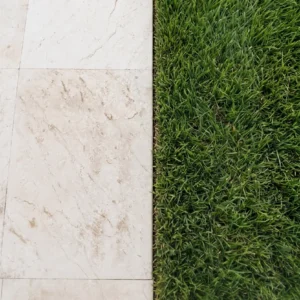
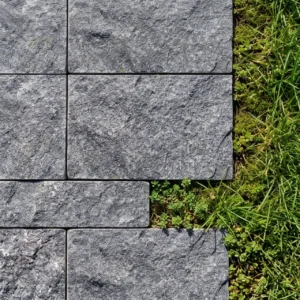
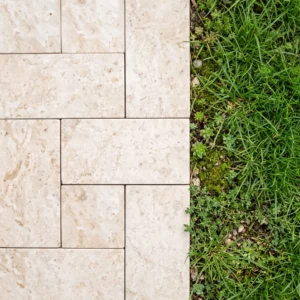
The square driveway with grass in Arizona is a design approach that looks straightforward but demands careful hydraulic planning to function well over time. The concept — alternating paver squares with planted grass panels or ground cover — reduces heat island effect and improves drainage, but it introduces a maintenance dynamic that not every property owner anticipates. Grass panels in a Phoenix or Scottsdale driveway need irrigation that doesn’t saturate your aggregate base, and that requires precise emitter placement and pressure-regulated drip systems rather than spray heads.
Structurally, the grass or ground cover panels create a void in your load-bearing surface. This means your aggregate base must be continuous and fully compacted beneath both paver and planted areas, not just beneath the stone. A common installation mistake is reducing base depth beneath the planted panels to accommodate root depth — this creates differential settlement between paved and planted zones that opens up over two to three seasons. A well-executed square driveway with grass in Arizona depends on consistent base engineering across the entire footprint, not just the paved portions.
- Base aggregate should be uniform depth across both paved and planted panel zones
- Use open-cell plastic grid systems beneath planted panels to maintain structural support
- Root barriers between paver zones and planted panels prevent root intrusion under adjacent pavers
- Drip irrigation in planted panels should run on a schedule that allows the base to dry between cycles
- In Tucson‘s higher clay content zones, grade planted panels slightly higher than surrounding pavers to direct surface drainage away from base material
Joint Spacing and Sand Management in Arizona’s Climate
Joint sand is the element of a square paver driveway that most installers underspecify and most property owners underestimate. Arizona’s low-humidity environment accelerates joint sand loss through wind erosion and the pressure-washing that’s common in dusty desert environments. You’ll see joint sand levels drop 20–30% in the first year post-installation without polymeric sand stabilization, and that loss creates the rocking, shifting, and weed intrusion that defines a neglected installation.
Polymeric sand is non-negotiable for square driveway blocks in Arizona. Standard silica joint sand migrates too freely in both monsoon runoff and sustained wind exposure. Polymeric sand, once properly activated with water and allowed to cure, resists both wind erosion and water washout while remaining flexible enough to accommodate the minor movement that expansive soils will introduce.
In the Tucson corridor, where monsoon rainfall events can exceed 1 inch per hour, the hydraulic pressure on joint sand during storm events is significant. Sealed joints with polymeric sand rated for high-rainfall zones hold their joint fill through repeated monsoon seasons far better than standard silica sand under identical conditions. Reapplication intervals typically run every 5–7 years for well-cured polymeric installation, versus annual or biennial maintenance for untreated joints.
Sealing Square Driveway Pavers: What Arizona’s UV Load Actually Requires
Arizona’s UV index ranks among the highest in North America, and it affects natural stone driveway pavers in ways that don’t always show up until the second or third year. Unsealed porous stone surfaces experience accelerated color fade, surface dusting from carbonate dissolution, and increased susceptibility to oil staining from vehicle drips. Sealing is protective maintenance, not cosmetic enhancement — and the product choice matters as much as the timing.
Penetrating silane-siloxane sealers are the standard of practice for square driveway pavers in Arizona. They don’t create a surface film that peels or yellows under UV, and they allow vapor transmission — critical in a climate where temperature differentials between night and day can exceed 40°F. Film-forming acrylic sealers applied to Arizona driveways tend to delaminate within 18–24 months under intense UV exposure, leaving an adhesion-compromised surface that’s harder to re-treat than bare stone.
- Apply sealer to clean, fully cured pavers — minimum 30 days after installation before initial sealing
- Penetrating silane-siloxane sealers: reapply every 3–5 years depending on traffic and UV exposure
- Test water beading annually — when water no longer beads on the surface, sealer reapplication is due
- Avoid film-forming acrylic sealers in full-sun Arizona driveway applications
- In Scottsdale high-end residential projects, a two-coat silane-siloxane application at 90-day intervals after installation delivers better long-term stain resistance than a single heavy application
Long-Term Maintenance Expectations for a Square Paver Driveway in Arizona
Realistic maintenance planning for a square paver driveway in Arizona breaks down into three categories: joint sand replenishment, sealer reapplication, and individual paver replacement when needed. The third category is where interlocking paver systems genuinely outperform monolithic concrete — you can lift and reset individual pavers without disturbing the surrounding field, which makes utility access repairs and isolated settlement corrections fast and cost-effective.
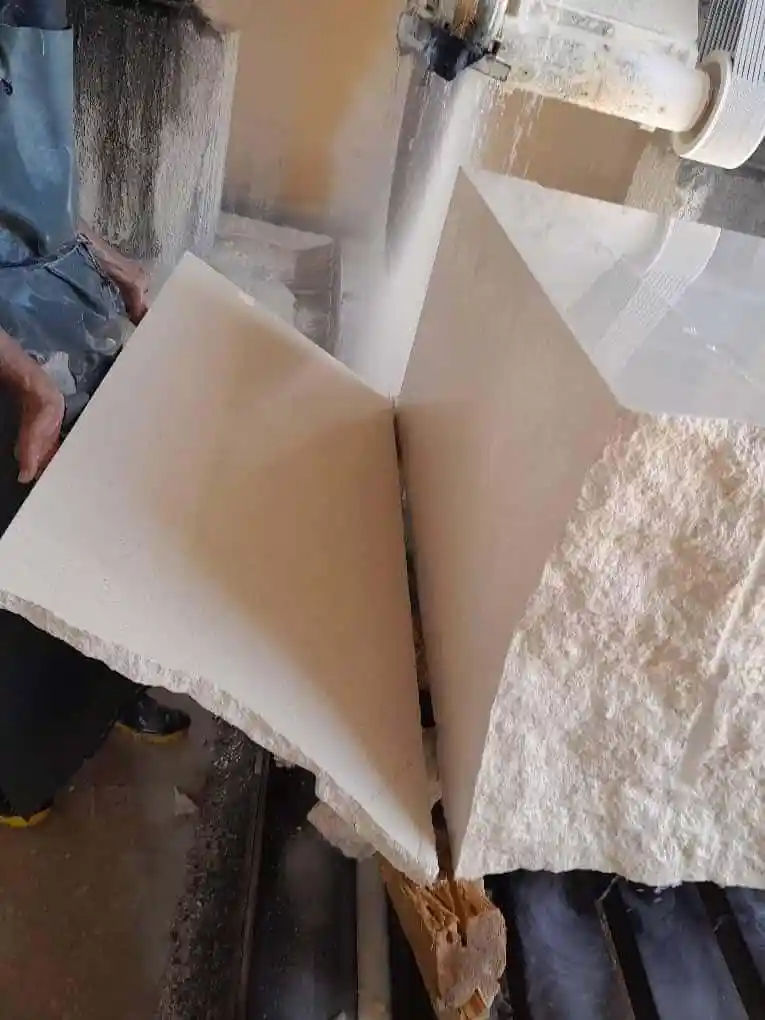
Sourced from our selected premium quarries, each batch of Citadel Stone natural stone pavers is inspected for dimensional consistency and surface integrity — which becomes practically important when you need to match replacements years after initial installation. Color and texture consistency in natural stone isn’t guaranteed across all suppliers, but quarry-matched inventory held in regional warehouse stock reduces the risk of visible patching when individual pavers need replacement.
- Joint sand inspection: annually before monsoon season and after each major storm event
- Sealer condition check: annually via water bead test, reapplication every 3–5 years
- Individual paver inspection: check for rocking or tipping every 2–3 years, re-bed as needed
- Edge restraint integrity: verify that border edging remains secure and flush, particularly in zones with heavy vehicle turning
- Drainage channel inspection: clear any sediment from perimeter drainage quarterly during summer months
Order Square Driveway Pavers in Arizona — Arizona Delivery Available
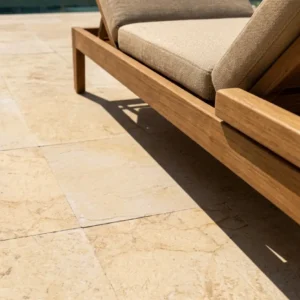
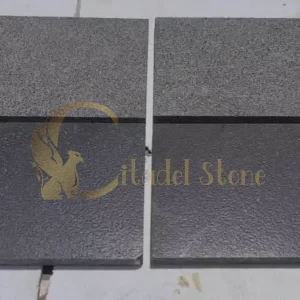
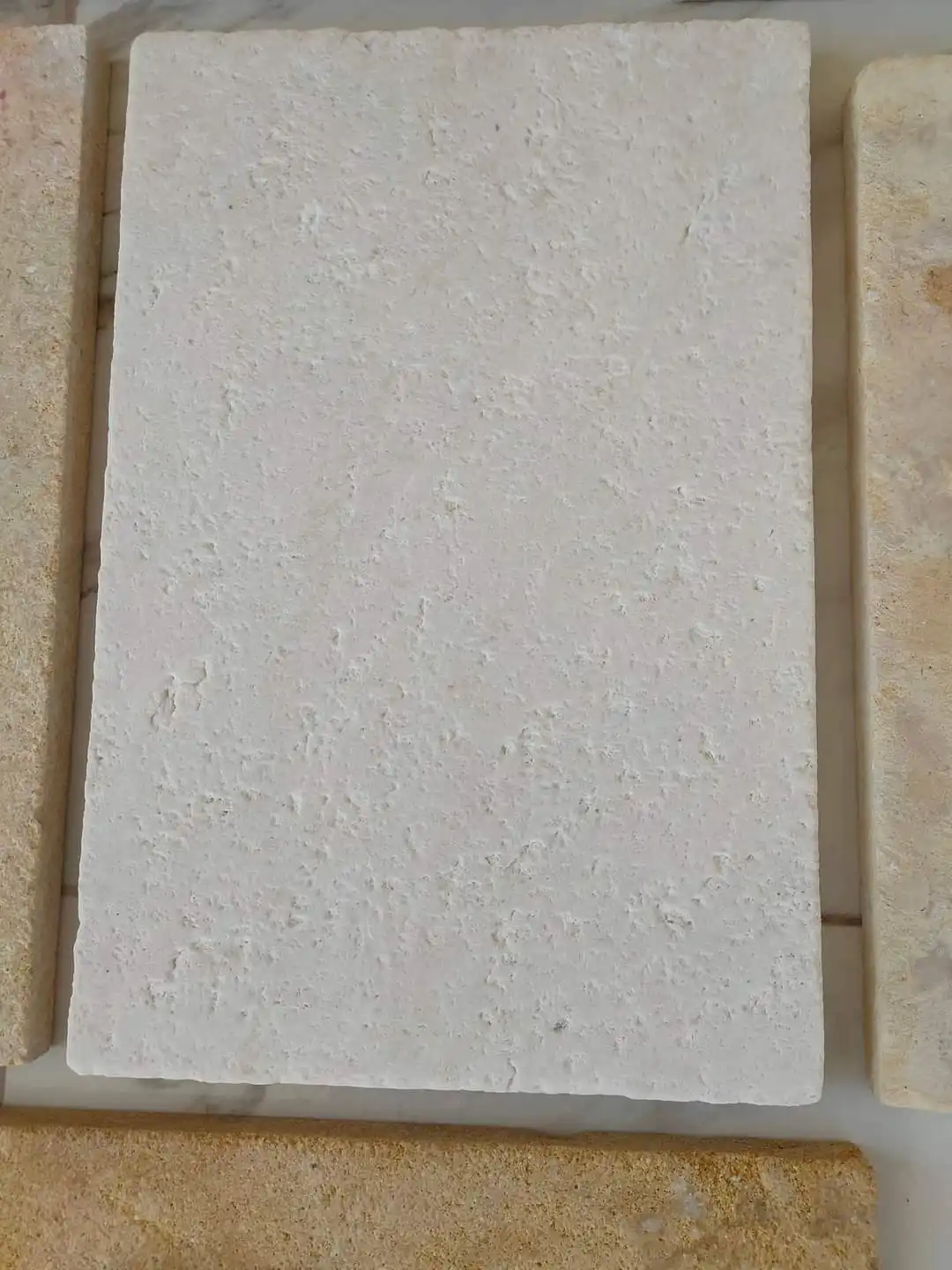
Citadel Stone supplies square driveway pavers across Arizona in standard formats — 12×12, 16×16, 18×18, and 24×24 inch sizes — in nominal thicknesses of 2 3/8 inch and 3 1/8 inch. Natural stone options include limestone, basalt, and travertine finishes available in tumbled, split-face, and brushed surface textures suited to driveway applications. You can request material samples and full specification sheets before placing a pallet order — a practical step for any project matching existing stone or confirming thickness requirements for specific load conditions.
Trade accounts and wholesale enquiries are handled through Citadel Stone’s project consultation team, who can confirm warehouse stock levels, production lead times, and truck delivery scheduling across Arizona — including the Phoenix metro, Tucson corridor, and northern Arizona destinations. Standard in-stock orders typically ship within 1–2 weeks from regional warehouse inventory, which is significantly faster than the 6–10 week import cycle many projects face when sourcing through non-stocked distributors.
For custom cut requirements, non-standard format requests, or large commercial volumes, lead times vary by material and current inventory — contact Citadel Stone’s team early in your project planning cycle to confirm availability before finalizing your installation schedule. Your project’s truck access constraints and site delivery requirements can also be factored into the logistics plan at the quoting stage. As you plan the full scope of your Arizona hardscape project, Square Block Paving in Arizona covers complementary paving approaches that may inform your overall material strategy. For Arizona properties requiring durable, well-proportioned driveway materials, Citadel Stone offers square driveway blocks suited to the region’s demanding conditions and long-term performance standards.