What the 12 x 12 Format Gets Right That Other Sizes Don’t
Travertine tile 12 x 12 hits a specification sweet spot that larger formats often miss — the 144-square-inch face area is small enough to seat fully on an uneven substrate without rocking, yet large enough to create visual continuity without excessive grout lines. You’re working with a format that’s been proven across decades of indoor and outdoor installations, and the 12-inch module aligns cleanly with standard stud spacing, cabinet runs, and most room dimensions, which simplifies layout math considerably. The format’s manageable weight per piece — typically 8 to 11 pounds depending on thickness and fill density — also means a single installer can handle placement without a second pair of hands, which matters on tighter job schedules.
The material’s calcium carbonate matrix gives it a density range of roughly 140 to 165 pounds per cubic foot depending on vein orientation and quarry source. That density variation is worth knowing because it affects both thermal mass and your adhesive open time. Denser cuts from Middle East quarries tend to exhibit tighter pore structures, which means your thinset coverage needs to be closer to 95% back-butter to prevent hollow spots — a detail that’s easy to shortcut and costly to fix later.
Finish Comparison: Which Surface Works for Your Application
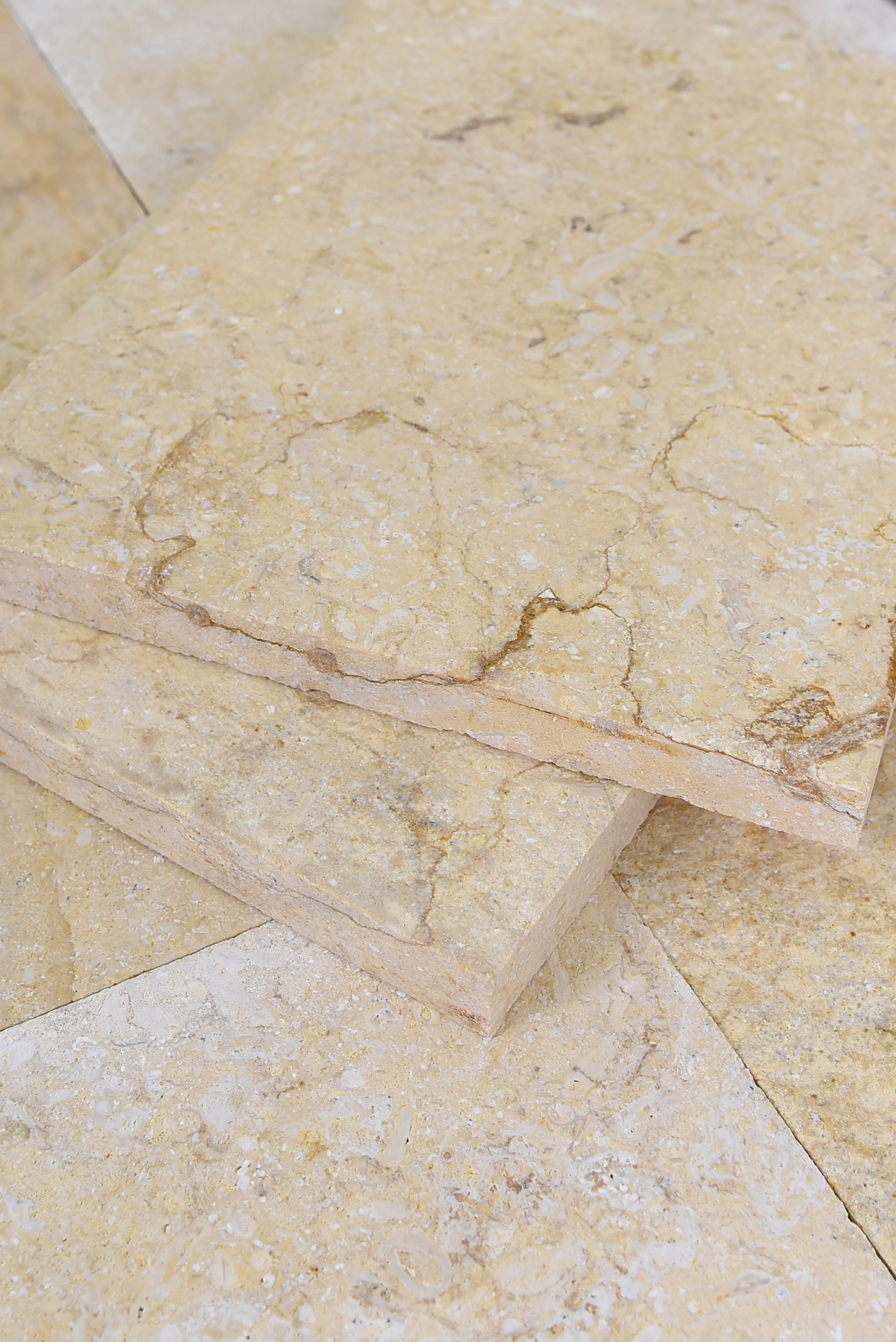
Your finish selection for travertine tile 12 x 12 is arguably a more consequential decision than the tile size itself. Each surface treatment creates a distinct performance profile, and the wrong finish in the wrong application means you’re either resurfacing early or managing slip liability. Here’s how the four primary finishes break down in practice:
- Honed: A matte, smooth surface achieved by grinding to a flat plane without buffing to reflectivity. Highly resistant to showing traffic wear lines because there’s no sheen to diminish. Your best choice for interior floors and transitional spaces that connect indoors to covered outdoor areas.
- Polished: A high-sheen surface that amplifies travertine’s natural vein patterns and color depth. Best suited for walls, feature areas, and low-traffic decorative floors. Polished travertine in 12 x 12 format is particularly popular for fireplace surrounds and shower feature walls where the reflectivity enhances ambient light.
- Brushed: Created by running wire or abrasive brushes across the surface to soften the texture and open micro-ridges. Offers better wet traction than honed and is frequently specified for indoor-outdoor transition zones and bathrooms.
- Tumbled: The most textured option, with rounded edges and a deliberately aged surface. Provides good slip resistance for outdoor applications but requires more frequent sealing because the open texture absorbs surface contaminants faster.
According to ASTM C1527 travertine dimension stone standards, surface finish consistency and dimensional tolerance are both regulated quality metrics for dimension stone — a point worth verifying with your supplier before committing to a large order. Finish inconsistency across pallets is one of the more common field complaints with budget travertine, and it compounds layout problems because tile edges that vary by even 1.5mm create lippage that catches light and foot traffic differently.
Filled vs. Unfilled: The Decision That Shapes Everything Downstream
The filled-versus-unfilled question comes up on almost every 12 x 12 travertine project, and the answer isn’t always obvious from product photos. Travertine forms with natural voids — called vughs — created as CO₂ escapes during calcification. These voids can run from pin-sized pores to cavities several centimeters across, and how they’re handled determines both appearance and long-term maintenance requirements.
Filled travertine arrives from the factory with voids packed using cementitious or epoxy-based grout, typically color-matched to the stone’s base tone. You get a flatter, more uniform surface that’s easier to clean and less prone to trapping debris. Unfilled travertine preserves the natural voids, which creates an authentic, rustic character that many designers specifically seek out. The trade-off is real: unfilled tiles require you to grout the voids on-site, which adds labor time, and the voids remain somewhat porous even after grouting unless you apply a penetrating sealer promptly.
For outdoor installations in regions that see significant rainfall, unfilled travertine creates a drainage advantage — water doesn’t pool on the surface but instead moves through and around the voids. For interior applications on heated substrates, filled travertine performs more predictably because the fill material responds to thermal cycling in a more uniform way than open voids. The Natural Stone Institute’s guidance on travertine properties confirms that fill material selection and adhesion quality directly influence the long-term performance of filled travertine in temperature-variable environments.
Thickness Specifications and Structural Loading
Travertine tile 12 x 12 is commonly available in three nominal thicknesses: 3/8 inch (approximately 10mm), 1/2 inch (12mm), and 3/4 inch (18-20mm). Your structural situation should drive that selection rather than aesthetics or price alone.
- 3/8-inch tiles are appropriate for wall applications and floors with a fully rigid, deflection-free substrate — specifically floors where the L/360 deflection standard is met before tile is set.
- 1/2-inch tiles offer the most common balance of weight and structural performance for standard residential floors, shower floors, and covered outdoor patios with solid concrete bases.
- 3/4-inch tiles are specified for exterior applications that must handle point loads — outdoor entertaining areas with furniture, commercial lobbies, and any surface where substrate prep can’t be verified to zero deflection.
Substrate deflection is the leading cause of cracked travertine installations. The Tile Council of North America’s standards, outlined in their published TCNA installation methods, specify that any substrate under natural stone tile must meet or exceed L/360 live-load deflection limits. For a 10-foot joist span, that’s no more than 1/3-inch deflection under full load. If your substrate doesn’t meet that threshold, adding an uncoupling membrane is a more reliable fix than simply upgrading to thicker tile — the membrane absorbs differential movement rather than transferring it to the stone face.
UV Exposure and How It Affects Your 12 x 12 Travertine Over Time
Sun-exposed installations introduce a variable that indoor specifications don’t have to account for — ultraviolet degradation of both the stone’s surface and any sealer system applied to it. Travertine itself is relatively stable under UV exposure compared to synthetic materials, but the organic compounds and iron oxides within the stone’s veining can shift subtly in color over years of direct sun exposure. You’ll notice this most in warmer-toned travertine — ivory and walnut varieties — where extended UV exposure can cause the gold and amber tones to become more muted as surface oxidation progresses.
Finish selection matters significantly here. Polished travertine loses its sheen faster in full-sun outdoor applications because UV light degrades the thin topmost crystal layer that creates reflectivity. Honed and brushed finishes start matte and remain perceptually consistent far longer under UV exposure — they simply don’t have a sheen to lose. Tumbled finishes are the most UV-stable in terms of appearance because the already-weathered surface texture has no high-gloss reference point to fade from.
Sealer chemistry is where the real UV protection work happens. Penetrating silane-siloxane sealers don’t sit on the surface where UV light can degrade them — they bond within the stone’s pore structure and maintain effectiveness as long as the stone’s surface is mechanically intact. Surface sealers and topical coatings, by contrast, absorb UV radiation directly and typically require reapplication every 12 to 18 months in high-sun exposures versus every 3 to 4 years for penetrating systems. For any travertine tile 12 x 12 installation that will see more than four hours of direct sun daily, a penetrating sealer is the practical specification choice. Plan your sealing schedule at installation — waiting until you notice color shift means the oxidation process is already underway.
Layout Patterns and Grout Joint Sizing for 12 x 12 Format
The 12 x 12 module is genuinely versatile from a layout standpoint, and your pattern selection affects both the visual result and the installation complexity. Here are the most specified patterns for this format and what each one demands technically:
- Running bond (brick pattern): Offsets each row by half a tile length. Creates a dynamic, horizontal movement that works well in rectangular rooms. Requires precise cuts at walls and increases tile waste by approximately 8 to 12 percent over straight stack.
- Straight stack (grid): Aligns all grout joints continuously in both directions. Creates a clean, formal look and minimizes waste. Demands the most precise substrate flatness — any substrate deviation reads immediately because the aligned grout lines act as a visual ruler.
- Diagonal: Sets tiles at 45 degrees to the room’s walls. Visually expands smaller spaces and draws the eye toward focal points. Increases material waste by 15 to 20 percent and requires accurate diagonal chalk lines before setting begins.
- Versailles pattern: Combines multiple tile sizes in a repeating module, with 12 x 12 as the anchor size paired with 6 x 12, 6 x 6, and sometimes 18 x 18 tiles. Complex to lay out but creates a premium finished appearance.
Grout joint width for travertine tile 12 x 12 typically runs 1/8 inch to 3/16 inch for a tight contemporary look, or up to 3/8 inch for a more traditional appearance with sanded grout. One practical point that often surprises newer installers: travertine’s dimensional tolerances are wider than porcelain’s. You should expect up to ±1/32-inch variation in tile dimensions within a single order. Wider grout joints — 3/16 inch and above — absorb that variation invisibly, while 1/16-inch joints will show tile-size inconsistency as irregular joint widths. If you want the tightest possible joints, verify dimensional consistency across multiple boxes before cutting a single tile.
Sealing and Long-Term Maintenance: What the Schedule Actually Looks Like
The maintenance conversation for travertine tile 12 x 12 gets oversimplified in most buyer guides. Here’s the honest version: sealing schedules depend heavily on traffic volume, finish type, and installation environment — not on a single universal number.
- Interior polished floors in residential use: test every 18 to 24 months using the water-drop test. If a water droplet absorbs within 4 minutes rather than beading, the sealer is depleted and reapplication is due.
- Interior honed floors in residential use: 24 to 36 months between sealer applications is typical for light-traffic areas. Kitchen floors near cooktops may need annual attention because cooking oils penetrate unsealed travertine and cause staining that’s difficult to reverse.
- Exterior tumbled or brushed installations: annual inspection and resealing every 12 to 18 months, particularly in climates with significant freeze-thaw cycling where water infiltration and ice expansion can degrade fill material in voids.
- High-sun outdoor applications: reduce sealer interval by approximately 30 percent compared to shaded outdoor applications, because UV exposure accelerates topical sealer breakdown even on penetrating-type products.
Cleaning chemistry matters as much as frequency. Travertine’s calcium carbonate base reacts visibly with acidic cleaners — vinegar, citrus-based products, and any bathroom cleaner with hydrochloric acid will etch the surface, creating dull patches that require mechanical honing to remove. You should specify pH-neutral stone soap for routine cleaning and educate your clients on this clearly at handover. That conversation saves callbacks.
Ordering, Lead Times, and Delivery Logistics for Large Projects
Your project timeline for travertine tile 12 x 12 needs to account for several logistics variables that don’t affect ceramic or porcelain orders in the same way. Natural stone ships in crates rather than standard pallet boxes, and crate weights for 12 x 12 travertine typically run 800 to 1,200 pounds per crate depending on fill and thickness. You need to confirm truck access to your job site before placing an order — a standard flatbed delivery requires a driveway or access road that can support that load and provide enough clearance for a lift-gate or forklift approach.
Citadel Stone maintains warehouse stock of travertine tile 12 x 12 in core finishes and fills, which typically compresses lead times to 5 to 10 business days for in-stock materials compared to the 6 to 10 week import cycle for custom quarry orders. That warehouse availability is particularly valuable when a project’s scope expands mid-installation and you need additional material quickly — dye-lot matching on a re-order from an active quarry batch is generally achievable within the same warehouse stock cycle, but it’s not guaranteed if the batch has closed.
Order 10 to 15 percent overage on your calculated square footage. For travertine specifically — where batch color variation is natural and quarry batches close — having surplus from the same production run is insurance against replacement headaches. Material stored from the same truck delivery as your original order will match; material from a subsequent quarry pull may not match closely enough for inconspicuous repairs. You can browse our 12-inch travertine options to compare available fills, finishes, and tones before committing to a specification.
Beige Tone Selection and Managing Natural Color Variation
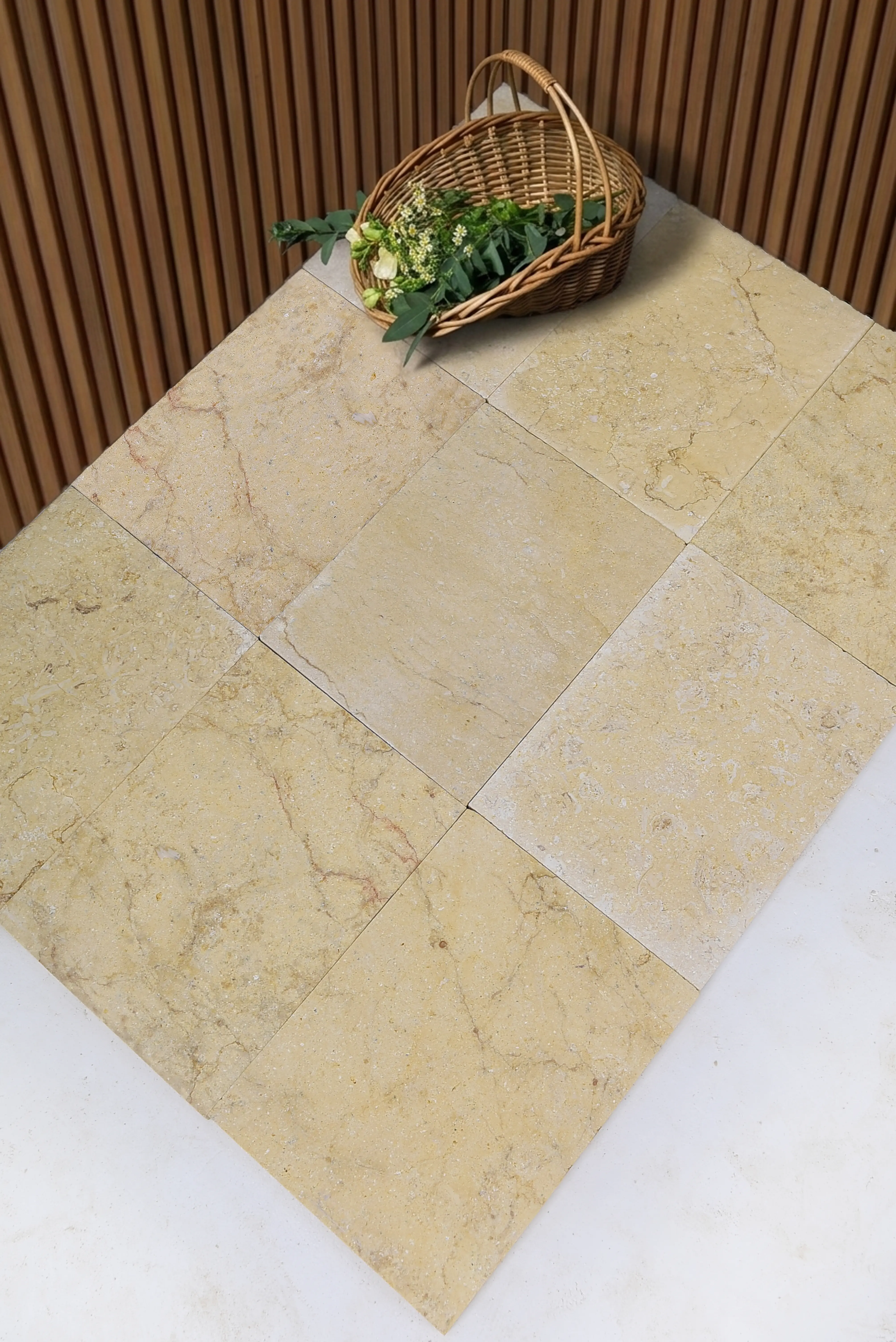
Travertine beige tile encompasses a broad range of natural tones — from pale cream and warm ivory to deep walnut and terracotta — and understanding how that variation works within a production batch prevents the most common aesthetic disappointment in travertine projects. Unlike manufactured materials where color is engineered to be uniform, travertine’s color comes from mineral content in the original limestone bed, which shifts across even a single quarry face.
The practical approach is to open and dry-lay tiles from multiple boxes before setting begins. Pull tiles from at least four to six different boxes and arrange them across the floor in their approximate final positions. You’ll immediately see how the color variation distributes, and you can blend the layout to avoid clustering the darkest or lightest tiles in one area. This step takes 20 to 30 minutes and prevents an installed result that looks blotchy.
Warm undertones in travertine beige tile respond differently to different light conditions, which is worth discussing with designers specifying the material. Under warm incandescent or LED-warm lighting, ivory travertine reads as golden and rich. Under cool daylight or blue-spectrum LEDs, the same tile reads as pale and neutral. Specify your lighting plan before finalizing stone selection — what looks ideal in a showroom under one light source may read completely differently under your project’s planned lighting.
Common Specification Mistakes and How to Avoid Them
The details that cause the most field problems with travertine tile 12 x 12 installations rarely involve the stone itself — they trace back to specification oversights that are straightforward to prevent if you know where to look.
- Specifying polished finish for exterior applications: polished travertine becomes highly slippery when wet and in direct sun, its surface sheen degrades faster than any other finish. Stick to honed, brushed, or tumbled for any outdoor or wet application.
- Using the wrong thinset: travertine requires a white, non-sag polymer-modified thinset. Gray thinset can telegraph through light-toned travertine over time, creating a grid shadow pattern visible under raking light. Non-modified thinset doesn’t achieve adequate bond strength on the tile’s sometimes-smooth back surface.
- Skipping movement joints: expansion and contraction joints are required every 8 to 10 feet in travertine floors per industry installation standards. Projects that omit these — especially in slab-on-grade applications where substrate movement is expected — develop tent cracking within two to three seasonal cycles.
- Neglecting substrate moisture testing: travertine is moderately porous and will absorb moisture vapor from a concrete slab. Concrete slabs should test below 5 pounds per 1,000 square feet per 24 hours using the calcium chloride method before stone installation proceeds.
- Ordering without verifying crate dimensions against warehouse access: oversized crates that can’t clear a facility’s loading dock or truck access route create costly re-delivery situations that delay project timelines by days.
One often-missed detail is the edge profile on 12 x 12 travertine. Machine-cut travertine typically ships with a 90-degree eased edge, but tumbled tiles have irregular, rounded edges that require a wider grout joint to absorb the variation. Mixing filled and unfilled tiles from different production runs in the same field is another field error — fill color and texture can differ enough to read as a visible inconsistency in the finished surface.
Parting Guidance for Travertine Tile 12 x 12 Projects
Getting a travertine tile 12 x 12 installation right means understanding the full chain from quarry characteristics to sealing schedules, not just choosing a color and calling it specified. The format is forgiving in many ways — its size handles substrate variation gracefully, its weight is manageable, and its modular dimension simplifies planning — but the material still demands respect for its natural variability and porosity. Your finish selection, fill type, substrate preparation, and sealer chemistry all compound. Make one decision in isolation and the others have to compensate for it. Make them as a coordinated system and the result performs for decades with minimal intervention.
Planning the installation budget alongside the material cost is equally important. Beyond the tile purchase, your specification should account for thinset, grout, sealer, and any substrate remediation work — costs that are easy to underestimate on first-time travertine projects. For a detailed look at what those numbers typically look like across project types, travertine installation cost details provides a thorough breakdown worth reviewing before you finalize your project budget. At Citadel Stone, we inspect travertine tile 12 x 12 for dimensional consistency and fill quality before it ships, because field problems that trace back to material inconsistency are far harder to resolve than those caught at the warehouse. Sourced from select natural stone quarries worldwide, Citadel Stone 12-inch travertine ships with tight tolerance edges for easier layout.
Related reading: travertine tile backsplash ideas · Gray Travertine Tile Ideas for Modern Interiors · polished travertine tile finish.