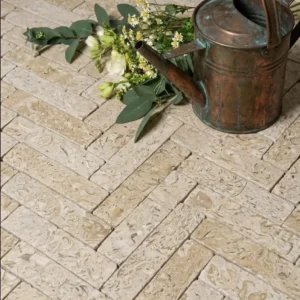
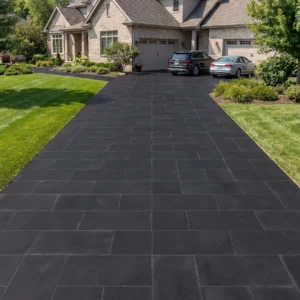
St. Lucia’s coast is not a ribbon of open sand; it is a drama of headlands, bluffs and pocket coves, with many of the island’s finest properties perched above water they can see but must earn. The route down — a stair working its way from garden to cove — is among the most demanding builds in Caribbean landscaping and among the most valuable: private sea access transforms a property’s worth and its daily life. Where the dune islands build paths across sand, the volcanic islands build stairs down rock. Here is that discipline.
Reading the descent
Every cove stair begins with an honest survey of the route: the stable rock and the loose slopes, the line that descends without crossing slip-prone ground, where the sea reaches in normal swell and where it reaches in storm. The best routes switchback with the terrain rather than fighting it — longer, gentler, cheaper to hold — and the survey decides early what mix the build will be: treads cut into and pinned to sound rock where the ground allows, engineered flights on foundations where it does not, and landings wherever the line turns or the descent deserves a rest. Professional eyes on the geology are not a luxury on this build; they are the build.
- Stable rock distinguished from loose slope before any line is drawn.
- A descent that avoids crossing slip-prone ground, even if it is longer.
- The reach of normal swell recorded, and the reach of storm swell recorded separately.
- Switchbacks used to follow the terrain rather than cutting straight down it.
- Drainage routes identified, since a stair is also a watercourse in heavy rain.
The stair itself
The geometry contract tightens on a sea stair: consistent risers absolutely, treads generous enough for wet feet carrying beach kit, and the nosing-and-grip rules applied with the understanding that every user will make the return climb tired and salt-wet. Materials follow the island’s two-stone logic — structure and mass from engineered concrete and local volcanic stone, wearing surfaces in dense imported treads with the coarsest textures in the catalog — and the fixing hardware throughout is marine-grade without exception, because the stair lives in the salt zone even when the water is calm. Handrails earn their place on any flight the family’s eldest or youngest will use: fixed into structure, not into cladding.
The lower reaches: designing for the sea’s share
The stair’s final flights belong partly to the ocean, and the design should concede them gracefully. Below the storm line, construction turns sacrificial-minded: massive simple steps that swell can wash over without prying loose, no delicate detailing, unit construction that repairs after the decade’s big event rather than resisting it in vain. The landing at the water — a level stone apron for kayaks, snorkels and the pause before the climb — sits as high as the cove’s geometry allows, and anything below it is built expecting the sea’s occasional editing. Owners who accept that bargain get decades from the upper stair and cheap honest repairs at the bottom; owners who fight it rebuild in finer materials, more often.
Rest, shade and the climb home
A cove stair is used twice per swim, and the return climb is the design’s human test. Landings double as rest stops with a seat-height wall cap and, where the route allows, real shade; a freshwater point near the top — even a simple tap — rinses salt from feet and gear before the garden; and lighting on the graze-and-punctuate principles makes the evening swim a feature instead of a risk. These touches cost little against the stair’s engineering and decide whether the cove gets used daily or admired from the terrace — the difference, in rental listings, between a photograph and a selling point.
Owning a sea stair
The maintenance covenant is short but firm: a walk-down inspection after every serious storm and annually regardless — treads sounded for movement, fixings checked, drainage clearing confirmed — with attic-stock treads from the original batch stored against the repair day, because a matching tread five years on is the cheapest insurance in the whole build. Salt-zone rinse discipline extends up the lower flights, and the salt-air care playbook covers the rest. Built honestly and owned attentively, the stair to the cove becomes the property’s signature — the walk guests remember, the morning ritual owners move islands for. The St. Lucia stone guide treats cove access as a specials-led specification: bring the survey, and the cutting list follows the rock.
- A walk-down inspection after every serious storm and annually regardless.
- Treads sounded for movement, and anything drummy re-bedded promptly.
- Fixings checked at the bedding line, where corrosion starts unseen.
- Drainage cleared so the next downpour does not scour the base of a flight.
- Spare treads held from the original batch, because replacements travel badly.
The beach room: kit, storage and the rinse yard
A used cove generates equipment, and the stair’s support spaces decide whether the sea life stays joyful or becomes a daily portage. The pattern that works stations the bulk at the top: a kit room or generous lockers near the stair head holding kayaks, boards and snorkel crates, on a stone apron that tolerates dripping gear and sandy feet, with wall hooks and drainage doing the drying. The landing below keeps only the day’s essentials — a small locker, paddle rack and the flat apron the stair guide already prescribes — so the climb home carries towels, not touring kayaks. The rinse yard completes the circuit: freshwater at the stair head over a draining stone pad, sized for boards and wetsuits, intercepting salt and sand before the garden. None of these spaces photographs for the brochure, and together they are why the cove gets used on the third morning as enthusiastically as the first — the measure, for sea-access properties, of whether the stair earned its engineering.
The cove as amenity: what the water offers back
A stair justifies its engineering by what waits at the bottom, and the sheltered coves of the volcanic coast repay attention as amenities in their own right. Snorkelling leads: rocky coves grow the reef life sandy beaches cannot, and the property that knows its own underwater geography — where the healthy coral heads sit, where entry over the rocks is kindest at each tide — turns a swim into a guided experience worth paragraphs in any listing. The stone contribution at the waterline is restraint plus a few precise moves: a flat entry apron where the natural rock is hostile, steps into the water only where the honest survey supports them, and never so much construction that the cove stops feeling found. Kayaks and paddleboards extend the range — the coast reads differently from the water, and neighboring coves join the property’s territory — which loops back to the kit-room logistics at the stair head. Shade at the bottom, even one well-placed umbrella socket drilled into a stone apron, doubles the hours the cove serves. And the quiet duty that comes with private access: guests briefed on reef courtesy, no anchoring on the coral, the cove left as found. Properties that treat their water as a stewarded amenity rather than a backdrop find it becomes the thing guests write about — the stair was the price; the cove is the product.
Grip on the wettest, most consequential steps on the property
A sea stair is used barefoot, wet, with salt on the treads, twice per swim, often carrying something. There is no surface on a villa where slip performance matters more. This account of friction testing on stone walking surfaces explains what the current standard covers.
- ANSI A326.3 measures dynamic coefficient of friction and can be run in place as well as in a laboratory.
- Its 0.42 benchmark applies to level interior surfaces walked on wet, so a stair sits outside that scope.
- No threshold is specified for ramped or stepped surfaces, which leaves the judgment with the specifier.
- Polished finishes generally fail the benchmark and have no business on a sea stair.
- Coarser honed and textured surfaces test better and cope with salt film.
Planning the work around the storm season
Building on a shoreline is scheduling as much as engineering, and the published climatology sets the window. The National Hurricane Center publishes the Atlantic season climatology that every coastal program should respect.
- The season runs June 1 to November 30, which brackets the risky months for exposed work.
- Climatological peak activity falls on September 10.
- Most activity concentrates between mid-August and mid-October.
- An average season produces fourteen named storms, seven hurricanes and three major hurricanes.
- Lower flights completed and cured well before the active window, not during it.
Handrails, fixings and the hardware that corrodes
On a sea stair the stone usually outlasts everything bolted to it, so the metalwork deserves as much specification attention as the treads.
- Marine-grade stainless throughout, isolated from any dissimilar metal.
- Fixings set into solid bedding with no voids to hold salt water.
- Handrail runs continuous through every flight, with no gap at a landing.
- Posts fixed into the structure rather than into a coping unit.
- An annual check of every through-fixing, at the same time as the storm walk-down.
Stone stairs to the sea, built for the climb back up
The descent sells the property; the return climb is what people remember. A good sea stair follows stable ground, keeps its risers identical from top to bottom, gives generous treads with real grip, concedes its lowest flights to the ocean in massive sacrificial units, offers shade and a rest at the landings, and finishes with a freshwater tap before the garden. Add marine-grade hardware and an annual walk-down and it will still be there in thirty years. Where the route reaches the terrace above, our Piton view villa stone guide picks it up. Design the stair for the tired climb home and the walk down is a pleasure.