What Specifiers Get Wrong About Quarry Tile Selection
Commercial quarry tile failures in high-traffic environments almost always trace back to decisions made before the first tile is ever set — base preparation, thickness specification, and joint width tolerances get compromised under budget pressure, and the installation pays the price within three to five years. The material itself is rarely the problem. Dense-fired commercial quarry tile carries compressive strength ratings that routinely exceed 10,000 PSI, and its through-body composition means surface wear doesn’t expose a weaker substrate layer the way glazed alternatives do. What matters is matching the tile’s mechanical properties to the actual load profile and subgrade conditions your project presents.
You’ll find that most generic quarry tile specifications default to manufacturer minimums — 3/4-inch thickness, 3/8-inch joints, standard thinset. Those numbers work in controlled environments. Busy commercial kitchens, loading dock transitions, and institutional corridors demand a different level of precision. The interaction between thermal cycling, point-load frequency, and subgrade movement determines whether your installation holds for twelve years or twenty-five.
Understanding Density, Absorption, and Why They Matter in Practice
Commercial quarry tile is vitreous to highly moisture-resistant by classification — absorption rates typically fall below 3%, with high-fired units achieving under 0.5%. That distinction carries real consequences for specification. A tile sitting at 2.8% absorption in a commercial kitchen with daily steam-cleaning cycles and thermal shock from cold deliveries is operating at its tolerance limit. Specify the 0.5% unit and you eliminate that risk category entirely.
According to NSI stone tile specifications and ASTM standards, absorption class directly governs appropriate application environments for tile materials — a standard most specifiers reference for natural stone but rarely apply rigorously to manufactured quarry products. The same logic holds: match absorption class to environmental exposure before you finalize your spec.
- Vitreous classification (0.5–3.0% absorption): appropriate for interior commercial floors with moderate moisture exposure
- Low-absorption classification (below 0.5%): required for food-service floors, wet processing areas, and exterior applications in freeze-thaw regions
- Through-body color composition: wear patterns remain visually consistent even after years of abrasion in high-traffic corridors
- Thermal shock resistance: high-fired quarry tile handles temperature differentials up to 300°F without delamination — critical for kitchen environments
Your finish selection also affects long-term maintenance. Unglazed quarry tile with a natural matte surface leaves an open matte texture that does not rely on applied treatments, unlike coatings that degrade over time. For wet zones, confirm the wet DCOF against ANSI A326.3, which sets wet DCOF minimums by use classification: commercial wet zones such as kitchens, showers and wet entries fall under interior wet plus at 0.50, with 0.42 for interior wet and 0.55 for exterior wet areas such as pool decks and patios. Product classifications are manufacturer-declared. A dry COF value does not answer a wet-area question.
Thickness and Format Decisions for Commercial Loads
The standard 1/2-inch commercial quarry tile format handles pedestrian traffic reliably, but you need to step up to 3/4-inch nominal thickness the moment your project introduces wheeled equipment, pallet jacks, or high-frequency point loads from commercial kitchen carts. The flexural strength difference between those two thickness classes — roughly 400 PSI versus 650 PSI modulus of rupture — sounds modest until you’re calculating load distribution over a 4×4-inch tile footprint.
Format size interacts with subgrade flatness tolerance in ways that catch installers off guard. Larger formats — 6×9 or 6×12 — require substrate flatness within 1/8 inch over a 10-foot radius. If your slab isn’t hitting that benchmark, you’re either grinding the substrate or accepting lippage that creates a trip-hazard liability in a commercial setting. Smaller 4×4 and 4×8 formats tolerate more subgrade variation, which is why they remain the workhorses of institutional and food-service installations.
- 4×4 inch format: maximum substrate deviation tolerance 3/16 inch over 10 feet — most forgiving for retrofit projects over existing concrete
- 4×8 inch format: directional laying patterns improve perceived floor straightness in long corridor runs
- 6×9 inch format: requires tighter substrate prep but delivers lower grout joint frequency — faster cleaning cycles in food-service environments
- 3/4-inch thick units: specify for any application involving wheeled equipment or concentrated point loads above 400 lbs
Subgrade Stability and Soil Conditions That Affect Your Installation
Here’s what most specifiers miss when they’re focused on tile selection: the subgrade beneath your commercial quarry tile installation is doing most of the structural work, and soil composition determines whether that foundation stays stable over decades. Expansive clay soils — common across broad swaths of the interior and southeast — can generate uplift pressures that crack even well-bonded tile systems. You’re not just managing foot traffic; you’re managing subgrade movement that cycles with moisture content through every wet and dry season.
Caliche layers in arid regions present the opposite problem. The hardpan creates a false sense of stability during installation, but its brittleness means point-load fractures propagate upward through even a well-bedded tile layer. The field fix — breaking through caliche and replacing with compacted granular fill — adds cost that wasn’t in the original budget. Identify it in your site investigation phase, not after the tile order is placed.
- Expansive clay subgrades: require a minimum 4-inch compacted granular base between clay and concrete slab — never set tile directly over clay-dominated fill
- Sandy or loose subgrades: increase base depth to 6 inches compacted aggregate; verify compaction to 95% standard Proctor density before slab pour
- Rocky or caliche subgrades: confirm load-bearing uniformity across the full installation footprint — localized hard spots create differential deflection under tile
- High water table sites: specify a vapor barrier between the granular base and slab to prevent moisture migration that weakens thinset bond over time
According to ASTM compressive strength and installation standards, concrete substrate compressive strength should reach a minimum of 3,000 PSI before tile installation begins — and that number assumes a properly prepared and stable subgrade below the slab. A slab poured over an inadequate base won’t maintain that strength rating under load cycling.
Sandy soils at the other extreme drain well but provide minimal lateral restraint. That matters most at slab perimeters and expansion joint locations, where differential movement between the tile field and surrounding structures needs a controlled release path. Building that into your design upfront — rather than cutting joints after the fact — keeps the installation intact through seasonal ground movement cycles.
Mortar and Setting Bed Specifications That Field Experience Teaches
The setting bed decision for commercial quarry tile splits into two paths depending on your substrate conditions and load profile. Thinset installations over properly prepared concrete slabs work well for standard pedestrian applications. For heavy-duty environments — commercial kitchens, loading areas, industrial corridors — a thick-bed mortar installation gives you something thinset can’t: the ability to fine-tune substrate flatness during installation and a more forgiving response to subgrade flex.
Thick-bed mortar (3/4 to 1-1/4 inch) distributes point loads more effectively than a thinset bond coat alone, and it provides a genuine thermal buffer between the tile surface and the concrete substrate. That thermal buffer matters in kitchen environments where surface temperatures swing rapidly. Your thinset selection also requires attention — modified polymer thinsets outperform standard cement-only formulas in commercial settings because their higher shear bond strength handles the thermal cycling and cleaning chemical exposure that commercial quarry tile faces daily.
- Standard thinset minimum bond strength: 200 PSI shear — adequate for light commercial pedestrian applications
- Polymer-modified thinset bond strength: 400–600 PSI shear — required for food-service, heavy commercial, and exterior applications
- Thick-bed mortar mix: 1 part Portland cement, 5–6 parts clean sharp sand, water to plastic consistency — no polymer admixtures in the scratch coat
- Curing time before grouting: minimum 24 hours for thinset, 48–72 hours for thick-bed mortar in ambient temperatures below 65°F
One detail that consistently gets underspecified: the back-buttering requirement for commercial quarry tile. Full back-buttering — applying thinset to both the substrate and the tile back — achieves 95–100% contact coverage versus the 80% minimum standard for residential applications. In high-traffic commercial environments, that contact coverage difference is the margin between a 15-year installation and a 25-year one.
Grout Joint Design and Chemical Resistance for High-Traffic Floors
Grout joint width for commercial quarry tile isn’t just an aesthetic decision — it’s a performance specification. Wider joints (3/8 to 1/2 inch) in food-service applications allow for thermal movement accommodation but create cleaning challenges. Narrower joints (1/4 inch) in pedestrian corridors reduce debris accumulation but demand tighter substrate flatness tolerances. Neither is universally correct; the application environment determines the call.
Chemical resistance of grout matters as much as the tile itself in commercial kitchens and food-processing environments. Standard cement grout is pH-sensitive and degrades under repeated acid cleaning cycles. Epoxy grout — while more expensive and more demanding to install — provides highly resistant performance against cleaning chemicals, grease, and thermal shock. The Tile Council of North America’s published installation guidance, available through TCNA installation standards, specifies epoxy grout as the industry recommendation for quarry tile in commercial kitchens and food-service environments — a specification requirement that saves significant remediation cost down the line.
- Cement grout with sealant: acceptable for light commercial corridors with neutral pH cleaning — reseal annually
- Furan resin grout: the premium choice for heavy chemical exposure environments — more chemically resistant than epoxy in industrial applications
- Epoxy grout: industry standard for food-service quarry tile floors — highly resistant to grease, acids, and alkaline cleaners
- Joint width at perimeters and columns: always 3/8-inch minimum to accommodate structural movement — filled with ASTM C920 sealant, not grout
Expansion Joints and Movement Accommodation in Large-Format Commercial Floors
Expansion joint placement is where the gap between a technically correct specification and a field-ready installation becomes most visible. The industry guideline of one expansion joint every 20–25 feet in interior applications assumes controlled environmental conditions. Commercial quarry tile installations in spaces with radiant heat systems, significant HVAC cycling, or large exterior exposures need joints at 12–15 foot intervals — not the 20-foot maximum.
Your expansion joint design needs to account for both in-plane thermal movement and any potential differential movement between the tile field and structural elements. Column bases, walls, changes in substrate type, and transitions from slab-on-grade to suspended slab sections all require isolation joints. Missing one of these transition points is the most common cause of diagonal cracking patterns that appear in commercial quarry tile floors within the first two years of service.
- Interior joints: every 12–15 feet in thermally active environments, 20–25 feet maximum in stable interior conditions
- Exterior quarry tile applications: every 8–10 feet — thermal movement ranges are substantially larger outdoors
- Joint material: ASTM C920 polyurethane or silicone sealant — color-matched to grout for visual continuity
- Joint width: minimum 3/8 inch for interior applications, 1/2 inch for exterior or high-thermal-range environments
Sourcing, Lead Times, and Project Scheduling for Commercial Projects
Getting commercial quarry tile specified correctly is half the equation — getting it to site on schedule is the other half. Standard commercial quarry tile in popular formats and colors typically ships from warehouse stock within 5–7 business days. Specialty formats, custom colors, and large-quantity orders in less common specifications may require 4–8 weeks from import cycle, so building that lead time into your project schedule is non-negotiable.
Verify your warehouse stock availability before you lock in your installation date — this is a step that experienced project managers do as a matter of course, but it gets skipped under schedule pressure and creates costly delays when the tile isn’t ready when the crew is. Citadel Stone maintains national warehouse inventory across the quarry tile range, which compresses the typical import lead time significantly for projects with standard format requirements. You can browse the full Citadel Stone quarry tile range to confirm available stock profiles before committing your installation schedule.
Truck access at your commercial site also affects delivery planning. Narrow site entrances, overhead restrictions in urban settings, and loading dock height variations all influence whether a standard flatbed delivery works or whether you need to plan for crane off-loading or smaller truck configurations. Communicate site access constraints to your supplier early — adjusting truck configuration after a delivery is scheduled adds cost and time that eats directly into your installation window.
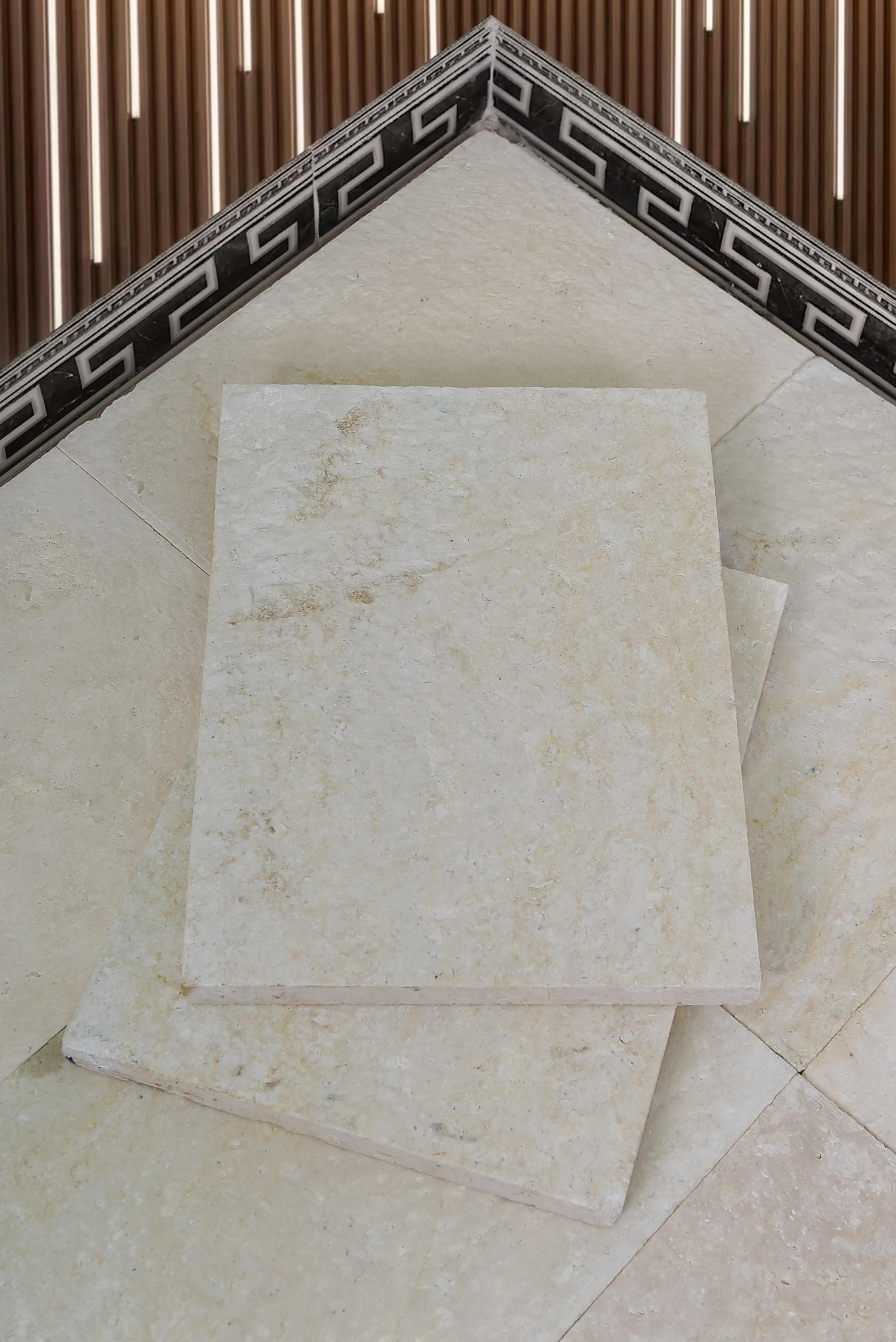
Granite Accents and Complementary Stone in Commercial Quarry Tile Projects
Commercial quarry tile floors often benefit from transition materials at entrances, borders, and feature zones — and this is where complementary natural stone adds genuine design and performance value. Costa esmeralda granite tile has become a practical choice for border insets and threshold transitions in commercial environments where the quarry tile field needs a visual anchor or a harder-wearing transition strip at primary entry points. Its tight crystalline structure and low absorption profile pair well with high-fired quarry tile from a maintenance compatibility standpoint — both surfaces tolerate the same cleaning chemistry and maintenance schedule.
The key to making mixed-material specifications work is matching grout joint profiles and finish levels between the two materials. A honed or matte finish on the costa esmeralda granite tile accent strip aligns with the natural texture of quarry tile and avoids the visual disconnect that polished stone creates against an industrial matte floor field. Specify both materials to the same thickness nominal where possible — managing height transitions between different tile materials in commercial traffic areas requires precision, and even 1/16-inch lippage creates an ADA compliance issue at accessible routes.
- Granite accent strips at entries: specify minimum 3/4-inch thickness to match commercial quarry tile nominal and eliminate substrate step requirements
- Finish matching: honed or flamed granite surface complements quarry tile’s natural matte texture better than polished finishes
- Grout compatibility: confirm the same grout product works for both materials — epoxy grout bonds well to dense granite and quarry tile surfaces
- ADA compliance at transitions: maximum 1/4-inch vertical change at transitions — beveled edge detail required for changes above 1/4 inch
According to NSI granite application and durability specifications, dense igneous granite achieves abrasion resistance values that complement the wear profile of commercial quarry tile in high-traffic transition zones — making it a technically sound pairing, not just an aesthetic one.
Getting Commercial Quarry Tile Specifications Right
Commercial quarry tile done well is an exercise in specification discipline — every variable from subgrade soil type to grout chemical resistance has a correct answer for your specific application, and the answers aren’t always the ones that show up in generic installation guides. Your installation’s service life depends on getting those details right before the first tile goes down, not correcting them after the floor is in service. Prioritize substrate investigation, match absorption class to environmental exposure, specify expansion joints at intervals your actual thermal conditions demand, and select mortar and grout systems designed for the chemical environment your floor will face.
As you finalize your stone selections across the broader project, related material decisions can inform your approach. practical quarry stone tile selection guidance covers additional specification considerations worth reviewing before you commit to your final product list. At Citadel Stone, we work directly with quarry partners across multiple continents and carry warehouse stock in the formats and thicknesses that commercial projects actually require — so your specification gets matched to available material before your schedule is at risk. Sourced direct from established quarry partners across multiple continents, Citadel Stone matches commercial quarry tile to demanding project schedules.
Related reading: rectangular travertine tile sizes compared · natural stone tile thickness guide · granite stone tile.