Natural stone floor tile cost breaks down very differently depending on which stone type you choose, how that stone is finished, and what your installation conditions actually demand. The material price tag on the invoice is rarely the number that matters most — it’s the total installed cost, factoring in substrate preparation, setting bed depth, grout selection, and long-term sealing schedules, that determines whether your project delivers value over decades. Most buyers focus on the per-square-foot material rate and miss the variables that shift the real number by 40% or more. This breakdown addresses each cost layer so you’re working from an accurate projection, not a showroom estimate.
Why Natural Stone Floor Tile Cost Varies So Widely
The single biggest driver of price variation isn’t the stone species — it’s the supply chain between the quarry and your project site. Granite quarried in Brazil moves through different logistics than limestone extracted from Middle East quarries, and those freight chains carry entirely different cost structures. You’ll also find that stones with very similar geological profiles can differ by $12–$18 per square foot purely because of finish processing. A honed travertine tile and a polished travertine tile from the same quarry block require different factory passes, different tooling wear rates, and different quality inspection thresholds — all of which land in the price.
Thickness is another underestimated cost variable. Standard 3/8-inch tiles suit interior residential floors with a properly leveled substrate, but anything going into a commercial corridor or an exterior courtyard typically requires 3/4-inch or full 1-inch material. That thickness jump doesn’t just double the material cost — it increases shipping weight per pallet by 60–80%, raising freight charges proportionally. Your project’s structural requirements should drive thickness selection before price-per-square-foot conversations happen.
Format size compounds cost in a way most project managers don’t anticipate. Large-format tiles — 24×24 inches and above — look exceptional on the floor but carry a higher wastage rate at cuts, especially on diagonal layouts. A 12×12 grid on a standard rectangular room might waste 5–8% of material. A 24×24 diagonal layout in the same room can push wastage to 15–18%, which means you’re buying considerably more tile than your net square footage suggests.
Stone Type Price Ranges: What You’re Actually Buying
Here’s a working reference for natural stone floor tile cost ranges by stone type, based on standard commercial supply pricing for honed or polished finishes in 12×12 through 24×24 formats:
- Travertine tile: $4–$14 per square foot material cost, depending on fill type (filled and honed vs. unfilled), color consistency grading, and format size
- Limestone tile: $6–$18 per square foot, with significant variation between standard grey limestone and premium architectural grades sourced from selected quarries from the Middle East
- Granite floor tile: $8–$22 per square foot, driven by color rarity, slab yield rates, and country of origin — Brazilian black granites typically sit at the lower end, while rare exotics push well above $20
- Marble tile: $10–$30 per square foot for standard commercial grades; bookmatched or premium-veined grades exceed this range
- Basalt tile: $9–$16 per square foot, with honed basalt commanding a slight premium due to extended processing time
- Slate tile: $5–$12 per square foot, though cleft-face slate finishes require additional leveling compound during installation
These ranges represent material-only cost. Installation labor, setting materials, and sealing add a separate cost layer discussed below. According to NSI stone tile specifications and standards, performance classifications for natural stone tile include absorption rates, modulus of rupture, and coefficient of friction — all of which vary by stone type and directly influence which products are appropriate for which floor applications.
Granite Floor Tile: Where the Cost Comes From
Granite floor tile sits at a higher material price point than travertine or limestone for one fundamental reason: quarry yield. Granite forms in massive crystalline bodies, and the process of extracting clean, defect-free blocks for tile production is technically demanding. Blocks with excessive fracture lines, color inconsistency, or inclusion clusters get downgraded or rejected entirely, which means the usable yield from any given quarry run is lower than softer sedimentary stones. That lower yield gets priced into the per-square-foot rate you see on the invoice.
Pricing for granite floor tile also correlates strongly with chromatic consistency. A granite tile where every piece in the box shows near-identical mineral patterning commands a premium because achieving that requires selective block sorting at the factory — a labor-intensive process that most standard quarry runs don’t bother with. If visual uniformity matters to your specification, budget for premium-grade granite and verify the grade classification before ordering.
- Standard commercial granite tile (12×12, grey or black): $8–$12 per square foot
- Mid-grade with moderate color variation (18×18 formats): $12–$16 per square foot
- Premium consistency grades, rare colors, or large formats (24×24 and above): $16–$22 per square foot
- Exotic granites with high veining or unique mineral inclusions: $22 and above
The ASTM C615 standard governs granite dimension stone quality — it sets minimum requirements for compressive strength, flexural strength, and absorption that all specification-grade granite floor tile should meet. ASTM C615 granite dimension stone quality standards provide the testing framework you should reference when evaluating supplier documentation. Any reputable supplier should be able to furnish test certificates confirming compliance with this standard upon request.
Installation Cost Variables That Change the Total Number
Material cost is only one layer of your natural stone floor tile cost projection. The installation layer is where project budgets most commonly diverge from initial estimates, and it’s the layer that varies most significantly based on site conditions rather than material selection.
Substrate preparation is the first variable to price accurately. A concrete slab that’s out of level by more than 1/4 inch over a 10-foot run requires self-leveling compound before any tile work begins. Depending on the depth of correction needed, leveling compound alone can add $2–$5 per square foot to your installed cost before a single tile is placed. Natural stone’s rigidity means it doesn’t flex across substrate irregularities the way vinyl or laminate products do — an unlevel base translates directly into lippage on the finished floor.
- Substrate preparation and leveling: $1.50–$5.00 per square foot depending on condition severity
- Setting mortar (large-format tile requires full mortar bed coverage): $0.80–$1.50 per square foot material cost
- Labor for installation — standard grid layout: $6–$10 per square foot
- Labor for diagonal or pattern layouts: $9–$14 per square foot (increased cut complexity)
- Grout and joint sealing: $0.50–$1.20 per square foot
- Initial sealer application: $0.75–$1.50 per square foot
Labor rates vary significantly depending on trade market conditions and project complexity, but the ranges above reflect standard commercial installation pricing. Residential projects in metro areas may run at the higher end of the labor range due to access constraints and smaller order quantities that reduce installer efficiency.
Sealing and Long-Term Maintenance: The Cost You Budget Over Time
Natural stone floor tile cost isn’t a one-time figure — it’s a lifecycle calculation. The upfront material and installation investment performs best when you budget realistically for maintenance over the installation’s service life. Sealing requirements vary significantly by stone type and are the primary determinant of ongoing maintenance cost.
Travertine and limestone are highly porous stones that require impregnating sealer reapplication every 12–24 months in high-traffic residential settings and every 6–12 months in commercial environments. Granite floor tile is far less porous — most granite tiles need resealing every 2–4 years depending on finish and traffic exposure. The TCNA natural stone tile installation standards include guidance on joint treatment and sealing schedules that are worth referencing when setting maintenance expectations with clients or project owners.
- Professional sealer application cost: $1.00–$2.50 per square foot per application cycle
- DIY sealer cost (materials only): $0.30–$0.70 per square foot
- Grout resealing every 3–5 years: $0.40–$0.80 per square foot
- Occasional professional cleaning and re-polishing for marble or polished granite: $2–$5 per square foot
Honed finishes on granite or limestone are typically more forgiving than polished finishes in terms of showing wear and etch marks — particularly relevant for kitchen and entry floors where acidic spills and grit traffic are common. Polished surfaces look spectacular but require more frequent attention to maintain their appearance. Factor the finish choice into your maintenance cost estimate, not just the material cost column.
Natural Stone vs. Porcelain Tile: An Honest Cost Comparison
The comparison between natural stone and porcelain is one of the most common conversations in floor tile specification, and it’s worth addressing directly because the numbers aren’t always what buyers expect. Entry-level porcelain tile is significantly cheaper than natural stone at the material level — you can find serviceable porcelain for $2–$5 per square foot. But premium large-format porcelain with realistic stone visuals now competes directly with mid-grade natural stone pricing, often reaching $12–$18 per square foot for slabs in the 24×48 or 48×48 format range.
Porcelain’s installation cost is comparable to natural stone for standard formats and slightly lower for large formats because porcelain’s dimensional consistency reduces lippage risk. However, porcelain requires specialized diamond tooling for cutting that wears quickly on through-body large formats — an installer cost that’s often not included in initial labor quotes. Verify that your installer’s per-square-foot labor quote accounts for large-format porcelain cutting time specifically.
- Natural stone: genuine material variation, unique character in every piece, irreplaceable authentic appearance
- Porcelain: highly consistent appearance, water-resistant surface, uniform thickness across production batches
- Natural stone resale impact: documented positive effect on property valuation in residential appraisals
- Porcelain long-term: color-stable, highly resistant to staining with proper installation, lower maintenance frequency
- Natural stone long-term: repairable in sections, can be re-honed or re-polished to restore original finish
The honest answer on the granite or tiles cost question — meaning granite natural stone versus porcelain alternatives — is that granite typically costs more upfront but offers a repairability advantage that porcelain doesn’t. A cracked granite tile can be replaced individually. A cracked large-format porcelain tile from a discontinued production run is nearly impossible to match, requiring a full floor replacement. That risk deserves weight in the lifecycle cost calculation.
Design Integration and Landscape Context: How Aesthetic Choices Drive Cost
Your design intent and landscape context directly affect which stone grades and formats you need — and therefore what you’ll spend. This connection between aesthetics and budget is underappreciated in early project planning stages, and addressing it early saves expensive specification changes later.
Modern minimalist interiors that specify large-format stone — 24×24 or 36×36 inch tiles — in a continuous indoor-outdoor run are committing to premium material grades because the large format amplifies any color inconsistency or veining variation. Standard commercial-grade tiles that look acceptable in a 12×12 grid look inconsistent at 24×24 in a minimalist setting where visual uniformity is the design intent. The premium-grade upcharge for consistent coloration can run $4–$8 per square foot above standard commercial pricing. Budget for it proactively.
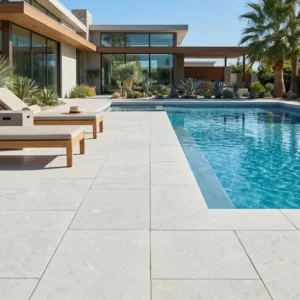
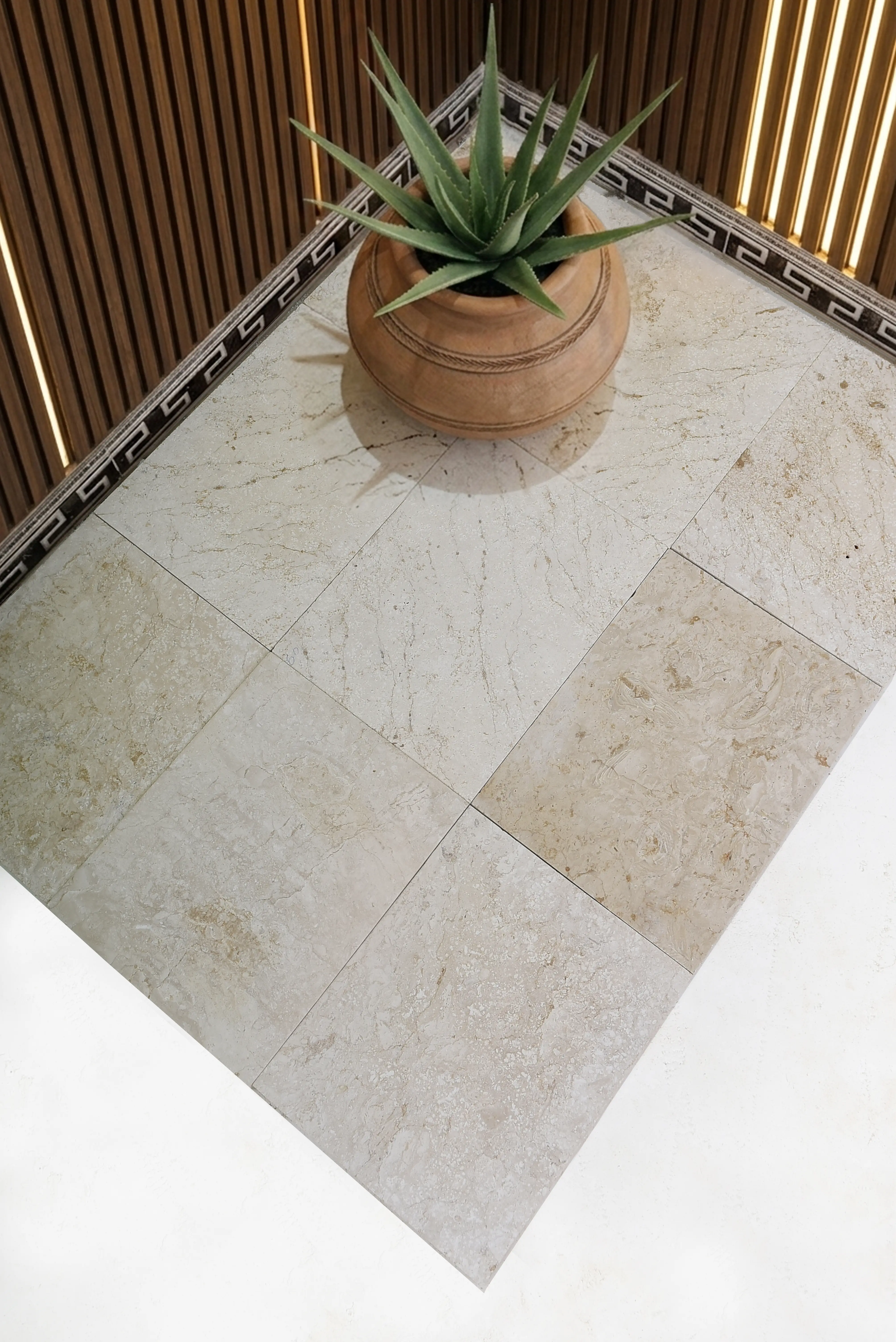
Desert xeriscaping and contemporary outdoor-indoor transitions often specify lighter limestone or travertine tones that reference the natural palette of the surrounding landscape. Selected quarries from the Middle East produce limestone colorways — warm creams, sandy buffs, and silvery greys — that integrate naturally with this aesthetic. These imported grades typically carry a $3–$6 per square foot premium over comparable domestic stone, but the visual coherence with landscape design themes justifies the cost difference on high-specification residential projects.
- Tropical and lush planting schemes often pair with darker basalt or black granite — materials that provide visual contrast and don’t show organic staining from leaves and moisture as readily
- Traditional colonial and heritage design contexts typically specify tumbled travertine or aged limestone finishes, which carry a processing premium of $2–$4 per square foot above standard honed equivalents
- Contemporary minimalist designs that extend stone flooring from interior to exterior courtyard require matching stone across the transition — specify from a single production batch and order the full quantity together to ensure color consistency
- Landscape designs with formal symmetry often use bookmatched stone panels or mirrored layouts that require sequential batch ordering — a sourcing complexity that extends lead times and increases cost
Reviewing ASTM natural stone tile absorption, strength, and slip resistance testing standards before finalizing exterior stone specifications helps confirm that your selected material meets the performance threshold for freeze-thaw cycles if your project sits in a climate zone where that’s relevant. Aesthetic choices and performance requirements need to align — a stone that looks perfect for a landscape scheme but falls short on freeze-thaw resistance creates an expensive problem within a few winters.
Ordering, Logistics, and Supply Chain: Hidden Costs in the Pipeline
The warehouse-to-site cost chain is one of the least visible components of natural stone floor tile cost, but it’s one of the most controllable if you plan your procurement correctly. Understanding how supply chain decisions affect your project budget gives you real leverage that most buyers leave on the table.
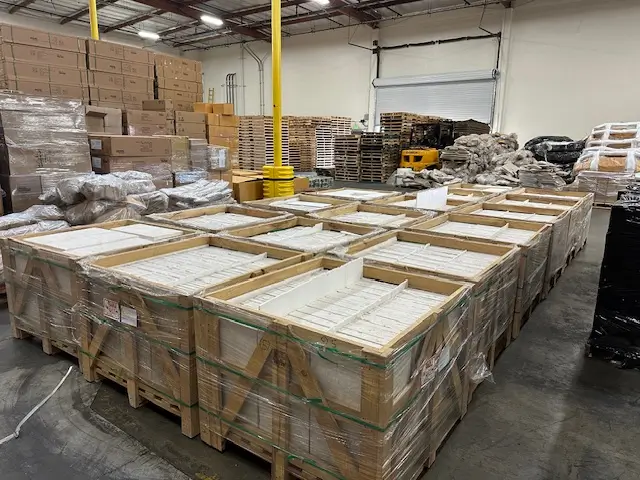
Verifying warehouse stock levels before committing to a project timeline is essential. Natural stone materials with strong demand — particularly popular travertine and limestone formats — move through warehouse inventory quickly, and restocking from international quarries typically takes 10–16 weeks depending on origin. If your project requires a large quantity of a specific format and color grade, securing the full quantity from a single warehouse lot is essential. Splitting across two warehouse lots risks color variation between batches that becomes visible on the installed floor.
At Citadel Stone, we recommend calculating your total square footage requirement — including your wastage allowance — before placing any order. For rectangular rooms with a straight grid layout, add 10% to your net square footage. For diagonal or herringbone layouts, add 15–18%. For large-format tiles in rooms with multiple angles or significant cut work, 20% overage is a prudent minimum. These aren’t conservative estimates — they’re the numbers field experience confirms. You can explore stone tile costs at Citadel Stone to benchmark material rates for a widely specified large-format option.
Truck delivery logistics are another cost variable that projects in constrained urban sites often underestimate. Standard flatbed truck delivery assumes reasonable access — a driveway or loading area that accommodates a full-size delivery vehicle. If your site has restricted access, a liftgate truck or crane-offload arrangement adds $150–$400 to the delivery cost per shipment. Confirm your site’s truck access conditions early, and communicate them to your supplier before delivery scheduling begins.
Common Natural Stone Floor Tile Cost Mistakes Worth Avoiding
Field experience surfaces the same budget mistakes repeatedly across projects of different scales. The following issues consistently cause natural stone floor tile cost to exceed the initial projection — addressing each one before it affects your budget is the most efficient form of cost control available at the planning stage.
- Ordering to net square footage without a wastage allowance — this is the most common procurement error and almost always results in a costly emergency reorder from a potentially different production batch
- Selecting a stone finish for appearance without confirming it meets slip resistance requirements for the intended application — a polished marble floor in a wet entry lobby creates a liability risk that costs more to fix than to prevent
- Failing to account for transition strips and edge profiles when budgeting — natural stone thresholds and edge pieces are priced separately and are often custom-cut, adding $15–$35 per linear foot to floor perimeter transitions
- Specifying premium stone for a substrate that hasn’t been properly assessed — discovering significant substrate remediation needs after material has been ordered creates scheduling delays and additional cost
- Overlooking acclimation requirements — natural stone tiles stored in an unconditioned warehouse environment should acclimate to the installation space’s temperature for 24–48 hours before installation to minimize dimensional change during the setting process
- Ignoring grout joint width recommendations for large-format tile — joints that are too narrow for a given format size trap lippage and make the floor harder to clean over time, leading to earlier-than-expected remediation costs
The granite floor tile against travertine comparison deserves specific attention on the wastage point. Granite’s dimensional precision typically means slightly lower wastage on standard cuts compared to travertine, which can exhibit minor size variation from the filling and honing process. On large-format diagonal layouts, however, both materials perform similarly in terms of cut waste — the geometry of the layout drives wastage more than the material type at that scale.
What Matters Most in Your Natural Stone Floor Tile Cost Calculation
The natural stone floor tile cost calculation that actually serves your project is a layered one — material type, format size, finish, installation complexity, substrate condition, wastage allowance, maintenance schedule, and supply chain logistics all contribute to a number that diverges meaningfully from a single per-square-foot material rate. Making significantly better procurement decisions requires addressing each cost layer explicitly before the first pallet is ordered. The upfront specificity is what separates a project that finishes on budget from one that absorbs a 20–30% overrun in the field. For projects that include stone flooring in kitchen applications, exploring options around kitchen stone floor design ideas can help you connect material cost decisions to design outcomes that make the investment worthwhile. At Citadel Stone, our technical team consults on specification questions daily — material selection, format sizing, wastage calculation, and delivery logistics are the practical details that determine whether a stone floor project delivers the performance and appearance it was designed to achieve. Buyers comparing granite floor tile against travertine through Citadel Stone should factor in the waste percentage, which typically runs higher on diagonal cuts for large formats.
Related reading: How to Install Large Floor Tile Without Lippage · Large Format Floor Tile Patterns: A Visual Guide.