Where the trades meet Aruba’s shallow northwest flats, the island runs one of the sport’s world capitals: the Fisherman’s Huts waters where windsurf and kite fleets carve daily, schools process beginners by the vanload, and a shore culture of rigging lawns, gear compounds and salt-crusted vans has evolved its own infrastructure grammar. Wind-sport shore craft is Aruba’s native genre — the kite-economy pattern at world-capital constancy — and this is its guide.
The constant-wind campus
Daily wind reshapes sport infrastructure: no season to wait for, schools and centers operating year-round at no-pause tempo, and shore facilities working like campuses — briefing areas, rigging fields, launch corridors, rescue-and-return systems — on ground that processes hundreds of sessions weekly. The stone grammar serves the flow: hardstanding aprons where trailers and van fleets marshal, rigging lawns kept honestly grassy with stone-spined service edges, and the pulse-infrastructure logic tuned to wind-sport hours — dawn glass for foilers, trade-built afternoons for the fleets.
Launch-corridor discipline
The sport’s safety runs on corridor clarity: launch and land zones separated from swim areas, kite lines commanding sterile ground during rig-and-launch, and shore design enforcing what flags request — physical corridor definition by low stone margins and texture shifts, sightline management keeping beach users and line zones mutually visible, and the public-shore courtesy woven through: the flats belong to everyone; the corridors organize coexistence.
- Keep the rigging area and the swimming route physically separate at ground level.
- Give the launch corridor the toughest surface on the site, since gear is dragged across it.
- Mark zones in the paving layout rather than with signage the wind will remove.
- Allow enough width for a rigged sail to be carried without turning it.
Gear economy at industrial-leisure scale
Wind-sport gear runs the cluster’s most intense equipment cycle — quivers by the dozen, kites and wings drying daily, boards racked in fleets — and its shore infrastructure borrows the professional-gear grammar at center scale: compound floors on working-apron stone with drainage for perpetual rinse cycles, rack foundations engineered for trade-wind loads (a racked sail fleet is a wall of small ships), lockup thresholds trafficked by barrows and boardbags, and freshwater plumbed as operational core — salt is the sport’s tax, and rinse infrastructure its collection office.
School flows and the beginner economy
The teaching economy processes novices at package-holiday volume, and its ground plane manages flow like a small airport: check-in and briefing shade on crowd-capable surfaces, kit-issue counters with queue geometry, walk-to-water routes surfaced for barefoot-with-board traffic, and the return cycle — rinse, de-kit, debrief — flowing without cross-tangle. Family spectating adds its layer: shaded viewing margins on seat-height walls where the supervision-sightline instinct watches first lessons from comfortable stone.
Sunset-station hospitality
The sport’s shore closes each day socially — session beers at the beach bars, sunset over the day’s water, the international windsport tribe at its evening parliament — and the hospitality register runs institution stone in board-culture dress: sand-tolerant floors, gear-parking margins where quivers rest against seat walls, van-life courtesy in the parking geography, and the warm-low evening rules as the flags come down. The capital’s social infrastructure is half its draw; the stone keeps it standing through the tribe’s seasons.
- Design the evening social area out of the direct wind so it is usable after sailing.
- Provide fixed seating, because loose furniture will not stay put here.
- Keep the surface easy to sweep, since sand accumulates faster than anywhere else on the plot.
- Light the route from the rigging area to the bar for the hour after sunset.
Building the capital’s shore
Wind-sport infrastructure specifies for its constants — wind loads on everything vertical, salt on everything metallic (marine-grade throughout), sand as perpetual abrasive, and duty cycles without off-seasons — and delivers through Aruba’s easy logistics with the sport’s calendar barely pausing. The island supply guide outfits centers, schools and shore businesses in the genre’s working grammar: aprons, corridors, compounds and sunset stations — the constant coast’s native craft, built to its own wind.
Championship weeks: when the world arrives with its gear
The constant-wind campus periodically becomes a stadium: international fleets, pro riders and media descending for competition weeks that test the shore’s infrastructure at levels the daily school trade never reaches. The event overlay is a logistics genre of its own — container-loads of competition kit landing on the island’s freight rhythm, rigging fields expanding onto every level surface, judging and media towers wanting power and stable ground, and spectator crowds arriving with the trades at their backs. The shore built for it absorbs the surge on its permanent stone: launch corridors uprated for fleet starts, hard aprons taking the container staging without rutting, the rinse-and-repair yards running at pit-lane tempo, and the event compound’s services — power, water, wash-down — dressed into ground that returns to ordinary school-beach duty the following week.
The permanent-versus-temporary split follows the cluster’s festival law: everything recurring is built once — the anchor points, the service pedestals, the widened corridors — and everything event-specific arrives, lashes to it, and leaves. Operators bid for the calendar knowing the ground is the pitch: federations inspect venues the way surveyors inspect houses, and the beach whose infrastructure file answers cleanly hosts again. The wind is the invitation; the stone is the venue.
Between championships the legacy works daily — the uprated corridors serve the schools, the aprons serve the gear economy, and the shore’s reputation compounds in the sport’s small world. The island’s wind was always world class; the campus’s job is matching it in ground, and the championship weeks are simply the exam the daily specification was already passing.
The rescue net: safety cover on a crowded launch
A launch corridor at capacity needs its safety layer organized, and the campus’s cover runs as quietly professional as its schools: rescue craft staged at the corridor’s downwind end — the direction every failed kite and snapped line travels — spotters’ positions with clear sightlines over the traffic, the flag-and-signal conventions taught in every first lesson, and the downwind boundary’s arithmetic respected, because on a constant-wind island whatever cannot self-rescue drifts to the same predictable shore. The premises’ contribution is infrastructure: the rescue station’s ramp and hardstand on working stone, radio and first-aid points at the marked positions, and the corridor’s entry boards carrying the day’s conditions where every rider passes. The culture completes it — schools and independents sharing the watch, the informal rule that everyone counts kites, and incidents debriefed into the campus’s accumulating craft. The wind never stops; the net beneath it is why the statistics stay boring, and boring is the sport’s finest safety record.
Why the wind sport industry chose this island
Aruba is one of the most reliable wind sport destinations in the hemisphere, and the reason is meteorological rather than commercial. Figures published by Aruba on its own weather and climate describe constant trade winds as a defining characteristic of the island, with a windy season running May through October when the wind strengthens further, temperatures of 80 to 90 degrees Fahrenheit year round, and only 18 inches of rain a year. The island also sits outside the main Atlantic hurricane belt, so the season is not interrupted.
- Design for daily use across an unbroken season rather than for a summer peak.
- Expect the surface to see gear traffic every single day, which is a heavier duty than foot traffic.
- Assume sand is airborne most of the time and specify surfaces that can be swept clean quickly.
- Provide shade that survives strong wind, since this is the one thing the site cannot borrow.
- Plan maintenance around the quieter months rather than around a shutdown that never comes.
A surface that takes gear, not just feet
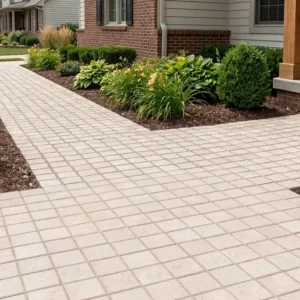
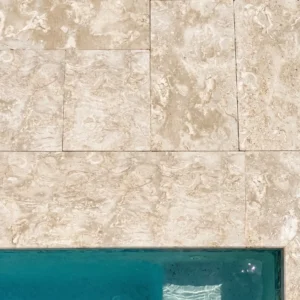
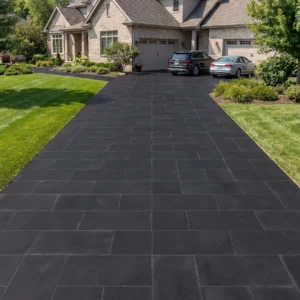
A rigging area is closer to a light industrial yard than to a terrace. Boards are dragged, masts are laid down, booms are dropped, and all of it happens on sand-covered stone. The overview from Use Natural Stone on paving detailing sets out mortar-set over a rigid base, sand-set over compacted aggregate and pedestal-set over structure, and here the choice follows the abuse rather than the aesthetics.
- Mortar-set the rigging and launch corridor where impact and dragging are constant.
- Sand-set the softer social areas so they drain quickly and can be relaid cheaply.
- Keep joints tight in the gear zone, because grit driven into an open joint acts as an abrasive.
- Specify thicker units on the launch route, since thickness is what resists a dropped mast foot.
Two coasts, two entirely different briefs
The sheltered west side and the exposed east side of Aruba behave like separate islands. Hadicurari and the leeward beaches see flat water, dense gear traffic and a social scene; the windward coast sees full ocean swell, heavier salt loading and far fewer people. A specification that suits one is usually wrong for the other, and the honest approach is to write two.
- Treat the leeward sites as high-traffic and the windward sites as high-exposure.
- Use lower-absorption material on the east coast, where salt arrives constantly and rain never rinses it.
- Reserve the heaviest wear detailing for the leeward launch areas, which see the most gear.
- Keep any east coast structure fully fixed, since there is no shelter of any kind out there.
Windsurf shore stone that keeps up with the fleet
A wind sport shore is judged by whether it still works in year five, after several thousand rigging sessions and a great deal of blown sand. That comes from a hard-wearing launch corridor, tight joints where grit collects, zoned circulation and a sheltered social area that people can actually sit in. Our Aruba stone supply guide sets out the formats, finishes and lead times that suit this island. The wind here is a permanent asset, and the ground plane is what turns it into a functioning business.