On an island where rain is a visitor, the pool is the oasis in the oldest sense: water as deliberate luxury, framed by desert light, serving the guaranteed-sunshine economy that fills Aruba year-round. The island’s pool culture spans timeshare amenity decks running the region’s hardest duty cycles to villa plunge courts in cactus gardens — all specified under permanent sun and permanent wind, with no storm season to pause the service. Here is the oasis standard.
Water as desert theater
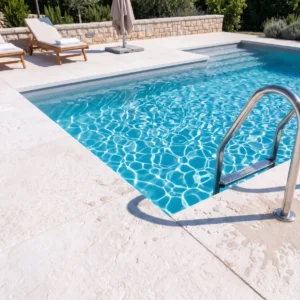
The desert-island pool performs against its setting: turquoise held in pale stone amid gravel-and-cactus composition, the genre’s restraint making modest water read as abundance, and evening transforming the theater — underwater light against dark desert sky, the warm-graze rules at desert clarity. Scale follows the theater’s logic: villa pools succeed at sanctuary dimensions where the composition does the luxury, while the resort corridor’s lagoon-scale decks serve crowds the sunshine guarantee delivers daily.
Permanent-sun specification
Aruba’s pools work under the cluster’s most relentless sun calendar — near-constant clear skies, no wet-season pauses — and surfaces specify accordingly: pale heat-shedding decks as thermal necessity, low-glare finishes against the double dazzle of sun and water, shade infrastructure engineered into the deck plan rather than umbrella’d after, and the UV-honest truth that the island’s light audits everything — colorfast stone earning its keep where lesser surfaces fade on schedule.
- Choose a pale tone for the open deck, because a dark surface here becomes unwalkable by mid morning.
- Keep a textured rather than honed finish so heat is broken up across the surface.
- Provide a shaded band at the pool edge where people stand longest.
- Test a sample in full sun before committing, since laboratory color tells you nothing about surface temperature.
Wind at the waterline
The trades cross every pool on the island, and the waterline detail answers: coping profiles that sit low and clean in moving air, deck furniture culture on the weighted-or-fixed rules, windbreak architecture — the lee walls and screens that make lounging civilized — integrated with the pool’s composition, and evaporation arithmetic taken seriously: covers and wind-sheltered siting protecting water the desalination plant made. Spray drift adds its note: downwind surfaces live wetter than the climate suggests, and their texture spec reads accordingly.
Amenity decks at timeshare tempo
The corridor’s amenity pools run the cluster’s maximum occupancy mathematics — the strata-governance duty at year-round fullness: duty-grade density for perpetual crowds, wet-tested textures under sunscreen slicks, repair windows measured in refurb-week precision, attic stock as operational necessity, and the daily reset choreography of decks serving thousands weekly without a low season to recover in. The specification’s honesty pays hourly; the corridor audits its surfaces like the asset registers they are.
No-storm-season operations
Aruba’s southern position rewrites pool operations: no annual shutter drill, no surge line rewriting the deck plan, no autumn insurance anxiety — the storm-zone chapter relaxing into simple wind-honesty and the maintenance calendar running uninterrupted. The freedom compounds commercially: pools operate and earn every week of the year, works schedule purely to occupancy, and capital planning drops the region’s risk premium. The desert island’s quiet advantage: water features that never batten down.
- Expect a year-round swimming season and specify for continuous rather than seasonal use.
- Allow for higher evaporation, which concentrates salts and chemicals in the water faster.
- Plan cleaning around dust rather than around leaf fall, since that is what actually lands here.
- Design shade into the deck layout instead of relying on umbrellas the wind will not tolerate.
The oasis, delivered
The Aruban pool package assembles under the island’s logistics gifts — Dutch-standard clearance, flat easy delivery, dry-air staging — as one system: deck fields, coping and weir families, lee-wall masonry, spares for the tempo. The island supply guide quotes oasis projects daily, corridor tower to cunucu villa, because on the desert island the pool is never optional decoration: it is the promise the sunshine economy keeps, held in pale stone against the wind.
The metered oasis: water arithmetic for a desal-fed pool
Every liter in an Aruban pool was manufactured from the sea, and the oasis’s running cost is written on a utility meter the design can befriend or ignore. Evaporation is the desert island’s quiet thief — constant sun and permanent wind lift water off an open surface at rates wet islands never see — and the countermeasures are design decisions, not habits: the walled lee that makes the court comfortable also slashes evaporative loss, covers earn their cost fastest here of anywhere in the cluster, and the pool’s size question deserves the honest framing — a smaller, deeper, sheltered pool holds its temperature and its water better than the broad shallow sheet the brochure drew. Backwash and overflow route to the garden’s thirstiest zone rather than the drain, because on this island graywater is a resource with a schedule.
The stone package participates directly. Deck falls that return splash toward the pool’s edge zone rather than shedding it outward keep the cannonball’s cost down; scupper and channel details capture what wind lifts off the water line; and the equipment court’s specification includes the meter itself — mounted readable, because the owner who glances weekly catches the liner’s slow leak that the quarterly bill would have announced expensively. Salt systems suit the island’s chemistry and its logistics both; their stone surrounds follow the salt-proof rules the cluster already keeps.
None of this diminishes the oasis — it disciplines it. The desert tradition the island inherits always treated water as wealth made visible, and the pool that honors the tradition runs cool, full and affordable through the permanent season. The meter is part of the specification; design for it once and the oasis pays its own way in comfort for decades.
The number a pool deck has to hit
Everything else about a desert pool is a preference; the walking surface is not. Guidance from Use Natural Stone on frictional testing identifies ANSI A326.3 as the applicable method and a dynamic coefficient of friction of 0.42 as the benchmark for level interior surfaces expected to be walked on wet, notes that no published threshold covers exterior use, and records that polished finishes generally fail the wet test. On a deck where wet feet meet hot stone all day, that settles the finish question before the color question is even opened.
- Specify a textured finish and keep polished material away from anywhere feet land.
- Test the exact finish being purchased, since the same stone can pass in one texture and fail in another.
- Treat 0.42 as a floor and aim above it where the deck falls toward the water.
- Carry one texture through the deck, the steps and the outdoor shower so grip never changes.
- Retest after a few seasons, because blown grit polishes a surface faster than foot traffic does.
What desalinated water does to stone
Aruba has no rivers, no lakes and extremely limited groundwater, so every drop in the pool started as seawater. The WEB Aruba company profile records production of 41,000 cubic meters a day across seawater reverse osmosis plants dating from 2006 and 2012 running at 4.2 kilowatt hours per cubic meter, alongside older multistage flash units from 1992 to 1998 at 28.3 kilowatt hours, serving roughly 41,000 homes and businesses with water safe to drink straight from the tap. Water that expensive to make is water nobody wastes on backwashing a badly specified deck.
- Choose low-absorption stone so the deck does not need repeated washing to stay presentable.
- Design the deck to drain quickly rather than to hold a film that has to evaporate.
- Keep pool overflow separate from any surface you do not want carrying mineral deposit.
- Specify materials that tolerate the mineral profile of desalinated water without efflorescing.
Coping in relentless sun
The coping is the one part of a pool that hands and feet meet constantly, and on this island it also spends every day under near-vertical light. Absorption governs how it behaves: the lower it is, the less water and dissolved salt the stone takes in, and the less it moves, stains or spalls. Thermal comfort is the second criterion, and it is decided by tone and texture rather than by material family.
- Specify low-absorption stone for coping even where the wider deck uses something more porous.
- Choose a rounded or softly eased profile so a swimmer pulling out never meets a sharp arris.
- Keep the coping tone pale, since this is the surface people rest their forearms on.
- Match batch across the whole coping run, because a tonal step reads instantly along a straight edge.
Desert pool stone that stays comfortable all day
A pool here is used every month of the year, in strong sun, with water that costs real energy to produce. That argues for pale, low-absorption, properly textured material, a deck that drains rather than pools, and coping chosen for the hand as much as for the eye. Our Aruba stone supply guide sets out the formats, finishes and lead times that suit this island. Get the surface temperature and the wet-test number right and the rest of the terrace becomes a design conversation rather than a problem.