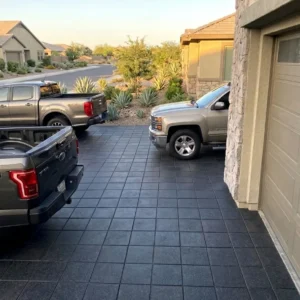
Turks & Caicos sits squarely in the hurricane belt, and 2017 — when Irma crossed the islands — remains the reference point for every building conversation since. Roofs, glazing and standby power dominate those conversations, as they should. But the landscape around a building faces the same storm, and the materials chosen for it decide whether the week after a hurricane is a rinse-down or a rebuild. Ground-set natural stone has the quietest storm record of any exterior surface, and the reasons are worth understanding before the next season, not after it.
Why ground-level stone survives
Hurricanes destroy through uplift, projectiles and water. A mortar-set stone terrace offers almost nothing to any of the three: it presents no surface for wind to get beneath, weighs far too much per unit to fly, and is indifferent to a day underwater. Compare the alternatives honestly. Elevated timber and composite decks carry hundreds of fastener points, every one a corrosion site in salt air and a failure origin under uplift; boards that let go become projectiles aimed at the building they surround. Loose lightweight furnishings and decorative elements travel in any serious blow. The paradox of storm-zone landscaping is that the most solid, permanent-feeling choice is also the safest one — mass, in a hurricane, is a virtue.
The failure points stone does have
An honest storm audit of a stone landscape finds its weak spots at the attachments and the loose elements, not the field. Pergolas and shade structures fixed to or through paving need engineered connections rated for uplift, or they become the landscape’s sacrificial element. Unrestrained gravel — decorative beds close to glazing — can be mobilized by extreme wind and is better placed in sheltered courts or bound with resin in exposed positions. Pot groupings, loungers and umbrella bases all need a stated storm-plan home: a store room, a strap-down point, a drill that staff or owners actually run when a watch is issued. The stone itself asks only that its edges be restrained and its bedding sound; a unit rocked loose by debris impact is a repair, not a failure mode.
- Pergolas and shade structures fixed through paving, where uplift is carried by the connection rather than the stone.
- Free-standing planters, furniture and fire bowls that become projectiles at wind speed.
- Unrestrained edges and steps, where surge finds something to lift and carry.
- Gravel and loose aggregate zones sited upwind of glazing.
- Anything screwed into coping or treads without an engineered fixing behind it.
Water: the storm’s second act
Storm surge and rain flooding do more cumulative damage across the islands than wind, and here stone’s indifference to immersion is decisive. A flooded limestone terrace is rinsed, inspected and back in service; there is no swelling, delamination or rot cycle, no insurance-claim line for the surface itself. Salt-laden floodwater should be hosed off with fresh water once supply allows — the same routine the coastal maintenance playbook prescribes for ordinary spray, applied once more with feeling. Design contributes too: terraces laid with honest falls and clear discharge routes shed floodwater the way they shed rain, and paved surfaces that double as drainage paths recover fastest of all.
After the storm: the quiet advantage
The week after a hurricane is when material choices present their bills. Stone’s is short: sweep and rinse the field, re-bed the isolated units that debris strikes loosened, check perimeter restraints, done — days, not months, and no specialist trades in the island-wide scramble that follows every event. Surfaces that require replacement boards, re-staining, or complete renewal join a queue for materials and labor precisely when both are scarcest and dearest. For rental villas the arithmetic sharpens further: reopening speed is revenue, and a property whose outdoor spaces reset in a week markets itself while neighbors renovate.
Specifying for the storm zone
The storm-resilient specification is mostly the good-practice specification with intent: dense, low-absorption stone; full mortar beds on properly compacted bases; restrained edges; movement joints that let the assembly breathe; and connection details for anything vertical, engineered rather than assumed. Add the operational layer — storm homes for loose items, a pre-season walkthrough, attic-stock spares from the original batch for post-event repairs — and the landscape becomes one of the few parts of a TCI property that faces the season with genuine composure. The TCI supply guide covers the material side; the deck standard shows what it protects.
- Dense, low-absorption stone that gains nothing from a day underwater.
- Full mortar beds over properly compacted bases, with no voids to fill with surge water.
- Restrained edges on every free perimeter, not just the visible ones.
- Movement joints that let a sun-baked assembly expand without loading the stone.
- Engineered connections for anything vertical, specified rather than improvised on site.
Paper armor: documenting the landscape for the season
The storm-zone habit that costs least and pays best is documentation. Before each season, walk the property and photograph the hardscape systematically — terraces from fixed corners, wall lines, steps, the pool surround, close-ups of representative detailing — and store the set with the property’s insurance papers. After any event, the same angles retaken tell the honest story: usually reassuring, occasionally the evidence that turns a claim conversation from argument into paperwork. Insurers respond well to robust-materials narratives backed by photographs, and a landscape whose record shows mortar-set stone, engineered connections and maintained drainage is an easier risk to underwrite than an undocumented one. Keep the stone’s own paper nearby too — the original order’s batch records and the location of attic-stock spares — because the fastest post-storm repair is the one that skips the matching hunt entirely. Ten minutes of photography twice a year is the cheapest resilience line item on the island.
After the all-clear: the triage order
The first post-storm walk of the landscape has an efficient order, and running it saves both time and avoidable damage. Drains first: clear every channel, gully and soakaway mouth before the next rain band, because the storm rarely travels alone and blocked drainage turns aftermath into flooding. Hazards second: anything overhead or leaning — a cracked limb, a loosened pergola member — dealt with before anyone works beneath it. Then the systematic survey with the pre-season photo set in hand: terraces walked for loose or shifted units (a gentle tap finds the hollow bed by ear), copings and wall caps sounded along their runs, edges checked where debris struck, steps tested before they are trusted. Rinse third — fresh water over everything salt touched, in the calm confidence that the stone itself is fine. Only then repairs, in duty order: safety items immediately, water-management items before the next weather, cosmetic items when the island’s trades have exhaled. Most properties discover the whole list amounts to a weekend with a broom, a hose and a bag of mortar — which, compared to the neighborhood’s reboarding and refinishing queues, is the entire argument of this guide restated in the least glamorous possible terms.
The season, and when it actually bites
Storm planning is calendar work before it is materials work. The National Hurricane Center publishes the climatology plainly, and the shape of the season decides when hardscape can be built, when it should be secured, and when nobody will answer a call for plant hire. Their tropical cyclone climatology is the reference worth working from.
- The Atlantic season runs June 1 to November 30, which is the window every schedule has to respect.
- Climatological peak activity falls on September 10, so that month is the one to keep clear of critical works.
- Most activity concentrates between mid-August and mid-October.
- An average season produces fourteen named storms, seven hurricanes and three major hurricanes.
- Plan hardscape completion, not just commencement, ahead of the active window.
Setting systems and how each behaves in a storm
The way stone is held down matters more than which stone it is. Three systems dominate exterior paving, and they behave very differently when water arrives with force. This summary of detailing stone paving for durability sets out the choices.
- Mortar-set assemblies, chosen where stability governs, which is most of a storm-zone property.
- Sand-set paving, common for exterior fields and easy to lift and re-lay after an event.
- Pedestal systems, which drain and allow access but need particular attention to uplift at exposed edges.
- Substrate, drainage and movement addressed as part of the choice rather than after it.
Loose objects: the projectile audit
Stone that is bedded stays put. The damage bill after an event is written by everything around it that was not. A projectile audit takes an hour and is the cheapest storm work on the property.
- Every loose item on the hardscape listed, with a named storm home it can actually fit into.
- Furniture that cannot be moved anchored, not merely stacked in a corner.
- Gravel mulch and decorative pebble reviewed wherever it sits within throwing distance of glass.
- Umbrella bases, planters and fire bowls weighed against the wind speed the code assumes.
- The audit repeated each May, because properties accumulate loose objects year on year.
A pre-season checklist for the hardscape
The same walk, done every year, catches almost everything that goes wrong. It takes one morning and it is the difference between a rinse and a rebuild.
- Sound the copings, treads and edges for hollow beds, and re-bed anything drummy.
- Check perimeter restraints along every free edge, including behind planting.
- Clear drainage lines and gullies so surge water has somewhere to go.
- Confirm attic stock is still on site, still dry, and still from the original batch.
- Photograph the hardscape from fixed corners and store the set with the insurance papers.
Hurricane resistant hardscape that earns its keep
The argument for stone at ground level in this climate is not romantic; it is actuarial. A bedded stone terrace offers wind nothing to lift, is unbothered by immersion, and returns to service in days rather than seasons. What it does need is discipline at the attachments, restraint at the edges, and an owner who spends one morning a year on the walkthrough. Vertical elements deserve the same scrutiny, which is why boundary and screen structures get their own treatment in our notes on boundary and wind walls in Turks and Caicos. Build the ground plane to be rinsed rather than replaced, and the week after a storm becomes an inspection instead of a project.