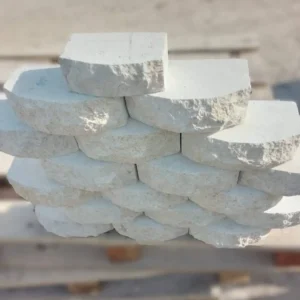
Aruba receives freight the way the Dutch Caribbean prefers: to standard, on schedule, with paperwork that reconciles. For stone buyers the island is among the cluster’s most straightforward destinations — a professional port, honest brokerage, flat short roads, and a calendar unburdened by hurricane-season nerves. Straightforward still rewards knowing the route, and here it is end to end.
Samples under a desert sun
The opening ritual gains a Aruban emphasis: the island’s light is desert-bright and its surfaces reflect — white beaches, pale architecture, glittering water — so samples must be judged at noon as well as evening, dry as well as wet. Glare behavior becomes a first-order selection criterion: the stone that reads elegantly at midday on Palm Beach is the one whose finish scatters light rather than flashing it, and an on-site sample hour tells you more than any rendering. Courier samples arrive within 3 working days; the sun is always available for the test.
Freight modes and the corridor’s cadence
Scale sets the mode as everywhere — palletized and groupage for villa work, full containers at roughly 24–26 tonnes for resort phases — and Aruba’s deep tourism economy keeps sailings from US hubs frequent and dependable. The resort corridor adds its cadence to planning: renovation programs buy against occupancy windows, so orders time their arrivals to the softer months when amenity decks can close zone by zone. With no storm season loading the autumn, the calendar bends to commerce alone — a freedom storm-belt buyers take a while to trust.
- Groupage suits a single villa terrace where ten or twelve pallets is the entire scope.
- A dedicated box starts paying for itself once one format passes roughly twenty pallets.
- Keep one crate per stone type so a partial release never separates a batch.
- Consolidating trades into a single container removes a second clearance and a second haul.
Brokerage, duty and the Dutch paper standard
Aruban clearance runs on the Dutch-Caribbean expectation that documents match: one description across invoice, packing list and bill of lading, values reconciling to the quote, the consignee correctly the importer of record. Duty belongs in the landed-cost conversation from the first quote — your broker prices it before the vessel sails, and the itemized paperwork we prepare gives them exact lines to price. The port’s professionalism cuts both ways: clean files clear briskly; improvised ones meet a system with no appetite for improvisation.
The easiest last mile in the cluster
Island delivery is where Aruba spoils its buyers: distances short, terrain flat, roads good, and no ridge-line switchbacks or inter-island barges in sight. The planning that remains is social rather than topographic — resort loading docks and their booked slots, condominium service hours, villa-district access arrangements — plus the universal courtesy of matched equipment: the forklift booked to the clearance date, staging agreed before crates arrive. Wind earns one note even here: open staging areas take the trade wind all day, so crate stacks stay low and strapping stays honest.
Storage, phasing and the renovation rhythm
The corridor’s renovation economy often lands stone ahead of its phase, and Aruba’s dry climate is generous to stored cargo: crated stone waits outdoors indefinitely, and a reserved batch landed once then drawn down zone by zone beats repeated small shipments for both cost and color consistency. The discipline is documentation — batch records filed with the program, spares inventoried, each phase’s drawdown recorded — the amenity-governance habits running at Aruban ease.
- Order long-lead formats first and let the quick items catch up behind them.
- Build a buffer for one missed sailing, since a skipped call moves delivery by roughly a fortnight.
- Insure to replacement landed cost rather than invoice value, because freight is the larger half.
- Confirm site access and lay-down space before the box leaves, not while it stands on the quay.
Arrival, verification, and done
The close is the cluster’s standard fifteen minutes: crates counted against the packing list, transit questions photographed before anything moves, one crate per stone type opened against approved samples, escrow releasing on confirmation for new clients. Then the island’s favorite part: laying weather tomorrow, and the day after, and the day after that — the Aruba supply page quotes the whole route in one conversation, and on this island the route keeps its promises.
Delivering into the fullest calendar in the Caribbean
Aruba’s occupancy runs at levels the region envies — the timeshare model books years ahead, the resort corridor fills essentially year-round, and “low season” here would be a record month elsewhere — which turns renovation logistics into precision scheduling. Works windows are narrow, contractual and immovable: a tower’s refurbishment week is fixed in owner calendars long before stone is ordered, amenity-deck phases book their closure permits against occupancy forecasts, and a delivery that misses its window does not slip a week — it waits for next year’s. Stone orders into this market therefore run backwards from the window with double honesty: production and sailing buffered, cargo landed early as policy, and the island’s generous dry storage doing what it does best — holding reserved batches beside the project until the calendar says now.
The delivery week itself runs on hospitality-operations discipline: service-corridor routes agreed with the property, crate movements timed to guest-flow quiet hours, staging screened and immaculate because the pool deck twenty meters away is at full occupancy, and crews briefed that they are working inside a live product. The corridor’s operators are superb at this choreography and expect suppliers to match them; consignments that arrive labeled by phase, sequenced by zone and packed to move quietly earn the repeat relationships this market runs on. It is the cluster’s standard renovation craft executed at the region’s highest occupancy — and one more reason the hurricane-free calendar matters: on an island this full, the weather is the one variable nobody needs.
What Barcadera actually handles
Almost every pallet of stone that reaches an Aruban site crosses one terminal. The Aruba Ports Authority description of Barcadera records a 440 meter quay with 11 meters of quay depth and 40 reefer positions, and states plainly that the terminal handles essentially all sea-borne cargo imported to and exported from Aruba, with roughly 40,000 square meters of reclaimed land east of the existing quays earmarked for expansion. Those numbers explain the schedule better than any freight quote does.
- An 11 meter depth accepts regional feeder vessels comfortably, so transshipment through a larger hub is normal.
- A 440 meter quay means several vessels can work at once, which keeps waiting time short in practice.
- Break bulk moves through the same facility, so oversized slabs and crated goods are routine rather than exceptional.
- The single-terminal arrangement concentrates clearance in one place, which simplifies broker coordination.
- Planned expansion matters for long programs, since capacity constraints ease rather than tighten.
The Oranjestad container berth and why it still matters
The capital keeps its own container capability alongside the cruise berths. The Aruba Ports Authority description of Oranjestad lists a 250 meter container berth with a maximum draft of 9.75 meters served by a 50 ton Nelcon gantry crane moving 20 to 25 boxes per hour, a cargo terminal of 1.4 million square feet with more than 7,500 TEU of storage and 36 reefer points, and harbor depth of 33 feet at mean low water across 4,070 feet of dock. Container operations run around the clock, every day of the year.
- A 50 ton gantry lifts a fully loaded box without difficulty, so heavy stone consignments are unremarkable here.
- Twenty to twenty-five moves an hour sets a fair expectation for how quickly a vessel discharges.
- Generous TEU storage reduces the pressure to strip a container the moment it lands.
- Round-the-clock operation means clearance is rarely the bottleneck on an Aruban program.
The last mile is genuinely short
Aruba is small, flat and well surfaced, which makes the leg most islands struggle with the easiest part of the job here. A truck from Barcadera reaches Noord, Oranjestad, Savaneta or San Nicolas within a short drive on good road, and there is no ferry, no barge and no mountain hairpin between the terminal and the site. That single fact changes what can sensibly be specified.
- Large-format units are viable because there is no small boat or narrow track limiting the crate.
- Deliveries can be staged in several drops without adding meaningful cost, which frees up site storage.
- A forgotten item is a same-week problem rather than a next-month one.
- Heavier, denser material is worth specifying, since the road leg does not punish weight the way a tender does.
Getting shipping stone to Aruba right the first time
The island rewards a clean single consignment more than it rewards speed. Consolidate the order, crate by stone type, insure to landed cost and add attic stock while the container is open, because a replacement piece ordered two years later costs far more in freight than it does in material. Our Aruba stone supply guide sets out the formats, finishes and lead times that suit this island. Plan the container properly and Aruba gives you the easiest last mile in the Caribbean.