When Beryl crossed the southern Grenadines in 2024, Union Island took the region’s hardest measure of it — homes unroofed by the hundred, the harbor town battered, an island community facing reconstruction at a scale small islands rarely survive intact. The years since have answered with the Grenadines’ deepest resource: communities that rebuild each other. The southern rebuild continues, its lessons compound, and construction there now carries responsibilities and wisdom this guide sets out plainly — because building in a recovering community is its own discipline.
The rebuild’s ground truth
Recovery-era construction operates inside realities imported projects must respect: local trades stretched across the community’s own priorities, materials arriving through freight channels that rebuilding has kept busy, infrastructure — power, water, jetty capacity — restored in stages, and a community whose patience and generosity have been drawn on heavily. The practical translations: programs planned with honest slack, consignments that arrive complete and store patiently, crews that bring capacity rather than compete for it, and the baseline courtesy of projects that add to the island’s recovery rather than queue-jumping it.
- Local trades stretched across the community own priorities before any private project.
- Freight channels that rebuilding has kept continuously busy.
- Infrastructure still being restored, so power and water on site cannot be assumed.
- Accommodation for visiting crews genuinely scarce.
- Program buffers that respect all of the above rather than a mainland schedule.
Building back better, literally
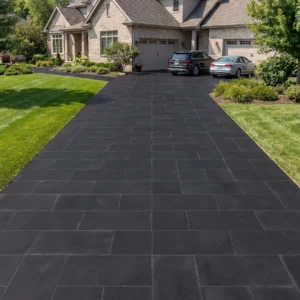
Beryl’s inventory repeated the region’s oldest lesson at terrible clarity — engineered mass stood, lightweight construction traveled — and the southern rebuild has absorbed it structurally: roofs strapped and rated, masonry respected, and hard landscapes on the full built-to-stay specification: mortar-set surfaces, capped engineered walls, storm-capacity drainage, connections engineered rather than assumed. Stone’s recovery logic proved itself across the affected islands — surfaces that survived needed sweeping; those that flew needed replacing — and rebuild-era specification treats the distinction as settled: repairability from documented spares is the storm-zone standard, full stop.
The harbor town’s renewal
Clifton’s recovery — the harbor front, the market square, the kitesurf-economy beach rows — carries the community’s public life, and its ground-plane rebuilding runs the harbor-town rules under recovery economics: surfaces chosen for decades because the island cannot fund do-overs, civic durability at honest cost, repairable unit construction so future storms meet a town that patches rather than rebuilds, and the phased, funded pragmatism of a community restoring its square while living on it. Visiting projects can serve the renewal directly: specifying local labor, sequencing around civic works, and leaving behind capacity — trained hands, spare materials, documented details — the town keeps.
Kite economy, rebuilt frontage
Union’s pre-storm rise ran on wind — the kitesurfing economy that made Clifton’s lagoon front famous — and the rebuild is restoring that frontage with the wet-sport register at kite pitch: rigging lawns and launch corridors kept honestly clear, gear-wash circuits and board racks on working-apron stone, barefoot-tough surfaces from beach bar to lagoon edge, and the wind-wise furnishing culture a coast this breezy never forgets. The economy’s return is the recovery’s proof: visitors funding the island’s rebuilding by enjoying what the wind always gave it.
Small-island recovery wisdom
The southern islands’ rebuild has distilled small-island construction wisdom the whole cluster can read: redundancy as kindness (the spare materials that fixed a neighbor’s wall), documentation as continuity (records surviving where memories were scattered), phasing as dignity (communities rebuilding homes before amenities), and the freight discipline of islands where every delivery matters — consignments complete, crates shareable, nothing wasted. The frontier-logistics rules apply with recovery’s urgency and the Grenadines’ grace.
- Redundancy as kindness, since the spare materials on your site fix a neighbor wall.
- Documentation as currency in every insurance and grant conversation.
- Materials that a local crew can lay now and repair later without specialist plant.
- Sequencing that gets roofs on before anything decorative begins.
- Surfaces chosen for decades, because the island cannot fund a second attempt.
Building with the rising
Union and its neighbors are rising — homes reroofed, the harbor working, the lagoon flying kites again — and construction there now joins a community mid-story: projects succeed by contributing to the rise, respecting its pace, and building to the standard the storm taught. The chain supply guide serves southern-rebuild projects with the era’s priorities built in — storm-standard specification, complete consignments, honest programs, spares that stay — because the southern Grenadines are writing the cluster’s most important chapter: how small islands come back. Building well there is the privilege of joining it.
What came back first: the rebuild’s supply lessons
Beryl’s aftermath taught Union Island a logistics curriculum the whole southern chain now quotes, and its first lesson was about what could move when everything needed to. Materials that shipped dense, stacked flat and survived open staging — stone prominent among them — flowed through the strained freight chain and waited on the quay without loss, while fragile finishes queued for covered storage that did not exist and weather windows that did not come. The rebuild’s early streetscape showed the result: masonry cores and stone ground works advancing while lighter trades waited on their supply lines, and the island’s builders re-learned an old small-island preference the hard way — specify what the chain can actually deliver in a bad year, because the bad year chooses its own timing.
The staging lessons cut just as deep. Consolidated consignments beat trickled orders when every sailing is contested; crates packed for rough handling and open storage beat packaging that assumes a warehouse; and the one-consignment discipline — everything for a phase in one planned landing — beat the optimism of follow-up orders in a queue measured in months. Batch documentation earned its keep too: repairs and completions matched cleanly where records existed, while undocumented surfaces joined the matching lottery. None of this is emergency-only wisdom; it is the southern Grenadines’ ordinary logistics with the margins removed, which is why the rebuild’s habits have persisted into the island’s calmer present.
For projects joining the island’s next chapter, the specification writes itself: dense durable materials, consolidated and documented, staged to survive weather and waiting. The rising harbor town is being built by the supply lessons its worst week taught — and the stone in its new ground is there partly because, when everything was hard, it was the material that kept arriving.
Reading the season the rebuild has to work around
Reconstruction in the southern Grenadines runs against a calendar that is published and predictable, and ignoring it is how a rebuild loses a year. The National Hurricane Center sets out the Atlantic season climatology.
- The season runs June 1 to November 30, which brackets the window every program respects.
- Climatological peak activity falls on September 10.
- Most activity concentrates between mid-August and mid-October.
- An average season produces fourteen named storms, seven hurricanes and three major hurricanes.
- Roofs and weatherproofing completed ahead of the active window, with finishes following after.
Where the approvals are actually handled
A rebuild still needs permission, and on Union Island the route is closer than most owners expect. The St. Vincent and the Grenadines Physical Planning Unit has decentralized development control.
- The Unit implements the Town and Country Planning Act through development control and land use planning.
- Planning desks operate in Georgetown, Barrouallie, Bequia and Union Island.
- Each desk runs monthly with planning technicians, building inspectors and clerks.
- Applications, inspections and planning advice are all available locally.
- National Building Regulations have applied to all projects since October 2011.
Specifying so the next storm is a clean-up
The point of building back better is not that nothing will happen; it is that the response is a broom rather than a rebuild.
- Mortar-set stone on every surface that must not move.
- Edge restraint on all free perimeters, including those planting will later hide.
- Drainage sized for storm rain and cleared before each season.
- Modular formats so damage is repaired unit by unit rather than in whole areas.
- Attic stock held on the island, which is the difference between days and months.
Island rebuild construction and the working method
Union Island has taught the region a set of lessons it did not ask for: engineered mass survives, lightweight construction travels, documentation decides what gets paid, and spare materials are a community asset. A private project here works best when it respects the sequencing everyone else is following, brings its own crew accommodation and consumables, lodges its application at the local desk, and specifies surfaces the island can maintain for decades. Where the harbor town frontage is the subject, our harbor town stone guide covers the register. Build so the next event is swept up rather than rebuilt.