The BVI’s economy sails: the world’s largest charter fleets base here, and the territory’s villas, bars and waterfronts are calibrated to guests who arrive by dinghy as often as by taxi. A charter-economy property lives a specific life — wet-footed, salt-crusted, high-turnover, photographed relentlessly — and its stone package should be specified for that life rather than for a generic villa brochure. Here is the charter register, surface by surface.
The dinghy-to-deck sequence
Charter guests arrive from the water, and the property’s first impression runs bottom-up: the dinghy landing’s textured steps, the dock apron built to the working-waterfront rules, the gear route wide enough for cooler-laden crews, the freshwater rinse point that intercepts salt and sand before the terraces, and the path climbing to the villa on treads that grip wet deck shoes. Every element earns marine-grade fixings and sacrificial-minded detailing at the waterline — the sea edits the bottom meter of everything eventually — with the refined register beginning where the spray genuinely stops.
Terraces for crews, not couples
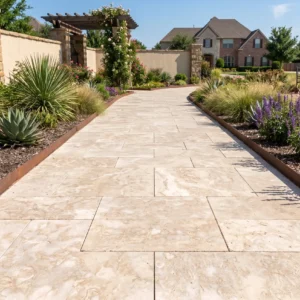
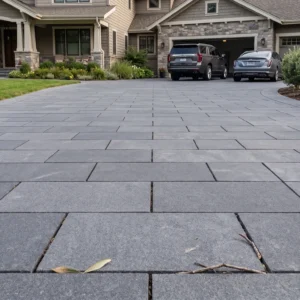
Charter villas host groups — six to twelve guests moving as a flotilla — and their outdoor rooms scale accordingly: long-table dining terraces on the generous-geometry rules, lounge decks sized for a crew’s worth of loungers, circulation that lets a laden barbecue run pass a sunbather without negotiation. Surfaces carry group life: dense stone with eased edges for dragged furniture, mid-tones and texture that hide a weekend’s traffic between cleans, flush thresholds that survive rolling coolers. The design brief is resilience wearing hospitality’s clothes — which is, conveniently, the specification this cluster writes everywhere.
- Size the main terrace for one long table rather than several small clusters, because charter parties eat together.
- Keep circulation routes wide enough for two people carrying trays to pass without stepping onto planting.
- Give every seating zone a shaded edge, since a terrace that bakes from noon is a terrace nobody uses.
- Set thresholds flush so bare feet, wet feet and rolling luggage all cross the same line without catching.
The turnover clock
Charter-adjacent properties turn over on boat schedules — changeover days when one crew leaves at ten and the next lands at four — and the stone package serves the clock: surfaces that reset with a rinse and sweep, pool surrounds whose morning service runs minutes, outdoor showers that hose clean, and the turnover economics running at charter tempo. Attic-stock spares matter doubly on turnover properties: a chipped step is repaired between crews, never during them, and only if the matching unit is already on island.
Bars, bases and the shoreside business
The territory’s beach bars, charter bases and provisioning docks run commercial versions of the same physics: crowd-grade paving on the public-space rules, wet-zone textures where swimsuited customers pad in from the water, hose-down serviceability after big nights, and the fuel-and-gear zones honestly zoned in tougher stone. These businesses live on atmosphere — the barefoot-bar register is the brand — and stone delivers it durably where timber demands its subscription and concrete apologizes for itself.
Photography is infrastructure
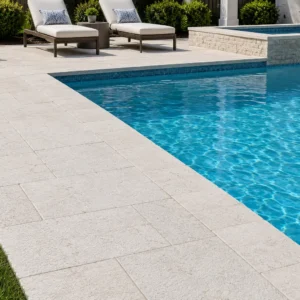
Charter itineraries are sold on images, and villa listings compete in the same feed: the property’s stone is its stage, and the stage must photograph. Pale decks against the channel’s blue, clean view edges over the anchorage, warm evening light grazing textured walls — the after-dark playbook earns direct revenue here, because sunset shots book charters. The maintenance corollary: the surfaces in the photographs stay photograph-ready, which is a scheduling decision — the sunrise service, the pre-season refresh — rather than a hope.
- Choose one dominant paving tone and let planting, timber and water supply the contrast.
- Avoid busy multi-color blends, which read as noise in a wide-angle photograph.
- Keep joint widths consistent, because irregular joints are the first thing a camera exaggerates.
- Specify a finish that photographs well when wet, since the pool surround is in almost every listing shot.
Specifying for the season
The charter year has its rhythm — the winter peak, the spring regattas, the summer lull, the autumn watch — and stone works schedule into it: upgrades and re-lays in the quiet months, deliveries ahead of the season, nothing disruptive while the moorings are full. Orders specify duty-grade for the traffic, marine-grade for the exposure, spares for the turnover clock, and batch continuity for the property that upgrades in phases. The territory’s supply guide prices it in one conversation — and understands, as everyone here does, that the season waits for no snag list.
Regatta weeks: when the territory fills
The BVI’s sailing calendar crests in its regatta weeks — the spring festival above all — when the territory’s population multiplies afloat, every mooring holds, and the shoreside economy runs at redline. For charter-facing properties these weeks are the year’s revenue concentrated, and the stone package proves itself under maximum load: terraces at capacity nightly, docks cycling tenders continuously, bars processing crews by the hundred, and every surface photographed against the massed fleets. Preparation is operational rather than structural — the pre-season inspection brought forward, attic-stock repairs completed before the fleets arrive, turnover resets rehearsed at speed, and the sunrise service running before the first race briefing — because during the week itself, nothing gets fixed, only survived.
The design lesson regattas teach reaches every specification the cluster writes: peak load is the true duty rating. The terrace sized for the regatta party is generous all year; the dock apron that handles raft-up crowds shrugs ordinary weekends; the drainage that clears a hundred wet crews’ worth of deck-shoe traffic never notices a family’s beach afternoon. Properties that specify to their busiest week — crowd-grade density on the gathering surfaces, eased edges everywhere gear travels, circulation that lets a laden bar run pass a seated fleet crew — spend marginally more once and own their calendar’s summit forever. The territory’s fondest bookings are made during regatta weeks by guests who watched a property handle the crush gracefully; the stone underfoot is half of what they watched.
The slip number that actually applies
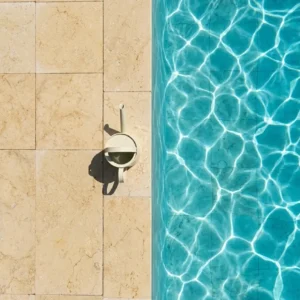
A charter villa is a wet building. Guests come out of the pool, off the dinghy and in from the rain, and they do it barefoot. Guidance published by Use Natural Stone on frictional testing sets out ANSI A326.3 as the current method, with a dynamic coefficient of friction of 0.42 as the benchmark for level interior spaces expected to be walked on wet. There is no equivalent published threshold for exterior use, and polished surfaces generally fail the wet test, which is why a polished pool surround is a specification error rather than a style choice.
- Test the actual finish you intend to buy, not the same stone in a different surface treatment.
- Treat 0.42 as a floor for wet interior circulation and aim higher for anything sloping toward a pool.
- Keep one texture family across pool deck, shower and steps so the underfoot feel never changes abruptly.
- Retest after a few seasons, because wear and cleaning regimes both move the number over time.
Designing around the hurricane calendar
Turnover economics collapse in the autumn, and that is the window a sensible owner uses. The National Hurricane Center climatology records the Atlantic season as June 1 to November 30, with activity concentrating from mid-August to mid-October and a statistical peak around September 10. Charter bookings thin out across exactly that stretch, which makes it the natural slot for terrace works, resurfacing and anything that needs the pool drained.
- Schedule disruptive stone works for the quiet weeks rather than fighting a full booking sheet.
- Land material before the peak so a delayed sailing does not strand a half-finished terrace.
- Detail loose items such as pots and furniture so they can be struck and stored in a few hours.
- Fix anything cantilevered or lightly bedded, because wind takes the unattached long before it takes the built.
What weekly turnover does to a surface
A house that changes guests every Saturday sees a decade of ordinary domestic use compressed into a couple of years. Sunscreen, spilled wine, dragged furniture and cleaning chemicals arrive on a schedule. The material question is not whether a surface can be damaged but whether the housekeeping team can reset it in the three hours between checkout and check-in.
- Favor through-body materials so a scuff sands out instead of exposing a different color underneath.
- Avoid anything needing a dedicated product, because the villa gets cleaned with whatever is in the store cupboard.
- Put felt pads on the schedule of works, not on the housekeeping wish list.
- Hold attic stock on the island so a cracked unit is a morning job rather than a shipping problem.
Getting charter villa stone right before the season starts
Charter work is unforgiving in a very specific way: the house is judged by strangers, in writing, every single week. That makes durability a revenue question rather than a maintenance one. Specify to the wet-test number, buy the finish that resets with a rinse, and hold spare material where the caretaker can reach it. Our British Virgin Islands stone guide sets out the formats, finishes and lead times that suit this territory. A terrace that still photographs well in year five is the cheapest marketing a charter villa will ever buy.