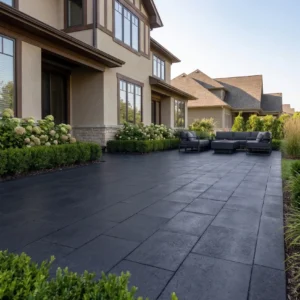
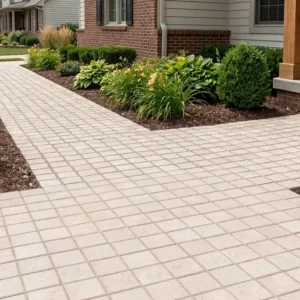
Grenada’s rental market has a second face the vacation listings never show: the long-let belt. Around True Blue, L’Anse aux Épines and the Grand Anse corridor, university staff and students, medical professionals, remote workers and relocating families rent by the year rather than the night — a market with steadier income, lower churn drama and completely different property economics. For landlords in this belt, finish decisions are investment decisions, and stone is the finish that thinks in the same timescales a landlord does.
A different tenant, a different brief
The long-let tenant is not photographing sunsets for a review; they are living — cooking daily, working at home, parking a car, growing a pot-plant jungle on the terrace. The property brief follows: surfaces that survive years of real domestic life, outdoor spaces that need no gardener to stay presentable, and a home that feels solid rather than styled. What the vacation market calls wow-factor, this market calls maintenance risk; what it rewards instead is the quiet quality of floors that stay level, cool and easy — which happens to be a precise description of a stone floor in the tropics. The vacation-rental spec optimizes for the photograph; the long-let spec optimizes for year five.
The turnover economy
Long-let economics concentrate at turnover: the weeks between tenancies when the property must be inspected, refreshed and re-let with minimal vacancy. Stone is the turnover landlord’s ally — a deep clean returns it to day-one presentation without the repaint-and-recarpet cycle lesser finishes demand, chips repair stone-by-stone from a small attic stock, and joints refresh in an afternoon. The make-ready checklist for a stone property is short and mechanical: wash, inspect edges and steps, renew the odd joint, re-oil nothing, replace nothing. Every cycle the floor does not consume becomes margin, and across a decade of tenancies the arithmetic compounds quietly in the landlord’s favor.
Tenant-proof by design
Specification for years of unsupervised domestic life has its own rules of thumb. Mid-tones over precious pale — they carry real life invisibly between cleans. Honed and textured over anything polished — polish records every scratch and demands ceremony. Eased edges everywhere furniture and appliances move. Dense low-absorption stone in kitchens and utility zones where oil and rust otherwise print. Outdoors, the low-maintenance garden logic at full strength: firm paths, gravel-and-slab courts, planting that survives tenant indifference, and nothing that requires enthusiasm to stay tidy. None of this is austere — done well it reads as calm and expensive — it is simply designed for the realistic case.
- Mid-tones over precious pale, because they carry real life invisibly between cleans.
- Honed and textured finishes over anything polished, which records every scratch.
- Eased edges everywhere furniture and appliances are moved.
- Dense, low-absorption stone in kitchens, bathrooms and anywhere liquids land.
- Modular formats so one damaged unit is a swap rather than a project.
What attracts and what retains
In a market of concrete-and-tile rentals, stone is differentiation a listing photograph carries instantly: the terrace reads established, the interiors read cool and serious, and the property earns its modest premium at the first viewing. Retention is the quieter win — tenants renew in homes that feel permanent and well-kept, and a landlord’s best financial event is the tenancy that simply continues. The south-coast geography helps the case: this belt is also the yachting coast, and properties that serve both markets — a long-let year, a sailing-season sublet — benefit from finishes that satisfy the fussier of the two audiences automatically.
Retrofitting the rental you already own
Most long-let landlords inherit their finishes and upgrade incrementally, and the stone entry points rank neatly by return: the main terrace first (the space tenants actually live in and viewings remember), the entrance and parking threshold second (first impressions and the mud line), wet zones third where original tiling has aged badly. Phased small orders travel by shared-container freight exactly as the guesthouse upgrade guide describes, tenancy gaps provide the working windows, and batch continuity keeps a property upgraded across three years from looking upgraded across three years. The full Grenada supply guide carries the mechanics; the strategy fits on an index card: durable, calm, repairable — and chosen once.
- The main terrace first, since it is the space tenants live in and viewings sell.
- Entrance and threshold second, which sets the impression before the door opens.
- Kitchen and bathroom floors as they come up for renewal.
- Steps and level changes, where damage and complaints concentrate.
- Parking and approach last, in a hard-wearing format that tolerates neglect.
The handover pack
The long-let landlord’s finish investment is protected at handover, in ten minutes and two pages. Page one is the care sheet: what the floors and terraces are, the pH-neutral cleaning rule, the short prohibited list — acid descalers, bleach on outdoor stone, dragging appliances — and the one-line reassurance that stone wants less fuss than tenants expect. Page two is the record: date-stamped photographs of floors, terraces, steps and thresholds at move-in, signed alongside the inventory, which turns end-of-tenancy conversations about wear versus damage from negotiation into comparison. Between tenancies the landlord’s own cadence does the rest — an annual walk of edges, joints and falls, the attic stock checked, the odd chip repaired while it is one stone rather than a trip hazard. Tenants respond to the pack’s signal as much as its content: a property handed over with documented, well-kept stone announces a landlord who notices, and homes with landlords who notice are the ones that get looked after. The pack costs an evening to create once, serves every tenancy after, and quietly completes the durability argument the stone began.
Furnished or unfurnished: what the floor decides
The long-let landlord’s other perennial question — furnished, semi, or bare — interacts with the stone decision more than either conversation usually admits. Furnished lets multiply the floor’s duty: every tenancy rearranges the landlord’s own furniture, movers drag what they should lift, and the finish must survive people who did not choose the sofa they are shoving — all of which the eased-edge, mid-tone, dense specification absorbs, and delicate finishes remember. Unfurnished lets shift the risk profile to move-in days: pianos, wardrobes and appliance trolleys crossing thresholds argue for the same forgiving floor plus protected threshold details at the doorways where every tenancy’s heaviest hour happens. Stone tilts the wider decision too: a property with handsome, durable floors shows beautifully empty — unfurnished listings live or die on their photographs of bare rooms — while the same floors let a furnished landlord buy simpler, cheaper furniture that reads well against quality ground, rather than expensive pieces compensating for tired tiles. And at every tenancy change, whichever model, the floor is the one asset that resets with a clean rather than a spend. The strategic summary for the belt’s landlords: specify the ground once, properly, and the furnishing question becomes a lifestyle choice instead of a risk calculation.
The formats and finishes that repair without a full lift
Everything about a rental floor should assume that something will be dropped on it. What separates a cheap repair from an expensive one is the format and the batch, not the stone itself. The Natural Stone Institute records that limestone absorption ranges from below one percent to above ten, with dolomitic varieties generally denser, less absorbent and more abrasion resistant.
- Low absorption where cooking, cleaning and outdoor life put liquids on the floor.
- Higher abrasion resistance on the routes tenants walk with shoes on.
- Modular unit sizes rather than oversized slabs, so a replacement is one piece.
- Acid-sensitive stone kept away from kitchens, since tenants will use whatever cleaner they buy.
- Spares kept from the original batch and stored dry, which is the whole repair strategy.
Slip resistance you can point to in a dispute
Landlords carry a duty of care that photographs do not discharge, and wet floors are where it is tested. The current standard and its limits are set out in this account of friction testing on stone walking surfaces.
- ANSI A326.3 measures dynamic coefficient of friction and can be run in place as well as in a laboratory.
- The 0.42 benchmark applies to level interior surfaces walked on wet, which covers bathrooms.
- No exterior threshold is specified, so terraces and steps need a specifier judgment.
- Polished finishes generally fall short and are a poor choice for any let property.
- Keeping the test result on file is cheap, and it is the document that matters if a claim arises.
Writing the tenancy pack so the floor survives
Most rental stone damage is not malice; it is a tenant using the wrong product in good faith.
- A one-page care note in the tenancy pack naming the cleaner to use and the ones to avoid.
- Acidic products explicitly excluded, since limescale removers destroy limestone.
- Felt pads supplied for furniture feet at the start of every tenancy.
- Inventory photographs of each floor at check-in and check-out, taken from fixed points.
- A named contact for repairs, with the batch reference already recorded.
Rental property stone flooring that outlasts the tenancies
A long-let landlord is buying a decade, not a photograph. That points at mid-tone, dense, textured stone in modular formats, spares from the original batch, a care note in the tenancy pack, and a slip test kept on file. It also points at spending first on the terrace and the entrance, where viewings are won and daily life is lived. Done that way the floors stop appearing in the turnover budget at all, which is the whole point. Where the outdoor rooms need covering, our garden structure stone guide continues the thought. Specify for the fifth tenant and the first four never notice a thing.