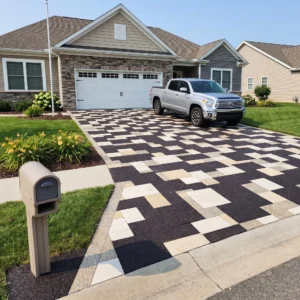
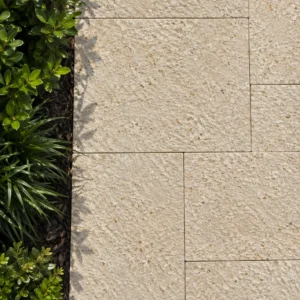
Grenada’s gardeners have the opposite problem to most of the world’s: nothing refuses to grow. Volcanic soil, generous rain and a greenhouse climate produce growth rates that swallow a neglected path in a single season and turn five-year landscape plans into jungle in three. Hardscape in this setting is not decoration — it is the garden’s skeleton, the permanent structure that keeps exuberance legible. Designing stone for a Grenadian garden means designing for the speed of green.
The structure that holds the show
In temperate gardens, plants furnish a layout the hardscape merely suggests. In Grenada the roles reverse: the stone must be strong enough — visually and physically — to hold its lines against vegetation that will lean on, spill over and root under it. Practically that means generous widths (a path that is ample at planting is narrow in eighteen months), bold simple geometry that stays readable under overhang, and real edges: solid stone edging or flush borders that give the gardener a defensible line to cut to. A garden with firm bones can be let to riot gorgeously; one without simply disappears.
Roots, edges and the long game
Tropical trees are magnificent and strategic: their roots seek moisture under paving, and the wrong tree in the wrong place lifts a terrace in a decade. The answers are placement first — large-species trees stood off from paved areas by honest distances, root barriers where the design insists on intimacy — and construction second: well-compacted bases resist exploratory roots far better than lazy ones, and unit paving tolerates the long game gracefully because a lifted corner can be taken up, the root addressed, and the same stones relaid. It is another argument for the repairability principle at garden scale: in a growing landscape, repairability is not a contingency, it is the plan.
- Large-species trees stood off from paved areas by an honest distance, decided at planting.
- Root barriers installed where the stand-off cannot be achieved.
- Generous, restrained edges that hold a line when a root eventually arrives.
- Modular formats on root-risk routes, so one lifted slab is an hour of work.
- Irrigation kept away from paving edges, since roots follow the water you provide.
The staining rain of a generous canopy
Lush gardens redecorate their floors continuously: leaf tannins print shadows after wet weeks, fallen mangoes and breadfruit leave their marks, blossom drifts stain in pretty but persistent ways, and birds contribute from the fig’s branches. Design manages most of it — dining terraces and pale precious surfaces sited out of the drop zones of the messiest trees, mid-toned stone under the canopy where fallout is heaviest, and prompt-sweep habits where it cannot be avoided. Chemistry manages the rest: pH-neutral cleaning, patience with organic shadows that weather out, and no acid products chasing quick results on limestone. The gardener’s broom, honestly, is the most important stone-care tool on the island.
The kitchen garden in stone
The Spice Island’s home gardens grow food as a matter of culture, and stone serves them practically: raised beds with stone edges hold soil on sloping plots, warm quickly and drain well; a stone-capped bed edge at sitting height turns weeding into a comfortable job; and firm paths between beds keep harvest trips mud-free through the wet months. On slopes the beds terrace naturally — small retaining runs with the same drainage manners as their larger hillside cousins — and the whole composition sits happily beside the ornamental garden, sharing its palette and its rain.
A maintenance partnership
Every Grenadian garden of ambition has a gardener, and the hardscape should be designed as their ally: hose points where washing happens, tool-width paths to the working corners, a hardstanding for compost and cuttings that keeps the mess off the lawns, and gravel zones where fallen leaves rake out easily. Add a shared calendar — pruning that keeps canopy off the paths, algae-season attention for shaded stone, an annual joint-and-edge inspection — and the garden’s two systems, growing and built, work as one. Materials for all of it travel together through the Grenada supply overview; the green, as ever on this island, arrives free and enthusiastic.
- Hose points placed where washing actually happens, not where the plumbing was easiest.
- Tool-width paths reaching every working corner of the garden.
- A hardstanding for compost, bags and the wheelbarrow that lives outside.
- Turning space at path ends, because a barrow reversed through planting does damage.
- Storage sited on the route the gardener already walks.
The lawn question, answered honestly
Every Grenadian garden plan eventually argues about lawn, and the honest answer is: some, deliberately. Tropical grass grows with the same enthusiasm as everything else on the island, which means mowing as a permanent commitment; it also takes traffic poorly in the wet months, turning the shortcut route to mud precisely when the garden is at its most beautiful. The design response is to let lawn do what lawn does best — a defined green plane for play, dogs and bare feet in the garden’s heart — and give the working routes and gathering places to stone, which carries the traffic lawn cannot. The junction detail matters more than either surface: a flush stone mowing strip at every lawn edge lets the mower run its wheel on stone and cut clean to the line, abolishing the strimmer damage that otherwise chews both the lawn’s edge and the paving’s arris. Lawn as a chosen feature inside firm stone bones is the maintainable version of the tropical garden dream; lawn as the default ground cover is a subscription that renews weekly forever.
Compost corners and the tidy cycle
A garden that grows this fast produces biomass at industrial rates, and where the cuttings go decides how the whole property reads. The composting corner deserves promotion from guilty heap to designed facility: a stone-paved hardstanding sized for real volumes, low walls in the garden’s own masonry organizing bays for fresh cuttings, working compost and finished material, and a firm barrow route connecting it to the borders it feeds. The stone floor is what makes the cycle civilized — turning compost on paving is clean work while turning it on mud is punishment, and the hardstanding hoses down after the messiest sessions. Site the corner downwind and screened but not exiled: a facility fifty inconvenient meters away gets bypassed, and green waste starts accumulating exactly where it should not. The economics reward the investment quickly — a lush Grenadian garden fed by its own compost cuts both the waste-removal runs and the imported-fertilizer bill, and the dark finished product is the best mulch the island’s beds can receive. There is even a quiet aesthetic dividend: gardens with a working compost court tend to be the tidy ones, because the system gives every pruning session a destination. Order the corner’s modest stone with the main package; it is the least glamorous square footage on the property and among the most used.
What the rain actually delivers
Fast growth and organic staining both trace back to one number, and Grenada’s is published. The Caribbean Regional Climate Centre profile for Grenada explains why a garden here behaves the way it does.
- Mean annual rainfall around 1,161 mm at the airport over 1986 to 2015.
- Totals from roughly 1,150 mm in the extreme southwest to over 3,000 mm at higher elevations.
- A wet season from June to November, with more than 100 mm every month.
- A dry season from February to April, often below 50 mm per month.
- Mean annual temperature around 27.5 degrees Celsius, with almost no seasonal relief.
Setting systems for ground that never stops moving
A tropical garden is a soft, wet, root-filled place to build, which makes the setting system a maintenance decision as much as a structural one. This overview of detailing natural stone paving covers the three options and what each demands.
- Sand-set paving on garden paths, so slabs can be lifted and relaid when a root arrives.
- Mortar-set construction at steps, seat walls and terraces where stability governs.
- Pedestal systems where a terrace sits over structure with free drainage beneath.
- Compacted base depth matched to the traffic, including the mower and the barrow.
- Drainage designed as part of the system, because standing water feeds everything you do not want.
Keeping algae and stains in their place
Organic staining is not a failure; it is the climate. What matters is whether the garden was designed so that cleaning takes minutes.
- Dining terraces and pale surfaces sited out from under fruiting and heavily flowering trees.
- Mid-tone stone on shaded routes, which carries tannin marks far better than brilliant pale.
- A scheduled wash rather than a reactive one, timed to the end of the wet season.
- Neutral cleaners only, since acidic products damage limestone permanently.
- Enough light and air movement over damp paths, because permanent shade guarantees algae.
Tropical garden hardscape that keeps its lines
In a climate where everything grows, the hardscape is the only part of the garden that holds still, and that is precisely its job. Give it generous edges, modular formats that repair in an hour, sensible stand-offs from big trees, drainage that never lets water sit, and a maintenance routine the gardener can actually run. Do that and the planting can be as exuberant as Grenada encourages, because the structure underneath will still be legible in ten years. If the terrace and pool side of the garden is still open, our hillside villa stone guide covers the levels above. Build the structure to be permanent and let the planting be the part that changes.