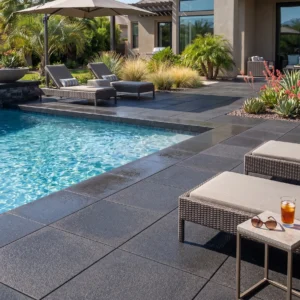
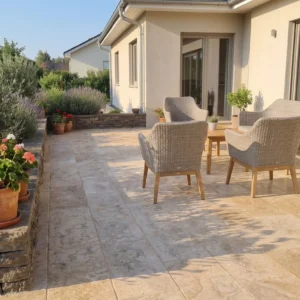
A distinctive slice of Providenciales real estate lives on water you can park a boat in: the canal homes of Leeward, properties around Turtle Cove, and the residences threaded through marina developments. These homes run a different daily rhythm — the garden ends at a dock, the boat is a family member, and the landscape works harder than any inland plot: salt wetting from below, gear traffic across it, and a waterline edge that is both infrastructure and view. Stone is the material that handles all three lives at once.
The splash zone is a specification of its own
Dock edges, bulkhead lines and the first meter of garden behind them live in near-permanent salt contact — not the drifting spray a beachfront terrace sees, but wetting from wake, tide and wash-down, daily. The stone answer is density: low-absorption material throughout the splash zone, full mortar beds with no voids for brine to colonize, and joints finished flush so rinsing actually clears them. Every metal fixing in the zone — cleat bolts, ladder brackets, light fittings — should be marine-grade, because the stone will outlast three generations of inferior hardware around it. The freshwater rinse that the coastal playbook prescribes weekly for spray zones is a more frequent habit here, ideally plumbed for: a hose point at the dock head makes the right routine the easy one.
Capping the bulkhead
The engineered seawall or bulkhead that holds the canal edge is concrete infrastructure; the stone cap is what turns it into architecture. A dimensioned capping run — generous overhang waterside, drip groove beneath, units sized so each spans comfortably between movement joints — gives the waterline a finished line that reads from across the canal and doubles as the dock’s working edge: a place to step, sit, land a cooler, tie a fender. Long straight runs move with temperature, so joint discipline matters more than on any garden wall; and because caps take the knocks of dock life, spare units from the same batch belong in the garage against the day a swinging outboard wins an argument with the edge.
The working waterfront: designing for gear
Boat life is equipment life: coolers dragged, tanks trundled, tackle boxes dropped, carts wheeled from garage to dock. The landscape between house and water should be specified like a small working quay rather than a display garden — 3 cm-plus stone on the main gear route, eased edges that shrug impacts, a surface texture that grips wet deck shoes, and a layout that gives the route straight, generous geometry rather than steps and pinch points. A dedicated utility zone earns its keep: a hose-down apron with a fish-cleaning bench, draining away from the social terrace, in stone chosen for cleanability — smooth enough to wash clean, textured enough to stand on wet. Zoning the practical surfaces honestly keeps the social surfaces pristine.
- A continuous hard route from garage to dock, wide enough for a loaded cart to turn.
- Flush transitions at every threshold, since wheels and lips are what chip stone edges.
- A tough, textured finish on the gear route rather than the terrace finish extended outward.
- A wash-down point at the dock end, plumbed and drained away from the paving.
- Spare units held from the original batch, because the gear route takes the damage.
One palette from terrace to tide
The canal home’s pleasure is continuity: the same material story flowing from the villa’s Grace Bay benchmark down the garden, across the gear route, onto the dock apron and out along the bulkhead cap. Palette continuity makes a modest plot feel composed and long; it also photographs — canal frontage is bought and sold on exactly this view. Duty changes along the route, so thickness and finish shift zone by zone while tone holds steady, which is an ordering discipline: one batch, one supplier conversation, zones specified line by line through the Turks and Caicos guide. Evening light completes the composition — low fittings washing the cap line and dock edge, so the waterline reads safely and beautifully after dark, from the terrace and from arriving boats alike.
Storm season at the dock
Waterfront stonework meets storm season earlier and harder than the rest of the property, and the canal home’s pre-season routine reflects it. The movable inventory goes first: dock boxes, fenders, cleaning stations and furniture all have designated storm homes inland of the house. The fixed stonework asks for inspection rather than evacuation — bulkhead caps checked for hollow beds and open joints (surge exploits both), dock-edge fixings tightened, and the drainage paths from garden to canal cleared so storm rain leaves fast. After a surge event the sequence is rinse, inspect, re-bed: fresh water over everything the sea touched, a slow walk of the cap line for movement, and prompt re-bedding of any unit the water worked loose, from the attic stock every waterfront property should hold. The waterline itself keeps its own calendar — the algae shadow that marks the splash zone darkens through the warm months regardless of storms — and a stiff brush and patience remain the correct response; the sea signs its work, and waterfront owners learn to read the signature calmly.
- Dock boxes, fenders, cleaning stations and furniture assigned storm homes inland of the house.
- Bulkhead caps sounded for hollow beds before each season.
- Cleats, ladders and lift fixings checked for corrosion at the bedding line, not just at the head.
- Drainage lines cleared so surge water leaves the apron rather than sitting on it.
- The whole apron photographed from fixed points and filed with the insurance papers.
Boat lifts, davits and the heavy hardware
Serious waterfront living eventually bolts serious machinery to its stonework, and the interface deserves engineering respect. Boat lifts and davits deliver concentrated loads — static weight plus the dynamic surge of a vessel settling — into whatever they stand on, so their foundations are structural elements designed as such, with the surrounding stone detailed to meet them rather than carry them: movement joints isolating the equipment pad from the terrace field, so machinery vibration never telegraphs into the paving, and access margins left honest for the service technician who will visit annually. Fixing points for cleats, fender hooks and canopy frames follow the same rule at smaller scale — anchored into structure or dedicated pads, never into facing or caps, with marine-grade hardware throughout because the fastener is always the first casualty. Cable and power runs for lifts want sleeves under the stone laid at build time, arriving at a dressed service point rather than a conduit stapled across a wall. And the visual trick that keeps a working dock elegant: let the machinery stand on its engineered pads while the stone composes calmly around it, the same zoning honesty that separates gear routes from social terraces applied vertically. Equipment ages and gets replaced; the stone that was detailed to accommodate rather than embed it survives every upgrade cycle untouched.
What salt actually does to the stone
The splash zone is a chemistry problem as much as a wear problem. Salt arrives dissolved, migrates into the pore structure, and crystallizes as the surface dries, which is what lifts a face over years rather than months. Absorption is therefore the number that matters most, and the Natural Stone Institute records that limestone absorption runs from below one percent to above ten, with dolomitic stone generally denser and less absorbent.
- The lowest-absorption stone available for the bulkhead cap and the first run of apron behind it.
- Textured rather than polished finishes, which hide the efflorescence that salt eventually produces.
- Fresh-water rinsing after wash-down and after storms, wherever supply allows.
- Acid cleaners avoided entirely, since carbonate stone reacts to them and the damage is permanent.
- Jointing and bedding mortars specified for marine exposure rather than for a garden terrace.
Setting stone that will be walked on wet every day
A dock apron is wet more often than it is dry, and the way it is laid decides whether it stays flat when the ground beneath moves with the tide. The three setting systems behave differently here, and this summary of detailing natural stone paving sets out the choices.
- Mortar-set construction on the bulkhead cap and anywhere stability is non-negotiable.
- Sand-set paving on the garden run, where individual units can be lifted and relaid.
- Pedestal systems only where a terrace sits over structure with free drainage beneath.
- Movement joints where the apron meets the seawall, because those two elements move differently.
- Full beds under every cap unit, since a hollow cap at the water edge fails first and fails visibly.
Hardware, point loads and the fixings that fail quietly
Lifts, davits, ladders and cleats concentrate loads into small areas of stone and steel, and the failure is almost always at the interface rather than in the machine.
- Loads taken into the concrete structure, with stone treated as a facing rather than as a bearing element.
- Fixings specified in marine-grade stainless and isolated from dissimilar metals.
- Bedding at fixing points made solid and continuous, with no voids to hold water.
- Access left for inspection, so a corroding fixing can be seen before it is a failure.
- An annual check of every through-fixing, at the same time as the pre-season walk.
Waterfront home stone that lives well at the dock
Canal and marina homes ask their stone to do two contradictory jobs: look like the villa terrace and survive like infrastructure. The way through is to keep one palette but change the specification as you approach the water, dropping absorption, tightening the finish, and treating the bulkhead cap as a marine component that happens to be beautiful. Add a gear route that tolerates dragged coolers, fixings chosen for salt rather than convenience, and a pre-season routine that takes a morning. The deck end of that palette is covered in our guide to deck stone along Grace Bay. Specify the last three feet before the water as seriously as the first three feet outside the door.