Travertine tile for pools performs differently than most buyers anticipate — not because the material is unpredictable, but because pool environments create a specific combination of demands that expose any specification gap almost immediately. Sustained chemical exposure, thermal cycling between cool water and hot sun, and the ever-present wet-surface safety requirement all intersect in a pool setting. Understanding how travertine tile for pools navigates those demands — and where you need to pay closer attention than a standard tile spec — is what separates a 25-year installation from one that needs remediation within a decade.
What Is Travertine Tile?
Travertine is a sedimentary limestone formed through the precipitation of calcium carbonate from geothermal springs and groundwater systems. The process creates a characteristically banded stone with a natural open-pore structure — those familiar pits and voids that distinguish it from dense marble or granite. You’re looking at a material that formed over thousands of years as dissolved minerals deposited layer by layer, which is why each slab carries genuine variation in color, vein pattern, and surface texture. No two installations look identical, and that’s a feature, not a flaw.
The stone’s porosity comes directly from carbon dioxide escaping during formation, leaving behind a cellular void network within the calcium carbonate matrix. Depending on the quarry and formation conditions, travertine’s absorption rate typically falls between 3% and 12% — a wide range that matters significantly when you’re specifying for a pool environment. Higher-absorption material requires more aggressive sealing schedules, while lower-absorption travertine can handle lighter maintenance cycles. Knowing where your selected material falls on that spectrum is a foundational decision, not an afterthought.
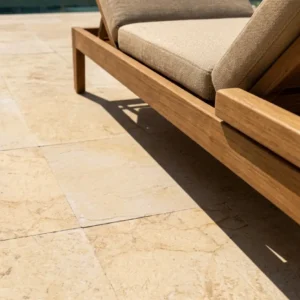
For pool applications, travertine tile is most commonly available in filled-and-honed, tumbled, and brushed finishes. Each finish choice affects slip resistance, heat retention, and long-term maintenance requirements in ways that are worth understanding before you finalize a specification — and that understanding begins with the question of what travertine tile is and how its formation directly shapes its performance characteristics.
Surface Finish and Slip Resistance for Pool Decks
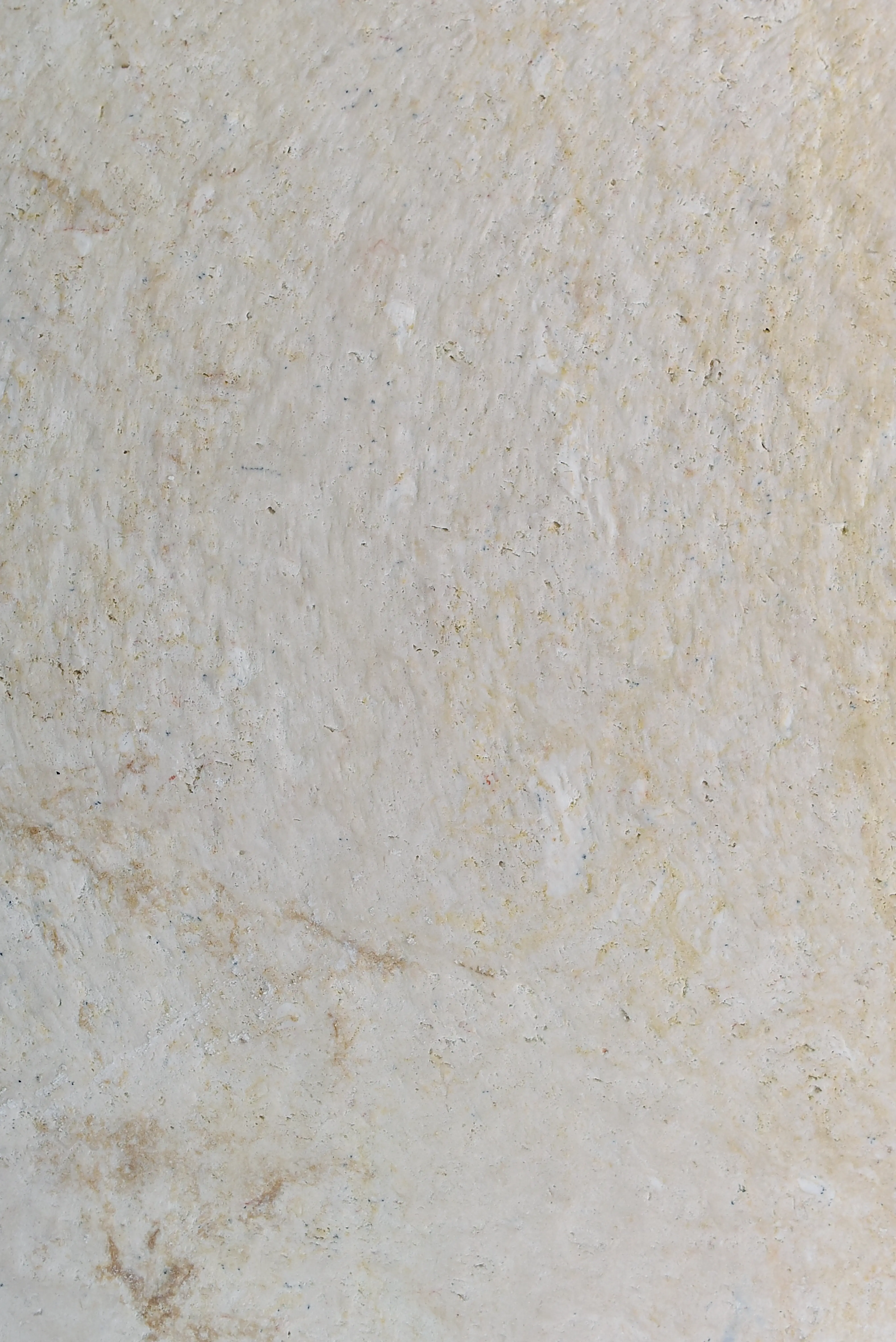
The surface finish decision is the specification choice that most directly affects pool safety, and it’s the one that gets glossed over most often in product literature. Travertine’s natural open-pore structure creates inherent micro-texture that aids traction — but the finish you select amplifies or diminishes that advantage considerably.
- Tumbled travertine produces a naturally roughened surface with rounded edges, and that finish is what governs wet traction — 0.42 wet DCOF is the minimum threshold that ANSI A326.3 generally targets for safe pool deck use
- Brushed finishes use wire or abrasive tools to open the surface grain without removing the stone’s natural variation, giving you a reliably textured result that holds up well under repeated chemical exposure
- Filled-and-honed travertine offers a flatter, more refined surface — acceptable for coping and transitional areas but less ideal for broad deck surfaces where wet bare feet are the norm
- Polished travertine is essentially off the table for pool decks — the smooth, closed surface becomes genuinely hazardous when wet and offers no practical benefit in an outdoor pool environment
The PHTA pool deck safety standards provide specific COF guidance for wet stone surfaces in aquatic environments — it’s worth reviewing those parameters against your material’s test data before committing to a finish choice.
Thermal Performance and Heat Retention
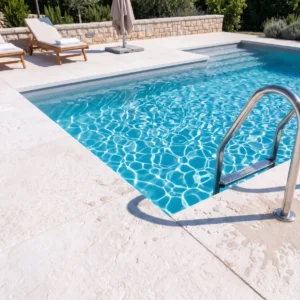
Here’s one of the genuine advantages travertine tile for pools delivers that denser materials simply can’t match. Travertine’s open pore structure reduces its thermal mass compared to granite or dense porcelain, which means the surface stays meaningfully cooler under direct sun exposure. On a peak summer afternoon when dark granite can reach surface temperatures exceeding 140°F, travertine in a light ivory or cream finish typically runs 20–35°F cooler. For barefoot pool deck use, that difference is immediately noticeable and practically significant.
The color selection amplifies or reduces this effect. Light-toned travertine — ivory, silver, walnut cream — reflects substantially more solar radiation than darker varieties. In high-heat climates where sun exposure is intense for six or more months annually, specifying a lighter travertine isn’t just an aesthetic preference; it’s a functional decision that affects how usable the deck is during peak afternoon hours. Darker travertine can still perform well, but you’ll want to build shade structures or restrict peak-hour use into the design brief if you go that direction.
Travertine’s natural formation also makes it less prone to rapid thermal shock than dense igneous stones. The micro-void structure provides a slight buffer against the extreme temperature differential between pool water splash and sun-baked surface — a subtle benefit that contributes to long-term dimensional stability.
Chemical Compatibility and Pool Water Exposure
This is the section most buyers skip, and it’s the one that creates the most problems in the field. Travertine is a calcium carbonate stone, which means it reacts with acids. Pool water chemistry — specifically chlorine, pH levels, and any acid-washing maintenance — directly affects travertine’s surface and grout joints over time.
Your pool water pH should stay consistently between 7.2 and 7.6 for both water quality and stone preservation. When pH drops below 7.0, the acidic water accelerates surface etching on any calcium carbonate stone, including travertine. You’ll see this first as a dulling of the honed surface and eventually as roughening and pitting beyond the stone’s natural texture. Saltwater chlorination systems deserve specific attention — they operate at lower chlorine concentrations but the salt chemistry can accelerate surface degradation on unsealed or poorly sealed travertine tile for pools.
- Maintain pool water pH between 7.2 and 7.6 as a hard operating limit, not a suggestion
- Avoid any acid-based cleaning products — including muriatic acid — on or near travertine pool surrounds
- For saltwater pools, increase sealing frequency to at least annually rather than the standard 18-24 month cycle
- Grout selection matters as much as the stone — use a non-sanded epoxy or polymer-modified grout that resists chemical penetration and doesn’t absorb pool water
- Check expansion joints at the pool bond beam annually — chemical exposure concentrates at those transitions and early intervention prevents costly remediation
According to ASTM C1527 travertine dimension stone standard specifications, absorption and chemical resistance testing should inform your material selection before purchase — ask your supplier for test data on the specific material you’re specifying, not generic category data.
Thickness and Structural Specification
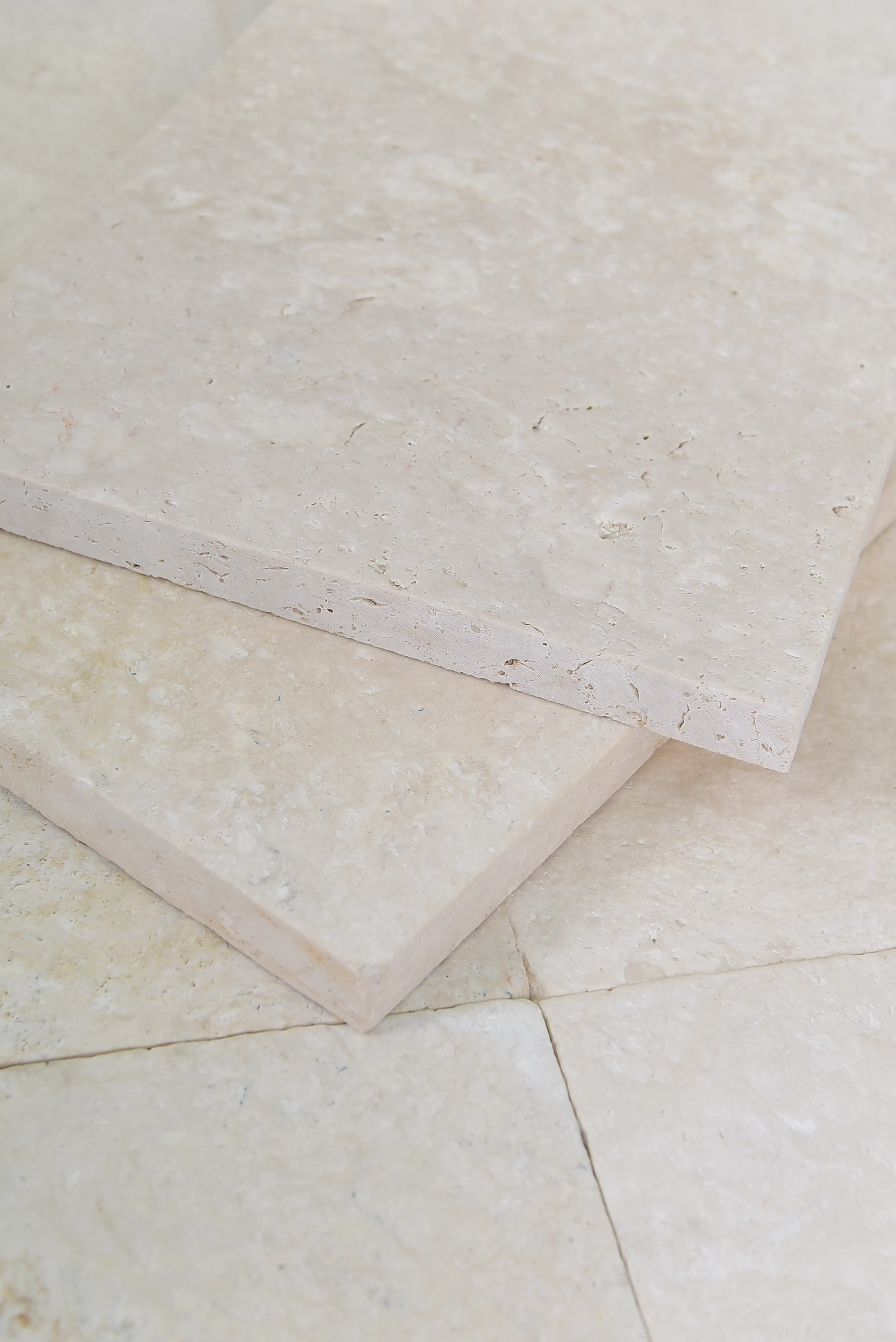
Pool deck travertine tile runs in two practical thickness ranges depending on application: 3/8-inch to 1/2-inch for thin-set tile installation over a concrete substrate, and 1 1/4-inch to 2-inch for paver-style applications set over a compacted aggregate base or pedestals. The choice between these approaches determines your substrate requirements, your drainage design, and your long-term maintenance access.
Thin-set tile installation over an existing pool deck slab is the more common residential approach. You’ll need a structurally sound, crack-free concrete substrate — any existing cracks in the slab will telegraph through your travertine within two or three seasonal cycles if you don’t address them with crack isolation membrane before setting tile. The membrane adds cost but it’s non-negotiable on older pool decks with any visible movement history.
Paver-style travertine tile in the thicker range gives you better freeze-thaw performance in colder climates because the installation can accommodate minor substrate movement without cracking individual units. In freeze-thaw regions, the thicker paver format over a properly graded base also provides natural drainage — water drains through joints rather than pooling on the surface, which reduces ice formation risk and extends the installation’s service life considerably.
For coping specifically, you’re typically looking at 12-inch or 16-inch width pieces with a bullnose or drop-face edge profile. The coping takes more direct mechanical stress from swimmers pushing off, pool equipment contact, and thermal cycling at the water line — specifying at least 1 1/4-inch thickness at coping is standard practice regardless of what thickness you use on the broader deck.
What Is the Right Tile Size for Pool Applications?
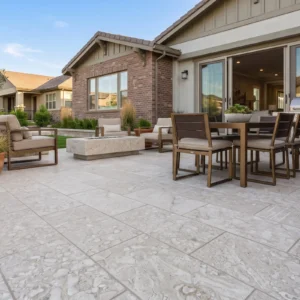
Size selection for travertine tile for pools follows different logic than interior flooring. Larger format tiles — 16×16 and 18×18 — minimize grout joint lines across the deck, which reduces the number of penetration points for pool chemicals and makes cleaning more efficient. You’ll also get a more expansive visual effect that works well with larger pool shapes.
The practical constraint on size is your substrate flatness tolerance. For 16×16 or larger tiles set in thin-set, your concrete substrate needs to be within 1/8-inch flat over a 10-foot span. Larger tiles bridge surface irregularities differently than smaller tiles — hollows under large tiles create stress concentration points that crack the tile under point loading. You can work around minor flatness issues with a medium-bed mortar rather than standard thin-set, but significant substrate variation needs grinding or self-leveling compound before tile installation begins.
- 12×12 tiles suit most residential pool decks and offer the best tolerance for minor substrate imperfections
- 16×16 and 18×18 work well on new-construction decks where substrate flatness can be specified from the start
- Smaller formats — 4×4 and 6×6 — work well for step risers and tight coping returns but look visually busy on broad deck surfaces
- Irregular or versailles pattern layouts can add visual interest but require more complex cutting and generate more waste — factor an additional 12-15% material overage for pattern installations
Browsing our poolside travertine range will give you a clear view of the color variation and fill consistency across the available formats — something worth evaluating in person or via sample before finalizing your selection.
Sealing Requirements and Maintenance Schedule
Travertine tile for pools is highly resistant to wear and weathering when properly sealed — but the sealing protocol in a pool environment is more demanding than interior applications and needs to be built into your project’s long-term maintenance plan. The combination of UV exposure, chemical contact, and thermal cycling accelerates sealer degradation compared to a covered patio or indoor floor.
Use a penetrating impregnating sealer — not a topical or surface sealer — for pool deck travertine. Penetrating sealers bond within the stone’s pore structure rather than forming a surface film, which means pool splash and chemical exposure don’t strip the protection the way they would with a film-forming sealer. Look for a product rated for exterior stone with UV inhibitors. Apply the first coat before grouting and a second coat after grout cure is complete — this pre-grouting application protects the stone face during grout installation and is a step that gets skipped far too often.
A realistic maintenance sealing schedule for pool environments:
- Standard chlorine pools: reseal every 18–24 months
- Saltwater pools: reseal annually
- High-UV coastal or desert climates: reseal annually regardless of pool type
- Perform a simple water-bead test annually — if water soaks in rather than beading on the surface, it’s time to reseal regardless of the calendar schedule
The Natural Stone Institute’s travertine outdoor performance data provides detailed guidance on absorption rates and how they correlate with sealing frequency — material-specific data rather than generic stone advice.
Budgeting, Freight, and Cost Factors
Material cost is rarely the whole story with travertine tile for pools, and this is where projects get mispriced most frequently. The material-to-labor ratio on a pool deck installation typically runs 40:60 in most markets — meaning skilled labor often costs more than the stone itself. That ratio shifts based on your local trade market, and it has a direct bearing on where value engineering makes sense.
Freight distance from supplier to project site can add meaningfully to total material cost, particularly for large pool projects requiring significant tonnage. Palletized travertine tile is heavy freight — typically 40–50 lbs per square foot at 1 1/4-inch thickness — and truckload minimums affect pricing. Projects under 500 square feet often pay LTL (less-than-truckload) freight rates that add 15–25% to material cost compared to a full-pallet, full-truck shipment. Consolidating your order to a single truck delivery where possible eliminates that premium. Citadel Stone ships travertine tile nationwide from warehouse stock, which keeps lead times manageable — typically 1–2 weeks from order to delivery for stocked formats rather than the 6–8 week cycle for specially imported material.
The smarter value engineering move on travertine pool projects isn’t always choosing a lower-priced stone. Consider where dimensional consistency pays dividends in labor efficiency — premium-grade travertine with tight thickness tolerance and consistent fill quality installs faster and produces less waste than economy material with variable thickness. In high labor-cost markets, the premium on better-graded material often pays for itself in reduced installation hours and lower waste overage. Specify your grading requirements clearly in writing before purchasing: fill quality, thickness tolerance, calibration method, and edge consistency all affect field installation time.
Regional material availability also affects lead times on custom sizes and finishes. Filled-and-honed in standard formats ships readily from warehouse stock in most markets. Tumbled finishes in larger formats or non-standard dimensions may require additional production lead time — confirm warehouse stock levels before locking in a project schedule, especially for jobs starting within four weeks of material order.
Installation Variables That Determine Long-Term Service Life
The gap between a travertine pool installation that looks great for five years and one that performs well for 25 years almost always traces back to installation decisions, not material quality. You can specify excellent travertine tile and still end up with an underperforming installation if the details aren’t executed correctly.
Expansion joint placement is the detail most frequently shortchanged. Travertine’s thermal expansion coefficient sits around 4.4 × 10⁻⁶ per °F — modest compared to concrete, but the differential movement between the tile field and the concrete slab beneath it still accumulates meaningfully across seasonal temperature swings. Industry guidance calls for expansion joints every 12–15 feet in both directions for exterior travertine tile, with an additional joint at all transitions — pool edge, structure walls, steps. Those joints need to be filled with a flexible polyurethane or silicone caulk, not grout. Grouting an expansion joint location is one of the most common installation mistakes and one of the most predictable causes of tile cracking within the first few years.
- Mortar coverage must reach 95% of the tile back surface for exterior pool applications — use a back-butter technique on larger tiles to ensure full contact
- Allow full mortar cure (minimum 72 hours, longer in cool conditions) before allowing foot traffic or water exposure
- Slope the deck surface a minimum of 1/8-inch per foot away from the pool structure to direct water drainage away from the bond beam
- Fill travertine holes and voids with color-matched epoxy fill before final sealing — unfilled voids collect pool chemicals and debris, accelerating localized degradation
- Set pool coping with a 1/4-inch overhang beyond the pool shell edge to direct water drips away from the waterline tile below
According to USGS geological data on natural stone composition, the mineral structure of calcium carbonate stones like travertine responds differently to freeze-thaw stress than silicate stones — a distinction that directly informs your joint design in colder installation environments. In freeze-thaw regions specifically, the combination of proper joint placement, penetrating sealer, and adequate substrate drainage is what separates an installation that survives winter from one that begins delaminating by spring.
Getting Travertine Tile Pool Specifications Right
Travertine tile for pools earns its reputation as an exceptionally durable, high-performance pool material — but that reputation holds only when the specification is complete. Surface finish, absorption rate, chemical compatibility, sealing schedule, expansion joint placement, and substrate preparation all feed into whether your installation reaches its potential service life. Shortcuts in any one of these areas tend to compound over time in a pool environment where chemical exposure, UV, and thermal cycling are continuous rather than occasional stresses.
Your specification should start with the material’s test data — absorption rate, COF on wet surfaces, thickness calibration tolerance — rather than with aesthetics alone. Aesthetics matter, and travertine’s natural variation and warm tonal palette are genuinely hard to replicate with manufactured alternatives. But locking in the performance parameters first ensures the material you select for its beauty also holds up to everything a pool environment will put it through over the following decades. For everything related to keeping your stone in top condition over the long haul, safe travertine cleaning methods covers the maintenance approach that protects your investment without damaging the stone surface — a natural companion resource for any pool project spec that includes travertine.
At Citadel Stone, we evaluate travertine through the lens of actual pool project requirements — checking fill consistency, thickness calibration, and finish quality against what installation crews encounter in the field, not just what looks good in a product image. That hands-on quality review at the warehouse level is what gives you confidence that the material arriving on your truck matches the sample you approved. Sourced direct from quarries in Turkey, the Mediterranean, and beyond, this pool travertine ships in consistent 12-inch runs for coping and decks.
Related reading: gray travertine tile ideas · travertine polished tile · travertine tile installation cost.