What Surface Temperature Actually Means for Coping Selection
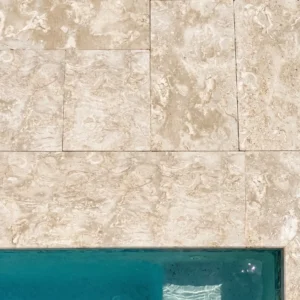
A travertine coping heat comparison isn’t just about which shade looks coolest — it’s about quantifiable surface temperature differentials that determine whether barefoot contact is comfortable or genuinely painful. The three dominant travertine tones in commercial and residential pool specification — Ivory, Gray, and Silver — each behave differently under direct solar load, and those differences aren’t subtle. You’re looking at peak-hour surface temperature spreads of 18–26°F between the lightest and darkest tones, measured at 1–2 pm solar time on honed finishes in full sun exposure.
The mechanism driving those differences is solar reflectance, technically expressed as the Solar Reflectance Index (SRI). Ivory travertine typically registers an SRI of 55–70 depending on finish and fill treatment, Gray travertine falls in the 35–50 range, and Silver travertine — despite its name suggesting a light tone — reads 40–55 due to its cooler undertones and natural vein density. Understanding where each variant sits on that scale gives you the specification clarity that generic “travertine is cool underfoot” claims never provide.
Ivory Travertine Coping: Thermal Profile and When It Leads the Spec
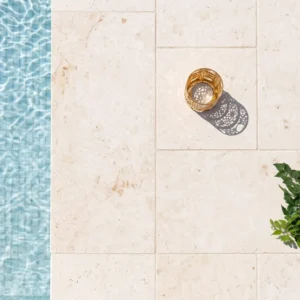
Ivory travertine consistently delivers the lowest surface temperatures of the three tones — typically 15–22°F cooler than Gray under equivalent midday solar load. That performance gap traces directly to its high calcium carbonate matrix density and low iron oxide content, both of which reduce solar heat absorption. On a 95°F ambient day, Ivory honed coping commonly reads 115–122°F at peak, compared to 133–140°F for mid-tone Gray. That 18°F differential is the difference between tolerable barefoot contact and a surface that sends people to the towel immediately.
The thermal advantage of Ivory coping does come with a practical trade-off you need to plan around. Its high porosity — typically 3.5–7% absorption by weight per ASTM C97 — means it picks up organic staining from tanning oils, algae splash, and iron-rich water noticeably faster than darker tones. You’ll want a penetrating silane-siloxane sealer applied before the pool is filled, reapplied on a 24-month cycle, and tested annually with the water bead test. Skipping the initial seal after installation is the single most common field error on Ivory coping projects — by the time the homeowner notices discoloration, the staining has penetrated 3–5mm into the face.
- Best thermal performance of the three tones — lowest peak surface temperature under direct sun
- SRI range of 55–70 makes it the strongest performer for barefoot pool surround use
- Requires consistent sealing program — minimum biennial application of penetrating silane-siloxane sealer
- Pairs naturally with white, cream, or light-gray plaster finishes without visual contrast clash
- Shows efflorescence more visibly than Gray or Silver — verify your setting bed is fully cured before exposure to pool splash
For travertine pool coping specifications, thickness matters as much as tone. Ivory coping in the 2-inch nominal range (actual 1¾ inch) handles standard residential cantilever overhangs of 1.5–2 inches without flexural stress issues. Push that overhang beyond 2.5 inches and you’ll need to move to 3-inch stock or add a continuous supporting ledge — a detail that comes up repeatedly in retrofit projects where existing bond beams weren’t poured to current overhang tolerances.
Gray Travertine Coping: Heat Behavior and the Mid-Tone Trade-Off
Gray travertine occupies the middle ground in every meaningful performance category — surface temperature, stain resistance, and visual versatility. Its mid-range SRI of 35–50 translates to peak surface temperatures of 128–140°F under full midday sun on a 95°F day, roughly 10–18°F warmer than Ivory but 6–12°F cooler than the darkest Silver variants. For projects where aesthetic neutrality is a priority and barefoot comfort is secondary — think commercial pool decks used primarily by guests who arrive wearing footwear — Gray delivers a reasonable compromise.
The real specification case for Gray travertine coping centers on its superior stain resistance relative to Ivory. Its natural iron and silica content creates a denser surface matrix that resists organic staining penetration more effectively, and the mid-tone coloration masks minor discoloration that would be immediately visible on an Ivory surface. In high-bather-load environments — aquatic centers, resort pools, HOA community pools — that practical maintenance advantage is worth the modest surface temperature penalty. Resealing schedules on Gray are less demanding than the rigid biennial cycle that Ivory requires.
- Mid-range SRI (35–50) positions it as a thermal compromise between Ivory and darker Silver variants
- Better stain concealment than Ivory — practical advantage in high-use commercial settings
- Natural iron content provides inherently denser surface matrix, slowing stain penetration
- Broader visual compatibility — works with gray, charcoal, and blue-tinted pool finishes
- Verify vein color consistency across your delivery — Gray travertine shows the widest quarry-to-quarry variation in vein pattern of the three tones
One field detail that catches specifiers off guard with Gray coping: the variation in undertone between batches. Gray travertine sourced from different quarry faces can shift noticeably toward warm beige or cool blue-gray. At Citadel Stone, we photograph and document vein and base color from every warehouse batch, which is worth requesting before you confirm a large coping order — especially on projects where coping is being matched to existing deck pavers already on site.
Silver Travertine Coping: Reading the Heat Data Correctly
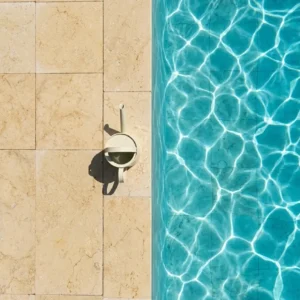
Silver travertine is the most misspecified of the three tones when heat performance is the primary concern. Its name implies a light, cool material — and visually it reads that way in shaded conditions — but its natural magnesium-rich composition and higher crystalline density give it an SRI of 40–55, which places it firmly between Gray and Ivory in thermal performance, not at the cool end of the scale. Peak surface temperatures on Silver honed coping typically land at 122–132°F under full midday solar exposure, measurably warmer than Ivory but generally cooler than the darkest Gray quarries.
The thermal performance data for travertine pool coping, including SRI measurements and finish-specific absorption rates, is most reliably sourced from standardized stone testing — ASTM C1527 travertine dimension stone specifications provide the foundational framework for evaluating dimensional and absorption properties that directly influence heat behavior. Silver travertine’s slightly higher crystalline content also affects its interaction with pool chemistry — its absorption coefficient of 1.5–3.5% sits below Gray and Ivory, meaning less moisture uptake and generally lower risk of subsurface salt crystallization damage in pool splash zones.
- SRI of 40–55 — cooler than most Gray quarries but warmer than Ivory under direct sun
- Lower absorption coefficient (1.5–3.5%) reduces moisture-driven damage risk near waterline
- Excellent compatibility with dark-bottom pools and charcoal plaster finishes where visual contrast is the design intent
- Dense crystalline matrix makes it the most freeze-thaw resistant of the three tones — relevant for pools in regions with significant seasonal temperature swings
- Verify SRI documentation from your supplier — Silver travertine has the widest quarry-to-quarry SRI variation of the three tones
For designers working on contemporary pool projects where the aesthetic calls for a cooler, more architectural look, Silver travertine coping delivers strong visual performance. The specification risk lies in assuming its visual lightness translates directly to lower surface temperatures — it doesn’t, at least not to the degree Ivory does. Review our travertine shade and heat data before finalizing your tone selection, particularly if barefoot comfort is a client priority on the project brief.
How Finish Selection Amplifies or Reduces Heat Across All Three Tones
The finish you specify on any of these three tones has a measurable effect on surface temperature — one that many specifications overlook entirely. Honed travertine absorbs more solar radiation than tumbled or brushed finishes because its flatter, denser surface has lower micro-surface reflectance. Field measurements consistently show honed finishes running 4–8°F warmer than tumbled finishes on the same base tone under identical conditions. That’s a meaningful delta when you’re already working with a Gray or Silver tone that starts with a thermal disadvantage relative to Ivory.
Tumbled travertine coping introduces a different variable worth understanding: its irregular surface texture improves wet slip resistance (typically achieving a DCOF above 0.42 per ANSI A326.3 testing) but also creates micro-shadow pockets that moderate surface temperature slightly. The PHTA pool deck safety standardsPer-finish wet DCOF results (ANSI A326.3) will be published here. Honed finishes, by contrast, often require a light acid etch or mechanical texturing to achieve the same wet traction rating.
- Tumbled finish: 4–8°F cooler than honed on equivalent base tone — lower surface reflectance area, better wet traction
- Honed finish: smoother, visually cleaner, but warmer underfoot and marginally lower wet DCOF before texturing
- Brushed finish: intermediate thermal performance — slightly better reflectance than honed, better traction than polished
- Fill treatment affects heat too — unfilled voids retain air that insulates slightly; epoxy-filled holes conduct heat more uniformly across the surface
- Specify finish and fill treatment together — they interact in both thermal and slip-resistance performance
Installation of Travertine Tile Coping: Base Preparation and Thermal Movement
Correct base preparation is where most travertine coping heat performance problems actually originate — not in material selection. Thermal expansion in travertine runs approximately 4.4 × 10⁻⁶ per °F, which means a 12-foot run of coping will expand roughly ⅛ inch across a 50°F temperature swing from morning shade to afternoon peak. Your mortar bed and joint design need to accommodate that movement, or you’ll see edge lifting and joint cracking well before the 15-year mark — typically in years 4–7 on projects where the expansion allowance was undersized.
The installation of travertine tile coping on a pool bond beam requires a specific sequence that differs from standard paver installation. You’re bonding to a curved or straight concrete substrate that itself has its own thermal coefficient — and the differential movement between the concrete bond beam and the travertine slab creates shear stress at the mortar interface on every thermal cycle. Specify a polymer-modified thinset rated for exterior wet areas, applied in a full back-butter coverage pattern of at least 95% contact area — not the spot-bond pattern that shows up too often on site. Thin coverage is the primary cause of hollow spots and lippage that develop within the first two winters on pool coping installations.
- Allow expansion joints every 8–10 linear feet on travertine coping runs — never exceed 12 feet without a joint
- Joint width minimum 3/16 inch — fill with siliconized urethane caulk rated for immersion service, not standard grout
- Polymer-modified thinset minimum — ANSI A118.4 rated for exterior wet applications
- Full back-butter coverage at 95% contact minimum — verify by lifting a test piece 15 minutes after setting
- Allow 28 days full cure on new concrete bond beams before setting coping — moisture migration from green concrete compromises bond strength
Travertine Tiles in Bathrooms: How Indoor Heat Dynamics Differ
The travertine coping heat comparison methodology shifts considerably when you move from pool surround applications to travertine tiles bathrooms and interior wet-area installations. Radiant heat from underfloor systems is the dominant thermal driver indoors, not solar load — and the same tone hierarchy that applies to solar reflectance essentially reverses when you’re considering thermal conductivity for heated floors. Silver travertine’s denser crystalline structure makes it the best heat conductor of the three tones, meaning it warms up faster and more uniformly from a radiant system than Ivory’s more porous matrix.
For bathroom floor applications with hydronic radiant heating, Silver travertine reaches operating temperature (typically 68–75°F surface) faster than Ivory because its lower porosity reduces the thermal resistance between the heating element and the walking surface. The specification implication: you can run a radiant system at a lower output temperature with Silver to achieve the same floor feel, which reduces energy demand over a heating season. Ivory travertine on radiant systems requires slightly higher output temperatures to compensate for its porous matrix acting as mild insulation — a detail worth passing to the mechanical engineer on projects where energy efficiency is a specification requirement. The same material properties that affect travertine tiles outdoors in solar-load conditions are at work indoors, just driven by a different heat source.
Cost Factors, Sourcing, and Project Budgeting for Travertine Coping
The material-to-labor cost ratio on travertine coping projects typically runs 40:60 — meaning labor represents the larger share of your total installed cost. That ratio matters when you’re evaluating the premium between Ivory, Gray, and Silver tones, because the material cost difference between them is often smaller than clients expect. Ivory travertine generally carries a 10–18% price premium over Gray at the supply level, while Silver typically prices between the two — but that premium is compressed significantly when you factor in the full installed cost, where labor rates dominate. A $2.50/SF material differential on a 200-SF coping run adds $500 to a project with a $6,000–8,000 total installed cost.
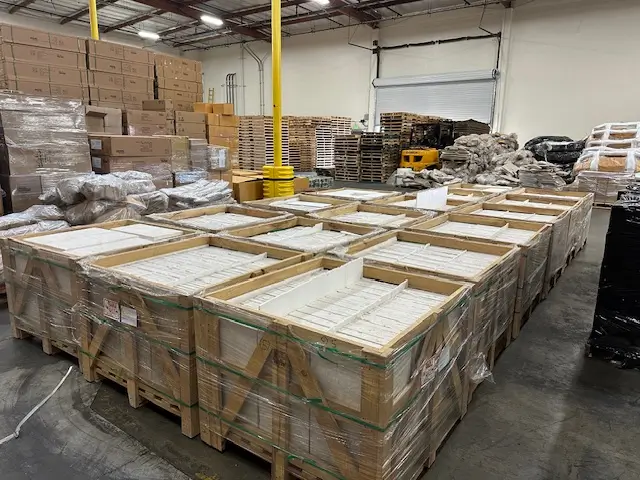
Freight distance from the warehouse to your project site is the more variable cost factor in travertine coping budgets — and it’s one that’s often underweighted in early estimates. Natural stone ships at high weight-to-value ratios compared to porcelain or concrete alternatives, and truck freight on a full pallet of 2-inch coping from a warehouse to a project site 800 miles away can add $0.75–$1.40/SF to your effective material cost. Citadel Stone maintains warehouse inventory across multiple distribution points nationally, which reduces average freight hauls and helps compress that variable cost — typically bringing lead times to 1–2 weeks rather than the 6–8 week import cycle that direct-order projects face. Confirming warehouse availability before finalizing your project timeline prevents the schedule gaps that push labor costs up when crews are waiting on material.
- Material cost difference between tones is typically 10–18% — modest relative to total installed project cost
- Freight from warehouse to project site is the most variable and most commonly underestimated line item
- Confirm warehouse stock levels before committing crew scheduling — stone delivery delays are the leading cause of labor cost overruns on coping projects
- Value engineer by adjusting coping profile (standard bullnose vs. drop-face) before substituting material tone — the profile choice affects fabrication cost more than tone selection
- Request material-to-labor cost breakdowns from your installer before approving specs — the ratio varies significantly by region and affects how much the tone premium actually matters to total project cost
Regional labor market conditions also affect the total cost calculation in ways that the material selection doesn’t change. In markets where skilled stone installation labor is scarce and day rates are high, the installation of travertine tile on a pool coping profile is more expensive regardless of which tone you specify. Budget your labor contingency at 15–20% on first-time travertine coping projects in those markets — it’s a more honest allowance than the 10% that shows up in most early estimates.
Travertine Tiles Outdoors: Long-Term Performance Across All Three Tones
Long-term outdoor performance for travertine coping traces back to three variables that operate independently of tone: absorption coefficient, freeze-thaw cycle count, and sealing protocol adherence. All three tones — Ivory, Gray, and Silver — perform well in moderate climates with consistent maintenance. The performance hierarchy shifts in freeze-thaw regions, where Silver travertine’s lower absorption coefficient (1.5–3.5%) gives it a measurable durability advantage over Ivory (3.5–7%) in severe exposure. Water absorbed into porous travertine expands approximately 9% on freezing, and that expansion force on open voids eventually causes surface spalling in materials that weren’t sealed correctly or consistently.
The 20-year performance benchmark for travertine tiles outdoors is achievable across all three tones — but only with specific maintenance commitments. Honed Ivory requires biennial sealing minimum. Tumbled Gray can typically extend to a 36-month cycle due to its lower absorption rate and better stain concealment. Silver in its tumbled finish, given its denser matrix, often performs well on a 30–36 month schedule even in demanding exposure conditions. Letting any of these maintenance cycles lapse by more than 12 months introduces cumulative staining and moisture penetration risk that compounds with each additional season.
- Ivory honed: biennial sealing mandatory — most porosity of the three tones, highest stain risk
- Gray tumbled: 30–36 month sealing cycle typically sufficient in moderate exposure
- Silver tumbled: 30–36 month cycle adequate; lowest absorption coefficient supports longer intervals
- All tones: inspect grout and caulk joints annually — joint failure precedes most coping substrate damage
- All tones: pressure wash at maximum 1,200 PSI — higher pressure drives moisture into the stone matrix rather than cleaning the surface
Completing Your Travertine Coping Heat Comparison: Final Specification Guidance
The travertine coping heat comparison between Ivory, Gray, and Silver ultimately resolves into a decision matrix that balances surface temperature, maintenance commitment, design intent, and total project cost. Ivory delivers the lowest surface temperatures and works best where barefoot comfort is a client priority — accept the sealing obligation that comes with it. Gray provides the best maintenance profile for high-use commercial settings and conceals staining more forgivingly than Ivory. Silver occupies a genuine middle ground on both thermal performance and durability, with its lower absorption coefficient making it the strongest specification for freeze-thaw exposed projects.
Your finish selection interacts with all three tone choices — tumbled finishes reduce surface temperature by 4–8°F and improve wet traction, while honed finishes offer cleaner aesthetics at the cost of marginally higher surface temperatures and lower initial wet DCOF. Neither finish is universally correct; the right choice follows from the project’s use profile and your client’s aesthetic priorities. Factor in freight distance from the warehouse to your project site when finalizing budgets — it’s a real cost variable that the per-SF material price alone doesn’t capture. As you plan related hardscape elements for the same project, mosaic pool tile performance and care covers another dimension of pool surround specification worth reviewing alongside your coping selection. Choosing the right shade from Citadel Stone based on heat behavior can meaningfully improve barefoot comfort along pool edges in hot, dry climates.
Related reading: scabos travertine pool coping · Travertine Tile Pool Coping vs Solid Coping Units · black and white pool tiles.