Why Black Mosaic Pool Tiles Develop Scale and Patchy Zones
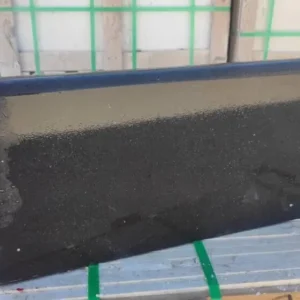
Scaling on black mosaic pool tiles doesn’t announce itself gradually — it accumulates invisibly until a single afternoon of low-angle sunlight reveals an uneven, blotchy surface that looks nothing like the crisp installation you started with. The dark base colour amplifies every mineral deposit, making calcium carbonate buildup appear as stark white patches rather than the subtle haze you’d notice on lighter materials. Understanding what triggers this process is the first step toward fixing it properly.
Pool water chemistry sits at the centre of the problem. Calcium hardness levels above 400 ppm combined with a pH drifting above 7.8 create conditions where dissolved minerals precipitate out of solution and bond to tile surfaces. On black mosaic pool tiles, that bond locks into the micro-texture of the surface finish, making removal far more complicated than a simple rinse.
Diagnosing the Source of a Patchy Appearance
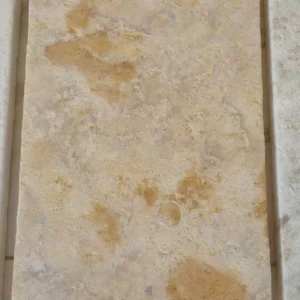
Your first diagnostic task is to distinguish between two different failure types that look similar but require opposite treatments. Efflorescence — mineral migration from beneath the tile — produces a powdery, irregular whitish haze that doesn’t follow grout lines. True calcium scaling, by contrast, produces harder, crystalline deposits that cluster near the waterline and along tile edges where evaporation is most active.
Run a simple acid test: apply a small drop of diluted muriatic acid (roughly 10:1 water-to-acid ratio) to a discrete patch. If the deposit fizzes and dissolves within 30 seconds, you’re dealing with carbonate scaling. If it softens slightly but doesn’t fizz, you may have silica-based scale or a film from sunscreen and body oils — both of which need enzymatic or alkaline cleaners rather than acid treatment. Getting this diagnosis right before treatment prevents unnecessary surface etching on a pool tiles black finish.
The PHTA pool deck and coping safety standards provide broader context for pool surface maintenance protocols, including chemical compatibility requirements for tile finishes exposed to treated water.
Fixing Carbonate Scaling on Pool Tiles Black Finish
For established calcium carbonate scaling, the most effective field-proven approach combines a targeted acid wash with mechanical assistance. Drop the pool water level approximately 6 inches below the tile line so you’re working on a dry surface — trying to treat active scaling underwater produces inconsistent results and wastes chemical.
- Apply a commercial tile descaler with a pH between 1.5 and 2.5 directly to the scaled tiles using a stiff nylon brush, not wire — wire leaves micro-scratches that accelerate future buildup
- Allow a 5–8 minute dwell time before scrubbing in circular motions; on heavily scaled black tile swimming pool installations, a second application may be necessary
- Rinse thoroughly with clean water before refilling, and test pool chemistry within 24 hours to confirm pH has stabilised between 7.4 and 7.6
- For grout joints specifically, use a grout brush and a slightly more concentrated solution — scale embeds deeper in the porous grout matrix than on the tile face itself
One detail that often gets missed in DIY repairs: the waterline tile strip on a black tile swimming pool takes the highest evaporation load in the system. Treating only the visible scaling without addressing water chemistry means you’ll be back doing this every three to four months instead of annually.
Repairing Efflorescence Beneath Mosaic Tiles
Efflorescence that originates from beneath the tile is a substrate problem, not a surface problem — and that distinction changes your repair strategy entirely. This failure mode is most common in pools installed over expansive clay subgrades, where seasonal ground movement creates micro-fractures in the mortar bed. Water infiltrates those fractures, dissolves soluble salts in the setting material, and migrates to the tile surface as the moisture evaporates.
Soil conditions matter more to long-term tile performance than most pool builders acknowledge. In areas with expansive clay or poorly compacted fill, hydrostatic pressure behind the shell fluctuates significantly with soil moisture levels — and that fluctuation drives efflorescence cycles that no amount of surface cleaning will permanently resolve. A proper fix in those conditions requires addressing drainage around the pool shell itself, not just treating the tile face.
- Surface efflorescence limited to grout lines can often be managed with a silane-siloxane penetrating sealer that reduces moisture migration without altering the appearance of black mosaic pool tiles
- Widespread efflorescence across tile fields indicates a deeper moisture ingress issue — the affected tiles may need removal to allow the mortar bed to dry fully before regrouting
- In sandy or loose-fill subgrades, a perimeter drainage solution installed during construction significantly reduces the hydrostatic pressure that drives this failure mode
Finish Selection and Long-Term Scale Resistance
The finish on black mosaic pool tiles plays a decisive role in how aggressively scale adheres and how easily it releases during cleaning. Polished or vitrified tile faces have a surface porosity near zero, which means calcium deposits sit on the surface rather than bonding into micro-pores — making removal significantly easier. Honed or matte finishes, while preferred by many designers for their anti-glare properties, present a slightly more textured surface that gives scale more purchase.
For a pool tile black installation in a high-mineral-content water region, a polished or glazed mosaic finish is the pragmatic choice for maintenance-conscious owners. The aesthetic trade-off is real — matte finishes do look more sophisticated in many design contexts — but the cleaning frequency difference over a 10-year period is substantial. According to NSI tile stone specifications and standards, surface absorption rates below 0.5% are the benchmark for high-performance pool tile installations, and glazed ceramic mosaics typically achieve rates near 0%.
Sealer application on natural stone mosaic variants adds another layer of protection. A penetrating fluoropolymer sealer applied to dry tile — not just to the surface but worked into grout joints — reduces calcium bonding by approximately 40–60% in field conditions, based on typical performance ranges documented across pool maintenance literature.
Grout Joint Maintenance for Black Tile Swimming Pool Installations
Grout joints are the most vulnerable component in a black mosaic tile pool installation — and they’re the element most consistently neglected in maintenance schedules. Standard Portland cement grout is inherently porous and chemically reactive with pool water, which means it absorbs minerals and deteriorates faster than the tile face itself. Epoxy grout dramatically reduces this vulnerability and should be the specification baseline for any new pool tiles black installation.
- Inspect grout joints at every seasonal opening — hairline cracks wider than 1 mm are the primary entry point for scaling-cycle moisture
- Re-grout deteriorated sections before scale has time to migrate into the mortar bed; waiting until tiles loosen significantly increases repair scope and cost
- Colour-matched epoxy grout against a true black tile background tends to shift slightly towards dark grey over UV exposure — test a sample panel before committing to a full waterline re-grout
The TCNA natural stone tile installation standards cover grout selection and joint sizing for pool tile applications in detail — their guidelines on joint width relative to tile size directly affect how much movement the installation can accommodate before cracking.
How Coping Integration Affects Tile Surface Condition
The connection between pool coping and the mosaic tile field below it deserves attention in any scaling or patchy-look diagnosis. Coping that overhangs the tile without proper sealant continuity allows water to wick behind the cap and migrate down the tile face — concentrating mineral deposits in a band just below the coping lip. This produces a patchy appearance that follows the geometry of the coping rather than the waterline, and it’s easy to misidentify as a water chemistry problem when the real issue is a failed coping-to-tile joint.
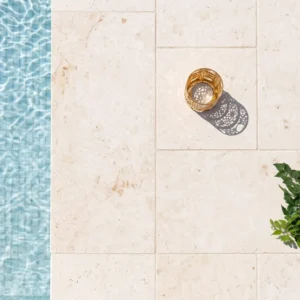
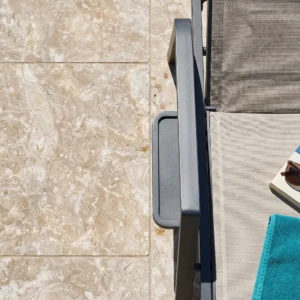
Specifying the right coping material improves the durability of the entire system. For pools featuring black tile in pool settings, a natural travertine coping provides a complementary aesthetic while its slightly absorbent face naturally buffers minor moisture fluctuations. You can explore our coping above black mosaic tile for specifications that integrate well with dark tile field installations. Keeping the coping-to-tile joint filled with a flexible, UV-stable sealant — not rigid grout — is the detail that prevents the bulk of waterline scaling issues over the long term.
Water Chemistry Management Specifically for Black Tile Pools
Maintaining correct water chemistry is the single highest-leverage action you can take against scale formation on black mosaic pool tiles. The Langelier Saturation Index (LSI), which balances pH, total alkalinity, calcium hardness, and water temperature, should be your primary monitoring tool rather than relying on pH alone. An LSI between 0 and +0.3 is the target range — above +0.3, your water is actively scale-forming; below 0, it becomes corrosive to grout and plaster.
- Test calcium hardness monthly during swim season; target 200–400 ppm and adjust with calcium chloride additions in small increments rather than large one-time doses
- Total alkalinity at 80–120 ppm provides the pH buffering that prevents rapid swings after rain or heavy bather load
- Phosphate levels above 200 ppb accelerate biofilm formation that can stain pool tiles black surfaces with an organic grey film distinct from mineral scaling
- Saltwater chlorination systems tend to produce slightly higher pH over time — check LSI weekly if your pool uses a salt chlorinator, as the drift toward scale-forming conditions is more consistent
What Matters Most for Black Mosaic Pool Tile Longevity
The longevity of a black mosaic pool tile installation comes down to three converging factors: water chemistry discipline, finish and grout selection made at the specification stage, and substrate stability that prevents moisture migration from below. Skipping the diagnostic step — and jumping straight to acid washing — is the most common mistake in field repairs, and it often worsens the patchy appearance it was meant to fix by etching tile faces that were actually clean to begin with. Citadel Stone cuts every order at its selected quarries, and the lead time for your specification is quoted with the order. As you plan the full pool surround, complementary materials round out the design cohesively — black and white pool tile pairings with travertine covers how contrasting tile fields and natural stone coping work together in demanding pool environments. Dark tile installed beneath Citadel Stone travertine coping can look patchy when scaling builds unevenly, making regular cleaning and finish choice especially important.
Related reading: Scabos Travertine Pool Coping: Palette and Edge Guide · travertine tile pool coping · travertine bullnose pool coping.