Base Preparation: The Variable That Decides Everything
Stone landscape steps fail most often before a single riser is set — the base layer is where the decision gets made. Your excavation depth needs to account for the full frost depth of your region, not just the weight-bearing calculation alone. In freeze-thaw regions, an undersized compacted aggregate base allows ground heave to progressively displace individual step units until the whole flight is misaligned. You’re looking at a minimum 6-inch compacted gravel base for light residential foot traffic, stepping up to 10–12 inches when the steps serve as a primary access route carrying heavy foot loads or equipment passage.
The aggregate gradation matters more than most installation guides admit. A well-graded crushed stone base — typically a ¾-inch minus blend — self-compacts under load and resists lateral creep at the toe of each riser stone. Angular aggregate outperforms rounded pea gravel here because the particle interlock is significantly tighter. Compact in 2–3 inch lifts, not all at once, and verify density with a plate compactor before setting any stone.
Choosing the Right Material for Stone Landscape Steps
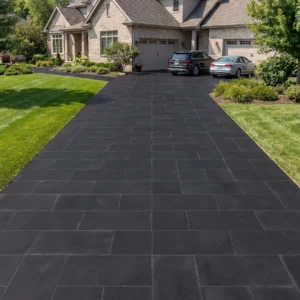
Not all natural stone performs equally in a step application — the tread surface you specify directly determines how the installation ages under daily use. Granite stone for landscaping delivers compressive strengths above 19,000 PSI and an abrasion resistance that holds a consistent texture even under decades of foot traffic. That durability is the reason granite remains the preferred choice for primary entry sequences on high-value residential and commercial projects. Limestone and bluestone offer softer aesthetics and are genuinely serviceable on lightly used garden steps, but both require more attentive sealing programs to resist surface wear and staining.
Thickness selection is non-negotiable from a structural standpoint. Step treads in a landscape stone slabs format should run a minimum 2 inches nominal for pedestrian loads — 3 inches when the tread spans more than 18 inches from front to back without an intermediate support. Thinner slabs concentrate flexural stress at mid-span, and that’s precisely where you’ll see cracking first in oversized treads that were under-specified. According to NSI stone step and tread design specs, flexural strength alongside compressive strength should be factored into every tread selection for outdoor applications.
Surface finish is the other dimension most specifiers underweight. A honed face looks refined but creates a genuinely hazardous surface on exterior steps, particularly in wet conditions. A thermal or flamed finish on granite, or a natural split face on limestone and bluestone, delivers the texture coefficient you need. The ADA surface slip resistance standards specify a minimum static coefficient of friction of 0.60 for accessible routes — exterior stone landscape steps serving any accessible path must hit that number, and thermal or split finishes reliably achieve it where honed finishes typically fall short.
Why Granite Holds Up in Step Applications
Granite stone for landscaping has a specific advantage in step construction that goes beyond raw compressive strength: its low absorption rate — typically below 0.4% — means moisture penetration into the body of the stone is negligible even in sustained wet conditions. Absorbed moisture is the primary mechanism driving freeze-thaw spalling in porous stones. Granite essentially side-steps that failure mode, which is why granite treads maintain their surface integrity in climates that would progressively deteriorate a softer sedimentary stone.
The surface texture on granite stays consistent over time rather than wearing to a smoothed patina. That consistency matters on step nosings where the leading edge gets the concentrated foot strike with every use. Bluestone and limestone develop a polished nosing edge over years of traffic — a subtle safety issue that builds gradually and gets noticed only after someone slips. Granite’s crystalline structure resists that progression.
- Compressive strength typically 19,000–23,000 PSI — suited to heavy-use access routes
- Absorption rate below 0.4% — resists freeze-thaw penetration without intensive sealing
- Consistent surface texture under long-term foot traffic — nosing edge stays serviceable
- Available in thermal, flamed, and natural cleft finishes for exterior slip resistance
- Compatible with both dry-set and mortar-set installation methods for step treads
Riser and Tread Geometry for Comfortable, Safe Steps
The geometry of a well-built stone step flight follows a simple rule that translates directly to comfort and safety: the sum of one tread depth plus two riser heights should fall between 24 and 27 inches. A 6-inch riser paired with a 14-inch tread produces a 26-inch total — comfortable for most adult stride patterns. Stray outside that range in either direction and the steps start to feel awkward, which compounds fatigue on longer flights and creates a subtle but real fall risk.
Tread overhang — the nosing projection beyond the riser face — is another detail that gets cut when projects run tight on time. A 1-inch overhang creates a shadow line that visually defines each step and gives the foot a natural catch point. Skip it and the steps feel flat and institutional. More practically, a zero-overhang tread has no reference edge for the descending foot, which is precisely when missteps happen. Your natural stone yard layout should account for this overhang when calculating material quantities — you’ll need slightly wider treads than the finished run dimension suggests.
Dry-Set vs. Mortar-Set: Picking the Right Installation Method
Both dry-set and mortar-set installations have genuine merit for stone landscape steps — the choice depends on the site conditions, not on which method is faster. Dry-set works well when the sub-base is exceptionally stable, drainage is excellent, and the step flight has no more than 4–6 risers. The advantage is that individual stones can be relevelled over time without demolition, and the free-draining joint structure eliminates hydrostatic pressure buildup behind risers.
Mortar-set is the specification for any step flight that carries consistent heavy traffic, has a long riser run, or sits on a soil type prone to differential settlement. Setting landscape stone slabs in a full mortar bed with mortared riser faces creates a monolithic system that distributes loads and resists individual unit displacement. The trade-off is that repair access requires more work — a cracked riser in a fully mortared flight means breaking out mortar to reset the stone. Plan your material orders accordingly and keep 5–10% overage in warehouse stock for that exact scenario.
- Dry-set: best on stable sub-base with high drainage — allows future adjustment
- Mortar-set: correct choice for long flights, high-traffic routes, or unstable soils
- Full mortar bed depth: minimum ¾ inch under each tread, consistent across the full bearing area
- Riser mortar joints: 3/8 inch minimum, fully tooled to shed water forward
- Expansion allowance: required at wall abutments every 10–12 feet of flight length
For project planning, check warehouse availability of your selected stone before committing to a mortar-set specification — this method requires consistent material dimensions that batch-to-batch variation can disrupt. At Citadel Stone, we inspect dimensional tolerances on step stone batches before they leave our facility, which eliminates the field adjustment time that inconsistent material creates.
Cost Factors, Freight, and Material Sourcing for Step Projects
Budget planning for stone landscape steps needs to account for more than the per-unit material price. Freight distance has a disproportionate effect on the delivered cost of dimensional stone because step treads and riser slabs are heavy, awkward to palletize, and prone to edge chipping in transit if not crated properly. A material priced attractively per square foot from a distant supplier can arrive with a total landed cost that exceeds a closer source by 20–30%. Factor truck delivery costs into your comparison before locking in a supplier — the rate per mile scales quickly with the weight of a step stone order.
Labor cost ratios vary considerably depending on your project region. In high-labor-cost markets, the material-to-labor ratio on a mortared granite step flight can tip toward 40% material and 60% labor, which shifts the value engineering question. In that context, spending more on a premium granite stone for landscaping that installs faster and requires less site remediation during setting is frequently the correct economic decision. Cheaper stone that demands more shimming, grinding, and adjustment time erodes the labor-side savings quickly.
You can access ASLA landscape hardscape guidance for context on material selection frameworks used by landscape architects when evaluating cost-performance trade-offs on step and hardscape projects. Citadel Stone ships nationwide with palletized delivery sized to accommodate step treads up to 6 feet long — the truck configuration matters when you’re receiving material on a site with limited access, so confirm your delivery window and equipment requirements early in the project timeline.
Sourcing from our natural stone slabs inventory gives you verified dimensional tolerances and matching batch consistency across the full step flight — critical when mortar joint widths need to stay uniform throughout.
Drainage Slope and Water Management in Step Design
Every tread on a stone landscape step flight needs a forward cross-slope — the standard is ⅛ inch per foot minimum, or approximately 1–2% grade. That slight pitch is enough to shed water off the tread face and prevent pooling at the nosing, where ice formation and moss growth concentrate when drainage stagnates. The slope direction always runs toward the open face of the step, not toward any adjacent wall or riser.
What often gets overlooked is the drainage condition at the base of the step flight. Water that sheds cleanly off each tread has to go somewhere, and if the grade at the bottom of the flight drains back toward the foundation or toward the lowest riser, you’ve relocated the problem rather than solved it. Design a positive drainage path that carries water laterally away from the step base. In practice this usually means either a gravel strip along the toe of the lowest riser or a channel drain set flush with the adjacent paving.
- Tread cross-slope: ⅛ inch per foot (1–2%) minimum toward the open nosing
- Never slope treads toward an adjacent wall or enclosed side — water has no exit
- Base drainage: positive grade away from the step toe — gravel strip or channel drain
- Weep gaps in mortared riser joints: one ½-inch gap per 4 linear feet of riser face
- Check drainage path after heavy rain events in the first season and adjust as needed
Sealing Protocols and Long-Term Maintenance
Your sealing schedule for natural stone yard steps depends entirely on the stone type and the surface finish you’ve specified. Dense igneous materials like granite need a penetrating silane-siloxane sealer applied at initial installation and then evaluated biennially — a water-bead test on the tread surface tells you quickly whether the sealer has depleted. Limestone and bluestone in a natural stone yard context are more porous and typically need sealer reapplication annually in high-traffic or high-moisture conditions.
The timing of initial sealing matters more than most installation crews acknowledge. Newly set stone should cure for a minimum of 28 days before sealer application if it was set in a mortar bed — applying sealer too early traps off-gassing moisture from the mortar and creates a white haze called efflorescence bloom that’s difficult to remove without acid washing. According to ASTM natural stone standards for outdoor applications, dimensional stone in exterior settings should be allowed full cure before protective treatments are applied. Dry-set steps can be sealed as soon as installation is complete and the surface is clean and dry.
Joint maintenance is the other ongoing task that prevents small issues from becoming expensive repairs. Check mortar joints on the riser faces every spring — a cracked or eroded joint allows water to migrate behind the riser and undercut the base, which is the starting point for step displacement. Repointing with a matching mortar mix takes 20 minutes per riser and prevents a resetting job that costs orders of magnitude more.
Getting Stone Landscape Steps Right: Final Perspective
Stone landscape steps are one of the few landscape elements where the specification decisions made at the planning stage determine performance across decades, not just seasons. The material choice, base depth, tread geometry, finish selection, and drainage design all interact — a strong choice in one area can’t fully compensate for a deficiency in another. Your best outcome comes from treating the flight as an integrated system rather than a series of individual decisions. As you plan the broader landscape context for your project, the approach to low-impact, low-maintenance stone selection covered in front yard rock landscaping strategies offers a useful complementary perspective on material durability and ground-level hardscape planning. Step slabs from Citadel Stone offer slip-textured surfaces that stay stable underfoot on graded garden slopes.
Related reading: white vs black landscaping rock · landscaping rock bulk cost · front yard landscaping with rocks.