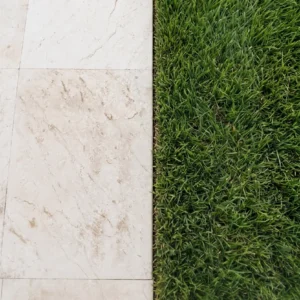
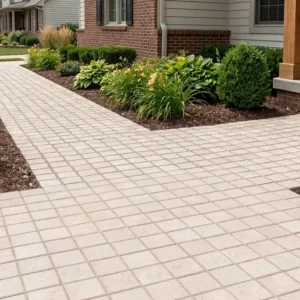
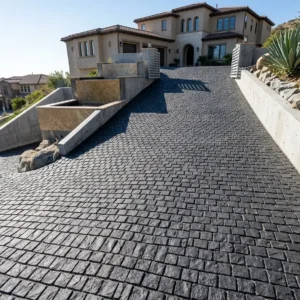
Round stepping stones layout decisions carry consequences that show up six months after installation, not on day one. The geometry of your path determines almost everything else — stride comfort, visual rhythm, drainage behavior, and how forgiving the layout is when the ground isn’t perfectly flat. Understanding where circular shapes outperform irregular slabs, and where they create avoidable headaches, separates a confident specification from an expensive guess.
Why Shape Changes the Specification
Circular stones eliminate the directional bias that comes with rectangular or irregular shapes. You can rotate them freely during layout without creating visual inconsistency — a quality that makes them forgiving in organic garden settings where the eye expects natural variation. That same quality becomes a limitation in formal rectilinear designs, where the curved perimeter reads as casual regardless of how precisely you space them.
Irregular flagstones work in the opposite direction. Their edges interlock visually — not physically — creating a mosaic impression that suits naturalistic or rustic aesthetics. The challenge is that each stone is unique, so your layout requires more time on-site to sequence pieces for both visual fit and structural stability. Neither approach is superior across all projects; the right choice depends on what your design is actually trying to do.
- Round stones suit curved pathways, garden loops, and informal routes through planted areas
- Irregular shapes work better in large open patio-adjacent paths where the eye needs visual complexity
- Mixed layouts using both shapes in the same path typically read as unresolved — commit to one geometry
- Round stones in formal straight runs look displaced unless spacing is very deliberate
Spacing Mechanics: Round vs. Irregular
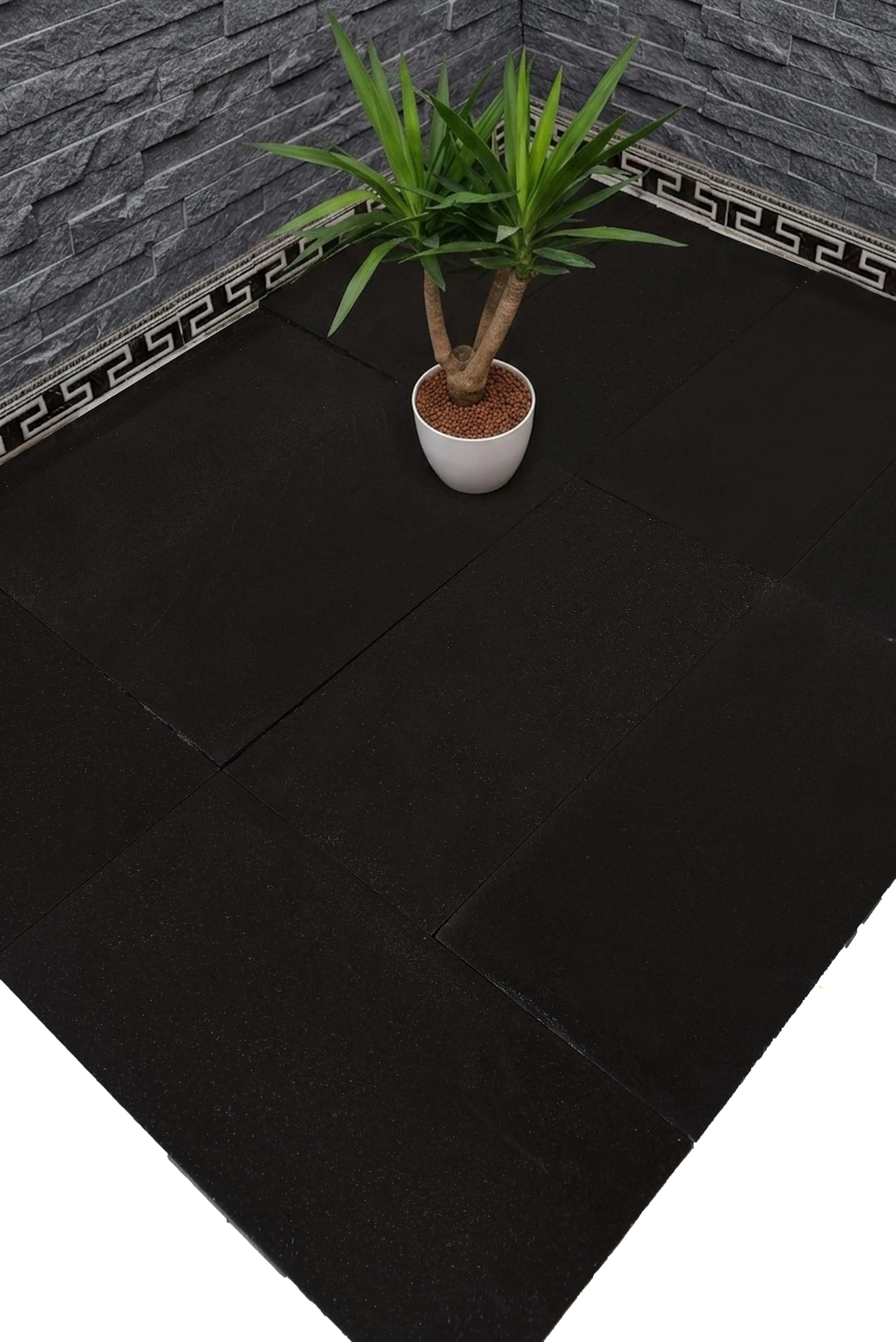
Spacing is where round stepping stones layout diverges most sharply from irregular-shape work. With round stones, you’re dealing with a consistent diameter — typically 16 to 24 inches for walkable garden stepping stones — so you can calculate stride gaps mathematically before a single stone touches the ground. Average adult stride is 24 to 28 inches center-to-center, which means a 20-inch diameter round stone leaves a gap of roughly 4 to 8 inches of exposed ground between centers, depending on your target pace.
Irregular shapes don’t offer that predictability. The usable edge — the part a foot actually lands on — varies stone to stone. You’re not measuring center to center; you’re reading the landing zone on each individual piece and adjusting the next stone’s position to match. This takes longer, but experienced installers will tell you the result has a naturalistic quality that round spacing can’t replicate.
- For round stones: center-to-center spacing of 24–27 inches suits a relaxed walking pace
- Tighter spacing (21–23 inches center-to-center) works for children’s paths or elderly users who take shorter strides
- Irregular shapes require field measurement of the actual landing zone per stone — not the overall stone dimension
- Avoid gaps wider than 3 inches on irregular layouts in high-traffic areas; vegetation fills those gaps unevenly and creates a trip hazard within two growing seasons
According to ASLA stepping stone and walkway design guidance, pedestrian surface continuity directly affects user confidence and safety — a point that applies equally to both round and irregular arrangements when gaps are improperly sized.
Base Preparation Differences by Shape
Round decorative stepping stones require individual setting beds rather than a continuous sand layer. Each stone sits in a discrete 3–4 inch excavated pocket filled with compacted decomposed granite or coarse sand, which means your base work is more localized. The gap between stones in a round stepping stone layout doesn’t carry structural load — only the stone itself does — so you’re not concerned with interstitial base continuity the way you would be with a patio installation.
Irregular shapes demand more base consistency across the entire footprint. Because the stone edges come closer together and the visual impression is of a connected surface, any differential settlement between adjacent stones is immediately obvious. Your base layer needs to be consistent in depth and compaction across a broader area, even though technically only the stone positions themselves need to carry load.
- Excavate each round stone setting bed 4 inches deep, plus stone thickness, to reach native subgrade
- Compact coarse sand or decomposed granite in the setting bed before placing the stone
- For irregular shapes, establish a uniform 3–4 inch compacted aggregate base across the full path width
- Check for high spots and low spots with a 6-foot straightedge before placing any stone
- Both shapes require individual leveling — neither format tolerates a set-and-forget approach
Drainage, Water Management, and Shape Selection
Your drainage conditions should influence shape selection well before aesthetics do. Ornamental stepping stones with larger open ground between pieces drain more efficiently in heavy rainfall because water has a clear path to grade around each stone. There’s no trapped surface area between stone edges that can pond or wick moisture back under the stone.
Irregular shapes, particularly those with tightly fitted edges, can create micro-catchments. Water follows the mortar or sand joint lines, and if those joints are compacted or silted, moisture tracks back under the stone rather than away from it. In regions with heavy rain seasons — extended monsoon patterns, hurricane-season rainfall, or prolonged wet winters — this matters considerably. Heaving, spalling at the base face, and differential settlement all trace back to poor water evacuation under the stone.
The ADA walkway surface and accessibility standards require that pedestrian walking surfaces maintain firm, stable characteristics even in wet conditions — a requirement that applies directly to how you manage drainage beneath and around both stone formats.
- In high-rainfall environments, a 1–2% cross-slope on the path sub-base directs water away before it reaches the stone setting bed
- Use angular crushed aggregate for base compaction rather than round pea gravel — angular material interlock resists lateral movement during wet-dry cycles
- Round stone layouts tolerate a slightly lower base compaction spec (95% Proctor vs. the 98% you’d want for irregular close-set layouts) because the open gaps relieve hydrostatic pressure naturally
- In drought-cycle climates, soil shrinkage can undermine compacted bases — check and re-level round stones every 12–18 months for the first two years after installation
Choosing the Right Material for Round Stepping Stones
Natural stone round stepping stones in limestone, bluestone, or basalt each behave differently under foot traffic and weathering. Limestone delivers a warm tonal range and tends to develop a pleasant patina in garden settings — but you’ll want a surface finish that reads safe underfoot. Honed or bush-hammered finishes add friction without detracting from the natural look. Polished surfaces are not appropriate for any exterior stepping stone regardless of shape.
Basalt carries compressive strength well above 15,000 PSI and handles freeze-thaw cycles without the surface spalling that softer stones can develop. For shaded garden paths where moss can colonize the stone surface, basalt’s density makes cleaning easier and reduces the slip risk that comes with biological growth. Bluestone is the workhorse choice for many designers — it’s hard, relatively consistent in thickness, and splits cleanly into rounds without the edge chipping that softer sedimentary options can produce.
The Natural Stone Institute stone variety and specification guidance outlines technical properties across stone types — a resource worth cross-referencing when you’re narrowing down material options against your specific site conditions.
- Minimum 1.5-inch thickness for round stepping stones in standard garden foot traffic applications
- 2-inch nominal thickness for paths that also handle wheelbarrow or equipment access
- Honed, flamed, or bush-hammered finishes for slip resistance — static coefficient of friction should be 0.60 or higher when wet
- Stones sourced from Middle East quarries typically arrive in consistent thickness ranges, making leveling faster on site
Visual Layout Principles for Ornamental Stepping Stones
The visual success of ornamental stepping stones depends as much on the surrounding groundcover as on the stones themselves. Round shapes read more dramatically when the contrast between stone and ground plane is high — light stone against dark mulch or dense low groundcover creates the crisp circular impression that makes round stepping stones layout distinctive. When the ground is bare soil or pale gravel, the circular geometry can flatten visually and lose its intended impact.
Irregular shapes integrate differently — they look best when the stone and setting material are tonally similar, creating the impression that the stones are emerging from the ground rather than placed on top of it. This is the classic dry-laid flagstone aesthetic, and it works because the eye reads the whole surface as unified.
- For round stones: create tonal contrast between stone color and setting material
- For irregular shapes: match stone and setting material color range within two or three value steps
- Vary stone diameter across the path by 10–20% for a more organic feel — using only one diameter reads as manufactured
- Avoid perfect symmetry in round stepping stone placement — slight offsets along the center line look intentional; rigid linear placement looks mechanical
- Group decorative stepping stones in clusters of three or five where the path widens, rather than continuing single-file spacing
You can explore the full range of options through Citadel Stone round and irregular stones — comparing actual stone dimensions and finishes before committing to a layout saves significant on-site adjustment time.
Installation Sequence: Round vs. Irregular Side by Side
Round stepping stones layout follows a simpler field sequence. Mark your center line, establish your center-to-center spacing with a measuring tape, and excavate each setting bed individually. The uniformity of round stones means you can pre-calculate the number of stones required for the full path length before the first piece arrives at site — a logistical advantage when you’re coordinating truck delivery timing with installation crews.
Irregular-shape installation runs more like a puzzle. Lay all stones out on grade before excavating anything. Sequence them visually, matching edges for the best visual interlock, and mark each stone’s position before picking it up to excavate beneath it. Trying to excavate first and then fit irregular pieces into set holes almost always results in rework. The sequence matters more with irregular shapes than with any other stepping stone format.
- Round stones: mark, excavate, set, level, repeat in linear sequence — straightforward pacing
- Irregular shapes: lay out full path, sequence stones, mark positions, then excavate each setting bed individually
- For paths longer than 25 feet, establish string lines at both edges to keep the path width consistent — round stones especially tend to drift wide when there’s no physical edge to reference
- Use a rubber mallet and level on every stone regardless of format — skip this step and you’ll be relaying within 18 months
- At Citadel Stone, we recommend confirming stone quantities with a site sketch before warehouse shipment — it prevents the mid-project delays that come from waiting on additional stock after installation has started
Long-Term Maintenance: Where Shape Makes a Difference
Round decorative stepping stones are easier to reset individually. Because each stone sits in its own discrete setting bed with open ground around it, you can lift and re-level one stone without disturbing adjacent pieces. After a wet season that causes heaving, this matters practically — you’re resetting two or three individual stones rather than re-laying a section of tightly fitted flagstones.
Irregular close-set layouts develop maintenance complexity over time as the ground between and beneath stones shifts. Weed pressure at the joints is also more persistent because irregular stone arrangements create irregular joint widths — some joints are wide enough to establish perennial root systems that are difficult to remove without lifting stones. Round stepping stone paths with open groundcover between stones sidestep this problem almost entirely.
- Inspect all stepping stones annually at the beginning of the dry season — catching soft spots early prevents full-stone-lift repairs later
- Apply a penetrating sealer every three to five years on limestone and softer sedimentary round stones — skip sealing on basalt and dense bluestone
- For organic-set paths in groundcover-heavy gardens, maintain a clear 2-inch margin around each round stone to prevent root lift
- Budget reset labor at approximately 20 minutes per stone for round formats, and 45 minutes per stone for tightly fitted irregular paths where adjacent pieces must be disturbed to access the problem area
Round Stepping Stones Layout: Getting the Specification Right
The shape decision in a stepping stone project isn’t just aesthetic — it drives your base specification, your installation sequence, your maintenance schedule, and how the path performs through wet seasons and dry ones. Round stepping stones layout rewards clear advance planning: you can calculate quantities precisely, set a predictable installation pace, and reset individual stones without cascading rework. Irregular shapes reward patience on site and produce a more complex visual result that suits certain design contexts better than any round format can.
Your drainage sub-base deserves the same attention as stone selection itself. Whether you choose round or irregular pieces, a poorly prepared base will telegraph every failure to the surface within two to three growing seasons. Get the cross-slope and compaction right first, then build the visual layer above it. As you think about sizing alongside shape, stepping stone sizing for walkways covers the dimensional decisions that round and irregular paths share — a useful companion reference for any path specification. Spacing decisions shift significantly between round and irregular stepping stones, and Citadel Stone’s varied shape options let designers test both approaches before purchasing.
Related reading: stepping stones for gardens · stepping stones for a walkway · Stepping Stones Sinking? How to Fix and Reset Them.