What Red Granite Tones Tell You Before You Spec It
Red granite’s colour is a direct indicator of mineralogical composition — and that composition drives real performance differences you need to understand before committing to a specification. The dominant feldspar content (orthoclase or potassium feldspar) produces those rich warm tones ranging from dusty rose through deep burgundy, while the ratio of quartz and biotite mica determines how the stone responds to cutting, polishing, and long-term surface wear. Higher feldspar concentrations typically yield more saturated, uniform reds; higher quartz fractions push the palette toward salmon and terracotta while adding notable hardness.
Red granite sits at 6–7 on the Mohs scale across most commercial varieties, with compressive strengths typically ranging from 19,000 to 28,000 PSI depending on crystal structure and quarry origin. The Natural Stone Institute granite durability specifications confirm that this hardness range makes it one of the most abrasion-resistant options in the natural stone category — a fact worth stating clearly when clients push back on cost relative to softer alternatives.
Grain Size and What It Changes in Practice
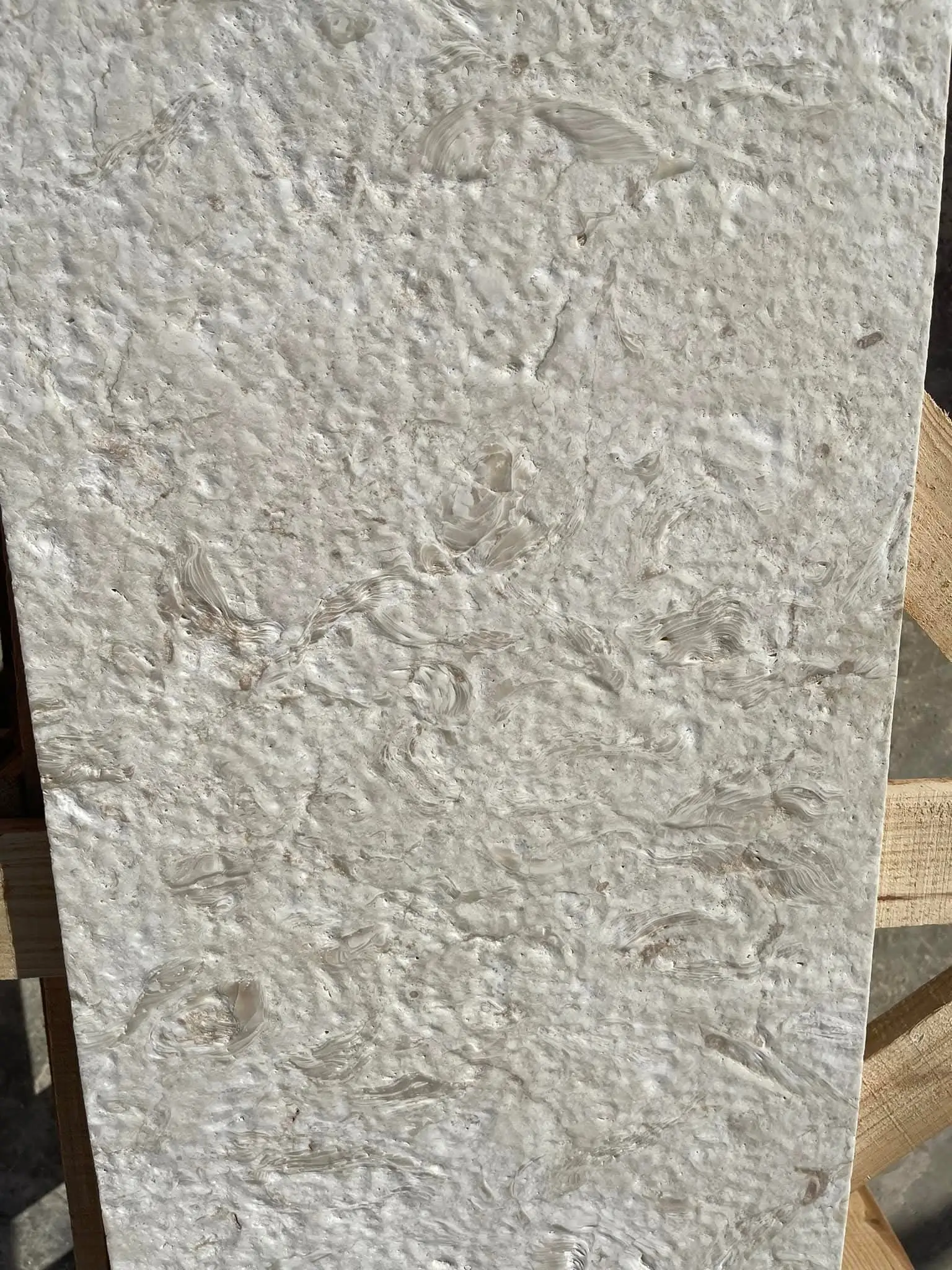
Grain structure is probably the single most underrated variable when specifiers compare red granite options side by side. Coarse-grained varieties — those with visible crystals above 5mm — offer dramatic visual depth and a naturally textured surface that holds up well in outdoor paving and cladding applications. Fine-grained red granite, with crystals under 1mm, takes a mirror polish more cleanly and delivers tighter dimensional tolerances during fabrication, making it the go-to for countertop and interior flooring work.
Medium-grained red granite sits in the most versatile range. You’ll get enough visual character for exterior applications without the surface irregularity that can complicate tight joint specifications indoors. For red granite pavers used in high-traffic commercial environments, a medium-grained honed finish typically outperforms both the polished and coarse-split options — the surface is easier to clean than a flamed texture and you can request the wet DCOF test report for the finish you specify to check it against the 0.42 minimum ANSI A326.3 sets for level wet surfaces.
- Coarse grain: best for exterior paving, water features, and rough-cut cladding where texture is a design feature
- Medium grain: versatile across indoor flooring, countertops, and outdoor applications with honed or brushed finishes
- Fine grain: preferred for polished countertops, thin-format tiles, and precision-fabricated interior surfaces
- Crystal uniformity within a batch matters as much as grain size — request slab samples from the same production run, not catalogue photos
Finish Options and Their Honest Trade-Offs
The finish you select for red granite fundamentally changes its visual identity and its maintenance requirements — and the two don’t always align with what clients expect. A polished finish amplifies the depth of red tones dramatically, bringing out the feldspar’s reflective quality in a way that photographs well. The practical downside is that polished surfaces show fingerprints, water marks, and light scratching more visibly than any other finish, which matters on countertops and high-touch wall panels.
Honed red granite delivers a matte, low-sheen surface that reads as more contemporary and is considerably more forgiving in daily use. You lose some of the chromatic intensity of the polished version, but the material remains cleaner in appearance over time without aggressive maintenance. Flamed and bush-hammered finishes are the workhorses for exterior hardscape — thermal flaming opens the surface slightly, reduces slip risk, and creates a rougher texture that weathers gracefully, though it does lighten the overall tone by 15–20% compared to polished slabs from the same batch.
- Polished: maximum colour depth, highest reflectivity, requires regular sealing on horizontal surfaces
- Honed: contemporary matte look, lower maintenance, slight tone reduction from polished equivalent
- Flamed: ideal for exterior paving and stairs, coarse open surface texture, lighter tone than polished or honed
- Bush-hammered: most textured option, used for heavy-duty commercial paving and feature walls
- Brushed/antiqued: softer texture than bush-hammered, works well for transitional and rustic design contexts
Slab Formats and Thickness Decisions
Format selection for red granite connects directly to structural requirements, and there’s a common specification error worth flagging here: specifiers routinely under-specify thickness for countertop overhangs and then compensate with support brackets that compromise the undercounter detail. Red granite countertops at 2cm (¾ inch nominal) handle spans up to 12 inches without support when the substrate is continuous, but anything beyond that in the 2cm format needs a laminated edge or intermediate support. The 3cm format (1¼ inch nominal) extends the unsupported span to roughly 18 inches and is standard for most residential kitchen specifications for good reason.
For red granite pavers and exterior cladding, thickness requirements shift depending on installation method and load expectations. Mortar-set exterior paving typically calls for 1¼ to 1½ inch thickness to handle point loads and resist flexural stress across the setting bed. Thinner formats — 3cm or less — are workable in dry-set applications on a properly compacted aggregate base, but you need to be confident in your subgrade before going thin. You can explore our red granite slabs across multiple format and thickness options to match your structural requirements before finalising the specification.
Subgrade and Base Preparation for Red Granite Paving
Base preparation is where many otherwise well-specified red granite paving projects fail — and the failure mode is almost always related to subgrade instability rather than the stone itself. Expansive clay soils present the most common challenge: as moisture content fluctuates seasonally, clay-heavy subgrades can move 1–3 inches vertically, which translates directly into lippage, cracked joints, and eventually fractured slabs regardless of the red granite’s compressive strength. The diagnostic question is whether your subgrade has been tested for plasticity index and swell potential before you pour the setting bed.
Sandy and gravelly subgrades are generally more cooperative, but they introduce differential settlement risk if not properly compacted in lifts of 4 inches or less. Rocky or caliche subgrades offer excellent bearing capacity but require careful evaluation of drainage — water that can’t move through or around a dense subgrade layer will pond under the setting bed and accelerate freeze-thaw damage in colder climates. The ASTM C615 granite dimension stone standard sets the baseline for what the stone itself must deliver; your base preparation determines whether those properties are ever actually tested by service conditions.
- Expansive clay subgrades require geotextile separation and often a minimum 8-inch compacted aggregate base to limit differential movement
- Sandy soils need compaction in 4-inch lifts with moisture control — loose sand under a mortar bed will migrate over time
- Caliche and rocky subgrades need drainage channels or weep holes to prevent hydrostatic pressure under the setting bed
- Always conduct a proof-roll test on the finished subgrade before setting your base course — soft spots that deflect under equipment will cause long-term problems
Best Uses for Red Granite by Application
Red granite earns its place in a specification differently depending on where it’s going. For countertops and vanity surfaces, the combination of hardness, low porosity in denser varieties, and strong visual warmth makes it one of the most durable choices in the natural stone category — it resists acid etching far better than marble and maintains surface integrity under daily use where softer stones degrade noticeably within a few years.
Exterior paving represents arguably the strongest application case for red granite. The material’s thermal expansion coefficient of approximately 4.5–8 × 10⁻⁶ per °C is manageable with standard expansion joint spacing, and the hardness means it handles vehicular loads in driveway and commercial plaza applications without the edge chipping and surface wear that plague softer stones. For feature walls and architectural cladding, red granite delivers the kind of permanent, high-value appearance that weathers without significant colour shift — unlike some lighter granites that develop a surface patina that reads as deterioration rather than character.
- Countertops and kitchen surfaces: 3cm polished or honed, excellent acid and scratch resistance compared to marble alternatives
- Exterior paving and plazas: flamed or bush-hammered finish, 1¼ inch minimum thickness, verify subgrade stability before specifying thin formats
- Architectural cladding: bookmatched slabs for feature walls, 2cm on continuous substrate with proper mechanical anchoring for tall installations
- Stairs and treads: flamed finish mandatory for exterior use, minimum 12-inch depth for residential, 14-inch for commercial applications
- Pool surrounds and water features: honed or flamed finish, confirm sealer compatibility with pool chemistry before installation
Ordering, Logistics, and What to Verify Early
Red granite is not a commodity product — colour consistency between production runs varies more than most clients anticipate, and that variation is a direct function of the quarry face being worked at the time of extraction. The single most important logistical step you can take is reserving your full project quantity from a single production lot before work begins. Attempting to match a later delivery to an earlier one is a gamble that rarely pays off, particularly with the more saturated deep-red varieties where even small mineralogical shifts read clearly side by side.
Citadel Stone maintains warehouse inventory across multiple red granite varieties, which typically reduces lead times to one to two weeks versus the six-to-eight-week import cycles that direct-quarry orders require. Verify warehouse stock levels against your full project quantity before committing your installation schedule — partial fills that require a supplemental order mid-project almost always introduce a colour variation that becomes a punch-list item. Truck access at the delivery site is worth confirming early as well; full-slab deliveries require a standard flatbed with boom or forklift capability, and sites with restricted access need to plan for either smaller-format deliveries or a crane transfer. The USGS dimension stone production data gives useful context on granite supply volumes and sourcing patterns that can inform your contingency planning on larger projects.
Sealing and Long-Term Maintenance
Red granite’s porosity varies significantly by variety, and that variation should drive your sealing protocol rather than a one-size-fits-all approach. Denser red granites — those with absorption rates below 0.2% per ASTM C97 — may not require sealing at all in interior applications. Coarser-grained varieties with higher porosity (0.4–0.8%) benefit from an impregnating sealer applied before grouting and reapplied every two to four years depending on use intensity and cleaning chemistry.
One maintenance detail that gets overlooked on exterior red granite paving is joint sand management. Polymeric joint sand that breaks down under UV exposure allows water infiltration that undermines the setting bed — particularly in subgrades with moderate clay content where moisture-driven movement compounds the problem. Inspect and top-dress joints annually on exterior installations, and use a penetrating sealer rather than a topical coating on flamed or textured finishes where a film sealer will peel and collect debris in the surface texture. You can expect 25–30 year performance on well-maintained exterior red granite paving when the base preparation, joint management, and sealing schedule are executed consistently.
Getting Red Granite Specifications Right
Specifying red granite well comes down to matching tone, grain, finish, and format to the actual performance demands of the application — not just the aesthetic brief. The decisions that separate a durable long-term installation from a premature failure are almost always made before the first slab arrives on site: subgrade assessment, production lot reservation, thickness selection for span requirements, and finish choice aligned with slip-resistance and maintenance realities. For projects where the supply chain is as important as the material specification itself, understanding how granite moves from quarry to warehouse to site is worth your time — how granite reaches your project site covers the distributor and supply chain side of that process in useful detail. Red granite from Citadel Stone arrives in 2cm and 3cm thicknesses, suited for warm-toned countertop layouts.
Related reading: How to Find Local Granite Suppliers That Deliver · White Granite Suppliers: Sourcing Bright Slabs · granite tools suppliers.